Welding Helmet Types: Which One to Buy
Auto-darkening hoods, passive helmets and PAPR systems compared by shade range, sensors, viewing area and optical clarity, with three helmets across the auto-darkening and PAPR types.

On this page
Top picks at a glance
As an Amazon Associate I earn from qualifying purchases.
- 1
 YESWELDER Auto Darkening Welding Helmet 1/1/1/19.6/10View on Amazon
- 2
 3M Speedglas Heavy-Duty Welding Helmet G5-019.6/10View on Amazon
- 3
 Lincoln Electric K5559-5 Viking 3350 ADV9.5/10View on Amazon
The bead is laid, the joint is cooling, and the next pass needs a hood that darkens when the arc strikes and clears when it stops. Welding helmet types come down to how the lens works: an auto-darkening helmet switches shade on its own, a passive helmet holds one fixed shade, and a PAPR helmet adds powered air to the hood. The helmets in this guide cover the auto-darkening and PAPR types, with shade ranges, sensors and clarity figures from their listings.
This guide links to our product roundups, where WeldGearLab gets a commission on purchases made through links on this page, and your price stays the same. Read our affiliate disclosure.
YESWELDER Auto Darkening Welding Helmet 1/1/1/1
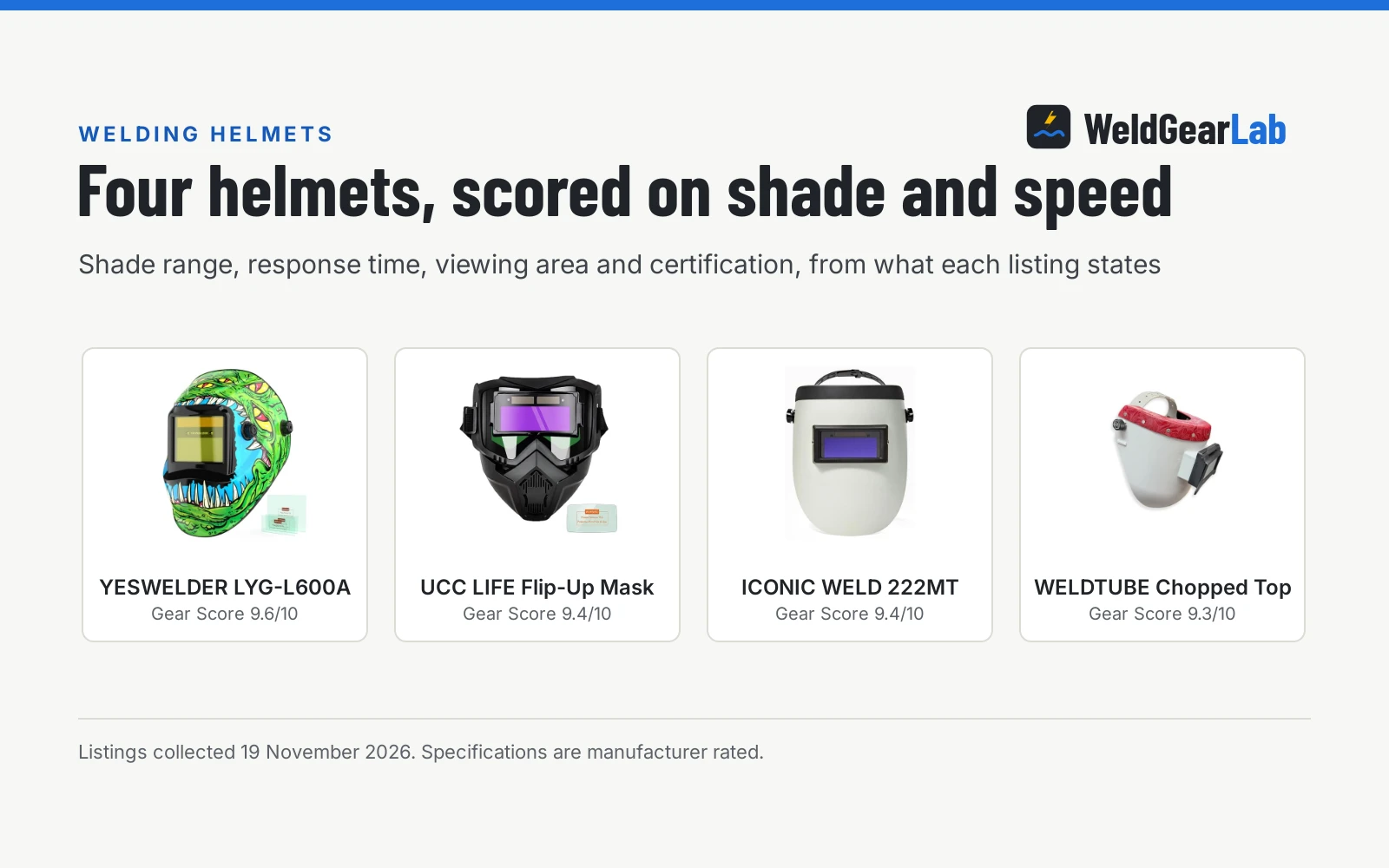
An auto-darkening helmet with 1/1/1/1 optical clarity, 2 arc sensors, a 1/30000 second response and shade 3/7-13 for TIG, MIG, ARC and grind, with ANSI Z87.1 and CSA Z94.3 stated.
Pros
- 1/1/1/1 optical clarity with a 3.64 x 1.67 inch viewing area
- 2 arc sensors with a 1/30000 second response
- Shade 3/7-13 covers TIG, MIG, ARC and grind
- Meets ANSI Z87.1 and CSA Z94.3, per the listing
Cons
- No warranty term is stated
- No memory slots are stated in the listing
- 3.64 x 1.67 inch viewing area is narrow for wide joints
- Replaceable CR2450 battery needs a spare on hand
3M Speedglas Heavy-Duty Welding Helmet G5-01
A heavy-duty helmet with a variable color filter, dark shades 5 and 8-14, an Adflo PAPR and Bluetooth, built for industrial use.
Pros
- Variable Color Technology with 3 color options: clear, cool or warm
- Dark shades 5 and 8-14 for a wide range of work
- Adflo PAPR gives powered air respiratory protection
- Up to ten memory modes through the phone app
Cons
- No warranty term is stated
- Listed for industrial and occupational use only, not for consumer sale or use
- The Adflo PAPR adds a second system to maintain
- Bluetooth and app setup add steps before the first weld
Lincoln Electric K5559-5 Viking 3350 ADV
A premium auto-darkening helmet with 4C lens technology, 1/1/1/1 optical clarity, shade 5-13, 4 modes and 3 memory slots, with a digital display and Bluetooth.
Pros
- 4C lens technology with 1/1/1/1 optical clarity
- Shade 5-13 with auto shade that adjusts to the environment
- 4 modes: weld, cut, grind and auto, with external grind controls
- 3 memory slots and Bluetooth to the GearPoint app
Cons
- No warranty term is stated
- No safety standard such as ANSI Z87.1 is stated
- Viewing area is not stated in the listing
- Digital display and app add setup steps before the first weld
Welding helmet types: auto-darkening, passive and PAPR
An auto-darkening helmet carries a lens that stays light while you set up, then darkens when the arc strikes and clears when the arc stops. The YESWELDER and Lincoln helmets here are auto-darkening, with shade ranges of 3/7-13 and 5-13. A passive helmet holds one fixed shade and you nod it down to start the arc; none of the helmets here is passive, so check the shade on the lens before you buy one. A PAPR helmet adds a powered air unit that feeds filtered air into the hood, like the Adflo unit on the 3M helmet here. Our passive vs auto-darkening welding helmet comparison covers the lens types in more detail.
Shade range and what it covers
Shade numbers run from light to dark. Check the processes the listing names against the range it states. The YESWELDER lists shade 3/7-13 for TIG, MIG, ARC and grind, with shade 3 as the light state. The Lincoln lists shade 5-13, and the 3M lists dark shades 5 and 8-14. Match the range to the processes you run: a helmet that lists grind can stay on your head between welding and grinding. Our best welding helmet for TIG welding guide compares hoods for TIG work.
Sensors, response and optical clarity
Arc sensors watch for the arc and switch the lens. The YESWELDER lists 2 arc sensors with a 1/30000 second response, and the listing states adjustable sensitivity and delay controls. Optical clarity carries a four-number grade, and the YESWELDER and Lincoln listings state 1/1/1/1. The Lincoln adds auto shade technology that monitors the environment and adjusts the lens shade, plus a digital display for settings. The 3M lists Variable Color Technology with 3 color options, clear, cool or warm, which the maker says may show the puddle, joint and arc better than earlier filters. Our analog vs digital welding helmet comparison covers digital displays and controls.
Grind mode and other modes
A grind mode keeps the lens light while you grind, so you can leave the helmet on between passes. The YESWELDER lists grind among the uses for its shade 3/7-13 range, and the Lincoln lists grind as one of four dedicated modes, with external grind controls and 3 memory slots to save settings. The Lincoln also lists weld, cut and auto modes, and the 3M app programs up to ten memory modes. If you grind often, a helmet that lists a grind mode is worth a closer look. Our best welding helmet with grind mode guide compares hoods with grind modes.
Side by side
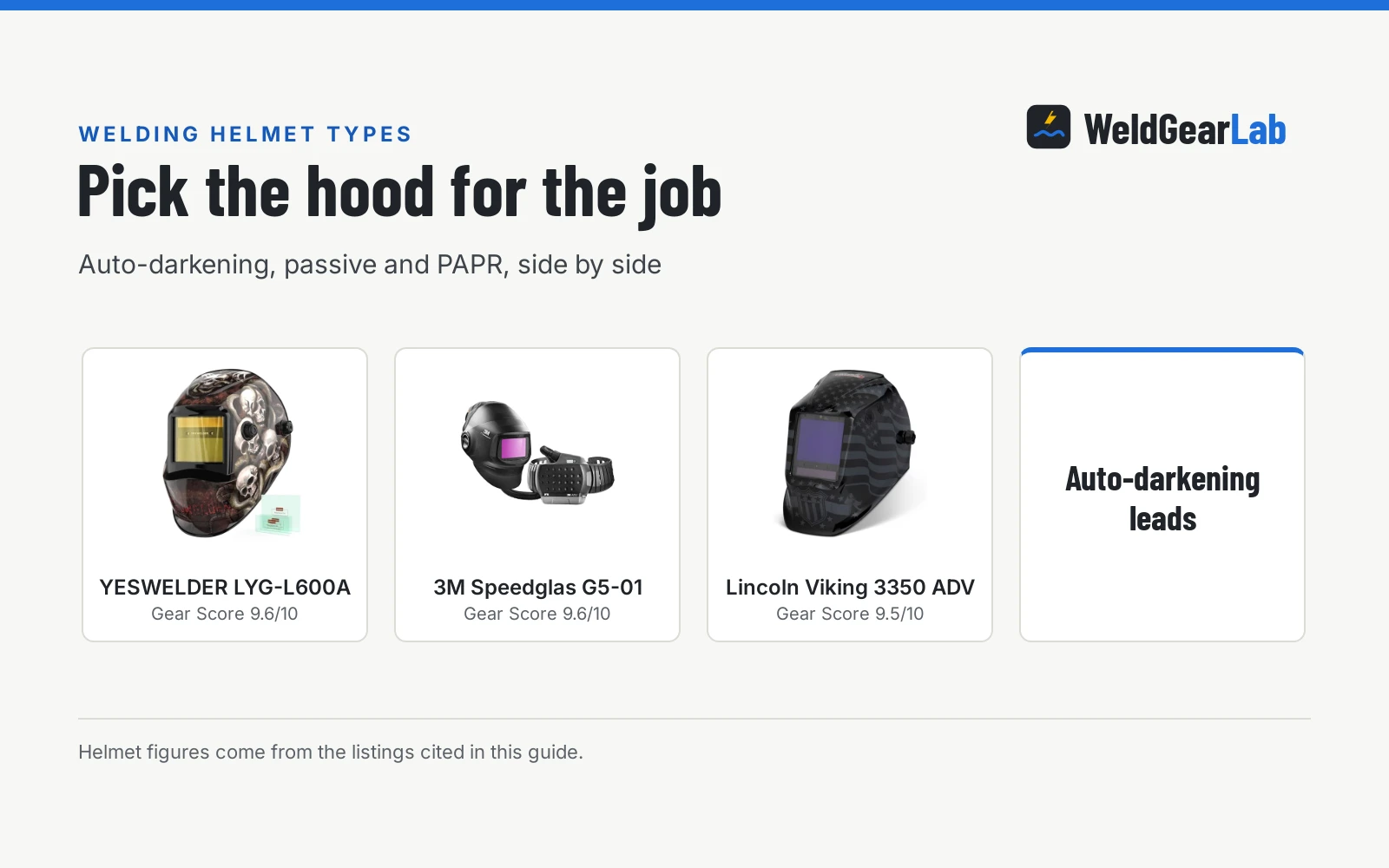
| Gear Score | Shade range | Viewing area | Notes | |
|---|---|---|---|---|
| YESWELDER LYG-L600A | 9.6/10 | 3/7-13 | 3.64 x 1.67 in | ANSI Z87.1 and CSA Z94.3 stated |
| 3M Speedglas G5-01 | 9.6/10 | 5, 8-14 | Not stated | Adflo PAPR included |
| Lincoln Viking 3350 ADV | 9.5/10 | 5-13 | Not stated | 4C lens, 4 modes |
Check the shade range, the modes and the stated standards against the work you do most, and read the listing before you buy. The scores in the table come from the figures the listings state.
Helmets for the types above
The shade range, the sensors and the air supply decide which type fits your work, and the helmets below list those figures.
FAQ for welders
What is the difference between an auto-darkening and a passive helmet?
An auto-darkening helmet darkens when the arc strikes and clears when it stops, while a passive helmet holds one fixed shade. The YESWELDER and Lincoln helmets here are auto-darkening, and the 3M uses an auto-darkening filter with a PAPR. A passive helmet needs a nod to drop it into place before the arc starts.
What shade should I use for MIG welding?
Use the shade range your helmet lists for the process, and check the listing for the processes it covers. The YESWELDER lists shade 3/7-13 for TIG, MIG, ARC and grind, and the Lincoln lists shade 5-13. If the listing does not name your process, check the manual before you weld.
Do I need a PAPR helmet?
A PAPR feeds filtered air into the hood, which suits long shifts and heavy fume work. The 3M helmet here pairs its filter with an Adflo PAPR. For short hobby sessions, an auto-darkening helmet without a PAPR is the simpler setup, but check the ventilation in your shop before you weld.
What does 1/1/1/1 optical clarity mean?
It is the top optical class a lens can state, and the YESWELDER and Lincoln listings state it. The grade covers the clarity of the view through the lens. Look for the grade on the listing when you compare lenses.
Which helmet here has a grind mode?
The Lincoln lists grind as one of four dedicated modes, with external grind controls. The YESWELDER lists grind among the uses for its shade range of 3/7-13. The 3M listing does not name a grind mode.
Related: best welding helmet for beginners, best true color welding helmet, best auto-darkening welding helmet for farm use, and the welding helmets hub.