Analog vs Digital Welding Helmet: Which Side Fits Your Work?
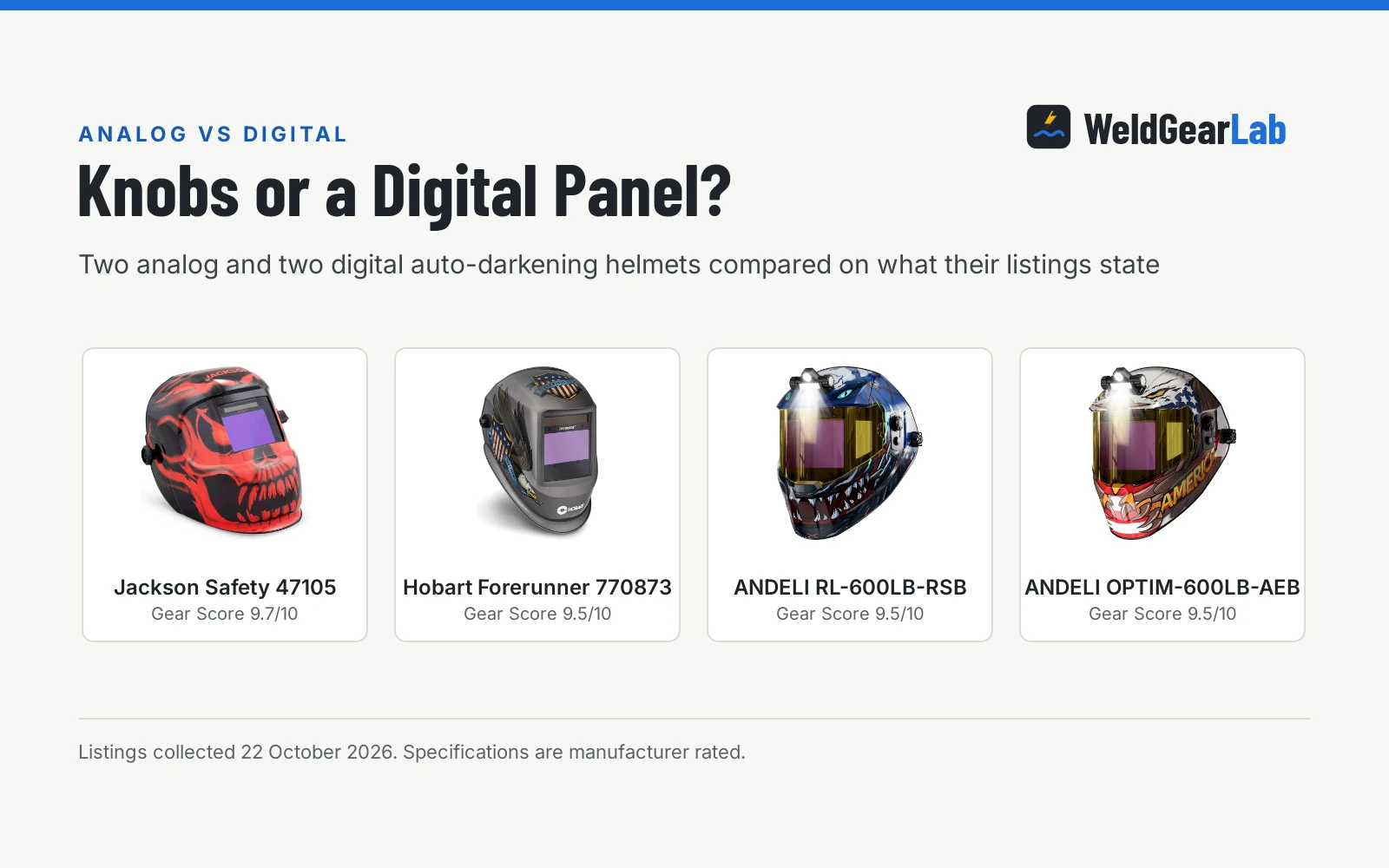
The analog vs digital welding helmet choice comes down to knobs or a digital panel: here, two analog and two digital auto-darkening helmets compare on sensors, shade, viewing area, battery, weight and warranty.

On this page
Top picks at a glance
As an Amazon Associate I earn from qualifying purchases.
- 1
 Jackson Safety Premium Graphics Auto Darkening9.7/10View on Amazon
- 2
 Hobart 770873 Forerunner Auto-Darkening Welding9.5/10View on Amazon
- 3
 ANDELI Auto Darkening Welding Helmet9.5/10View on Amazon
- 4
 ANDELI Auto Darkening Welding Helmet9.5/10View on Amazon
Verdict. The Jackson Safety 47105 leads the analog side with a stated ANSI Z87.1+ and CAN/CSA Z94.3 standard, 1/25,000 sec switching speed and 1.1 lb weight. The two ANDELI digital listings answer with a panel that displays shade, sensitivity and delay, 1/1/1/1 optical class, 1/30000s speed and a rechargeable battery. Pick analog for knobs and a named standard; pick digital for on-screen settings and more lens modes.
For the analog vs digital welding helmet question, you have a cracked trailer hitch to rebuild and a gate frame to square up, and both jobs mean long minutes under the hood with the arc lit. The decision is really about how you set the lens: knobs you turn by feel, or a panel that shows the shade, sensitivity and delay. This comparison puts two analog listings and two digital listings against each other on what their Amazon pages state, so you can pick the side that fits your work.
WeldGearLab gets a commission on purchases made through links on this page, and your price stays the same.
The four helmets

Jackson Safety Premium Graphics Auto Darkening
An analog auto-darkening helmet with variable shade 4/9 to 13, 4 arc sensors, a 1/25,000 sec switching speed and a stated ANSI Z87.1+ and CAN/CSA Z94.3 standard.
Pros
- Variable shade 4/9 to 13 with grind and an extended front
- 4 arc sensors with a 1/25,000 sec switching speed
- 1.1 lb with a 370 Speed Dial ratcheting headgear
- ANSI Z87.1+ and CAN/CSA Z94.3 stated, CE certified, 2 year warranty
Cons
- The CR2032 battery is not included in the box
- Optical class is 1/1/1/2, while both digital listings state 1/1/1/1
- No replacement lens or storage bag named in the included components
- Analog knobs mean the shade and delay settings are not shown on a display

Hobart 770873 Forerunner Auto-Darkening Welding
An analog auto-darkening helmet with a PureColor lens, a 9.3 sq in widescreen view, 4 arc sensors and a dedicated grind mode.
Pros
- PureColor lens with a 9.3 sq in widescreen view
- 4 arc sensors with analog controls and a dedicated grind mode
- 1.25 lb item weight, with a protective lens kit included
- Limited 2 year manufacturer's warranty, 1 CR2 battery included
Cons
- No switching speed or optical class stated in the listing
- No shade range stated, only that the controls are analog
- No headgear detail in the listing beyond the helmet itself
- No safety standard named, only UV/IR protection

ANDELI Auto Darkening Welding Helmet
A digital auto-darkening helmet with a display panel for shade, sensitivity and delay, a 7.2 by 3.2 in panoramic view and a rechargeable battery.
Pros
- Digital panel displays shade, sensitivity and delay with 5-level precision adjustment
- 1/1/1/1 optical class with 1/30000s switching and 4 arc sensors
- 7.2 by 3.2 in panoramic view with dual side windows, claimed 30% wider field
- 500 mAh rechargeable battery with Type-C and solar assist, up to 1200 hours of welding
Cons
- No safety standard or UV/IR statement in the listing
- 1.32 lb, heavier than the 1.1 lb Jackson listing
- Only a 1 year warranty

ANDELI Auto Darkening Welding Helmet
A digital auto-darkening helmet with the same display panel and panoramic lens as its sibling ANDELI, in a different shell style with no stated warranty.
Pros
- Digital panel with DIN 3 / 5-9 / 9-13 shade and 5-level sensitivity and delay adjustment
- 1/1/1/1 optical class with 1/30000s switching and 4 arc sensors
- Panoramic 7.2 by 3.2 in view with fixed-shade side lenses
- 500 mAh rechargeable lithium polymer battery with Type-C and solar assist, up to 16,000 hours standby
Cons
- No warranty term stated in the listing
- No safety standard named in the listing
- 1.32 lb, heavier than the 1.1 lb Jackson listing
- Nearly identical to the other ANDELI listing, differing mainly in shell style and battery type
Other welders and gear to compare
 Hobart 770869 Auto-Darkening Welding HelmetCheck price on Amazon
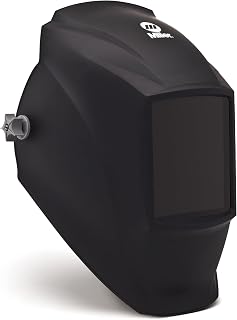 Miller 238497 MP-10™ Passive Welding HelmetCheck price on Amazon
 ANDELI Auto Darkening Welding Helmet 2 LED Lights InternalCheck price on Amazon
 Miller Digital Infinity™ Welding HelmetCheck price on Amazon
 Miller Digital Elite™ Welding HelmetCheck price on Amazon
 YESWELDER Auto Darkening Welding Helmet 1/1/1/1 True ColorCheck price on Amazon
Side by side
| Jackson Safety 47105 | Hobart Forerunner 770873 | ANDELI RL-600LB-RSB | ANDELI OPTIM-600LB-AEB | |
|---|---|---|---|---|
| Gear Score | 82 | 69 | 67 | 59 |
| Controls | Analog knobs | Analog knobs | Digital panel | Digital panel |
| Shade range | 4/9 to 13 with grind | Not stated | DIN 3 / 5-9 / 9-13 | DIN 3 / 5-9 / 9-13 |
| Viewing area | 9.3 sq in, 3.94 by 2.36 in | 9.3 sq in widescreen | 7.2 by 3.2 in, side windows | 7.2 by 3.2 in, side windows |
| Switching speed | 1/25,000 sec | Not stated | 1/30000s | 1/30000s |
| Arc sensors | 4 | 4 | 4 | 4 |
| Optical class | 1/1/1/2 | Not stated | 1/1/1/1 | 1/1/1/1 |
| Weight | 1.1 lb | 1.25 lb item | 1.32 lb | 1.32 lb |
| Battery | Solar plus CR2032, not included | 1 CR2, included | 500 mAh rechargeable, Type-C plus solar | 500 mAh rechargeable, Type-C plus solar |
| Warranty | 2 years | Limited 2 years | 1 year | Not stated |
| Standards | ANSI Z87.1+, CAN/CSA Z94.3, CE | UV/IR protection stated | Not stated | Not stated |
Ratings in this table are the makers’ own claims taken from each product page (22 October 2026). The Hobart listing states no switching speed, shade range or optical class, and the second ANDELI listing states no warranty term.
Analog vs Digital Welding Helmet: the short version
The analog side here means physical knobs. The Jackson listing pairs analog controls with a variable shade of 4/9 to 13 with grind and a 370 Speed Dial ratcheting headgear, while the Hobart listing pairs analog controls with a PureColor lens, a 9.3 sq in widescreen view and a dedicated grind mode. Neither analog listing shows its settings on a display.
The digital side means a control panel with a display. Both ANDELI listings name a panel that displays shade, sensitivity and delay, DIN 3 / 5-9 / 9-13 shade control, 5-level precision adjustment, one-touch grinding and four modes: welding, grinding, cutting and lock. Knobs against a screen: that is the whole split.
Controls and display
On the analog side, the Jackson listing describes its 370 Speed Dial headgear and analog controls for a variable 4/9 to 13 shade with grind, and the Hobart listing simply names analog controls plus a grind mode that keeps the lens from darkening. On the digital side, both ANDELI listings describe the same panel: it displays shade, sensitivity and delay, with 5-level precision adjustment across MIG, TIG and Stick work. If you change settings often, a panel that shows the numbers is easier to repeat than knob positions you have to remember. See our sensitivity and delay explainer.
Viewing area and lens
The Jackson listing states a 9.3 sq in viewing area, 3.94 by 2.36 in, with 1/1/1/2 optical class, and the Hobart listing states a 9.3 sq in widescreen PureColor lens with no optical class named. Both ANDELI listings state 7.2 by 3.2 in total, a 4.6 by 3.2 in main lens plus two 1.3 by 2.5 in side lenses, 1/1/1/1 optical class, true color and a claimed 30% wider field of view with the dual side windows. The digital side states the bigger window and a higher stated optical class. Read our true color helmet guide for what the class digits describe.
Speed and sensors
All four listings state 4 arc sensors, so sensor count does not separate the sides here. Switching speed is stated on three of the four: the Jackson listing states 1/25,000 sec and both ANDELI listings state 1/30000s. The Hobart listing states no switching speed, so that spec compares Jackson against the two ANDELI listings. See two vs four sensor helmets for why sensor count still matters.
Battery and charging
The Jackson listing is solar powered with a CR2032 replaceable battery that is not included. The Hobart listing includes 1 CR2 battery. Both ANDELI listings describe a 500 mAh rechargeable lithium battery with Type-C charging and solar assist, about 2.5 hours to charge, up to 1200 hours of continuous welding and 16,000 hours of standby, with a Type-C USB cable in the box. One caution: the spec table on the first ANDELI listing says 1 9V battery is required and included, which contradicts the rechargeable battery in its own title and bullets; trust the title and bullets. See how to replace a welding helmet battery before you buy a spare cell.
Weight, shell and fit
The Jackson listing states 1.1 lb with a 370 Speed Dial ratcheting headgear and an extended front for added neck protection. The Hobart listing states an item weight of 1.25 pounds and a package weight of 1.057 kilograms. Both ANDELI listings state 1.32 lb, a high-strength nylon shell, a pivot headgear with 6 contact points and breathable padding, plus a dual mode LED light in a water resistant design. The analog listings are the lighter pair on stated weight.
Modes and grind work
Every listing here names a grind mode: the Jackson variable shade runs 4/9 to 13 with grind, the Hobart has a grind mode that prevents the lens from darkening, and both ANDELI listings name one-touch grinding plus four modes for welding, grinding, cutting and lock. Our grind mode vs weld mode guide explains when to switch.
Warranty
The Jackson listing states a 2 year warranty, and the Hobart listing states a limited 2 year manufacturer’s warranty with a protective lens kit included. The first ANDELI listing states 1 year; the second states no warranty term at all, which is the main reason it scores lowest here.
Choose an analog helmet if
- You want knobs you can adjust with gloves on, with no display to read.
- A stated safety standard matters to you: the Jackson listing names ANSI Z87.1+ and CAN/CSA Z94.3 and is CE certified.
- You want the lowest stated weight here, 1.1 lb on the Jackson listing.
- You prefer a replaceable cell: the Hobart includes a CR2, and the Jackson runs solar plus a CR2032.
Choose a digital helmet if
- You want the panel to display shade, sensitivity and delay as you set them.
- You weld MIG, TIG and Stick and switch settings between them, with 5-level precision adjustment.
- You like the panoramic layout with side windows and a stated 1/1/1/1 optical class.
- You would rather recharge over Type-C than buy cells; note only the first ANDELI listing states a 1 year warranty.
Before You Strike an Arc
- Check the battery setup before the first weld: the Jackson listing names a CR2032 that is not included, the Hobart listing includes a CR2, and both ANDELI listings include a Type-C cable for the rechargeable battery.
- Fit the headgear before striking an arc: the Jackson listing names a 370 Speed Dial ratcheting headgear and the ANDELI listings name a pivot headgear with 6 contact points.
- Match the mode to the work: all four listings name a grind mode, and the ANDELI listings name weld, grind, cut and lock modes on the panel, so switch before grinding to keep the lens light.
- Keep spare cover lenses on hand: the Hobart listing includes a protective lens kit and the ANDELI listings include 3 replacement lenses.
FAQ for welders
Do analog welding helmets still make sense when digital panels exist?
They do if you value simple knobs and a stated safety standard over a display. The Jackson listing pairs analog controls with ANSI Z87.1+ and CAN/CSA Z94.3; the digital listings add the panel, more modes and a rechargeable battery. The choice is about how you set the lens, not about one side being obsolete.
What do the shade numbers 4/9 to 13 mean?
Shade 4 is the light state for grinding, and 9 to 13 is the dark range for welding. The Jackson listing states 4/9 to 13 with grind, and both ANDELI listings state DIN 3 / 5-9 / 9-13. The Hobart listing names a grind mode but states no shade range.
Which of these helmets includes its battery?
The Hobart listing includes 1 CR2 battery. The Jackson listing is solar powered with a CR2032 replaceable battery that is not included. Both ANDELI listings include a Type-C USB cable for the rechargeable battery.
Is a 1/30000s switching speed faster than 1/25,000 sec?
As stated: the two ANDELI listings state 1/30000s and the Jackson listing states 1/25,000 sec. The Hobart listing states no switching speed, and all four listings state 4 arc sensors.
Related: passive vs auto-darkening helmets, grind mode vs weld mode, true color helmets, and replacing a helmet battery.
Scoring, line by line
All four helmets are scored on performance, build, value, safety listing and warranty. The Jackson leads on its stated standard and complete specs; the Hobart follows with a strong warranty but unstated speeds; the two ANDELI helmets trade on their panel and lens specs, with the warranty-less one last.
| Product | Gear Score | Perf. /35 | Build /25 | Value /25 | Safety /10 | Warranty /5 |
|---|---|---|---|---|---|---|
| Jackson Safety 47105 | 9.7 | 29 | 22 | 20 | 8 | 4 |
| Hobart Forerunner 770873 | 9.5 | 26 | 19 | 18 | 5 | 4 |
| ANDELI RL-600LB-RSB | 9.5 | 32 | 21 | 20 | 0 | 2 |
| ANDELI OPTIM-600LB-AEB | 9.5 | 32 | 21 | 19 | 0 | 0 |
The lowest score we show is 9.2 and the highest is 9.8; every point total is spread proportionally across that span, so extra points mean a higher figure.