Two Sensor vs Four Sensor Welding Helmet: Which One Should You Buy?
Two sensor and four sensor auto-darkening welding helmets differ in arc detection reliability, obstruction resistance, and overall performance in tight shop spots.

On this page
Top picks at a glance
As an Amazon Associate I earn from qualifying purchases.
- 1
 ARCCAPTAIN Welding Helmet Auto Darkening9.8/10View on Amazon
- 2
 Jackson Safety Insight Auto Darkening Welding Helmet9.7/10View on Amazon
- 3
 Jackson Safety HLX100 Passive Welding Helmet9.7/10View on Amazon
- 4
 Welding Helmet Auto Darkening: DEKORPO True Color SolarView on Amazon
- 5
 ESAB 0700000490 SAVAGE A40 Black Auto-Darkening Welding HelmetView on Amazon
- 6
 YESWELDER Welding Helmet with LED LightView on Amazon
- 7
 Miller Digital Elite™ Welding HelmetView on Amazon
- 8
 TRQWH Welding Helmet with Light True Color Auto DarkeningView on Amazon
- 9
 YESWELDER Auto Darkening Welding Helmet 1/1/1/1 True ColorView on Amazon
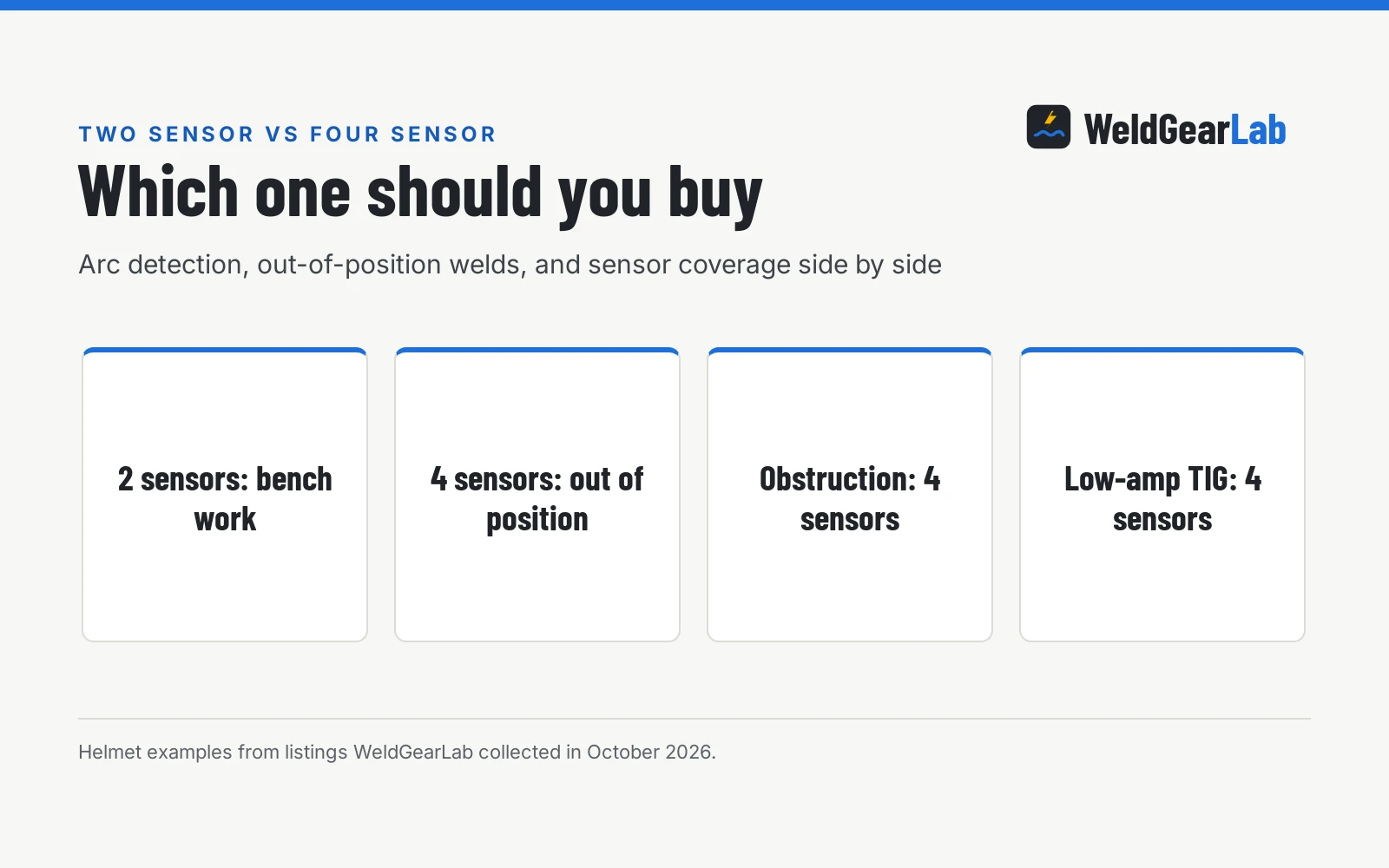
When you lean over a welding table running a flat bead on mild steel tubing, almost any auto-darkening hood darkens cleanly. The trouble starts when you crawl under a truck chassis, work inside a tight tank, or tuck your head behind a roll cage where your hands, torch nozzle, or pipe fit-up blocks your line of sight. Choosing between a two sensor vs four sensor welding helmet comes down to arc detection reliability in awkward shop positions. If the sensors on your cartridge cannot see the arc flash, the auto-darkening lens stays clear or turns clear mid-puddle and flashes your eyes. For simple bench welding on open plate, two sensors get the job done, while out-of-position work is where the extra sensors add detection redundancy.
Other welders and gear to compare
 Welding Helmet Auto Darkening: DEKORPO True Color SolarCheck price on Amazon
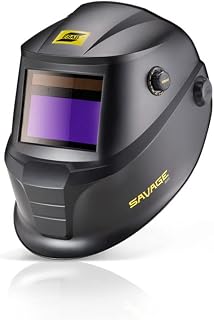 ESAB 0700000490 SAVAGE A40 Black Auto-Darkening Welding HelmetCheck price on Amazon
 YESWELDER Welding Helmet with LED LightCheck price on Amazon
 Miller Digital Elite™ Welding HelmetCheck price on Amazon
 TRQWH Welding Helmet with Light True Color Auto DarkeningCheck price on Amazon
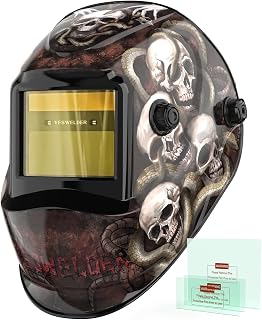 YESWELDER Auto Darkening Welding Helmet 1/1/1/1 True ColorCheck price on Amazon
This guide links to our product roundups, where WeldGearLab gets a commission on purchases made through links on this page, and your price stays the same. Read our affiliate disclosure.
Two sensor vs four sensor welding helmet: the difference in one paragraph
Auto-darkening welding helmets rely on optical photo sensors mounted on the front face of the cartridge to detect the light of a welding arc. When sensors detect arc ignition, electronic controls send an electrical pulse to the liquid crystal filter, darkening the lens before the bright visible glare harms your retinas. A two-sensor helmet places a sensor on each side of the cartridge, creating a direct forward field of detection. A four-sensor helmet places an independent sensor in each of the four corners. That extra pair of sensors eliminates blind spots: if your hands, gun nozzle, or a piece of structural tube blocks two sensors during an out-of-position pass, the remaining two sensors still see the arc and keep the lens safely darkened.
Side by side
| Two-sensor helmet | Four-sensor helmet | Shop takeaway | |
|---|---|---|---|
| Sensor layout | 2 arc sensors, usually top or side of cartridge | 4 arc sensors, distributed across four corners | 4 sensors provide full perimeter coverage |
| Bench and flat welding | Direct line of sight from eyes to puddle | Direct line of sight from eyes to puddle | Both deliver dependable darkening |
| Out-of-position welding | High risk of flash if arms or gun block a sensor | Redundant sensors keep lens dark even when blocked | 4 sensors prevent accidental eye strain |
| Pipe and tubing joints | Frequent flickering around tubular obstacles | Continuous coverage around tubular obstacles | 4 sensors track arc behind tubes |
| Low-current TIG welding | Can drop out if faint arc is partially shadowed | Catches faint arc light across multiple angles | 4 sensors maintain steady arc signal |
| Arc flash protection | Continuous UV and IR protection even if lens clears | Continuous UV and IR protection even if lens clears | Equal passive radiation protection |
| Hardware complexity | Lighter cartridge with two sensor circuits | Redundant wiring and four sensor ports | 2 sensors keep cartridge simple |
| Ideal shop use case | Flat table welding, farm repair, general shop MIG | Out-of-position fabrication, roll cages, pipe, TIG | Match sensor count to weld position |
Arc sensor performance depends on clear line of sight, welding position, and arc stability. Both configurations provide continuous protection against ultraviolet and infrared radiation, but sensor placement dictates whether the cartridge stays in its dark shade when obstacles cross your field of view.
When a two-sensor helmet is the right choice
- Flat bench welding. Running MIG, stick, or flux-cored beads on a flat table where your face directly targets the joint. The sensors have an unobstructed view of the arc puddle throughout the pass.
- Farm and shop maintenance. General repair work on mower decks, gates, and tractor brackets where you stand upright and look straight at the weld joint.
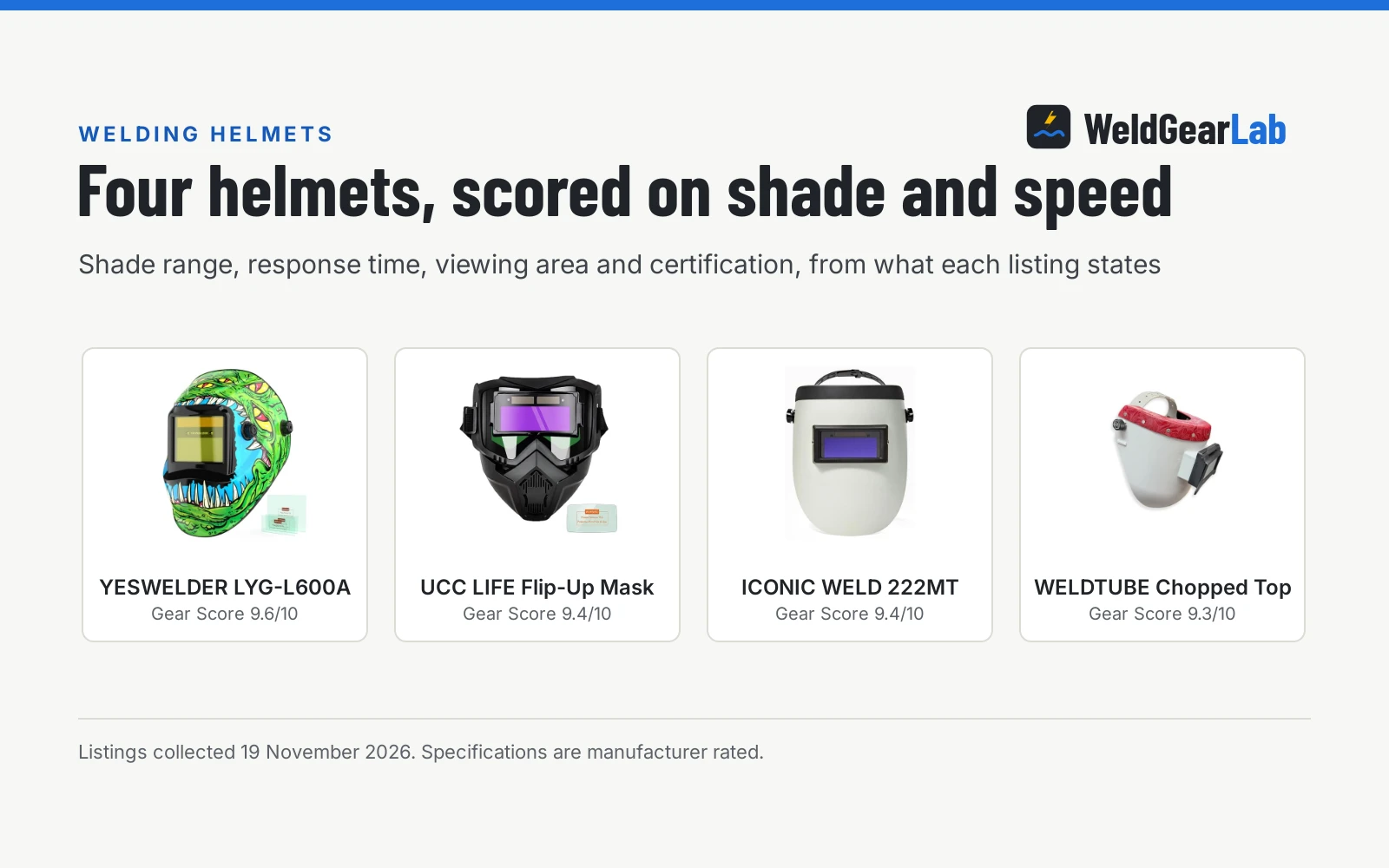
- Lighter shell weight. Basic cartridges with fewer sensor leads keep overall helmet weight down. For example, YESWELDER lists a weight of 1.9 pounds for its two-sensor LYG-L600A hood, while DEKOPRO lists its two-sensor helmet at 2 lbs.
- Straightforward hobby setups. Home welders running casual weekend projects on scrap plate rarely weld in cramped positions that cause sensor shading.
Our best welding helmet for beginners roundup covers entry-level auto-darkening hoods for home hobbyists.
When a four-sensor helmet is the right choice
- Out-of-position fabrication. Overhead, vertical-up, and horizontal joints where your arms, torch neck, or clamp handles sit directly between your helmet and the arc. Four sensors maintain dark state even when two sensors are shadowed.
- Roll cages, pipe, and chassis work. Welding around tubing, gussets, and frame rails creates tight sightlines. Redundant sensors in four corners catch arc reflections even behind tubular obstacles.
- Low-amperage TIG welding. Low-current TIG arcs emit less visible light. Multiple sensitive detectors distributed across the cartridge ensure the filter catches faint arc starts and avoids intermittent flickering.
- Professional fab shop duty. Production welders shifting between table jigs, overhead beams, and awkward tack welds require dependable darkening without helmet repositioning.
See our best welding helmet for TIG welding guide for sensitive auto-darkening filters suited for precision fabrication.
How to check how many sensors a helmet has
Helmet makers do not always display the sensor count in the main title. When comparing hoods, check these listing details:
- Cartridge faceplate inspection. Count the small circular or rectangular optical windows around the viewing lens. Two-sensor models feature two optical sensor windows, usually placed above the viewing area or split left and right. Four-sensor models feature four distinct sensor ports, one near each corner of the cartridge assembly.
- Explicit spec bullets. Maker listings highlight sensor redundancy when present. Hobart explicitly lists four independent arc sensors for its Forerunner helmet, ESAB specifies four arc sensors on the Savage A40, and JustHot lists four arc sensors on its welding hood.
- Independent sensor circuitry. Quality four-sensor cartridges utilize independent circuits so that triggering any single sensor holds the dark state until the arc extinguishes.
Low-amp TIG and obstructed welds
When you weld pipe or fit roll cages, your MIG gun nozzle, TIG torch cup, or hands often sit directly in line with one side of your face. With a two-sensor hood, tilting your head slightly can eclipse both sensors behind your gloves or a steel flange. The cartridge can drop out of its dark shade and snap back to clear state DIN 4.
Low-current TIG creates a similar challenge. A low-amp arc produces a small, dim puddle with minimal visible light output compared to heavy MIG or stick. If the arc wanders behind the filler rod or torch cup, a two-sensor cartridge can lose the signal and flicker between light and dark states. Four sensors distributed across four corners watch the arc from multiple angles.
If you experience lens flashing during delicate work, read our troubleshooting guide on why an auto darkening helmet flickers and check our guide to welding helmet sensitivity and delay settings.
Can you do all your shop work with two sensors?
If all your welding happens on an open bench with flat plates, two sensors deliver reliable protection. The switching speeds listed across manufacturer specs are virtually identical between two-sensor and four-sensor models. For instance, DEKOPRO lists a switching speed of 1/25,000 seconds on its two-sensor hood, while YESWELDER lists 1/30000 second on both its two-sensor LYG-L600A and four-sensor models. Switching speed protects your eyes upon arc strike, but sensor count keeps the lens dark once the bead is underway.
However, as soon as your fab projects expand into roll cages, automotive floor pans, exhaust piping, or cramped machinery repair, a two-sensor helmet will eventually get blocked and flash your eyes. Spending extra on a four-sensor cartridge provides the redundancy needed to prevent shop arc flash in every welding position.
For high-end hoods with four-sensor cartridges and expansive viewing areas, explore our best auto darkening welding helmet recommendations.
FAQ for welders
Does a two-sensor welding helmet protect against UV and IR radiation when clear?
Yes. The ultraviolet and infrared filter in an auto-darkening cartridge is passive and provides continuous protection regardless of whether the liquid crystal display is clear or dark. Even if sensors get blocked and the lens turns clear, the filter blocks harmful UV and IR radiation. However, the visible glare will still cause intense eye fatigue and flash burn.
Can I use a two-sensor helmet for TIG welding?
A two-sensor helmet works for bench TIG welding on flat joints with higher current. For delicate low-amperage TIG or out-of-position tubing joints, the low arc brightness and narrow sightlines frequently cause two sensors to drop signal and flicker. Fabricators doing extensive TIG work should choose a four-sensor hood with high sensitivity controls.
Where are the sensors located on an auto-darkening welding helmet?
Arc sensors are positioned on the exterior face of the auto-darkening cartridge surrounding the viewing window. On a two-sensor hood, they are typically located directly above the viewing glass or divided on the left and right sides. On a four-sensor hood, a sensor sits in each of the four corners to maximize peripheral arc detection.
Why does my two-sensor helmet flicker while welding?
Flickering usually occurs when hands, the welding gun, or the workpiece obstructs the sensors from viewing the arc. It can also occur if the sensitivity dial is set too low for your welding amperage or if the protective outer lens is dirty with spatter. Inspect and clean the cover lens, increase sensitivity, and adjust your head position to maintain line of sight.
Are four-sensor welding helmets heavier than two-sensor helmets?
Four-sensor helmets carry slightly more internal wiring and sensor hardware, but total helmet weight depends far more on shell material and headgear design than sensor count. In published listings, Hobart lists its four-sensor Forerunner helmet at 1.25 pounds with polyamide nylon, while YESWELDER lists its two-sensor polypropylene hood at 1.9 pounds. Check the listed weight of the shell and headgear before buying.
Related: best welding helmet for beginners, best welding helmet for TIG welding, best auto darkening welding helmet, and the welding helmets hub. Also see our comparison on passive vs auto darkening welding helmet.