Best Welding Helmet for TIG Welding (2026): 5 Hoods Scored
Five auto-darkening welding helmets for TIG welding, compared on low-amp arc response, optical clarity, viewing area, safety standards, and stated warranty terms.
 By WeldGearLab Editorial
Updated October 9, 2026
By WeldGearLab Editorial
Updated October 9, 2026
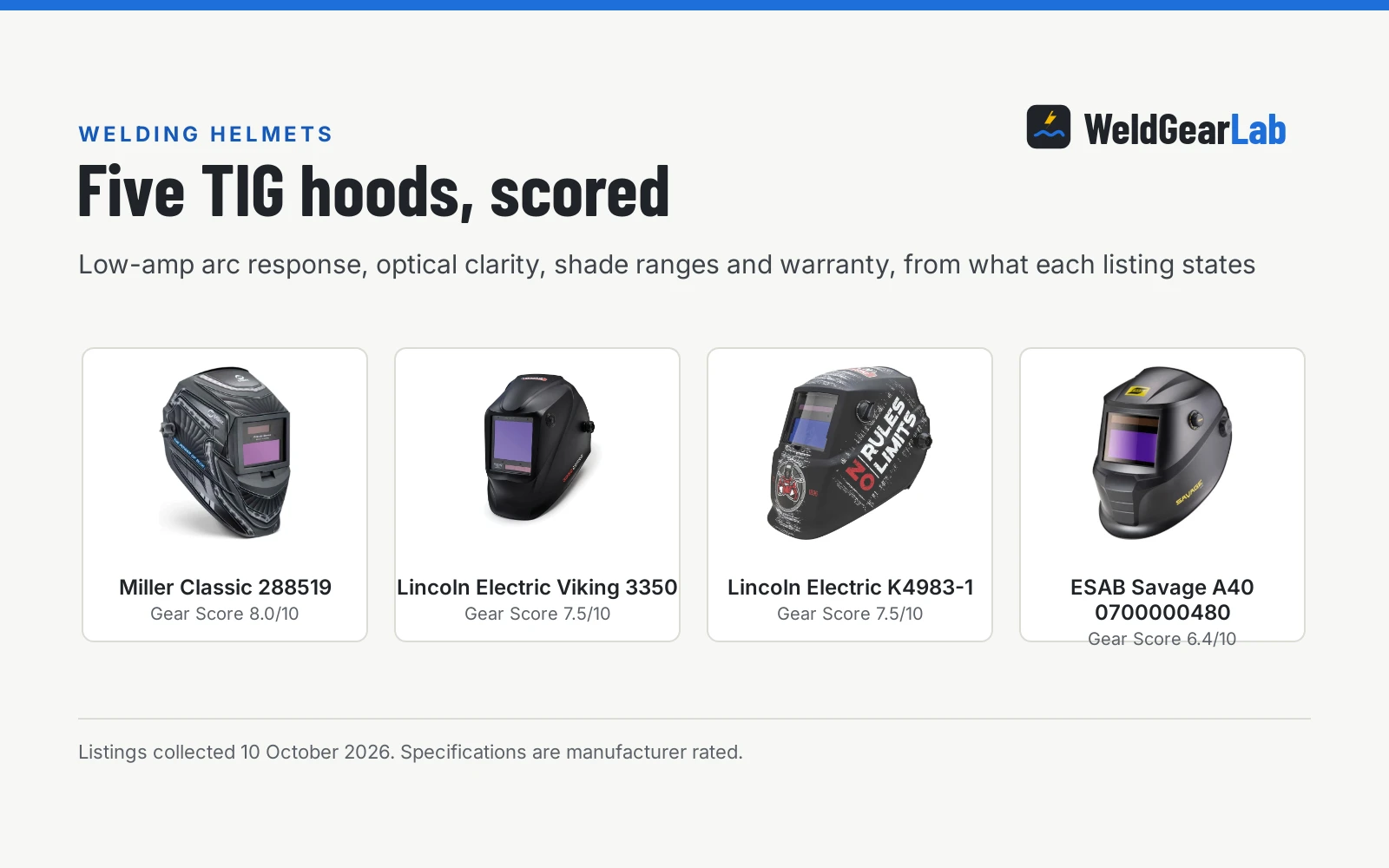
Finding the best welding helmet for tig welding means choosing an auto-darkening hood that reliably detects low-amperage arcs without flickering or flashing your eyes. Unlike high-amperage stick or flux-core welding, tungsten inert gas arcs can dip to 5 amps or below, demanding sensitive arc sensors, clear optics, and appropriate shade levels. This guide compares five welding helmets and goggles across stated specifications, including low-amp ratings, optical clarity, sensor counts, shade ranges, weight, and manufacturer warranties.
As an Amazon Associate I earn from qualifying purchases. WeldGearLab earns a commission when you buy through links on this page, at no extra cost to you. Read our affiliate disclosure.
Quick picks
- Best Overall Miller Classic 288519: Rates down to 5 amps for precision TIG, with ClearLight HD optics, 1/23,000 second switching speed, and ANSI Z87.1+ and CSA certifications. Check price on Amazon
- Best Optics Lincoln Electric Viking 3350: Stated 1/1/1/1 optical clarity, a 12.5 square inch viewing area, X6 headgear, and a 5-year manufacturer warranty. Check price on Amazon
- Best Lightweight Hood Lincoln Electric K4983-1: Weighs 17.5 oz, rates to 5 amps or more, covers shades 7 to 13 with grind mode, and meets ANSI Z87.1. Check price on Amazon
- Best Multi-Sensor ESAB Savage A40 0700000480: Features four arc sensors with dedicated delay and sensitivity controls for low-amp TIG arc response. Check price on Amazon
Compare the picks
| Model | Gear Score | Viewing Area | Optical Clarity | TIG Rating | Shades | Safety Standard | Warranty |
|---|---|---|---|---|---|---|---|
| Miller Classic 288519 | 8.0/10 | 6 sq in | ClearLight HD | 5A or below | Weld 8-13, cut 5-8, grind 3 | ANSI Z87.1+, CSA, CE | None stated |
| Lincoln Viking 3350 K3034-4 | 7.5/10 | 12.5 sq in | 1/1/1/1 | Not stated | Not stated | None stated | 5 years |
| Lincoln K4983-1 No Rules | 7.5/10 | 4.33 x 3.54 in | Not stated | ≥5A | Variable 7-13, grind | ANSI Z87.1 | None stated |
| ESAB Savage A40 | 6.4/10 | 3.93 x 1.96 in | Not stated | Low amp (rating not stated) | Not stated | None stated | None stated |
| TRQWH Trq-hm01 Goggles | 5.7/10 | Not stated | 1/1/1/2 | Not stated | DIN 3 / DIN 11 | None stated | 1 year |
Specifications are manufacturer rated, as published on each listing and collected 9 October 2026.
The picks
| Award | Product | Gear Score About the Gear ScoreThe Gear Score runs from 0 to 10 and weighs performance (35%), build (25%), value (25%), safety (10%, where it applies) and warranty (5%), using only what the manufacturer and the listing publish. How we pick › | |
|---|---|---|---|
 Miller Classic Series Welding Helmet, ClearLight™
|
8.0/10 | Check price on Amazon | |
 Lincoln Electric K3034-4 VIKING 3350 Auto
|
7.5/10 | Check price on Amazon | |
 Lincoln Electric No Rules No Limits Welding Helmet
|
7.5/10 | Check price on Amazon | |
 ESAB 0700000480 Black Savage A40 Welding Helmet
|
6.4/10 | Check price on Amazon | |
 TRQWH Welding Glasses Auto Darkening Safety
|
5.7/10 | Check price on Amazon |
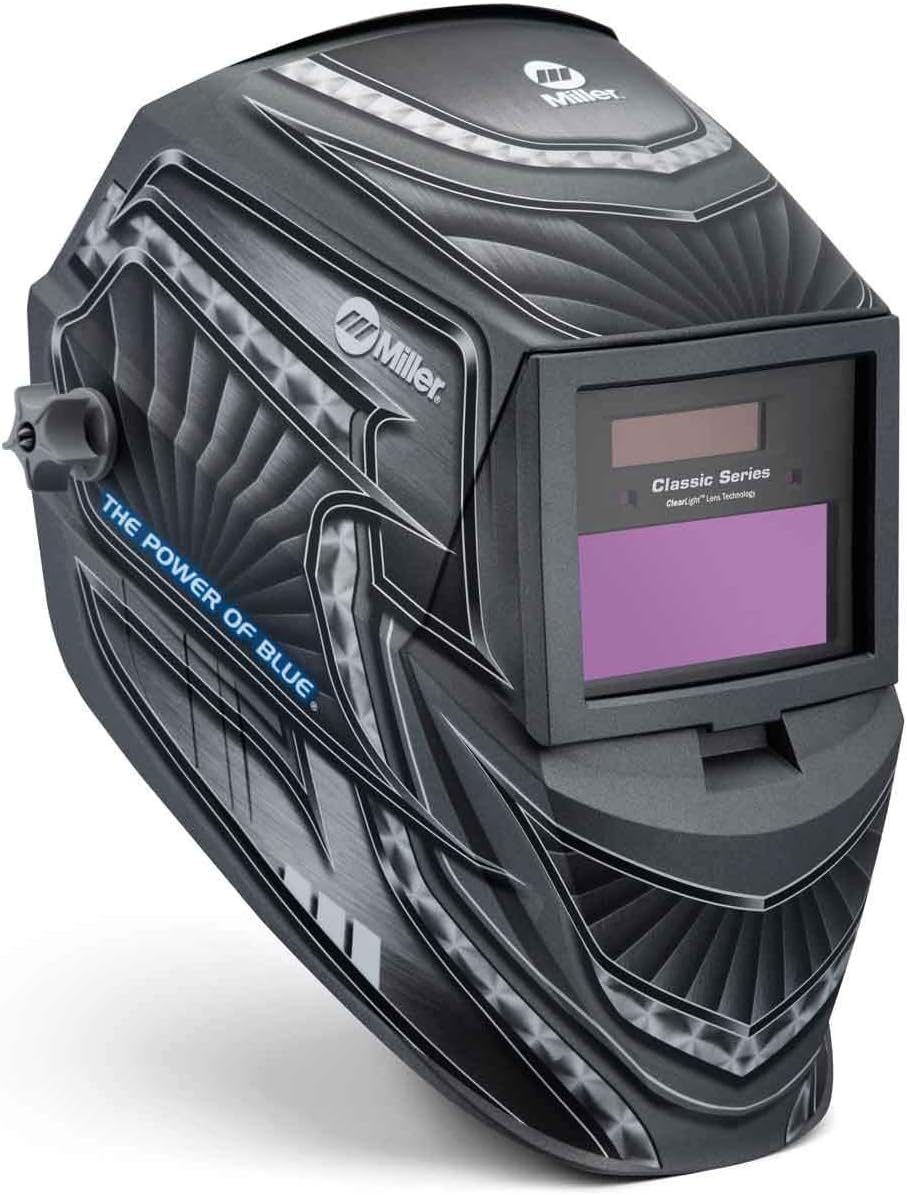
Miller Classic Series Welding Helmet, ClearLight™
A dual-process welding helmet rated down to 5 amps for TIG, with ClearLight HD optics, weld, cut and grind shades, and dual safety certifications.
Pros
- Rated for TIG welding down to 5 amps or below
- Meets ANSI Z87.1+, CSA and CE safety standards
- Covers weld shades 8 to 13, cut shades 5 to 8, and grind shade 3
- Features ClearLight lens technology with 1/23,000 second switching speed
Cons
- 6 square inch viewing area is smaller than several competing hoods
- Lists two arc sensors, fewer than the four sensors on some rivals
- Weight is 2.2 pounds, heavier than the 17.5 oz Lincoln K4983-1
- Optical clarity class is listed as ClearLight rather than a numerical EN score
Lincoln Electric K3034-4 VIKING 3350 Auto
A premium auto-darkening hood with perfect 1/1/1/1 optical clarity, a 12.5 square inch viewing area, X6 headgear, and a 5-year warranty.
Pros
- Perfect 1/1/1/1 optical clarity rating with 4C lens technology
- 12.5 square inch viewing area provides a large field of view
- Manufacturer backs the helmet with a stated 5-year warranty
- Includes helmet bag, bandana, 5 outside lenses, and 2 inside lenses
Cons
- No safety standards such as ANSI Z87.1 or CSA are stated in the listing
- Low-amp TIG threshold and arc sensor count are not stated
- Shade range numbers are not stated in the listing
- Spec table contradicts title by listing accessory type as outside cover lens
Lincoln Electric No Rules No Limits Welding Helmet
A lightweight 17.5 oz hood rated down to 5 amps for TIG, with shades 7 to 13, a 4.33 x 3.54 inch view, and ANSI Z87.1 certification.
Pros
- Stated TIG rating down to 5 amps or more for low-amperage work
- Covers shades 7 to 13 plus an independent grind mode shade
- Weighs 17.5 oz, lighter than the 2.2-pound helmets in this guide
- ANSI Z87.1 safety certified and hard hat compatible
Cons
- No warranty term is stated in the listing
- Sensor count is not stated in the listing
- Optical clarity numerical rating is not stated
- Listing spec table is completely empty
ESAB 0700000480 Black Savage A40 Welding Helmet
A four-sensor auto-darkening hood with dedicated delay and sensitivity controls tuned for low-amperage TIG welding.
Pros
- Four arc sensors provide higher response to the welding arc
- Adjustable sensitivity control designed for low-amp TIG welding
- Delay control allows adjustment between tack welds and high amps
- Viewing area measures 3.93 x 1.96 inches
Cons
- No warranty term is stated in the listing
- No safety standards such as ANSI Z87.1 or CSA are stated
- Specific minimum amperage rating for TIG is not stated
- Optical clarity class and shade range numbers are not stated
TRQWH Welding Glasses Auto Darkening Safety
Ultra-compact 100-gram solar auto-darkening welding goggles with 1/1/1/2 optical clarity and a fixed DIN 11 dark shade.
Pros
- Weighs 100 grams for compact portability and tight-space access
- Stated 1/1/1/2 optical clarity with true color technology
- Solar powered design requires no battery replacements
- 1-year warranty description stated in the listing
Cons
- Fixed dark shade DIN 11 lacks variable shade adjustment for lower amps
- Goggle style leaves face, ears, and neck exposed to arc radiation
- No safety standards such as ANSI Z87.1 or CSA are stated
- Low-amp TIG rating, sensor count, and switching speed are not stated
How we scored them
Each helmet is scored on performance, build, value, safety listing and warranty, following the methodology on our How We Pick page. Safety listing points require verified third-party standards such as ANSI Z87.1 or CSA published in the listing, while warranty scores reflect stated coverage periods. The overall score determines the ranking across all five models.
| Product | Gear Score | Perf. /35 | Build /25 | Value /25 | Safety /10 | Warranty /5 |
|---|---|---|---|---|---|---|
| Miller Classic 288519 | 8.0 | 29 | 21 | 21 | 9 | 0 |
| Lincoln Electric Viking 3350 | 7.5 | 28 | 21 | 21 | 0 | 4 |
| Lincoln Electric K4983-1 | 7.5 | 29 | 21 | 20 | 8 | 0 |
| ESAB Savage A40 0700000480 | 6.4 | 26 | 20 | 19 | 0 | 0 |
| TRQWH Trq-hm01 Goggles | 5.7 | 19 | 18 | 19 | 0 | 2 |
Buying guide: how to choose the best welding helmet for tig welding
Low-amperage arc detection and sensor count
TIG welding often produces a softer, lower-intensity arc than other electric welding processes. If a helmet lacks high sensitivity or sufficient sensors, the auto-darkening filter can fail to trigger or may flicker between dark and clear states during intricate joint work. Look for models that explicitly publish a low-amperage rating, such as 5 amps or below. Having multiple arc sensors also helps prevent sensor obstruction when your hands, torch cup, or filler rod block the line of sight to the puddle.
Variable shade ranges and light state
Standard welding hoods typically offer fixed or narrow shade adjustments between DIN 8 and 13. For low-amp DC or micro-TIG work, darker shades can obscure the puddle, requiring lighter settings such as DIN 7 or 8. Slower work benefits from a light state of shade 3.0, allowing you to position your tungsten electrode precisely before initiating the arc. For more guidance on matching lenses to different processes, read what shade lens for TIG welding matches your planned amperage, and see what shade for MIG welding balances multi-process shop setups.
Optical clarity ratings
Optical clarity standards rate lenses across four criteria: optical class, light diffusion, variations in luminous transmittance, and angle dependence, with 1/1/1/1 representing the highest score. High clarity minimizes puddle distortion and eye fatigue during prolonged bead placement. To understand what these four numbers mean for puddle visibility, review our guide to welding helmet optical clarity rating explained.
Lens switching speed and delay controls
Switching speed indicates how rapidly the liquid crystal filter darkens upon detecting an arc strike, with speeds around 1/23,000 second providing immediate protection. Adjustable delay settings govern how long the lens remains dark once the arc extinguishes, preventing eye strain from glowing weld puddles. If you need assistance tuning these controls, consult our breakdown on welding helmet sensitivity and delay settings explained.
Weight and headgear balance
Because TIG welding demands steady posture and prolonged concentration, helmet weight directly impacts neck comfort. Shells weighing around 1.4 pounds or 17.5 oz reduce strain over long work sessions compared to heavier hoods. Adjustable multi-point ratchet headgear helps distribute weight evenly around the crown of the head, stabilizing the lens position during close-up inspection.
Safety considerations and proper coverage
Use as directed. Auto-darkening welding helmets protect eyes and face against ultraviolet and infrared radiation, spatter, and sparks when fitted properly and set to the correct shade. Never weld with goggles alone unless your face, neck, and ears are fully shielded by secondary fire-resistant gear, as reflected arc rays cause severe skin burns. Inspect outer cover lenses before striking an arc, replacing pitted or cracked plates immediately to maintain optical clarity. Refer to manufacturer operating manuals and workplace safety standards for appropriate protective practices.
Frequently Asked Questions
What makes a welding helmet suitable for TIG welding?
A capable TIG welding helmet requires sensitive arc detection that responds to low electrical currents, often down to 5 amps. It also benefits from lighter variable shades such as DIN 7 or 8, high optical clarity for seeing fine puddle details, and reliable sensors that remain active even if the torch angle partially obstructs the lens.
How many arc sensors do I need for TIG welding?
While two arc sensors provide sufficient coverage for straightforward bench work, four arc sensors offer superior reliability for out-of-position welds. Extra sensors ensure that if your hands, torch, or workpiece block one or two sensors, the remaining detectors keep the auto-darkening filter dark.
What shade is recommended for low-amp TIG welding?
For low-amperage TIG welding, shades such as DIN 7 or 8 provide clear puddle visibility while shielding your eyes from harmful radiation. Higher currents require darker settings up to DIN 13. Adjust your lens so the puddle is sharp without causing squinting or afterimages.
Can I use welding goggles instead of a full helmet for TIG?
Welding goggles protect the eyes but leave the rest of your face, ears, and neck exposed to harmful ultraviolet and infrared radiation. Because the TIG arc produces intense ultraviolet light, using goggles without full-face leather or fire-resistant protection can result in painful radiation burns.
Why does my auto-darkening helmet flicker during low-amp TIG?
Flickering usually occurs when the welding current is lower than the helmet’s minimum sensitivity threshold, or when sensors are partially blocked. Increasing the sensitivity dial, cleaning the front cover lens, or switching to fresh batteries can restore steady darkening response.
Related: best true color welding helmet, best auto darkening welding helmet, best hobby welding helmet, and the welding helmets hub. Also see our what shade lens for TIG welding. Also see our what shade for MIG welding. Also see our best welding helmet for MIG welding. Also see our best welding helmet for flux core. Also see our how to use auto darkening welding helmet. Also see our how long do auto darkening welding helmets last. Also see our why does my auto darkening helmet flicker. Also see our welding helmet solar vs battery. Also see our how to clean a welding helmet lens. Also see our how to replace a welding helmet battery.
About the author
WeldGearLab Editorial is the editorial team behind WeldGearLab. We research product listings, specifications, safety listings and warranty terms, score every pick with the published Gear Score method, and correct errors when readers report them. We do not run our own shop trials; see How We Pick for exactly how picks are made.