Stick Welding Machine for Beginners
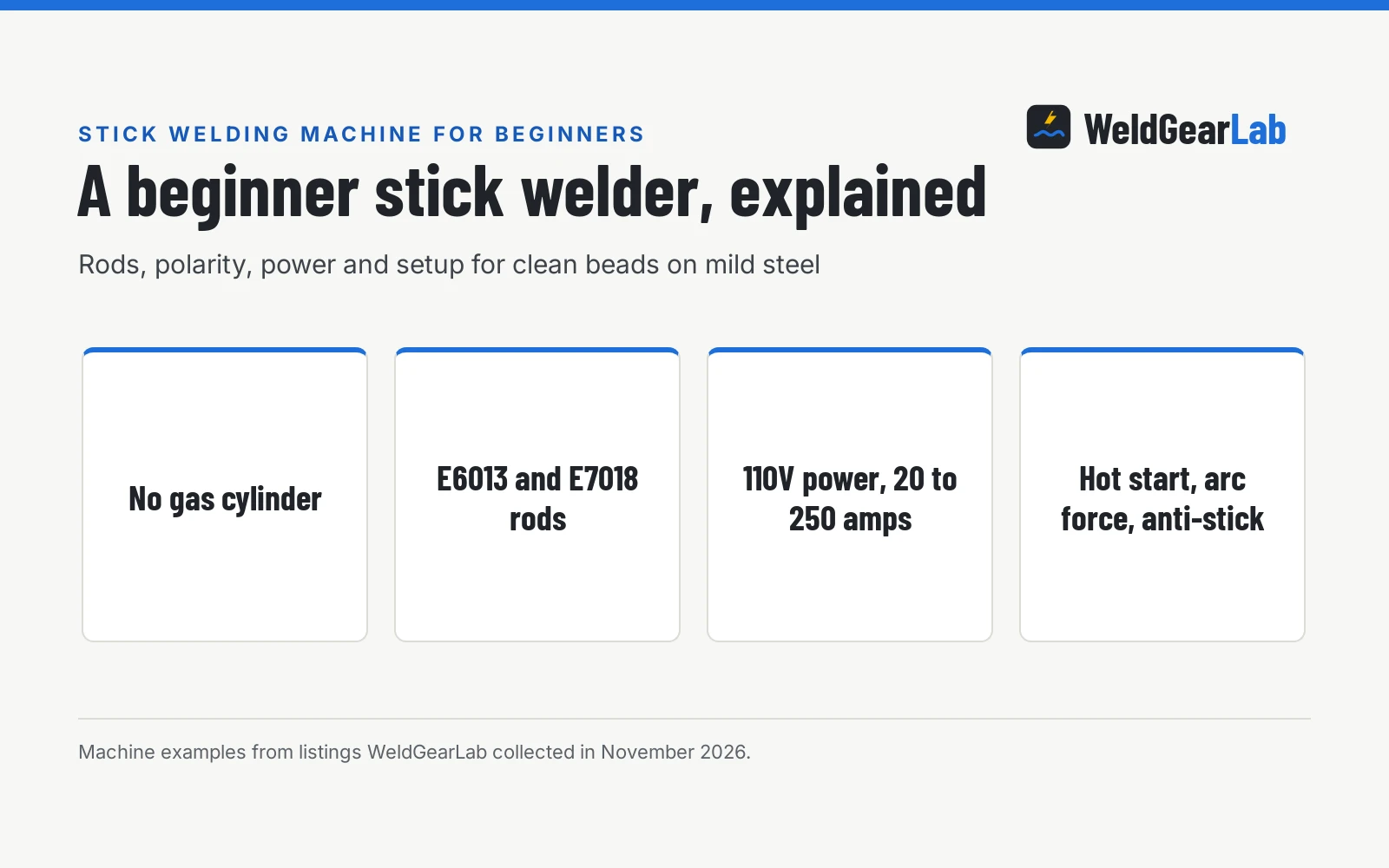
A stick welding machine for beginners runs off a household outlet, needs no gas cylinder, and lays a bead with a coated rod, which makes it a simple way to start welding mild steel at home.

On this page
Top picks at a glance
As an Amazon Associate I earn from qualifying purchases.
- 1
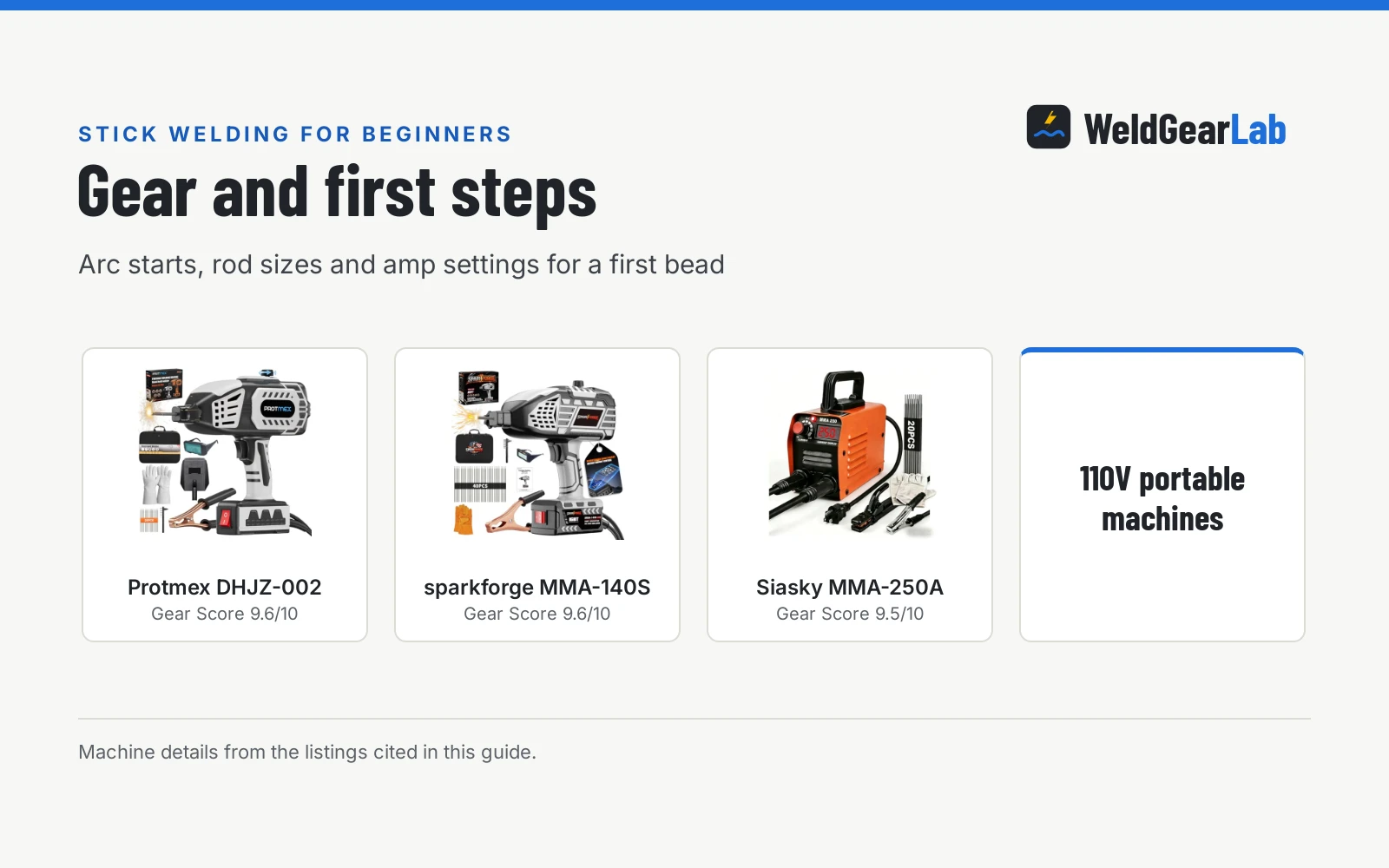
 Portable Handheld Welding Machine9.6/10View on Amazon
- 2
 Siasky Mini Welding Machine9.5/10View on Amazon
- 3
 Handheld Welder9.6/10View on Amazon
A gate hinge has cracked at the weld, a trailer bracket has split along an old bead, and a mower deck needs a patch where rust has eaten through the edge. The metal is mild steel, the job is outside in the yard, and the repair has to hold through daily use. A stick welding machine for beginners fits that kind of work: it runs off a household outlet, it needs no gas cylinder, and it lays a bead with a coated rod and an electrode holder. This guide explains what the machine does, what to look for in a beginner machine, which rods to use, and how to set up for clean beads.
This guide links to our product roundups, where WeldGearLab gets a commission on purchases made through links on this page, and your price stays the same. Read our affiliate disclosure.
What a stick welding machine for beginners does
Stick welding is also called manual metal arc welding, and it works by striking an arc between a coated electrode and the work. The arc melts the rod and the base metal together, and the coating on the rod forms a shield and a layer of slag over the bead as it cools. The slag chips off after the bead cools, and the weld underneath is the joint. A stick welding machine for beginners is built around that simple setup: a power source, an electrode holder, a ground clamp, and rods. There is no wire feeder and no gas cylinder to manage.
That simplicity is why stick welding suits farm and shop repairs. Wind that would blow shielding gas away affects a coated rod far less, so the process works outdoors on a fence, a gate, or a trailer. It tolerates light rust and mill scale better than a gas-shielded process, which helps on old farm equipment.
What to look for in a beginner stick welder
Start with power and current. A beginner machine that runs on 110V plugs into a household outlet, which keeps the setup simple for a home shop. The FEIFANKE listing gives an adjustable current of 20-250A, so the dial covers light sheet work at the low end and heavier beads at the high end. Check the current range in the listing before buying, and check that the outlet and the circuit in the shop match the machine.
Next, check size, weight, and the features that help a beginner keep an arc going. The FEIFANKE listing gives a size of 8.5 x 3.7 x 5.9 inches and a weight of 3.9 pounds, so the machine fits in a backpack or a toolbox and carries to the job. The listing names hot start, arc force, and anti-stick. Hot start gives the arc a boost at the strike, arc force keeps the arc stable near the puddle, and anti-stick cuts the current when the rod does stick, so the rod can be pulled free.
Finally, check what comes in the box. The FEIFANKE kit comes with 20 rods, a steel wire brush, a chipping hammer, welding gloves, and an electrode holder. A kit that includes rods and cleaning tools lets a beginner start without a separate trip to the supplier. The maker also offers 24-hour customer service online.
| FEIFANKE 250A | What it means | Check before you buy | |
|---|---|---|---|
| Current range | 20-250A | Dial covers light and heavy beads | Match the range to the metal thickness |
| Power | 110V | Plugs into a household outlet | Check the outlet and circuit in the shop |
| Rod sizes | 1/16 inch to 1/8 inch | E6013, E6011, E6010 and E7018 rods | Check the rod box for polarity |
| Metal thickness | 0.05-0.22 inch | Sheet and light plate | Measure the metal before welding |
| Size | 8.5 x 3.7 x 5.9 inches | Fits in a backpack or toolbox | Check where the welding happens |
| Weight | 3.9 pounds | Carries to the job | Check the carry weight |
| In the box | 20 rods | Rods, brush, hammer, gloves, holder | Check the kit contents on arrival |
Rods, polarity and metal
Rods are the consumable in stick welding, and the rod type and size decide the bead. The FEIFANKE listing covers AWS E6013, E6011, E6010, and E7018 rods in sizes from 1/16 inch to 1/8 inch, which is 1.6mm to 3.2mm. E6013 is a common rod for clean mild steel and easy restarts, while E7018 is a low hydrogen rod for stronger joints. Start with E6013 on mild steel, then move to E7018 as the hand steadies.
Polarity matters. Check the rod box for the polarity it calls for, then set the machine leads to match. The FEIFANKE listing states a thickness range of 0.05-0.22 inch for the workpiece, which covers sheet and light plate, and it names cast iron and mild steel as metals the machine welds. For more on rods and setup, see the stick welding for beginners guide.
Setting up for your opening beads
Fit-up comes before the arc. Clamp the work so the joint stays put, and clean the joint with a wire brush so the arc strikes on bare metal. Set the ground clamp on clean metal close to the joint, and keep the cable out of the way of the work. Strike the arc like striking a match, then hold a short arc length and move at a steady speed. Watch the puddle, not the arc light.
Practice on scrap of the same thickness as the repair before welding the real joint. Change the current in small steps and watch how the bead changes. When the bead looks even and the slag lifts cleanly, the setting suits the joint. Chip the slag only after the bead has cooled, and wear safety glasses under the helmet while chipping.
Arc flash, fumes and fire. Stick welding makes bright light, sparks, and fumes, so wear a welding helmet, gloves, and flame resistant clothing, and keep the head out of the plume. Weld outdoors or with strong ventilation, and clear dry grass and anything flammable from the area. Keep a fire extinguisher close. See the OSHA welding overview and the Safety Disclaimer.
FAQ for welders
What is a stick welding machine?
A stick welding machine is a power source that runs an arc between a coated rod and the work, melting both into a joint. It needs no gas cylinder and no wire feeder, which keeps the setup simple for a home shop.
What rods should a beginner use?
Start with E6013 rods on clean mild steel, since they restart easily and lay a smooth bead. The FEIFANKE listing covers E6013, E6011, E6010, and E7018 rods in sizes from 1/16 inch to 1/8 inch.
Is gas needed for stick welding?
No. The coating on the rod forms the shield as it burns, so there is no gas cylinder, hose, or regulator to buy or refill. That is why stick welding suits outdoor work, where wind would blow gas shielding away from a gas process.
What power does a beginner stick welder need?
A beginner machine that runs on 110V plugs into a household outlet. The FEIFANKE listing gives an adjustable current of 20-250A on 110V power.
Does a stick welder work outdoors?
Yes. The FEIFANKE listing states the machine works outdoors, indoors, or at height. Weld with strong ventilation or outdoors with the head out of the plume, and clear dry grass and anything flammable from the area.
Related: welders hub, stick welding set up, vertical stick welding tips, welder kit for beginners, and the manual metal arc welder guide.