Stick Welding for Beginners: Gear and First Steps
A first stick welder, a handful of rods and a steady hand: how a beginner starts an arc, sets the amps and lays a first bead.

On this page
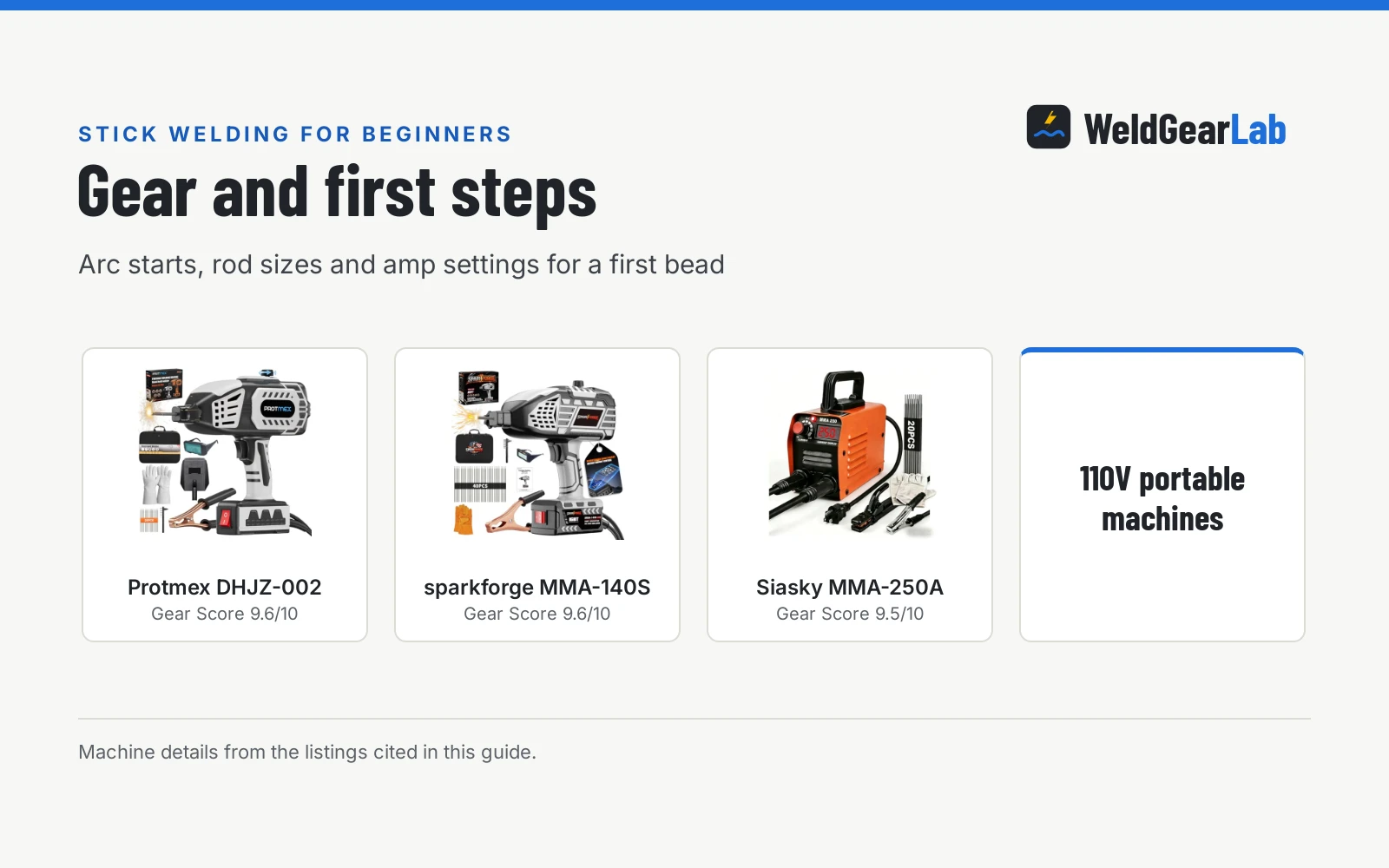
Top picks at a glance
As an Amazon Associate I earn from qualifying purchases.
- 1
 Handheld Welder - 110V Portable Welding Machine9.6/10View on Amazon
- 2
 Portable Handheld Welding Machine9.6/10View on Amazon
- 3
 Siasky Mini Welding Machine9.5/10View on Amazon
A cracked gate hinge, a fence post that snapped at the weld, a trailer bracket that needs another bead before the weekend: stick welding starts with jobs like these. Stick welding for beginners is the art of striking an arc with a flux-coated rod and laying a bead that holds, and it needs less gear than most beginners expect: a small welder, a handful of rods, and a steady hand. This guide walks through how the arc works, how to set the machine, and what to practise before welding on the real job.
This guide links to our product roundups, where WeldGearLab gets a commission on purchases made through links on this page, and your price stays the same. Read our affiliate disclosure.
| # | Product | Gear Score | Buy |
|---|---|---|---|
| 1 | Handheld Welder - 110V Portable Welding Machine | 9.6/10 | Buy on Amazon |
| 2 | Portable Handheld Welding Machine | 9.6/10 | Buy on Amazon |
| 3 | Siasky Mini Welding Machine | 9.5/10 | Buy on Amazon |
Handheld Welder - 110V Portable Welding Machine
A 110V handheld stick welder with a 20 to 120 amp range, a 5-position knob, hot start and anti-stick, sold as a full kit with 20 rods.
Pros
- 20 to 120 amp range on a 5-position rotary knob
- Fits 3/32 inch to 1/8 inch rods, with 20 rods in the box
- Hot start arc ignition and anti-stick function
- Full kit: mask, glasses, gloves, slag hammer, ground clamp and carry bag
Cons
- No warranty term is stated
- 5 fixed current steps instead of stepless control
- No duty cycle figure is stated
- No arc force control is listed
Portable Handheld Welding Machine
A 110V handheld stick welder with stepless 20 to 140 amp control, an LCD display and 3 modes, sold with 40 rods and a full kit.
Pros
- Stepless 20 to 140 amp control with an LCD display
- 3 modes: current, arc force and hot start
- 40 welding rods in the box
- Kit includes gloves, photochromic lenses, a level and a tape measure
Cons
- No warranty term is stated
- No weight or size figures are stated
- No duty cycle figure is stated
- Only 3/32 inch to 1/8 inch rods are covered
Siasky Mini Welding Machine
A 110V portable stick welder with an LED screen, automatic current match for beginners, hot start, arc force and anti-stick, with 20 rods.
Pros
- LED screen with automatic current match for beginners
- Hot start, arc force and anti-stick
- 20 welding rods in 2.5 mm in the box
- Weighs 3.3 pounds with a handle for outdoor work
Cons
- No amp range is stated in the bullets, only 250A in the model name
- No warranty term is stated
- Only 2.5 mm rods are named; no rod size range is stated
- No duty cycle figure is stated
Stick welding for beginners: how the arc works
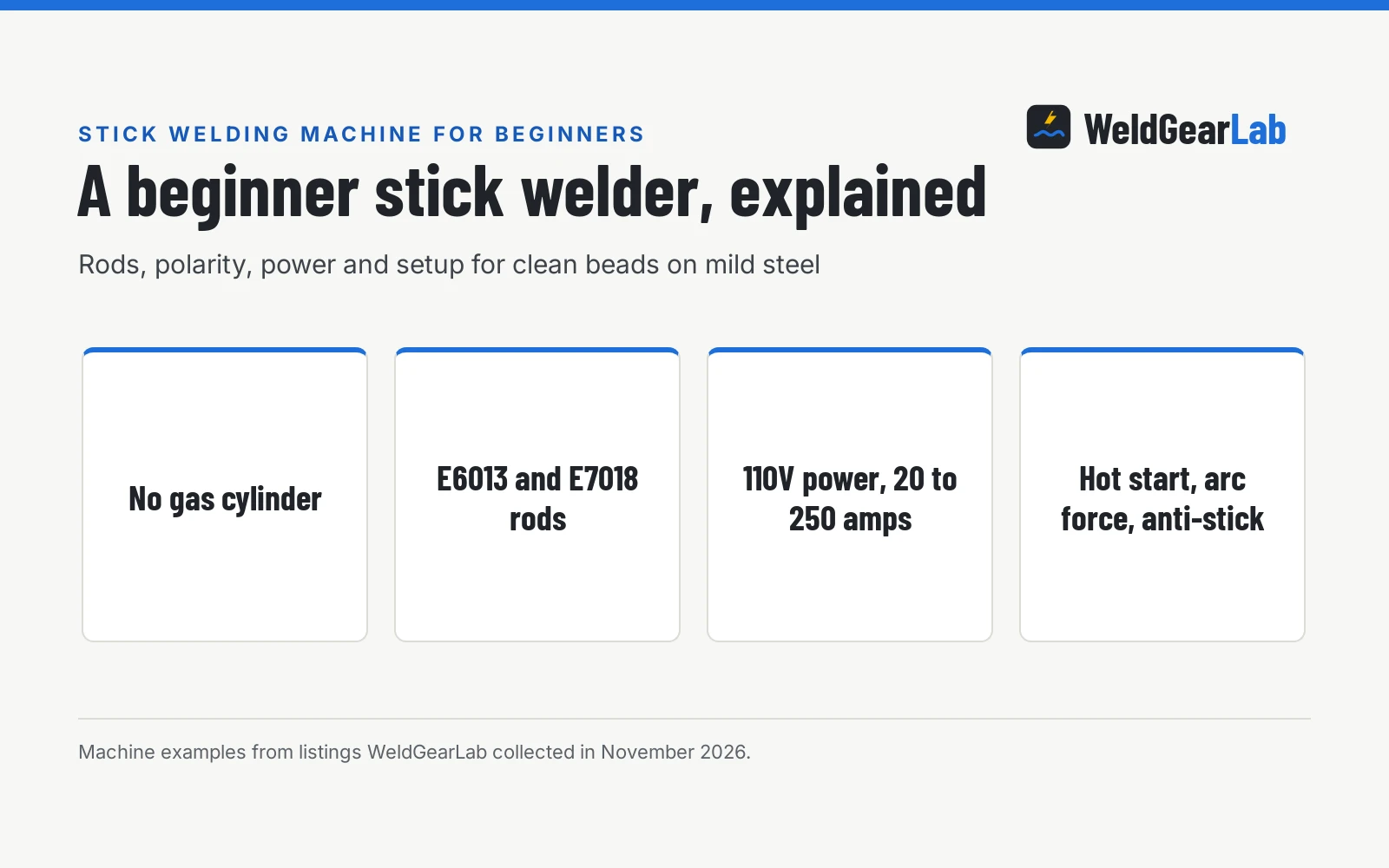
A stick welder feeds current through a flux-coated rod. Touch the rod to the metal and lift it a touch, and an arc jumps the gap, melting rod and base metal into a puddle while the flux burns off as gas and slag. The slag shields the puddle and chips off after the bead cools. Hot start gives the arc a push at the strike so the rod lights without sticking, arc force steadies the arc when the gap shortens, and anti-stick cuts the current when the rod freezes to the work.
Stick welding for beginners side by side
| Machine | Gear Score | Amp range | Notes |
|---|---|---|---|
| Protmex DHJZ-002 | 9.6/10 | 20 to 120 amps | 5-position knob, 20 rods and a full kit |
| sparkforge MMA-140S | 9.6/10 | 20 to 140 amps | Stepless control, LCD display, 40 rods |
| Siasky MMA-250A | 9.5/10 | Not stated | LED screen with automatic current match |
The table lines up the machines in this guide by Gear Score, with the amp range and the note that sets each machine apart. The Protmex leads on a fully stated range and the most complete kit, while the Siasky trails because its bullets state no amp range at all.
The gear for a first stick weld
Each machine below handles one part of learning the arc: striking it, holding it steady, and keeping the rod from freezing to the work.
How to set up a bead
Start with the machine, the rod and the metal, in that order.
- Match the rod to the machine. The Protmex and the sparkforge both fit 3/32 inch to 1/8 inch rods, and the Siasky kit carries 20 rods in 2.5 mm.
- Set the amps to the rod. The Protmex adjusts from 20 to 120 amps on a 5-position knob, and the sparkforge adjusts from 20 to 140 amps with stepless control. The Siasky matches the current for the beginner, per its listing.
- Use the screen. The sparkforge shows settings on an LCD display and the Siasky shows output current on an LED screen, so a beginner can see what the machine is doing.
- Mind the cord. The Protmex listing states automatic current compensation for steady output on long extension cords, which keeps the arc stable away from the outlet.
- Gear up from the kit. The Protmex kit carries a mask, gloves and a ground clamp, the sparkforge kit carries gloves, photochromic lenses and a ground wire, and the Siasky kit carries face shields and work clips. Match the kit to the gear you already own.
What trips up a beginner
- A rod that freezes to the work. Anti-stick is built into the Protmex and the Siasky, and the sparkforge modes prevent the rod from sticking, while hot start helps the arc light on the next strike. See our hot start vs arc force guide for how the features differ.
- An arc that wanders. Arc force steadies the arc when the gap shortens, which is why the Siasky and the sparkforge list it.
- Burn-through on thin metal. Lower amps suit thin metal, and the stepless control on the sparkforge lets a beginner creep down to the setting that holds.
- Slag left in the bead. Chip the slag off with the slag hammer and brush before the next pass, since a fresh bead over slag traps it in the joint.
For more options, see our guides guides.
FAQ for welders
What rod size should a beginner start with?
The Protmex and the sparkforge fit 3/32 inch to 1/8 inch rods, and the Siasky kit carries 20 rods in 2.5 mm. Start with the rod the machine lists, and match the amps to the rod size with the knob or the screen.
What does hot start do?
Hot start gives the arc a push at the strike so the rod lights without sticking. Each machine here lists hot start, and the Protmex names it as Hot Start Arc Ignition.
Why does my stick rod keep sticking?
A rod sticks when the arc dies at the strike or the gap closes. Anti-stick, which the Protmex and the Siasky list, cuts the current so the rod lets go, and the sparkforge modes prevent the rod from sticking. Hot start helps the next strike light cleanly.
Can a 110V stick welder run at home?
Yes. Each machine here plugs into a 110V outlet: the Protmex plugs into any 110V outlet, the Siasky runs on standard 110V household voltage, and the sparkforge plugs into any standard 110V household outlet. Keep the work dry, ventilate the space, and wear a face shield and gloves.
What comes in a beginner stick welder kit?
More than the machine. The Protmex kit carries a mask, safety glasses, gloves, a slag hammer and brush, a ground clamp, an electrode holder, 20 rods and a manual in a carry bag. The sparkforge kit adds a level and a tape measure, and the Siasky kit carries face shields, brushes and 20 rods in 2.5 mm.
Related: flux core vs stick for the home garage, MIG vs stick for rusty metal, MIG vs stick for mild steel, and TIG vs stick for the home garage.