MIG Welding for Beginners: Gear and Setup Basics
MIG welding for beginners starts with a wire feed machine, the right wire and gas or gasless shielding, plus a setup routine that keeps the early welds clean and safe.

On this page
Top picks at a glance
As an Amazon Associate I earn from qualifying purchases.
- 1
 ARCCAPTAIN Welding Helmet Auto Darkening9.7/10View on Amazon
- 2
 Handheld Welder9.6/10View on Amazon
- 3
 Portable Handheld Welding Machine9.6/10View on Amazon
MIG welding for beginners starts with a simple idea: a wire feed welder pushes wire through a gun, the wire melts into the joint, and a shield keeps air out of the molten metal. The machine does the feeding while the welder steers the gun. This guide explains what the process is, how gas and gasless wire differ, what gear a beginner needs, and how to set up for an opening weld.
This guide links to our product roundups, where WeldGearLab gets a commission on purchases made through links on this page, and your price stays the same. Read our affiliate disclosure.
MIG welding for beginners: what the process is
MIG stands for metal inert gas, and the process is also called wire feed welding. A spool of wire feeds through the gun at a steady speed, an arc melts the wire and the edges of the joint, and shielding gas or flux keeps air away from the puddle while it cools. The bead forms as the gun moves along the joint, so the welder focuses on travel speed and gun angle instead of feeding a rod by hand.
The shielding is the part that decides the setup. Gas MIG uses solid wire and gas from a cylinder, fed through the gun around the wire. Gasless flux core uses hollow wire filled with flux that burns to make its own shielding gas and leaves a layer of slag on the bead. The choice comes down to where the work happens and how clean the weld needs to look.
Side by side
| Gas MIG (solid wire) | Gasless flux core | What a beginner needs | |
|---|---|---|---|
| Shielding | Gas from a cylinder | Flux inside the wire | Either, if the machine lists it |
| Gear beyond the welder | Solid wire, cylinder, regulator, gas hose | Flux core wire | Wire, helmet, gloves, tools |
| Wind and outdoor work | Gas blows away, needs shelter | Tolerates a breeze | Flux core for outdoor work |
| Thin sheet | Easier, cleaner small beads | Harder, more heat and burn through | Gas MIG for thin panels |
| Cleanup | No slag, less spatter | Slag to chip, more spatter | A chipping hammer and wire brush |
| Wire sizes in the listings | 0.8 mm solid wire | .030 to .040 inch flux core wire | Match the wire to the machine |
Polarity is general practice for common wires; always follow the polarity printed on your wire’s label and in the machine’s manual. Most machines that run both have a polarity lead you swap when you change wire.
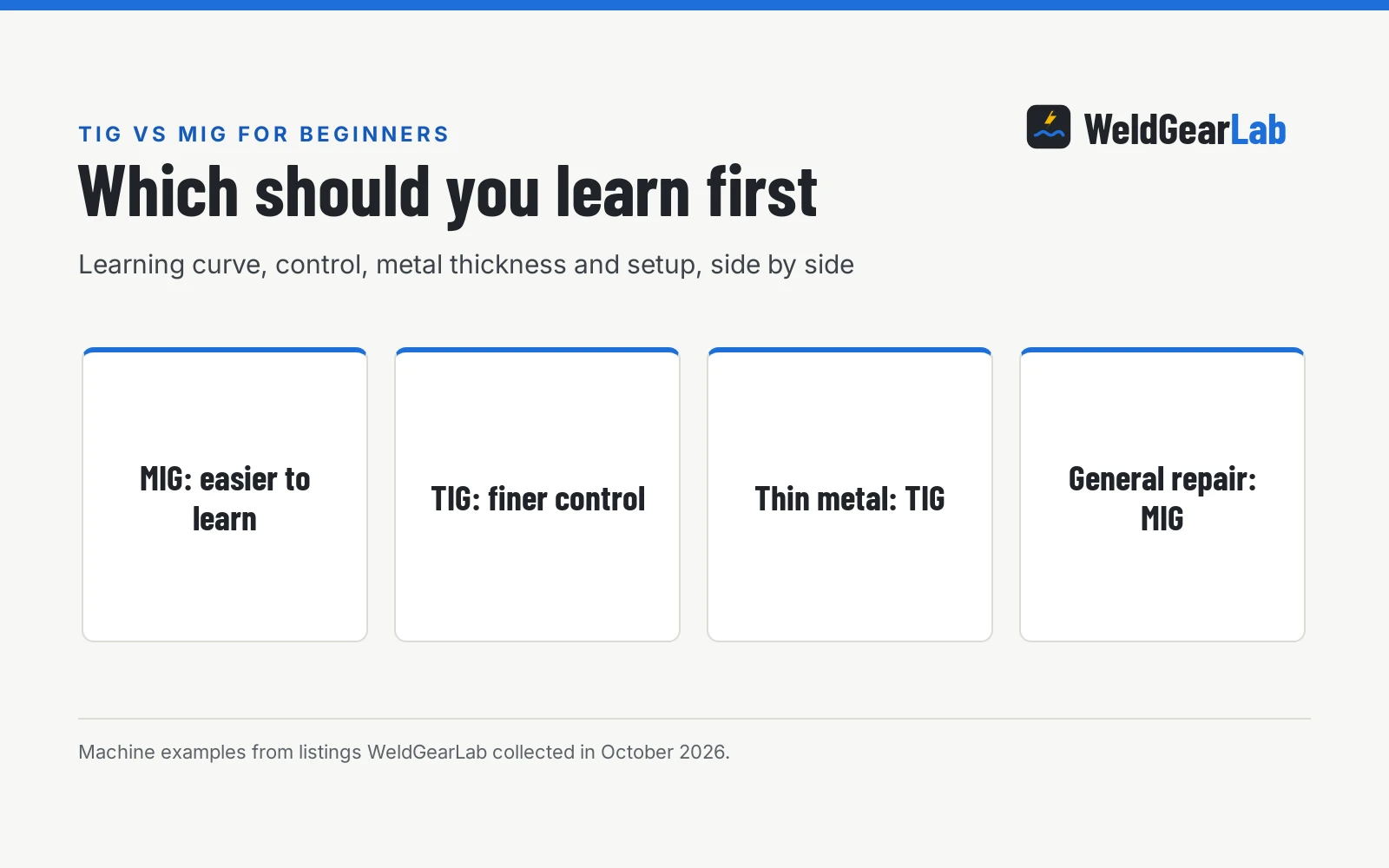
Gas or gasless: which to start with
Flux core is the easier place to start, because there is no cylinder, regulator or gas hose to set up. It tolerates a breeze outdoors, and it works on metal that is less than perfectly clean. The trade is more smoke, more spatter and slag to chip off the bead.
Gas MIG is the better choice for thin sheet and work that stays visible, with cleaner beads and no slag. It needs shelter from wind, cleaner metal, and a cylinder and regulator. A machine that lists both, like the BESTMIG 145A below, lets a beginner start with flux core and add gas later.
What gear a beginner needs
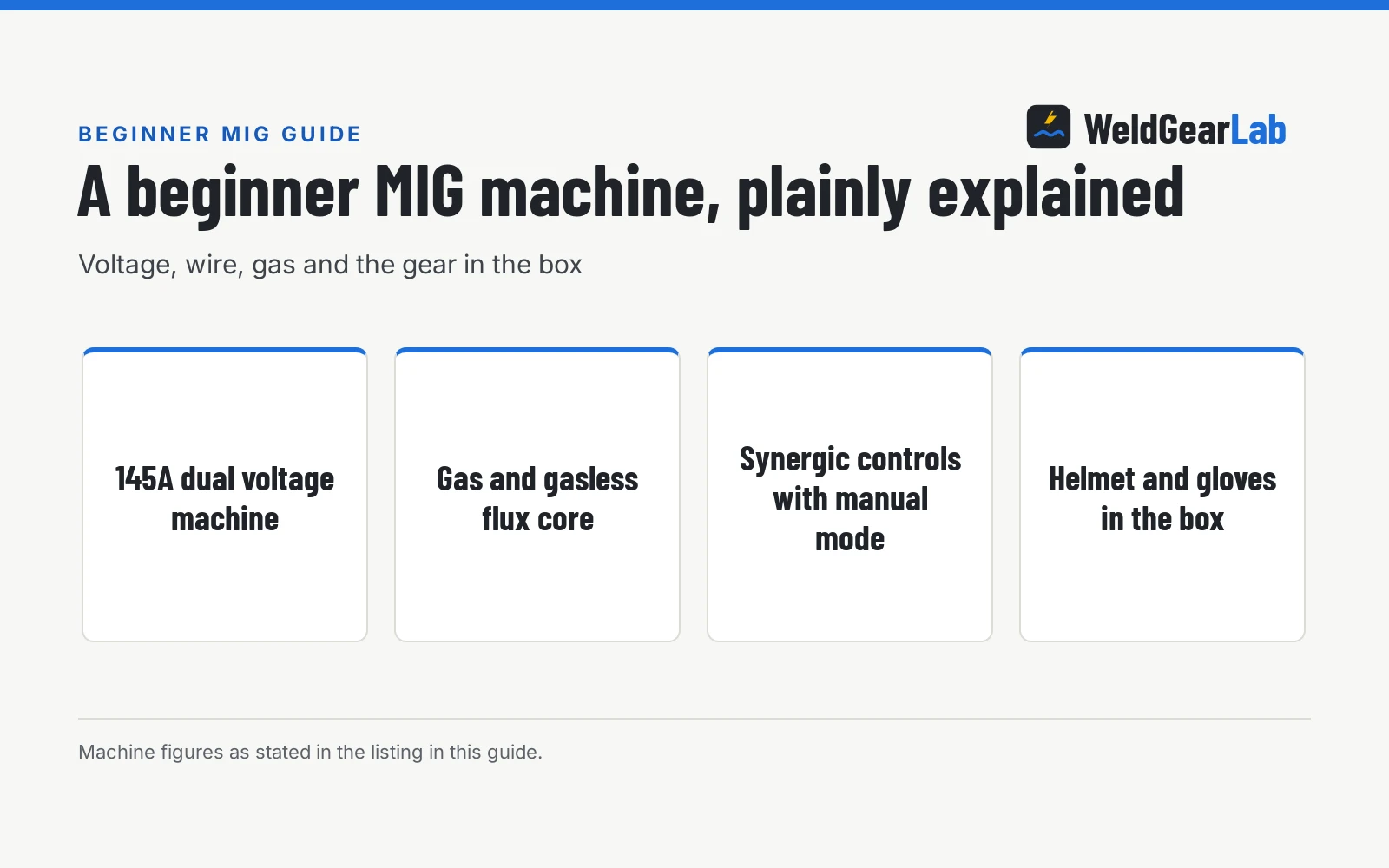
A beginner machine should list gas and gasless MIG in the same unit, so the machine you start with covers both kinds of work. The BESTMIG 145A in the listings is a 145A 4-in-1 unit that runs gas and gasless MIG, Stick and Lift TIG on dual voltage 110/220V. The listing states it handles stainless steel, carbon steel and mild steel up to 3mm thick, and it takes solid wire, flux-cored wire from .030 to .040 inch, and silicon wire from .030 to .040 inch. The listing prints 3mm with (2/5″) beside it, and the two do not match, so this guide follows 3mm. The listing notes solid wire welds at 0.8 mm.
The same listing describes synergic control: when the wire diameter or the current changes, the machine adjusts voltage and wire feed speed on its own, with manual adjustment still available. The machine carries over-current, overload, over-voltage and overheat protection, and a display that shows voltage and current. It weighs 11.55 pounds and measures 11.5 inches by 17.9 inches by 13.8 inches. The box includes a welding helmet and gloves, a ground clamp, an electrode holder, a 120V-240V power adapter cable, a MIG torch, 0.8 mm flux-cored wire, 0.8 mm solid wire, a gas tube with connector, a brush and hammer set, and a strap. A TIG torch is not included, so Lift TIG needs one bought separately.
Consumables wear out, and a kit keeps spares on hand. The YESWELDER MIG gun accessories kit (on Amazon) holds 24 pieces: 20 contact tips in .030 inch, 2 nozzles and 2 gas diffusers. It fits Lincoln Magnum 100L and Tweco Mini torches, and the listing names YESWELDER machines it fits, from the MIG-140DS PRO to the MIG-250PRO.
The VASTOOLS set holds 8 pieces: a chipping hammer 10-1/2 inches long with a 1-1/16 inch chisel, leather welding gloves 13.5 inches long, a 50 lb welding magnet, 4-3/4 inches, that holds angles of 45, 90 and 135 degrees, 8 inch Welpers pliers, a MIG nozzle reamer, a wire brush 11 inches long with bristles about 1 inch long in 4 by 15 rows, a soapstone holder with 5 flat and 45 round pieces, and a 16 foot by 1 inch tape measure. The set weighs 5.75 pounds and measures 11.0 inches by 6.1 inches by 2.0 inches.
How to tell what a machine supports
Not every machine sold as a MIG welder runs gas. Look for these in the listing:
- Explicit gas MIG. Phrases like gas MIG, solid wire, or a gas inlet and solenoid in the machine.
- A gas hose in the box. Machines that run both often include one, and the BESTMIG 145A includes a gas tube with connector.
- Solid wire sizes. Listings that name solid wire, such as 0.8 mm solid wire, usually support gas. Flux only machines list flux wire sizes.
- What is missing. A machine can list Lift TIG and still ship without a TIG torch, as the BESTMIG 145A does.
See the best welder for beginners guide for machines that list both modes.
Which gas for MIG on steel
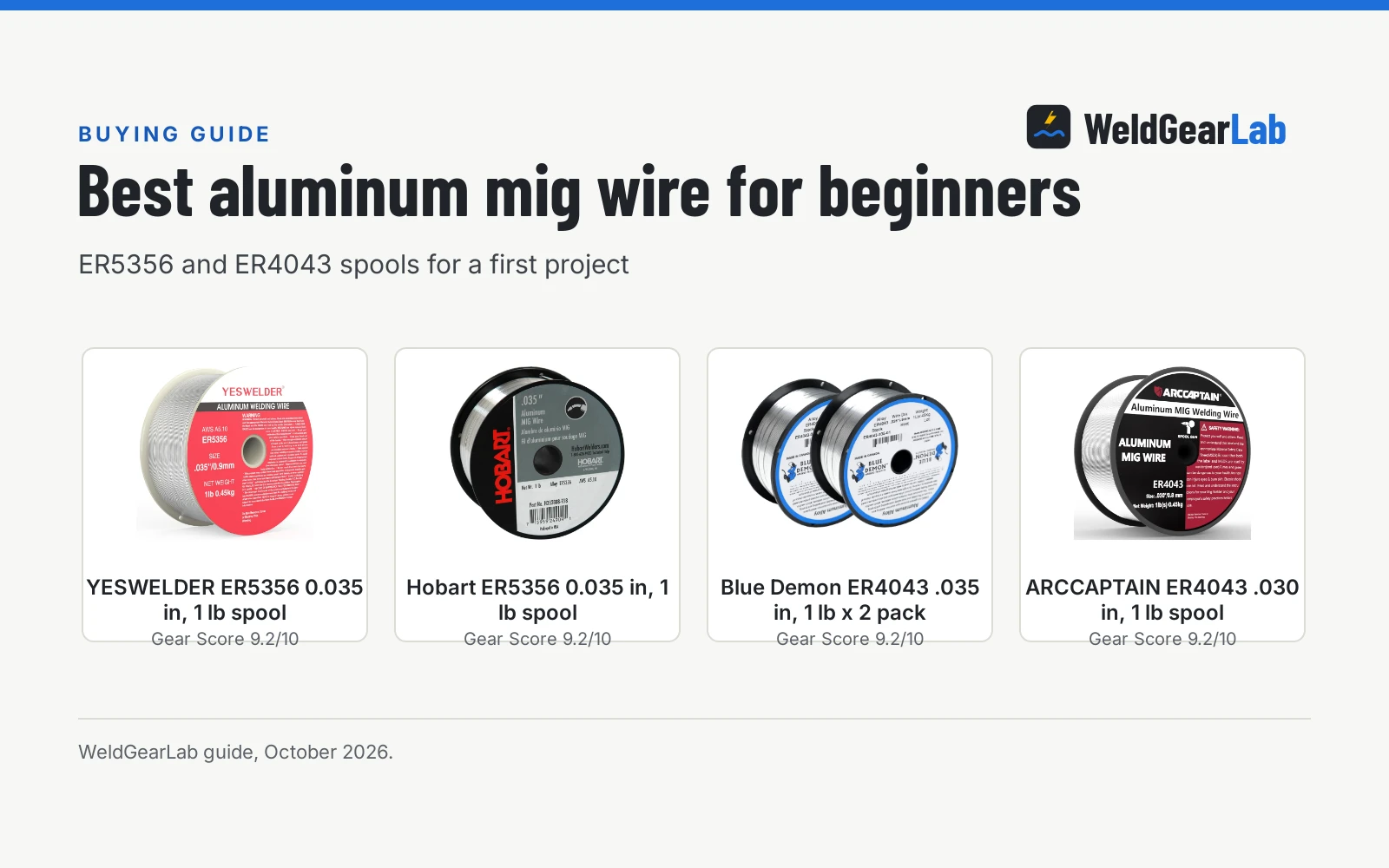
For mild steel, the common choice is a mix of argon and CO2, which gives a stable arc with moderate spatter. Straight CO2 is cheaper and penetrates well but spatters more. Aluminum needs pure argon. Check the gas your wire and machine manual recommend.
Setting up for an opening weld
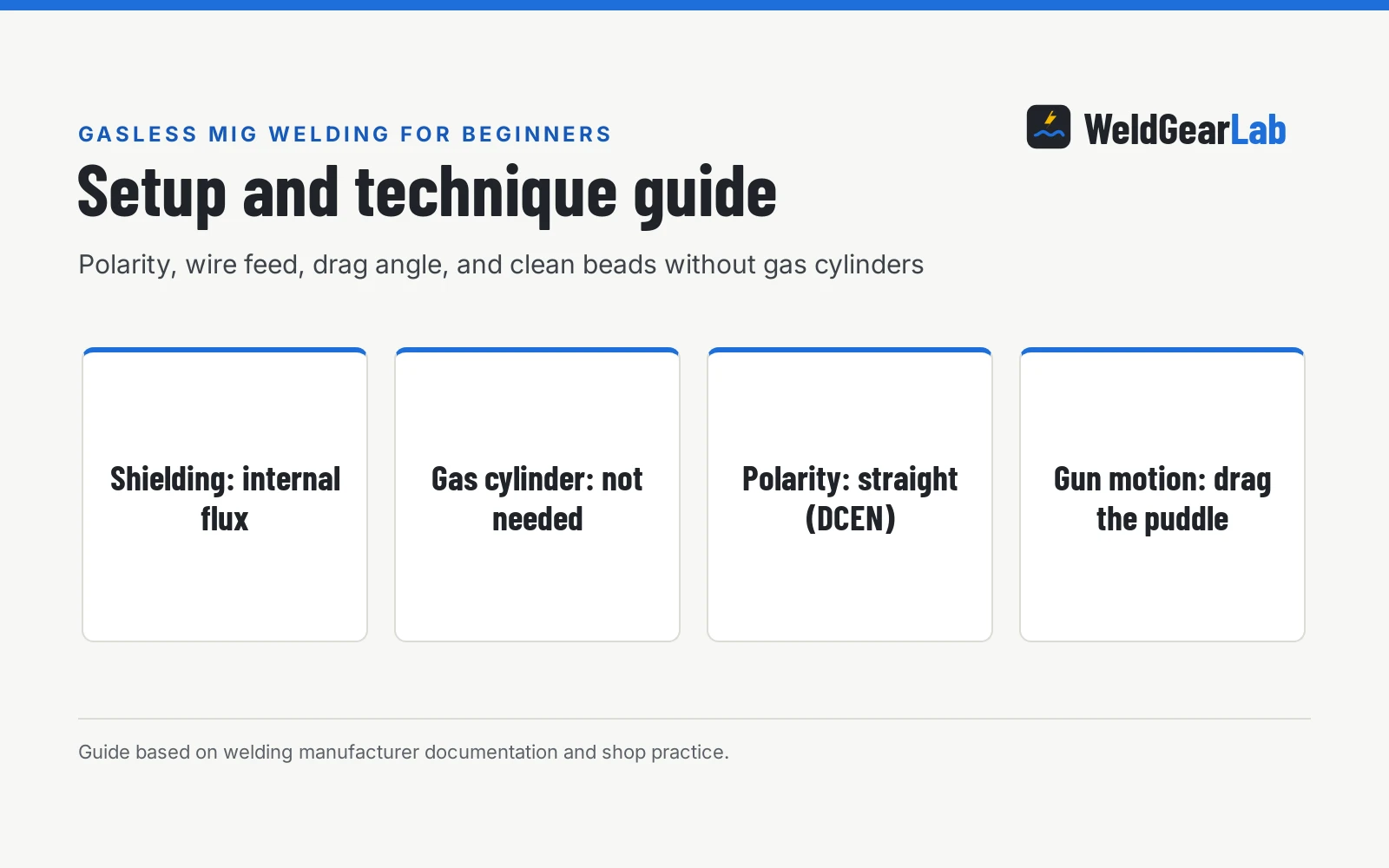
Set the polarity the wire calls for, fit a contact tip that matches the wire size, and load the wire so it feeds straight through the gun. Clamp the ground to clean metal close to the joint, and check that the gas is connected and the cylinder is secure when running gas MIG. Read the settings from the machine’s door chart or manual, run a short bead on scrap metal, and adjust the wire feed and voltage until the bead sits flat. Keep the gun angle steady and the stickout short, and chip slag and brush the bead between passes on flux core.
Arc flash, fumes and fire. MIG welding gives off bright light, smoke and sparks, so weld with a helmet down, gloves on, and ventilation that pulls fumes away from the face. Never weld on galvanized steel without knowing the fume risk, keep dry grass and anything flammable clear of the work, and wear safety glasses under the helmet when chipping. Secure gas cylinders upright with a chain. See the OSHA welding overview and our Safety Disclaimer.
FAQ for welders
What machine should a beginner start with?
A machine that lists gas and gasless MIG in one unit, so the machine you start with covers both kinds of work. The BESTMIG 145A in the listings runs gas and gasless MIG, Stick and Lift TIG on 110/220V, with synergic control that adjusts voltage and wire feed speed when the wire diameter or current changes.
Do I need gas to start MIG welding?
No. Flux core wire carries its own shielding, so a beginner can start without a cylinder, regulator or gas hose. Gas MIG gives cleaner beads on thin sheet and visible work, so beginners often start with flux core and add gas later.
What wire size should a beginner use?
Wire in .030 inch is a common starting size, and the YESWELDER kit in the listings holds 20 contact tips in .030 inch. The BESTMIG 145A takes flux-cored wire from .030 to .040 inch and solid wire at 0.8 mm. Match the contact tip to the wire size.
Can a beginner weld thin sheet with flux core?
It is harder, because flux core runs hotter and burns through thin panels more easily than gas MIG. Gas MIG with solid wire and a cylinder gives cleaner small beads on thin sheet. Practice on scrap of the same thickness before welding the real part.
What safety gear does a beginner need?
A welding helmet, gloves and ventilation are the starting point, and the BESTMIG 145A box includes an auto-darkening helmet and gloves. The VASTOOLS set adds leather gloves 13.5 inches long for handling hot metal. Wear safety glasses under the helmet when chipping slag.
Related: how to choose a MIG welder, best flux core welder, best 120V MIG welder, the MIG welders hub and the welders hub. Also see our why a MIG welder spatters.