Gasless MIG Welding for Beginners: Setup and Technique Guide
Gasless MIG welding uses flux-cored wire to weld steel outdoors and in home shops without shielding gas cylinders, regulators, or complex setups.

On this page
Top picks at a glance
As an Amazon Associate I earn from qualifying purchases.
- 1
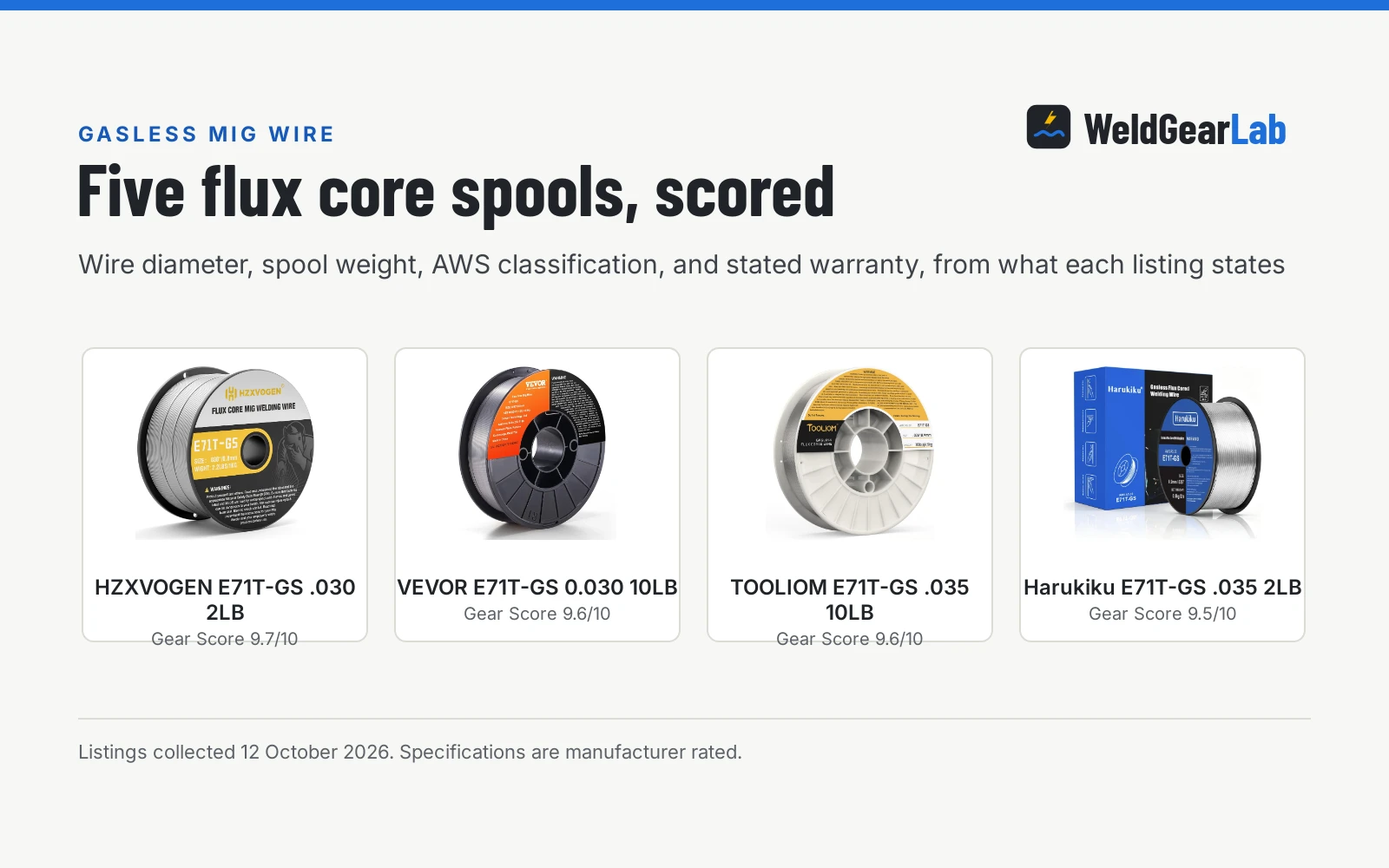
 HZXVOGEN Gasless Flux Core MIG Welding Wire9.7/10View on Amazon
- 2
 VEVOR Flux Core Welding Wire9.6/10View on Amazon
- 3
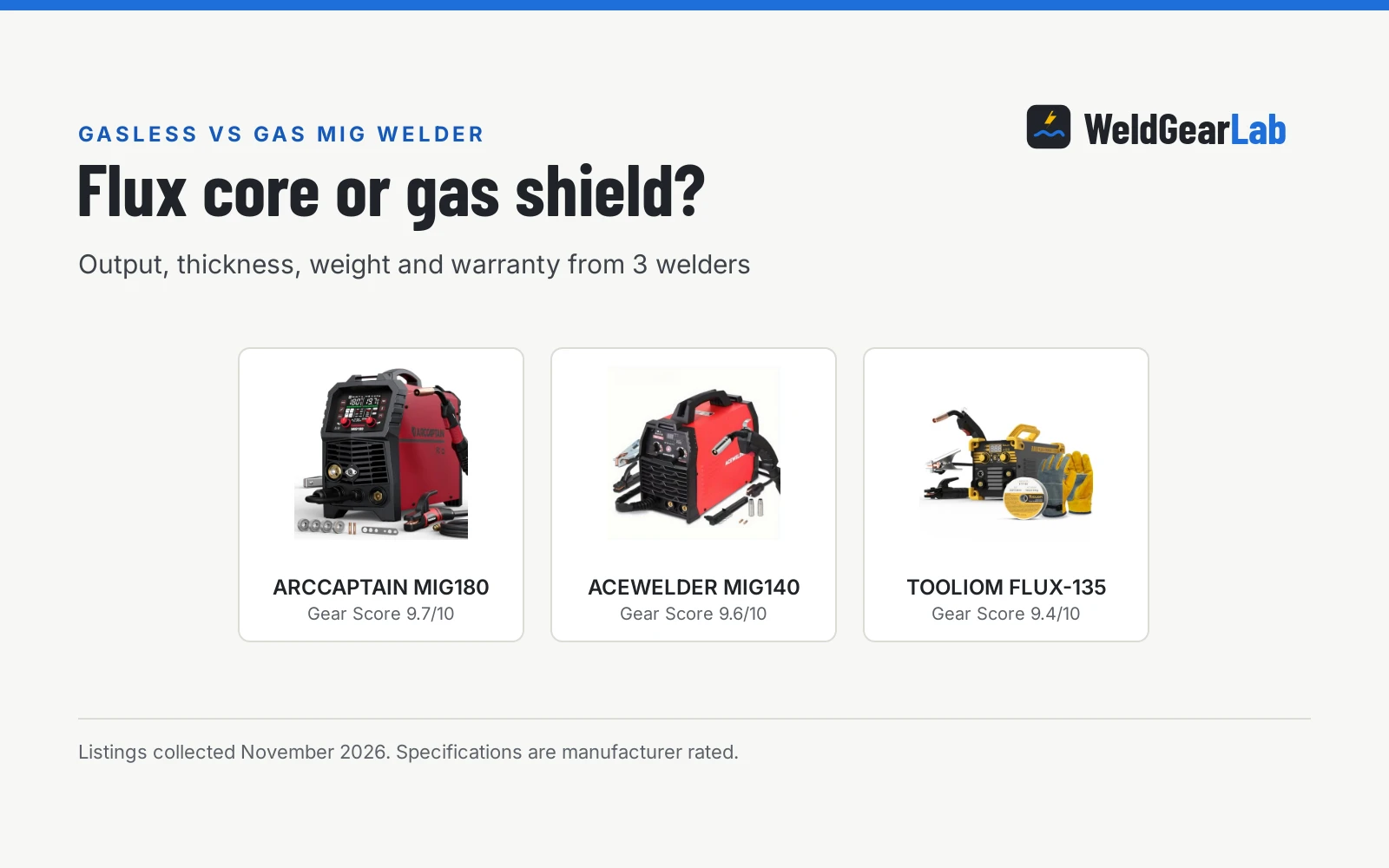
 ACEWELDER 140A Gasless Flux Core MIG Welder/Lift TIG/Stick 39.6/10View on Amazon
When you need to repair a broken steel gate, patch a bracket, or build a frame in your driveway, gasless mig welding for beginners is the simplest way to lay solid steel beads. Instead of renting high-pressure shielding gas cylinders and regulators, this process feeds hollow wire packed with flux directly into the joint. The flux vaporizes inside the electric arc to create its own protective gas shield and floating slag layer. Wind will not blow your shielding away, light surface rust will not ruin your bead, and compact machines plug directly into household outlets. This guide walks through machine polarity, drive roll setup, gun angle, and bead technique step by step.
This guide links to our product roundups, where WeldGearLab gets a commission on purchases made through links on this page, and your price stays the same. Read our affiliate disclosure.
Gasless MIG welding for beginners in one paragraph
Gasless wire welding uses a continuous wire feed gun like conventional MIG, but the shielding is packed entirely inside the wire core. Pulling the trigger feeds flux-cored wire into the joint while striking an electric arc against your grounded work piece. Intense heat melts the base metal and wire sheath while core ingredients vaporize into a protective shielding envelope. A glassy crust of slag floats over the molten pool to protect the puddle as it cools. Once the bead solidifies, you chip off the crust with a chipping hammer to reveal clean steel underneath. No gas bottles, regulators, or draft screens required.
Side by side
| Process factor | Gasless MIG (flux core) | Standard MIG (solid wire) | Beginner recommendation |
|---|---|---|---|
| Shielding mechanism | Internal core vaporizes into shielding cloud | External compressed gas cylinder and regulator | Gasless avoids bottle rental and regulator setup |
| Support gear required | Spool of flux-cored wire and chipping hammer | Solid wire spool, shielding bottle, flowmeter, hose | Gasless packs into a single portable suitcase |
| Outdoor wind tolerance | Shielding vapor resists outdoor wind drafts | Shielding gas envelope blows away in light breeze | Gasless is far superior for yard and driveway repairs |
| Base metal cleanliness | Deoxidizers tolerate light surface rust and scale | Demands bare shiny ground steel free of oxides | Gasless forgives imperfect steel prep on farm metal |
| Thin sheet metal control | Higher penetrating heat increases burn-through risk | Lower heat input allows cleaner beads on thin panels | Standard MIG excels on delicate auto body panels |
| Post-weld cleanup | Requires chipping glass slag and wire brushing | No slag crust to remove, minimal spatter cleanup | Standard MIG produces cleaner cosmetic finishes |
| Torch travel angle | Must drag the gun to prevent trapping slag | Can push or drag depending on joint orientation | Always pull or drag flux wire when slag is present |
| Machine electrical polarity | Direct current electrode negative (DCEN / straight) | Direct current electrode positive (DCEP / reverse) | Always check internal lugs before feeding flux wire |
| Alloy flexibility | Carbon and mild structural steel only | Welds steel, stainless, and aluminum with spool gun | Choose standard MIG if you plan to weld aluminum |
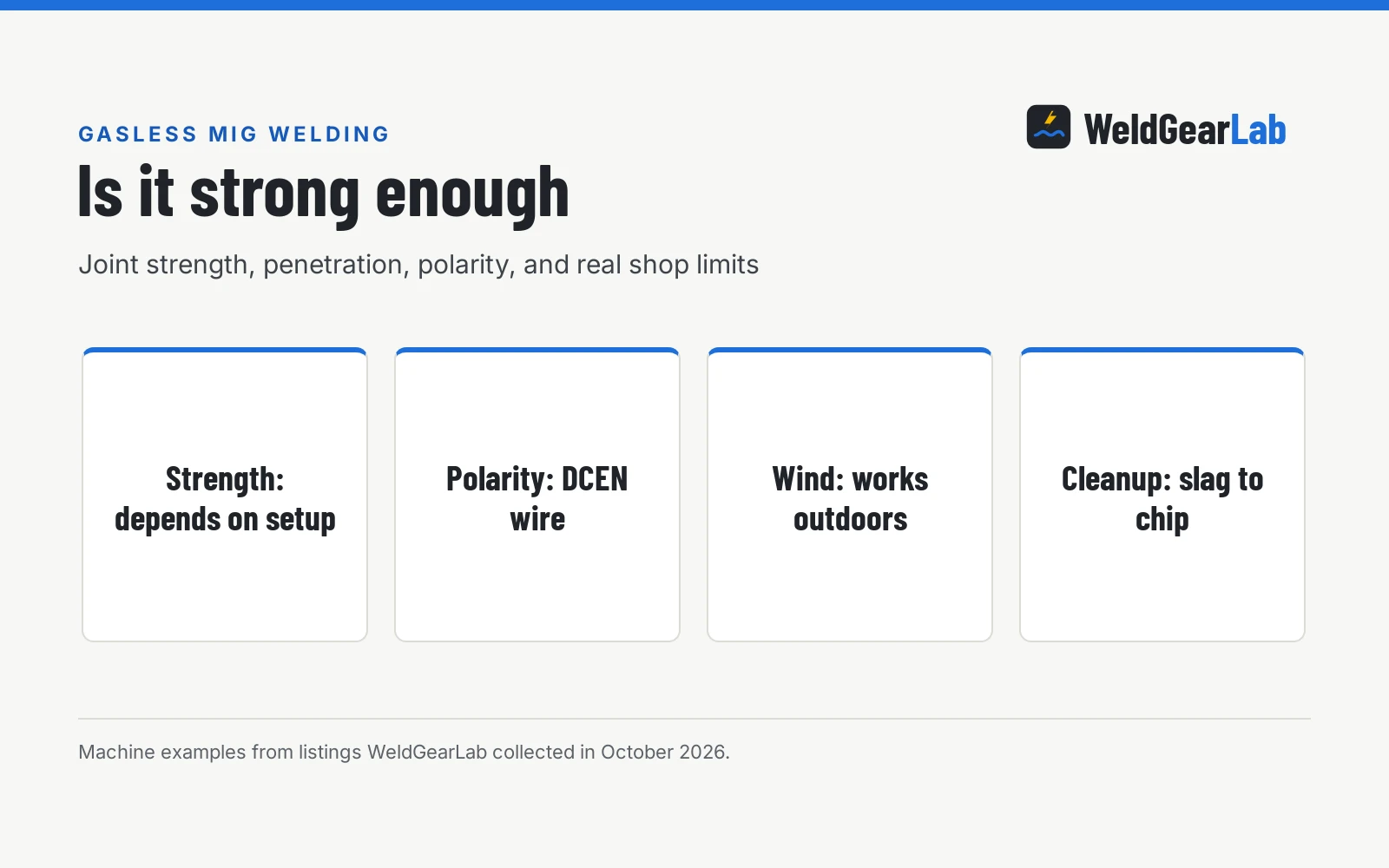
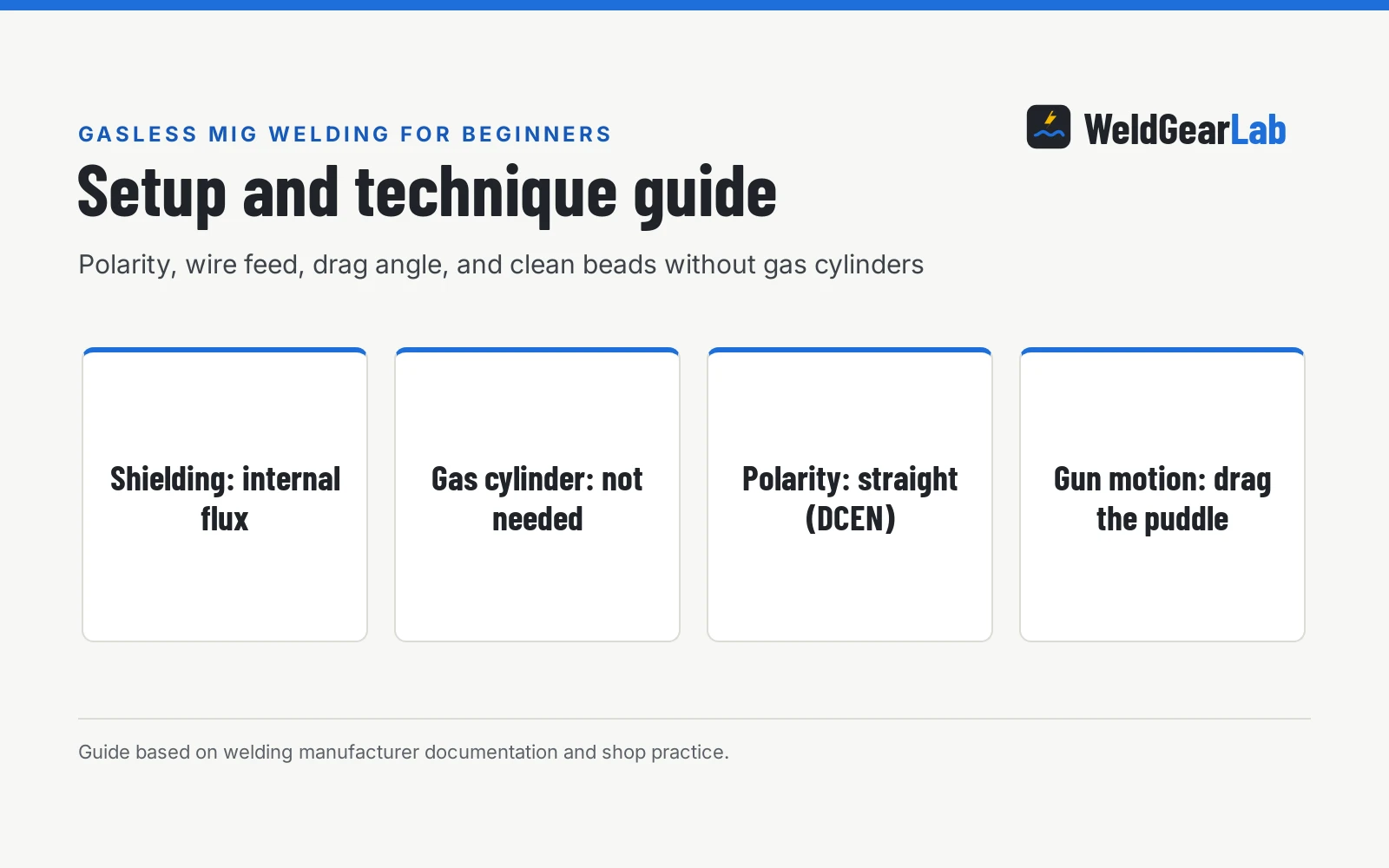
Polarity rules dictate the electrical circuit inside the machine cabinet: most self-shielded flux-cored wires run on direct current electrode negative (straight polarity), whereas solid wire with shielding gas uses direct current electrode positive (reverse polarity). Connecting the gun to the negative terminal stabilizes the arc on tubular wire. Always check the schematic diagram inside your wire drive door and the label on your wire spool before feeding wire through the gun liner.
When gasless flux core is the better choice
- Outdoor breeze and field repairs. Working outside on trailers, farm fences, and gates ruins solid wire beads because wind drafts strip away shielding gas. Flux core generates shielding vapor directly at the arc, protecting the puddle even in breezy pasture conditions.
- Surface rust and farm steel. Solid MIG wire demands bare steel ground bright. Flux deoxidizers tolerate light surface rust, mill scale, and primer without producing catastrophic porosity.
- Portable job site mobility. Eliminating bulky gas cylinders, flowmeters, and delivery hoses lets you carry a compact welder directly to the tailgate or repair site.
- Deep joint penetration. Concentrating arc energy through the narrow cross-section of tubular wire drives deep fusion into steel bevels, helping compact machines achieve sound root tie-in.
Our best flux core welder guide reviews dedicated gasless machines built for farm repairs and mobile fabrication.
When solid wire with shielding gas is the better choice
- Thin sheet metal and auto body panels. Solid wire under argon blends produces lower heat and tiny beads, reducing burn-through risks on thin sheet and delicate tubing.
- Appearance and minimal cleanup. Solid wire MIG leaves no slag over the bead and drastically cuts spatter droplets, eliminating tedious wire wheel buffing on visible furniture and handrails.
- Indoor shop fabrication. Lacking heavy chemical flux agents, solid wire generates far less dense smoke, keeping garage shop air clearer during long sessions.
- Nonferrous alloy welding. Solid wire paired with shielding gas and a spool gun lets you weld aluminum sheet. Self-shielded flux core cannot weld aluminum alloys.
How to set up machine polarity and wire feed
Setting up a gasless wire welder requires dialing in key mechanical components before you drop your hood:
- Set straight polarity. Open the drive cabinet and connect the torch lead to the negative terminal and the work clamp to the positive terminal. Running flux wire on reverse polarity causes violent popping, heavy spatter, and weak penetration. For details on terminal connections, see our guide on what polarity for flux core welding.
- Install knurled drive rolls. Tubular flux wire slips between smooth rollers. Knurled rolls have tiny teeth that grip the outer casing firmly with minimal clamping pressure, feeding wire smoothly without crushing the hollow core.
- Set light drive tension. Snug the tension nut just enough to feed wire continuously against light gloved resistance at the gun tip. Overtightening crushes tubular wire out of round, causing jams inside the liner.
- Match contact tip size. Install a contact tip matching your flux wire diameter into the gun diffuser, ensuring wire feeds freely through the bore without drag.
Gun angle and travel technique on the bench
The rule of flux-cored welding is simple: if there is slag, you drag. Pushing the torch pushes liquid slag ahead of the arc where it gets trapped under the freezing puddle, creating brittle slag pockets. Dragging keeps the arc biting into bare steel at the puddle front while floating molten slag backward across the bead face. For gun orientation details, review our guide on push vs pull MIG welding.
Maintain steady stickout from the contact tip to the steel. Flux wire needs adequate stickout so electrical resistance can preheat the core before entering the arc. Running too close risks burning the wire back to the copper tip, while excessive stickout causes arc wander and spatter. Keep travel speed steady: moving too fast leaves ropey beads with poor tie-in, while moving too slow piles filler metal into an overheated hump.
Keep your head to the side of the seam to watch the puddle freeze behind the arc rather than leaning directly into the rising smoke. Clean shop airflow and a reliable hood are essential when burning flux. For spatter fixes, see our guide on why your welder spatters.
Can one machine do both?
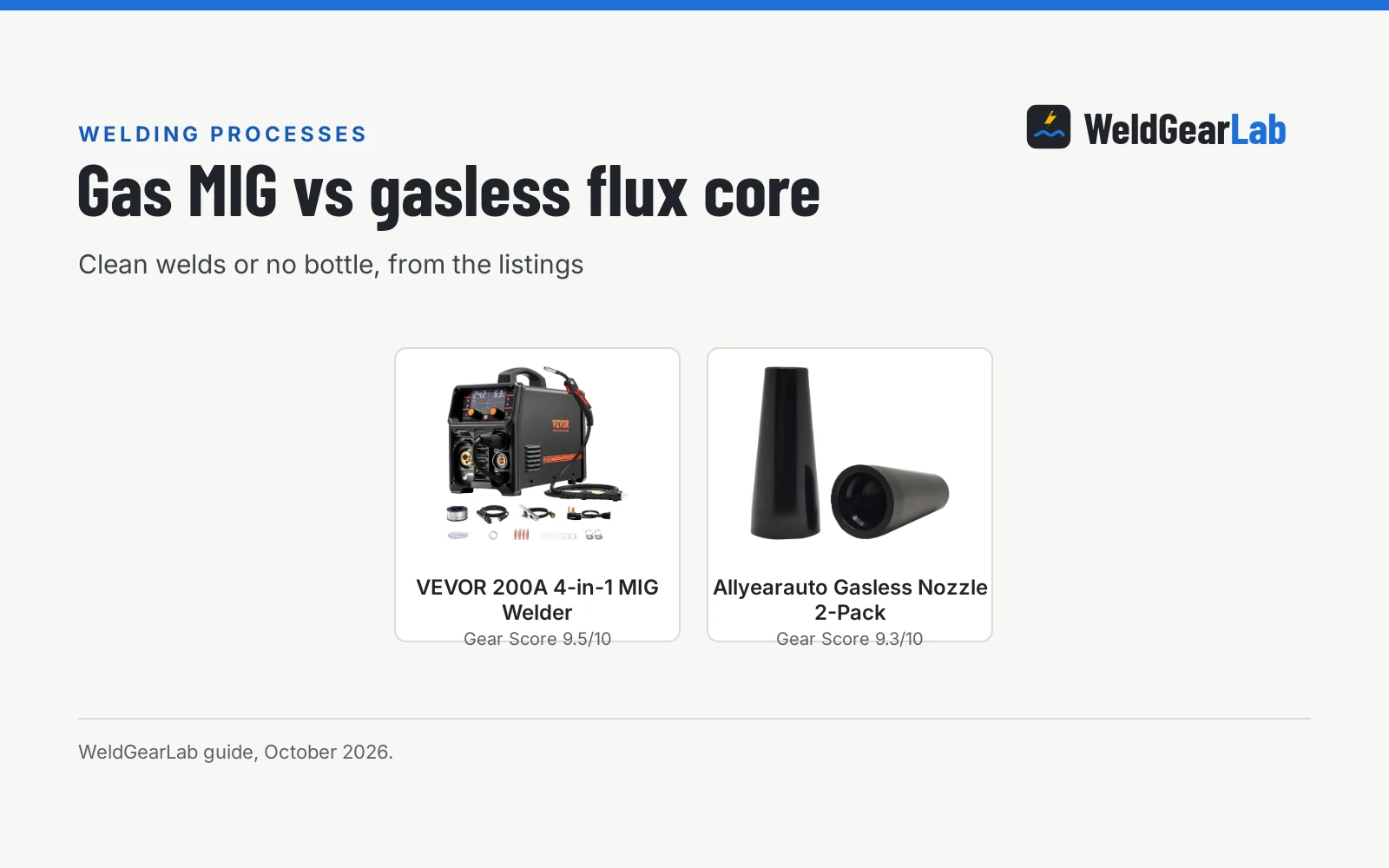
Yes, many wire feed machines include internal rectifiers and gas valves supporting both processes. You can run self-shielded flux wire when repairing gates and farm equipment outdoors, then switch to solid wire, connect a shielding gas bottle, and swap polarity leads for clean indoor projects. A dual-mode machine gives beginners room to expand without purchasing a separate welder.
If you are shopping for a workshop machine, our best welder for beginners guide reviews starter machines with intuitive wire drive controls. Also review our guides on can you MIG weld without gas and how to choose a MIG welder, or browse the full welders hub.
Safety precautions. Self-shielded wire generates dense smoke and mineral fumes. Weld in open air or under exhaust ventilation, keeping your face clear of the plume. Wear leather gloves, protective sleeves, and safety glasses under your helmet when chipping slag.
FAQ for welders
Can a beginner learn gasless MIG welding at home?
Yes. Gasless wire welding requires only the machine, flux wire, hand tools, and proper safety gear. Without gas bottles or regulators to configure, setup is straightforward for home garage projects.
What polarity does gasless MIG welding require?
Most self-shielded flux wire runs on direct current electrode negative, known as straight polarity. The torch connects to the negative terminal and the work clamp connects to the positive terminal. Always check the diagram inside your wire drive door.
Why does gasless flux core welding produce spatter?
Flux core boiling inside the arc generates shielding vapor, which produces more spatter droplets than solid wire in gas. You can reduce spatter by maintaining recommended stickout and matching wire feed speed to voltage.
Should you push or pull when gasless MIG welding?
Always drag the gun when welding with flux-cored wire. Dragging keeps the arc on the leading edge of the puddle and floats molten slag backward. Pushing flux wire traps slag pockets directly inside the bead.
Can you weld aluminum with gasless MIG?
No. Self-shielded flux wire is formulated for carbon steel and cannot weld aluminum. Welding aluminum requires solid aluminum wire, pure argon shielding gas, and a spool gun.
Related: how to choose a MIG welder, best flux core welder, best welder for beginners, and the MIG welders hub. Also see our guides on what polarity for flux core welding, push vs pull MIG welding, and the main welders hub.