Is Gasless MIG Welding Strong? Joint Strength and Limits
Gasless flux core MIG welding strength depends on proper polarity, voltage, wire rating and clean penetration, within the thickness limits the machine listings state.


On this page
Top picks at a glance
As an Amazon Associate I earn from qualifying purchases.
- 1
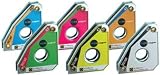 Strong Hand Welding MagnetView on Amazon
- 2
 ESTWING Welding Hammer + Strong Hand Welding Pliers BundleView on Amazon
When you need to repair a cracked farm gate, fix an equipment bracket, or build a heavy steel shop cart, you need to know if flux-cored wire will hold under real stress. So, is gasless mig welding strong? It can be strong enough for shop and farm work on mild steel when fusion, heat input, polarity and joint fit-up are right. The listings state machine thickness limits, not a tensile figure, so this guide quotes no tensile rating. Weld strength does not come from a shielding gas bottle. It comes from clean fusion, proper heat input, correct polarity, and sound joint fit-up. Gasless wire carries its own fluxing agents and deoxidizers inside the core, generating a protective vapor and slag layer that seals molten steel from air contamination even in breezy outdoor conditions where shielding gas blows away.
Other welders and gear to compare
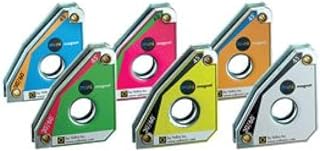 Strong Hand Welding MagnetCheck price on Amazon
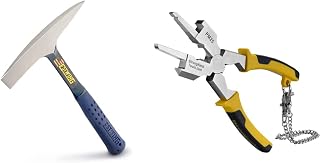 ESTWING Welding Hammer + Strong Hand Welding Pliers BundleCheck price on Amazon
This guide links to our product roundups, where WeldGearLab gets a commission on purchases made through links on this page, and your price stays the same. Read our affiliate disclosure.
Is gasless mig welding strong?
The short answer is that it can be: gasless flux-cored arc welding can produce sound joints for shop and farm use when executed with proper technique. Self-shielded flux-cored wire consists of a hollow steel sheath filled with fluxing agents, deoxidizers, and arc stabilizers. As current passes through the wire, the core vaporizes in the arc, forming a protective gas envelope around the molten puddle while depositing a solid slag blanket across the surface. This dual shielding action protects cooling steel from atmospheric oxygen and nitrogen, preventing internal porosity and brittle joints. When deposited on clean steel with matched settings, the weld metal can form a sound joint within the machine’s stated thickness limits. The listings state no tensile figure, so this guide quotes none.
Side by side
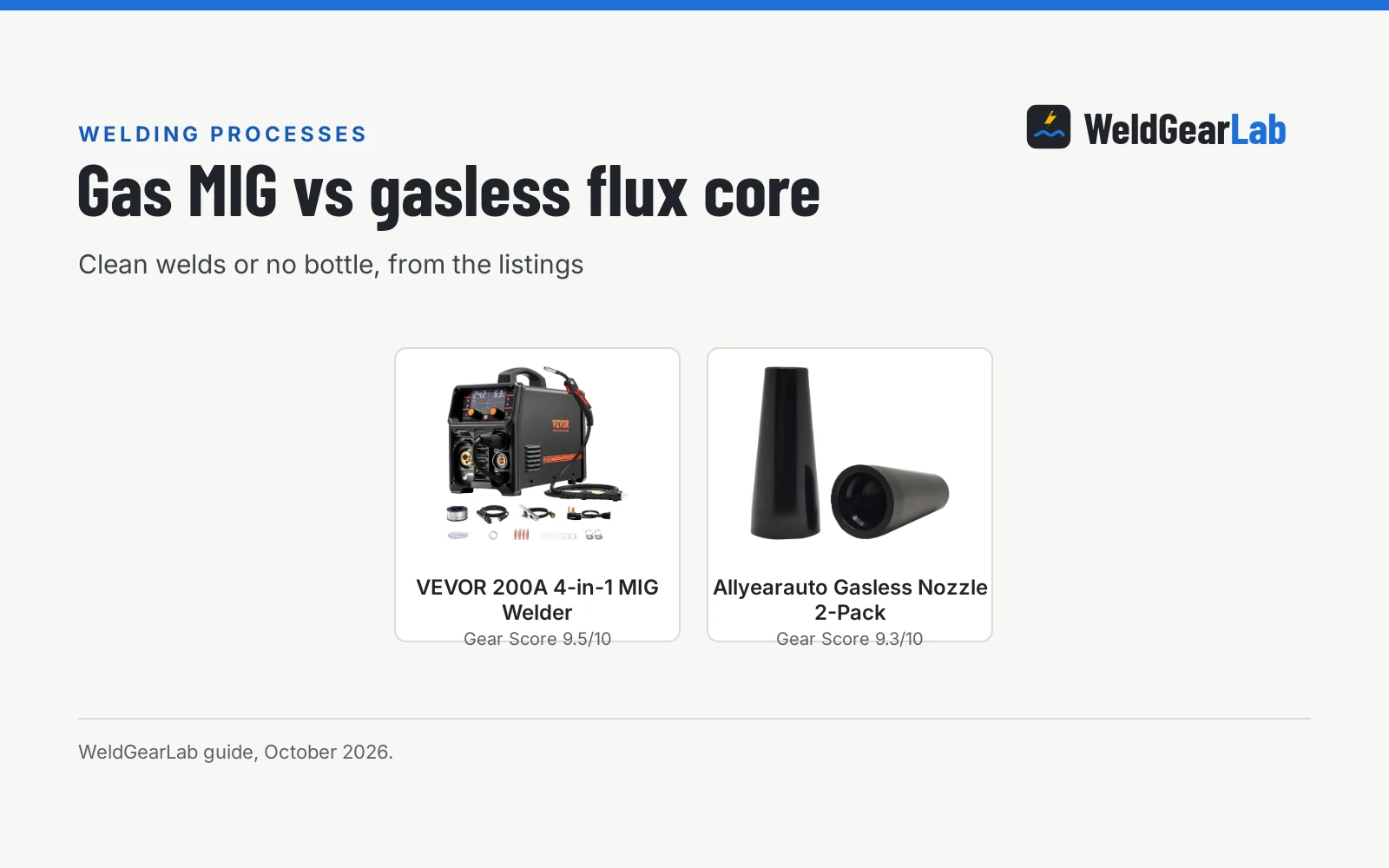
| Factor | Gasless MIG (flux core) | Gas-shielded MIG (solid wire) | Strength effect |
|---|---|---|---|
| Tensile and joint strength | Depends on fusion, polarity and wire rating; no tensile figure stated | Depends on shielding and fusion; no tensile figure stated | Sound fusion matters more than gas type |
| Penetration profile | Penetration varies with wire, settings and joint prep | Bead profile varies with settings | Root fusion depends on settings and thickness limits |
| Wind and outdoor performance | Maintains full shield in wind without porosity | Air currents blow shielding gas away causing porosity | Gasless avoids porosity flaws outdoors |
| Dirty or rusty steel tolerance | Flux scavengers handle mild rust and scale | Requires clean bare steel to prevent weak joints | Deoxidizers protect joint integrity |
| Standard operating polarity | DCEN (straight polarity) | DCEP (reverse polarity) | Wrong polarity severely weakens joint |
| Slag and bead appearance | Protective slag layer requires chipping | Clean weld pool with no slag layer | Trapped slag creates weak shear planes |
| Thin sheet metal risk | Higher risk of burn-through | Easier heat control on thin panels | Overheating can blow through thin roots |
| Aluminum capability | Not supported | Supported with spool gun and pure argon | Flux core cannot join aluminum alloys |
Polarity and drive roll selection are critical when switching processes; always verify the polarity printed on your wire spool and in the machine manual. Self-shielded flux core requires knurled drive rolls and straight polarity, while solid wire runs smooth rolls and reverse polarity.
Why penetration depends on wire and settings
Penetration matters because a weld that does not fuse at the root will not hold, whatever wire it uses. Because flux-cored wire is hollow, electrical current travels entirely through the outer steel sheath rather than across a solid wire cross-section. This concentrates current density into a narrower conductive ring, creating a stiff, forceful arc that digs heat deep into the root of the joint. The resulting bead fuses deeply into the base metal rather than crowning on the surface as cold lap.
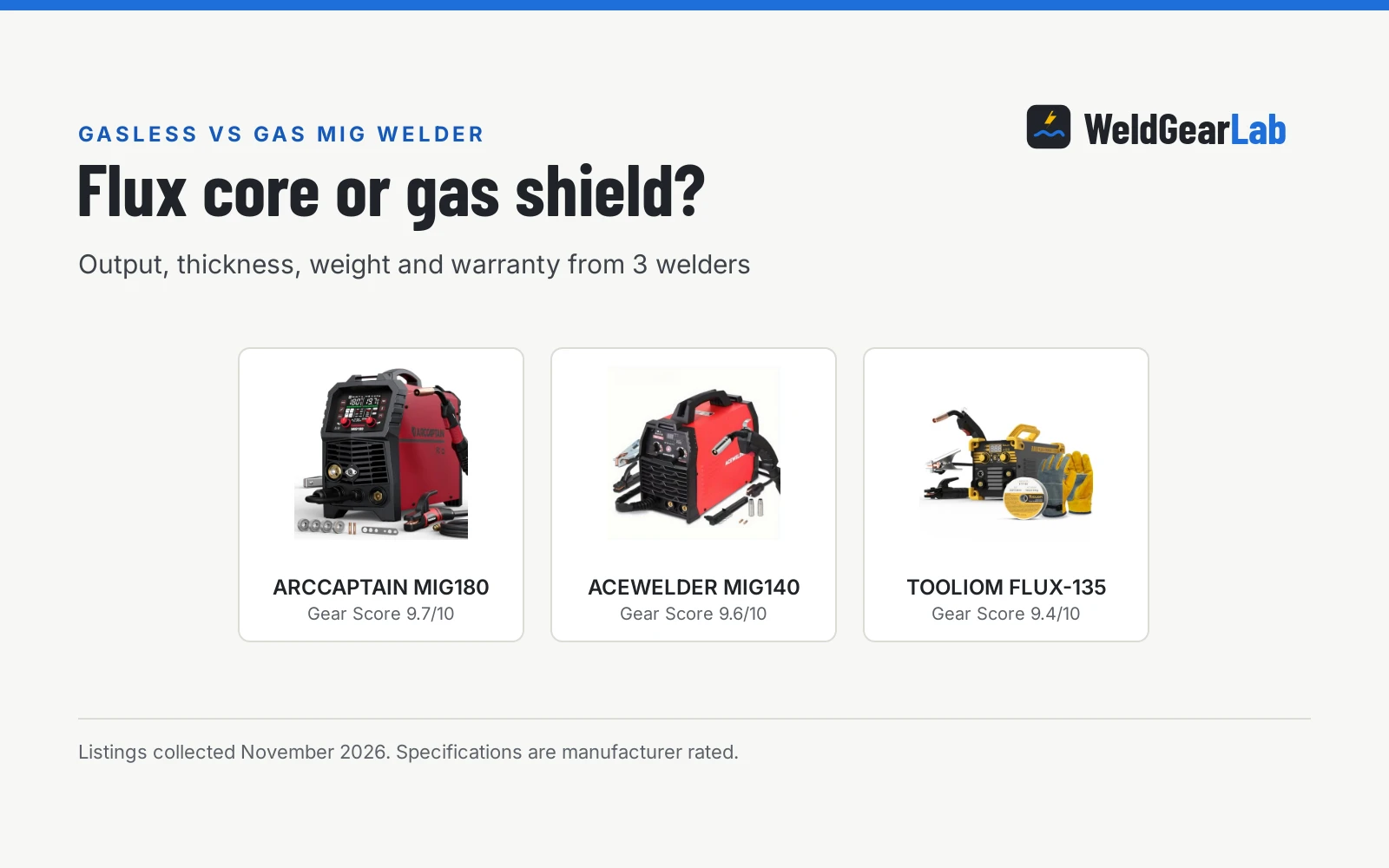
Makers calibrate their machines around this penetrating arc. DURATECH rates its 125A machine to weld mild steel up to a 3/16 inch plate on 120V household power. AWT lists its 140A unit for welding up to 5/32 inch (4.0mm) mild steel on 110V. On compact handheld equipment, HIZONE rates its 100A output for up to 1/8 inch (3.2mm) mild steel on 110V. For heavier shop projects, VEVOR states that its 130A flux core machine handles welding thicknesses up to 8mm on 110V.
Common mistakes that create weak gasless welds
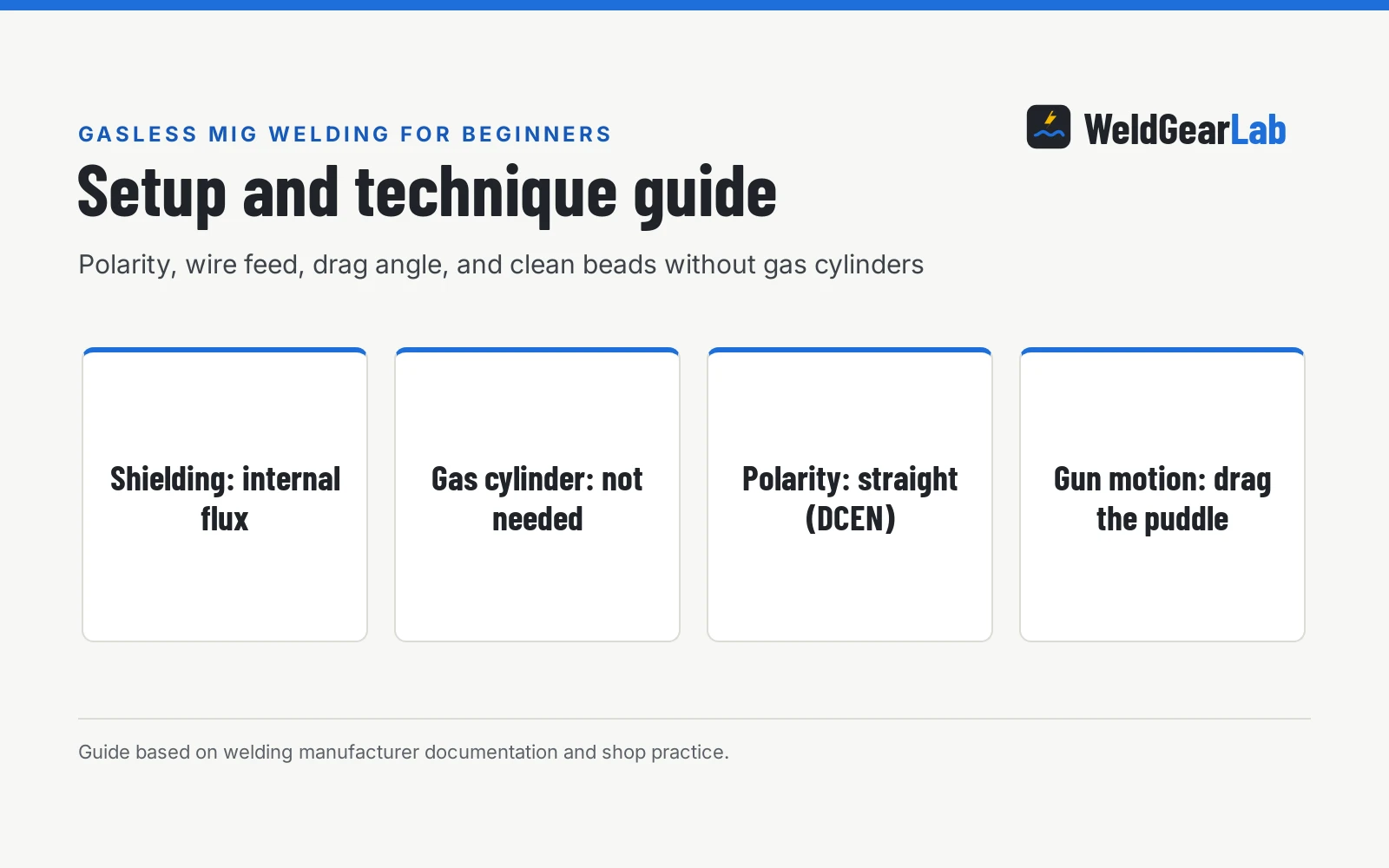
A gasless weld rarely fails from wire chemistry; it fails from avoidable operator error. The primary cause of weak joints is running the wrong electrical polarity. Gasless flux core wire requires direct current electrode negative (DCEN), or straight polarity, where the gun connects to the negative terminal and the ground clamp connects to positive. Running flux core on reverse polarity (DCEP), the standard setup for gas MIG, overheats the wire stickout, producing heavy spatter, poor arc stability, and shallow surface fusion.
Another common mistake is pushing the gun instead of dragging. With gas MIG, pushing directs shielding gas over the molten puddle. With flux-cored wire, pushing directs arc force into the liquid slag, pushing slag ahead of the arc where the puddle rolls over it. Trapping slag inside the weld creates voids and brittle inclusions that pull apart under stress. Maintain a slight drag angle so the arc force keeps molten slag trailing behind the puddle. Finally, traveling too fast leaves an undersized bead with poor edge tie-in, while traveling too slow piles molten filler metal on cold steel without achieving root fusion.
Wire selection and spool sizing for strong joints
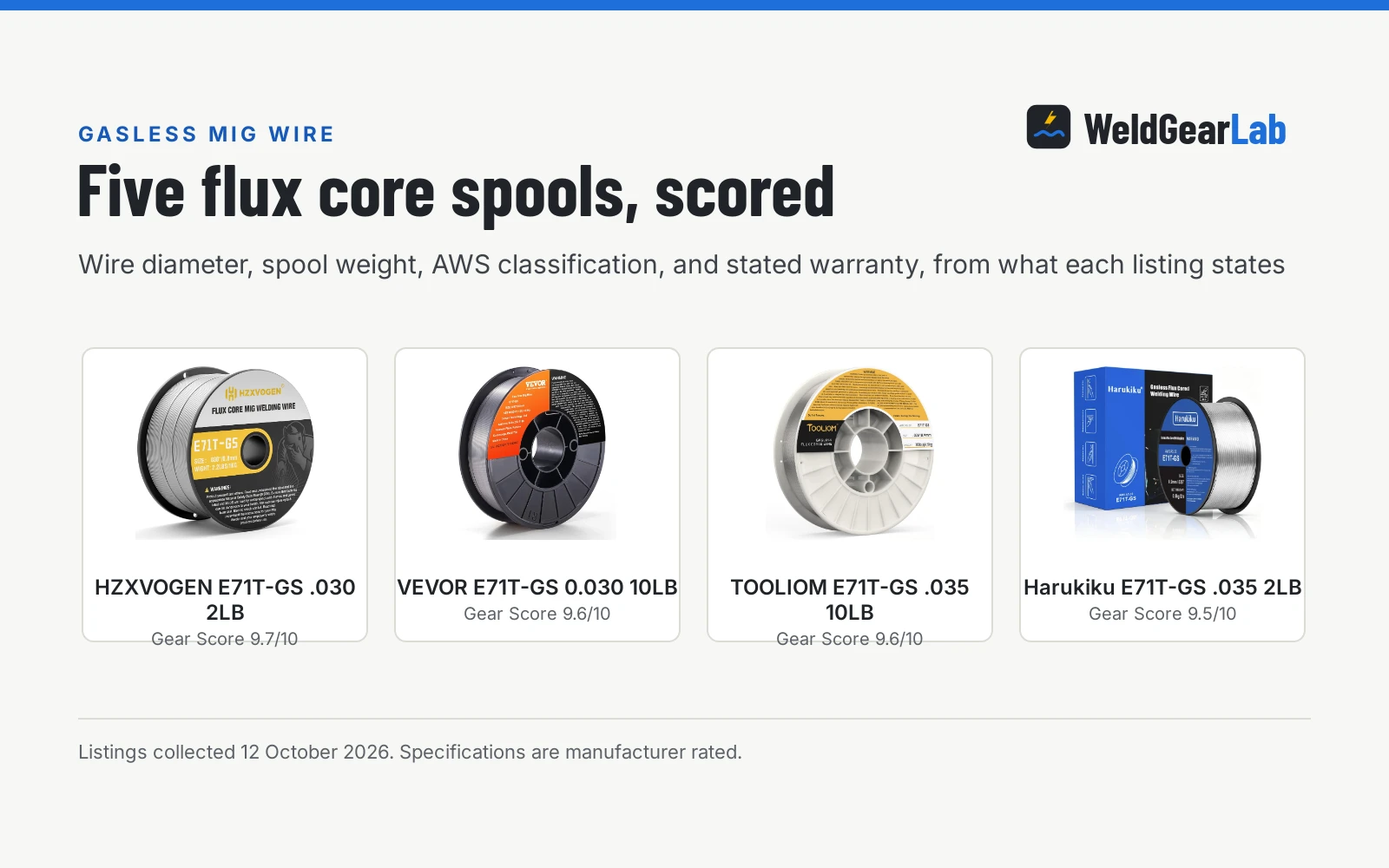
Selecting the right wire diameter directly affects penetration, deposition, and joint strength. Common general-purpose spools like E71T-GS contain deoxidizers formulated strictly for single-pass welds on carbon steel. Using single-pass wire for multiple stacked passes causes alloy elements to accumulate, creating a brittle joint prone to cracking. For thicker joints requiring multiple passes, welders must select wire rated for multi-pass fabrication. TASKZOOM supplies .030 inch E71T-GS wire with its 135A machine and supports both .030 inch and 0.035 inch spools. For light tubing, brackets, and thinner sheet, .030 inch wire offers smoother arc control and less risk of burn-through. When welding thicker plate, .035 inch wire carries higher current and fills joint grooves faster.
Spool capacity also varies by machine design. Sefaspe supports .030 inch, .035 inch, and .040 inch wire diameters on its 135A unit and accommodates spools up to 10lb, reducing changeovers during extended shop work. Compact units like the TASKZOOM 135A machine (on Amazon) and AWT 140A model hold 1lb or 2lb spools that keep the machine portable for field repairs. Always pair flux core wire with knurled drive rolls, which grip the soft outer sheath without crushing the hollow core.
Machine power and metal thickness limits
Joint strength ultimately depends on delivering sufficient amperage for the metal thickness on your bench. Stated thickness limits vary across individual machines rather than representing a universal standard. For instance, DURATECH rates its 125A machine for up to a 3/16 inch plate on 120V, whereas AWT specifies a 5/32 inch maximum at 140A, and HIZONE lists a 1/8 inch limit for its 100A model on 110V. When work involves thicker metal or demanding projects, dual-voltage power supplies provide the necessary amperage headroom.
Futelo equips its 160A machine for dual voltage operation across 110V and 220V power sources, providing extra output for thicker steel fabrication. Similarly, WZWANCHI publishes a 60% duty cycle with output reaching up to 145A on 220V, supporting MIG welding across a 1–5 mm thickness range. When metal thickness exceeds what a single pass can fuse, you must verify that your machine has adequate power and that your wire is approved for multi-pass applications before attempting heavier joints.
Flux core fumes and slag safety. Gasless flux core wire produces heavier smoke and fumes than gas MIG because the flux core vaporizes inside the arc. Always weld with adequate shop ventilation or outdoors with your face positioned clear of the fume plume. Hot slag can pop off the cooling bead without warning; keep your protective safety glasses on beneath your helmet when inspecting beads or chipping slag. Check machine electrical requirements, such as DURATECH providing a 15A to 20A plug adapter for standard circuits, and clear dry debris from your work area.
FAQ for welders
Can gasless flux core welding be used on structural projects?
Gasless flux core can produce structural-quality welds on mild steel, but only when using multi-pass rated wire, correct machine power, and qualified procedures. Common spools like E71T-GS are limited to single-pass applications and should not be used on critical load-bearing joints. For structural frames, trailers, or overhead components, always consult certified welding standards or have a qualified welder inspect the work.
Why does a gasless weld crack or snap?
A gasless weld typically cracks due to lack of fusion, trapped slag inclusions, or incorrect polarity. Running on electrode positive instead of electrode negative creates shallow penetration and brittle deposits. Using single-pass wire on multiple stacked passes or failing to clean slag between passes also introduces internal defects that fail under stress.
Does gasless flux core penetrate better than solid wire MIG?
Penetration depends on wire, settings and joint prep, and the listings state thickness limits per machine rather than a penetration comparison with solid wire. The hollow wire design concentrates current through the outer steel sheath, increasing current density and arc force into the base plate. Within those stated limits, the listed machines are rated for the thicknesses cited above.
Which polarity produces the strongest flux core weld?
Direct current electrode negative, or DCEN, produces the strongest weld with self-shielded flux-cored wire. Connecting the torch to negative and the ground clamp to positive establishes the proper electrical circuit for flux-cored wire chemistry. Running on straight polarity stabilizes the arc, controls melt-off rate, and ensures proper fusion, whereas reverse polarity produces erratic arc action, heavy spatter, and weak joints.
Which wire size makes a stronger joint, .030 or .035?
Both wire sizes produce equivalent joint strength per square inch when properly fused into the base metal. A .030 inch wire operates smoothly at lower amperages, making it preferable for thinner stock where burn-through is a risk. An .035 inch wire carries higher current and deposits more filler metal per pass, making it the better choice for heavier steel plate.
Related: our guide to best flux core welder, gasless MIG welding for beginners, what polarity for flux core welding, can you MIG weld without gas, and the MIG welders hub. Also check our overview of how to choose flux core wire, our roundup of the best welder for beginners, and our main directory of welders.