Best Stick Welder with Hot Start (2026): 5 Inverter Picks Scored
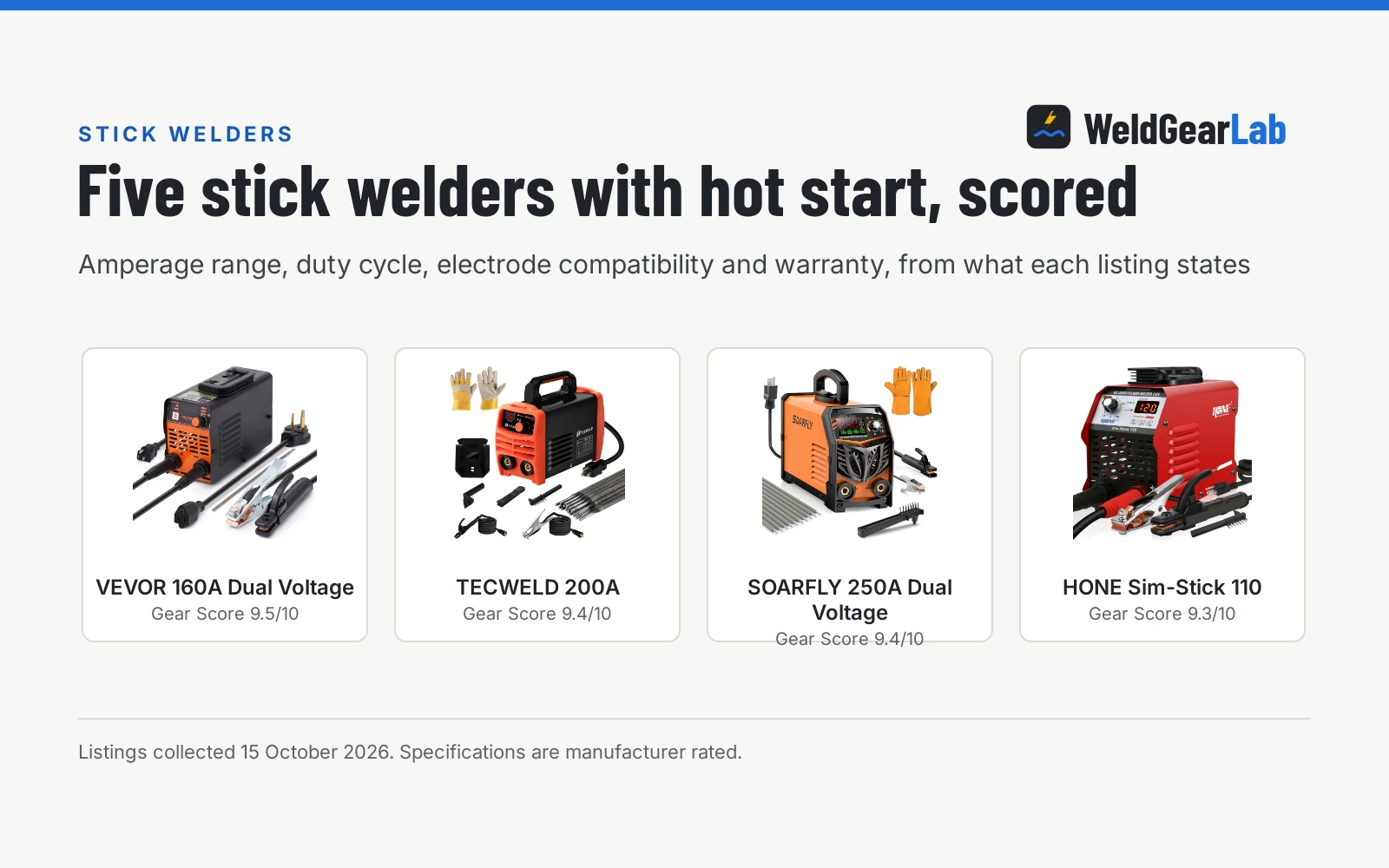
Five portable stick welders with hot start, compared on amperage range, duty cycle, electrode support, weight, and the warranty and safety features each listing states.

On this page
Top picks at a glance
As an Amazon Associate I earn from qualifying purchases.
- 1
 Best OverallVEVOR 160A Dual Voltage9.5/10View on Amazon
- 2
 Best Starter KitTECWELD 200A9.4/10View on Amazon
- 3
 Highest Rated AmperageSOARFLY 250A Dual Voltage9.4/10View on Amazon
- 4
 Most CompactHONE Sim-Stick 1109.3/10View on Amazon
When you have broken tractor brackets, rusted fence pipe, or heavy plate to join on the shop bench, a stick welder with hot start gets the arc burning immediately without freezing the rod to the cold workpiece. Sticky electrode strikes ruin beads and frustrate welders before the puddle even forms. This guide compares five portable stick welders with hot start on what each manufacturer listing states: amperage range, dual-voltage capability, stated duty cycle, electrode support, and build quality.
WeldGearLab gets a commission on purchases made through links on this page, and your price stays the same. Read our affiliate disclosure.
Quick picks
- Best Overall VEVOR 160A Dual Voltage: Dual voltage 110V and 220V power, 180A top output on 220V, Q235 cold-rolled steel casing, VRD electric shock protection, and Lift TIG capability. Check price on Amazon
- Best Starter Kit TECWELD 200A: A stated 60% duty cycle, synergic control, and a full kit with a folding helmet, gloves, brush and 20 welding rods. Check price on Amazon
- Highest Rated Amperage SOARFLY 250A Dual Voltage: A stated 250A output on dual 110V and 220V power, large LED display, and 10 included welding rods. Check price on Amazon
- Most Compact HONE Sim-Stick 110: Weighs 5.8 pounds, measures 6.1 inches long, and runs 1/16 to 1/8 inch rods on 110V power. Check price on Amazon
The machines


VEVOR Stick Welder, 160Amp 2 in 1 ARC/Lift Tig
A dual-voltage 110V and 220V inverter welder in a Q235 steel case, featuring Lift TIG, VRD shock protection, and smart hot start.
Pros
- Runs on both 110V and 220V inputs with automatic conversion
- Built in Q235 cold-rolled steel sheet housing for shop durability
- VRD electric shock protection added for user safety
- Supports E6010, E6011, E6013, E7014 and E7018 electrodes
Cons
- Duty cycle is not stated anywhere in the listing
- Lift TIG torch is not included in the package
- No warranty term is stated in the listing

200A Stick Welder 110V, Mini Portable Inverter
A compact 110V stick welder that states a 60% duty cycle, synergic control, and includes a full starter kit with 20 rods.
Pros
- Only welder here that states a duty cycle, listed at 60%
- Complete kit includes 20 welding rods, folding helmet and gloves
- Synergic control dial and digital display for easier adjustments
- Weighs 4.6 pounds with a compact 8.6 by 4.1 by 5.5 inch footprint
Cons
- Single-voltage 110V input only, with no 220V option
- Listing omits the operating amperage for the stated 60% duty cycle
- No warranty term is stated in the listing

SOARFLY Stick Welder, 110V/220V Dual Voltage
A dual-voltage 110V and 220V stick welder with a large LED screen, stated 250A output, and 10 included welding rods.
Pros
- Dual voltage 110V and 220V operation for shop or field outlets
- Large LED display shows current and welding mode clearly
- Includes 10 welding rods, electrode holder, clamp, gloves and brush
- Hot start, arc force, and anti-stick functions built in
Cons
- 220V use requires an adapter that is not included in the box
- Stated 250A output is limited to 1/8 inch maximum rod diameter
- Weight contradiction between 3.7 kg in bullets and 9.06 pounds in specs
- No warranty term is stated in the listing

HONE Stick Welder 110V, Actual 120Amp Smart Hot
A 5.8-pound 110V mini welder with 120A output, smart hot start, digital display, and support for 1/16 to 1/8 inch rods.
Pros
- Compact 6.1 inch length and 5.8 pound weight for easy carrying
- Runs 1/16 to 1/8 inch rods across E6010, E6011, E6013, and E7018
- LCD display showing output current with smart hot start and arc force
- Includes carry handle and shoulder strap in the package
Cons
- Included components list internal parts rather than welding leads
- Duty cycle is not stated anywhere in the listing
- No warranty term is stated in the listing

Portable Welding Machine 110V Handheld Arc Welder
A lightweight 110V handheld arc welder with a 20-120A range, hot start, and anti-stick for 3/32 to 1/8 inch rods.
Pros
- Lightweight handheld design for quick spot repairs
- Variable 20-120A output dial for thin sheet or heavier joints
- Hot start and anti-stick functions to assist arc striking
- Handles 3/32 inch and 1/8 inch welding electrodes
Cons
- Weight contradicts between 3.8 pounds in bullets and 2.7 pounds in specs
- No warranty term is stated in the listing
Other welders and gear to compare
 165A Stick Welder 110V/220V Portable Arc Welding Machine IGBTCheck price on Amazon
 YESWELDER 205Amp Stick Welder Digital Inverter IGBT ARCCheck price on Amazon
 Hpoouo 200Amp 20PCS Rods Stick WelderCheck price on Amazon
 ARCCAPTAIN Stick WelderCheck price on Amazon
 HGNVGZ 250A MMA Stick Welder 110VCheck price on Amazon
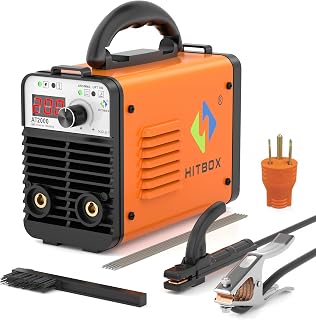 HITBOX 200Amp Stick WelderCheck price on Amazon
Spec sheet comparison
| Model | Gear Score | Input Voltage | Max Amperage | Duty Cycle | Supported Rods | Weight | Warranty |
|---|---|---|---|---|---|---|---|
| VEVOR 160A Dual Voltage | 9.5/10 | 110V / 220V | 180A (220V) / 110A (120V) | Not stated | E6010, E6011, E6013, E7014, E7018 | 7.58 lb | None stated |
| TECWELD 200A | 9.4/10 | 110V | 200A | 60% | 1/16 to 1/8 in | 4.6 lb | None stated |
| SOARFLY 250A Dual Voltage | 9.4/10 | 110V / 220V | 250A | Not stated | 3/32 to 1/8 in | 9.06 lb | None stated |
| HONE Sim-Stick 110 | 9.3/10 | 110V | 120A | Not stated | 1/16 to 1/8 in | 5.8 lb | None stated |
| Tvgoo HB-1 Handheld | 9.2/10 | 110V | 120A | Not stated | 3/32 to 1/8 in | 2.7 lb | None stated |
Ratings in this table are the makers’ own claims taken from each product page (14 October 2026).
Buying guide: choosing a stick welder with hot start
Hot start and arc ignition
Hot start delivers a momentary surge of current the instant the electrode touches the metal. This brief boost generates enough heat to ignite the arc quickly and prevent the rod from welding itself to the cold workpiece. For welders working with low-hydrogen electrodes like E7018, which tend to stick easily on initial contact, an automatic hot start feature reduces sticking and keeps your bead clean from the strike.
Input voltage: 110V household power versus 220V dual voltage
A machine that runs on 110 volts plugs directly into standard household outlets, making it convenient for quick maintenance and small farm fixes. However, single-voltage 110V units deliver limited penetration on thicker joint fit-ups. Dual-voltage machines that support both 110V and 220V provide higher maximum amperage on 220V power for heavier metal, while retaining the flexibility to run on 110V when away from dedicated shop receptacles.
Duty cycle and thermal protection
Duty cycle defines how long a machine can run within a given operating window before internal components overheat. Only one listing in this group states a duty cycle rating, listed at 60%, though it omits the operating amperage for that rating. The other listings omit duty cycle figures entirely. All five machines state internal thermal overload and overcurrent protections, but working within short bursts prevents unexpected thermal shutdowns on heavier beads.
Electrode compatibility
Stick welders in this group list support for standard flux-coated electrodes including E6010, E6011, E6013, and E7018, with supported diameters ranging from 1/16 inch up to 1/8 inch. While rutile rods like E6013 strike easily, cellulosic rods like E6010 require aggressive arc voltage to stay lit. Verify that your machine explicitly lists support for the electrode classification and diameter you plan to run.
Listing accuracy and component details
Compact inverter welders frequently show conflicting details across their Amazon listings. Across the five machines reviewed, listings show conflicting weights, contradictory amperage ratings between titles and bullet points, and even clerical errors listing ceramic heating elements or microscopic wattages. When comparing compact machines, look for stated chassis materials like cold-rolled sheet steel and verify whether essential accessories like ground clamps and electrode holders are included.
Use as directed. Arc welding produces intense ultraviolet radiation, toxic fumes, and flying spatter. Always wear a shade-appropriate welding helmet, leather gloves, and flame-resistant clothing. Ensure adequate ventilation when running flux-coated electrodes, keep a fire extinguisher near your bench, and never weld near flammable materials. See the OSHA welding overview and our Safety Disclaimer.
Before You Strike an Arc
Before clamping your ground and burning your first rod on a new inverter welder, complete these basic shop checks:
- Check your electrical supply and adapter: Confirm whether your machine runs strictly on 110V or dual 110V/220V power. If running dual voltage on 220V, verify whether an adapter cord is included in the box or must be sourced separately.
- Inspect lead connections and clamps: Ensure the DINSE-style twist connectors for your electrode holder and earth clamp seat fully into the front panel lugs, and clamp your ground to clean, unpainted bare metal.
- Verify electrode type and size: Check that your rods match the machine’s supported electrode list, such as E6011, E6013, or E7018, and stay within the stated diameter limits between 1/16 inch and 1/8 inch.
- Clear your work area: Hot spatter and falling slag easily ignite sawdust, cardboard, and rags. Clear all flammable items from around your bench and position a fire extinguisher within arm’s reach before starting your arc.
FAQ for welders
Why does my stick welder keep sticking?
A stick electrode sticks when there is insufficient heat at the moment of contact, causing the rod tip to fuse to the cold workpiece instead of forming an arc. Poor ground contact, rust on the joint, or setting the current too low will make sticking worse. Machines with automatic hot start provide an initial surge of current to establish the arc immediately, while anti-stick technology cuts the power so you can detach the rod without overheating the core wire.
What is a stick welder with hot start?
A stick welder with hot start includes an automated circuit that temporarily spikes the welding current above your dial setting for a fraction of a second when the rod touches the work. This extra burst of energy helps ignite difficult electrodes smoothly without requiring repeated scratching. Once the arc stabilizes, the machine drops back to your selected operating amperage for normal puddle control.
What size stick welder do I need?
For light garage maintenance, farm gate repairs, and hobby metal fabrication, a compact 110V machine delivering up to 120A handles common joints on steel up to 1/4 inch thick. If you plan to burn larger 1/8 inch rods continuously or work on structural steel, choosing a dual-voltage unit running on 220V provides greater penetration and more stable arc performance.
How to set a stick welder for clean beads?
Set your amperage based on the specific electrode classification and diameter you are running, adjusting the dial until the arc produces a crisp, steady frying sound. Too little current leads to a sluggish puddle and frequent rod sticking, while excessive amperage causes spatter, undercut, and burn-through. Maintain a tight arc length roughly equal to the core wire diameter and drag the rod at a steady travel speed.
How to fix a stick welder that will not strike?
First verify that your earth clamp is attached to clean, bare metal free of heavy mill scale, paint, or grease. Next, check that your power switch is on, the cooling fan is spinning, and no thermal overload or warning lights are illuminated on the digital display. If the machine still will not strike, scrape the glass-like slag off the end of your electrode tip to expose fresh core wire before attempting another strike.
Related: welders hub, stick welders, best portable stick welder, best stick welder for farm use, and the best small inverter stick welders. Also see our guide on how to use stick welder. Also see our guide on how to strike an arc with a stick welder. Also see our troubleshooting guide on why does my welding rod keep sticking. Also see our comparison of stick welder vs MIG welder for farm repairs. Also see our guide on stick welder AC vs DC. Also see our guide on inverter welder vs transformer welder. Also see our guide on welding duty cycle explained. Also see our guide to the best welder for beginners. Also see our guide on welding equipment for beginners. Also see our guide to the best stick welding helmet. Also see our guide to the best stick welding gloves. Also see our guide on can you stick weld thin metal. Also see our guide on how to weld cast iron with a stick welder. Also see our guide on how to stick weld rusty metal. Also see our comparison of stick vs MIG welder. Also see our comparison of stick vs TIG welder. Also see our comparison of stick welder vs wire welder. Also see our welding safety gear checklist for beginners.
Scoring, line by line
Each stick welder is scored out of 10 on performance, build, value, safety listing and warranty, following the criteria on our How We Pick page. None of the five listings publishes a recognized electrical safety certification standard such as UL, CSA, or ETL, and none provides a concrete warranty term in days, months, or years. Consequently, all five machines score zero for safety listing and warranty; the ranking is determined by performance, build, and value.
| Product | Gear Score | Perf. /35 | Build /25 | Value /25 | Safety /10 | Warranty /5 |
|---|---|---|---|---|---|---|
| VEVOR 160A Dual Voltage | 9.5 | 29 | 21 | 20 | 0 | 0 |
| TECWELD 200A | 9.4 | 28 | 19 | 21 | 0 | 0 |
| SOARFLY 250A Dual Voltage | 9.4 | 27 | 19 | 20 | 0 | 0 |
| HONE Sim-Stick 110 | 9.3 | 26 | 18 | 19 | 0 | 0 |
| Tvgoo HB-1 Handheld | 9.2 | 23 | 16 | 18 | 0 | 0 |
The lowest score we show is 9.2 and the highest is 9.8; every point total is spread proportionally across that span, so extra points mean a higher figure.