Stick vs Tig Welder: Which One Should You Buy?
Stick and TIG welding use electric arcs to fuse metal but fit completely different shop jobs, metal thicknesses, skill levels and equipment setups.

On this page
Top picks at a glance
As an Amazon Associate I earn from qualifying purchases.
- 1
 HGNVGZ 110V 250A Stick Welder9.7/10View on Amazon
- 2
 ARCCAPTAIN DC 5 In 1 TIG Welder With Pulse9.6/10View on Amazon
- 3
 ARCCAPTAIN TIG Welding Gun9.5/10View on Amazon
- 4
 HONE Stick Welder 110VView on Amazon
- 5
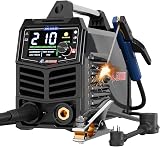 GZ GUOZHI Aluminum Stick Welder 210Amp Large LED DisplayView on Amazon
- 6
 ESAB® HandyArc 1/8" Stick WelderView on Amazon
- 7
 Stick WelderView on Amazon
- 8
 Arc Stick Welder 165AView on Amazon
- 9
 250Amp Stick Welder 110V IGBT Portable Arc Welding MachineView on Amazon
If you are staring at broken equipment brackets, dirty farm gates or structural steel on the fab bench, choosing between a stick vs tig welder comes down to metal thickness, fit-up cleanliness and operating conditions. Buy a stick welder if you need a durable, portable setup for thick steel, farm repairs, rusty metal and breezy outdoor conditions. Buy a TIG welder if your priority is clean, spatter-free joints on thin tubing, sheet metal, stainless steel or aluminum where weld appearance is critical. Both processes use an electric arc to fuse metal, but they handle shielding, puddle control and cleanup in opposite ways. This guide compares them side by side so you can pick the right setup for your shop.
Other welders and gear to compare
 HONE Stick Welder 110VCheck price on Amazon
 GZ GUOZHI Aluminum Stick Welder 210Amp Large LED DisplayCheck price on Amazon
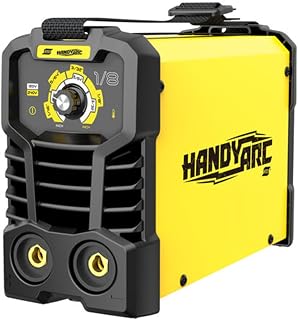 ESAB® HandyArc 1/8" Stick WelderCheck price on Amazon
 Stick WelderCheck price on Amazon
 Arc Stick Welder 165ACheck price on Amazon
 250Amp Stick Welder 110V IGBT Portable Arc Welding MachineCheck price on Amazon
This guide links to our product roundups, where WeldGearLab gets a commission on purchases made through links on this page, and your price stays the same. Read our affiliate disclosure.
The difference in one paragraph
Molten steel reacts quickly with oxygen and nitrogen in surrounding air, causing porosity and cracking in the weld bead. A stick welder uses a consumable metal rod coated in flux; as the rod melts, the flux burns to create a protective gas shield and forms a heavy layer of slag over the cooling puddle. A TIG welder uses a non-consumable tungsten electrode surrounded by a nozzle that floods the puddle with pure shielding gas from a pressurized cylinder. Stick carries its own shielding inside the electrode flux, while TIG relies on an external gas supply and clean base metal.
Side by side
| Stick (SMAW) | DC TIG | AC TIG | |
|---|---|---|---|
| Shielding | Flux coating on electrode | Pure argon cylinder | Pure argon cylinder |
| Electrode | Consumable flux-coated rod | Non-consumable tungsten | Non-consumable tungsten |
| Primary metals | Carbon steel, cast iron, stainless | Mild steel, stainless steel, chrome-moly | Aluminum and magnesium alloys |
| Wind and outdoor work | Tolerates outdoor wind and breezes | Gas blows away, requires sheltered air | Gas blows away, requires sheltered air |
| Dirty or rusty steel | Burns through light rust and mill scale | Requires bare, clean metal | Requires clean metal, deoxidized |
| Thin sheet metal | Difficult on thin sheet, burns through easily | Precise heat control without burn-through | High control on thin sheet and tubing |
| Spatter and cleanup | Heavy spatter and slag crust to chip | No slag and no spatter | No slag and no spatter |
| Equipment needed | Electrode holder, ground clamp, rods | Torch, argon cylinder, regulator, filler | AC/DC machine, torch, argon, filler |
| Learning curve | Moderate arc strike and rod feeding | Steep coordinated torch and filler control | Steep pedal, torch and filler coordination |
Process characteristics reflect typical shop practice. Stick welding operates on either polarity depending on rod type, while steel TIG runs direct current electrode negative for concentrated penetration, and aluminum TIG requires alternating current to scrub off oxide skin.
When stick welding is the better choice
- Breezy and outdoor work. Fence lines, trailers, equipment hitches and gate repairs in open air. A gust of wind blows away shielding gas from a torch, but stick flux burns right at the arc tip without losing protection.
- Dirty, rusty or scaled steel. Stick electrodes burn through mill scale, light surface rust and paint residues that would ruin a gas-shielded weld.
- Thick metal and structural repairs. Burning heavy electrodes provides deep penetration into thick plate, angle iron and agricultural implements.
- Simple setup without gas cylinders. You carry only the power supply, stinger clamp, ground lead and a carton of electrodes, with no gas cylinders or delicate regulators to haul.
For field maintenance and fencing, see our roundup of the best stick welder for farm use, where machines handle dirty steel and heavy joint fit-ups without shielding gas.
When TIG welding is the better choice
- Thin sheet metal and precision tubing. Precise heat regulation keeps thin gauge metal from burning through or warping out of square.
- Cosmetic welds with no spatter. TIG leaves smooth, uniform ripples with no slag coating to chip away and no stray droplets to grind off finished surfaces.
- Exotic alloys and aluminum. TIG handles stainless steel, chrome-moly tubing and aluminum with exceptional puddle clarity and puddle control.
- Sanitary and pressure-tight joints. Ideal for exhaust manifolds, intake piping, fuel tanks and roll cages where joints must be clean and free of slag inclusions.
If you are outfitting a shop bench for clean precision jobs, check our guide to the best entry level TIG welder for machines offering smooth arc starts and stable amperage control.
Stick vs tig welder: how to choose for your shop
Selecting between these machine styles depends on your shop space, project materials and portability needs. When examining machine listings, check stated specifications for rated current, electrode sizes and input voltage:
- Electrode capacity and metal thickness. Individual machine listings publish different thickness and electrode limits. For example, TECWELD lists its inverter for welding metals up to 1/4 inch thick using 1/16 to 1/8 inch electrodes, while the ESAB Rogue ES 180i listing specifies capacity for electrodes up to 5/32 inch at up to 180 amps.
- Input power requirements. Voltage support varies across individual models. The HONE stick welder listing states 110V operation with output up to 120 amps, whereas the GZ GUOZHI ARC-210LED listing specifies dual-voltage conversion between 110V and 220V with output up to 210 amps.
- Operating weight and transport. Machine weights vary across portable inverters. The Siasky listing reports an item weight of 3.3 pounds, while ESAB lists the HandyArc stick welder at 6.3 pounds.
TIG welding demands substantial additional shop equipment beyond the power source itself. You must budget floor space and funds for a high-pressure argon cylinder, a flowmeter regulator, gas hose fittings, tungsten electrodes and filler rod packs.
Shielding gas and consumables setup
Shielding gas is the primary operational divider between these processes. Stick welding requires no cylinder because the flux coating on the electrode burns to generate a protective gas envelope and molten slag blanket directly over the puddle. For steel stick work, popular electrodes include fast-freeze rods like E6010 and E6011 for deep penetration on contaminated joints, smooth-running E6013 for general light repairs and clean beads, and low-hydrogen E7018 for structural strength. Listings like haxiaoer and ZOJAN specifically cite compatibility with E6013 and E7018 electrodes.
TIG welding requires pure argon shielding gas to protect the tungsten electrode and molten pool from atmospheric oxidation. Carbon dioxide mixtures commonly used in MIG welding will rapidly burn up a tungsten electrode. In addition to shielding gas, a TIG setup requires dedicated tungsten electrodes ground to a clean point, collets, collet bodies, gas lenses and bare filler rods matching the parent alloy.
Can one machine do both?
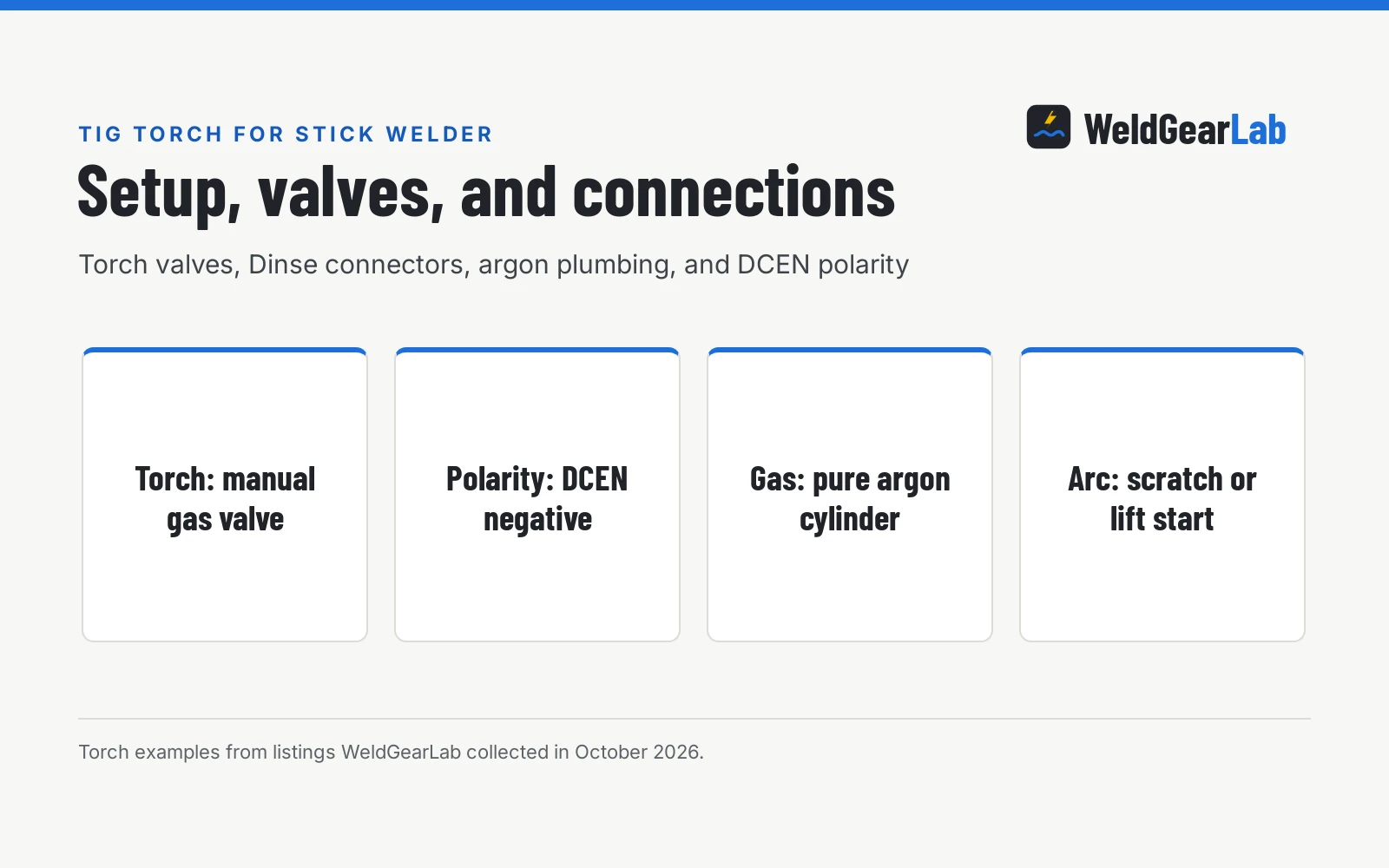
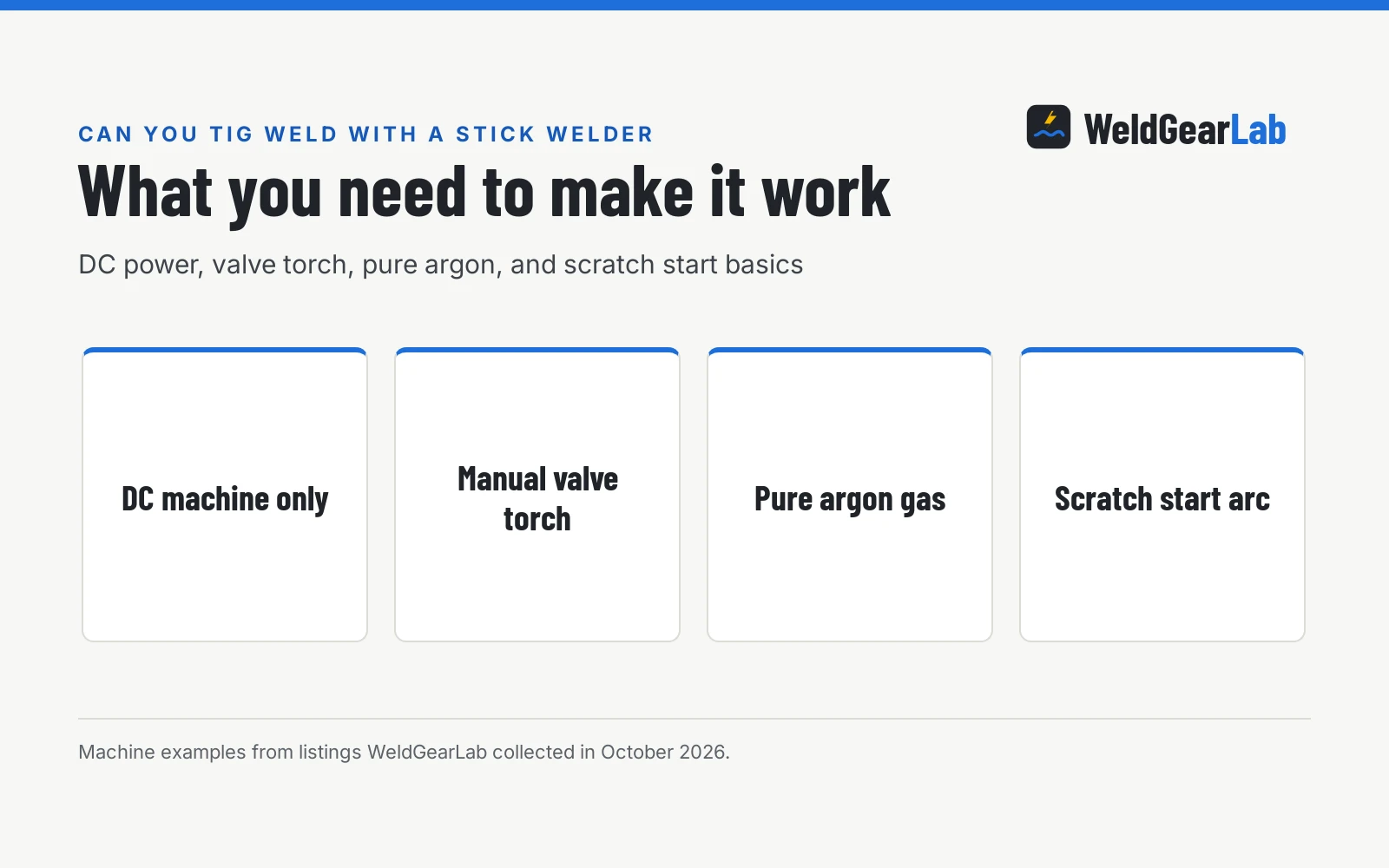
Yes, many modern inverter welders can perform both stick and TIG welding from a single power source. Because both methods rely on constant-current power supplies, a machine designed for stick welding can often run scratch start or lift TIG by connecting a compatible valved TIG torch to the negative terminal (DCEN), the work clamp to positive, and plumbing an external argon cylinder. For example, the TOOLIOM ARC-135 PRO listing specifies 2-in-1 capability supporting both stick and lift TIG on 110V and 220V circuits at up to 135 amps.
However, running TIG on a stick power source usually limits you to lift or scratch starts without a remote foot pedal for variable amperage control, and DC-only machines cannot weld aluminum. If you plan to add TIG capability to your existing stick equipment, read our detailed guide on whether can you TIG weld with a stick welder before purchasing torches and gas hardware.
Safety considerations on the shop floor. Both arc welding methods produce intense ultraviolet radiation and airborne hazards. Stick welding generates substantial smoke and hot slag projectiles that can pop off the bead unexpectedly; wear shade-appropriate eye protection, leather gauntlets and safety glasses under the hood when chipping. TIG welding produces less visible smoke but emits high levels of reflective UV radiation that can cause skin burns quickly. Always ensure adequate shop ventilation, secure compressed gas cylinders upright with safety chains, and inspect lead insulation before striking an arc.
FAQ for welders
Should a beginner start with stick welding or TIG welding?
Stick welding is generally easier for beginners to set up because it requires no gas cylinders, regulators or complex torch assemblies. TIG welding has a steeper learning curve because it requires coordinated hand control, feeding filler rod while controlling arc length and torch angle. Beginners working on structural repairs or farm equipment usually benefit from starting with stick welding.
Can you run TIG on a stick welder?
Many constant-current DC stick welders can run scratch start or lift TIG when paired with a valved TIG torch and an argon gas cylinder. However, basic stick machines lack high-frequency arc starting, gas solenoid valves and remote amperage control. Dedicated AC/DC TIG machines remain superior for precision joint control and aluminum fabrication.
Is stick welding stronger than TIG welding?
Both processes produce high-strength joints that meet structural requirements when executed with proper filler selection and joint preparation. Stick welding provides deep penetration on thick, heavy plate and handles imperfect joint fit-up effectively. TIG produces cleaner welds with fewer slag inclusions, making it the preferred choice for critical sanitary and pressure vessels.
Why can stick weld outdoors when TIG cannot?
Stick welding generates its own protective gas envelope directly at the puddle through the thermal breakdown of the electrode flux coating. This localized shielding withstands outdoor breezes and drafts without dispersing. TIG shielding gas flows from an external nozzle and easily blows away in moving air, resulting in severe weld porosity.
Which process is better for welding aluminum?
TIG welding is far superior for aluminum fabrication when using an AC-capable power source. The alternating current provides essential cleaning action to remove aluminum oxide skin while depositing clean filler. While specialized aluminum stick electrodes exist, they produce heavy spatter, erratic arc starts and corrosive slag residues that are difficult to manage.
Related: best portable stick welder, best TIG welder for aluminum, stick vs MIG welder comparison, the stick welders hub, and the TIG welders hub.