Tig Torch for Stick Welder: Setup and Selection Guide (2026)
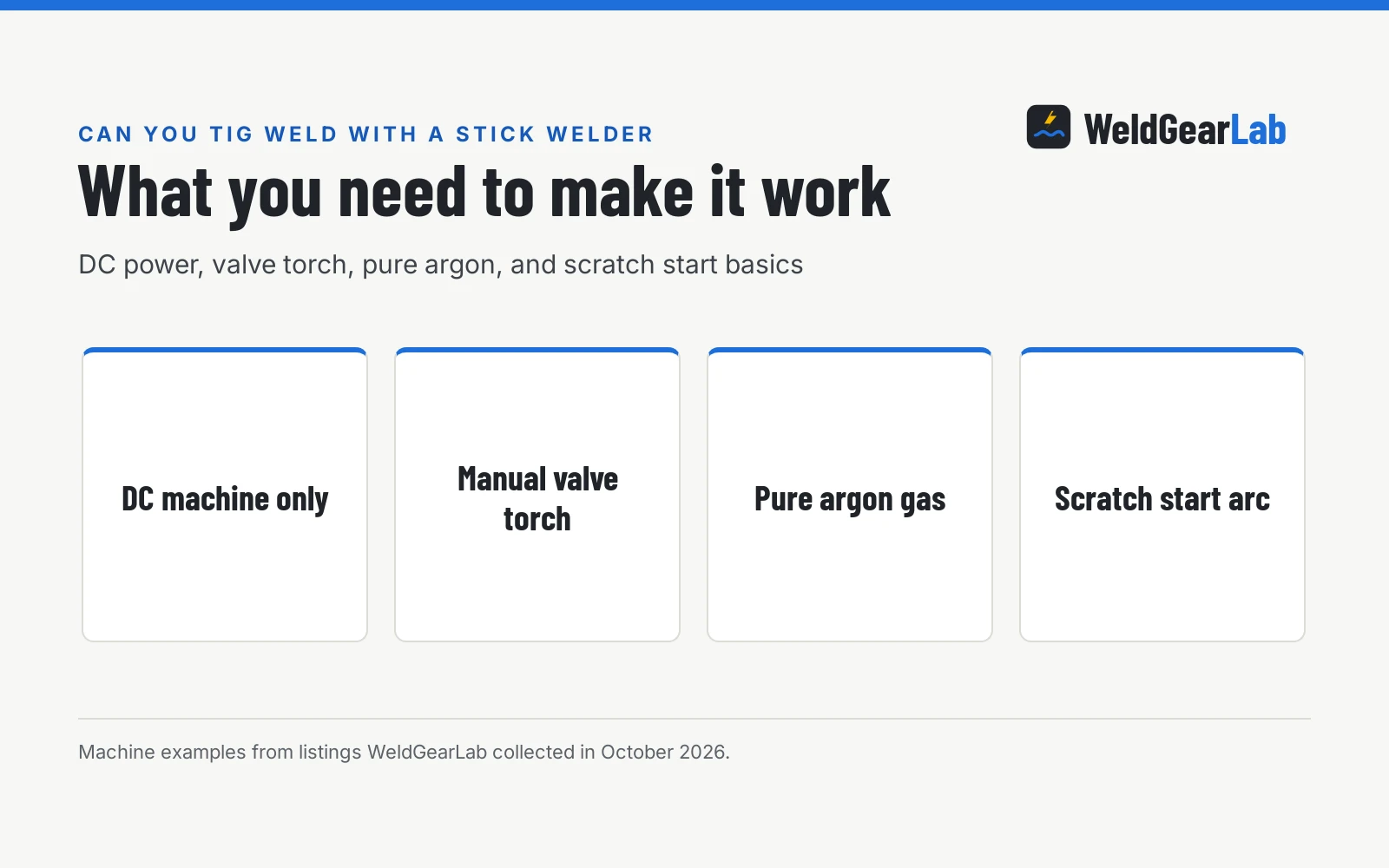
A stick welder can run TIG with an air-cooled manual valve torch, an external argon cylinder, and DCEN polarity to make clean welds without a foot pedal or solenoid.

On this page
Top picks at a glance
As an Amazon Associate I earn from qualifying purchases.
- 1
 YESWELDER TIG Torch9.3/10View on Amazon
- 2
 TOOLIOM 150A Lift TIG Torch Air-Cooled Welding Gun with 4 m9.3/10View on Amazon
- 3
 CK17 Air Cooled TIG Torch Kit9.5/10View on Amazon
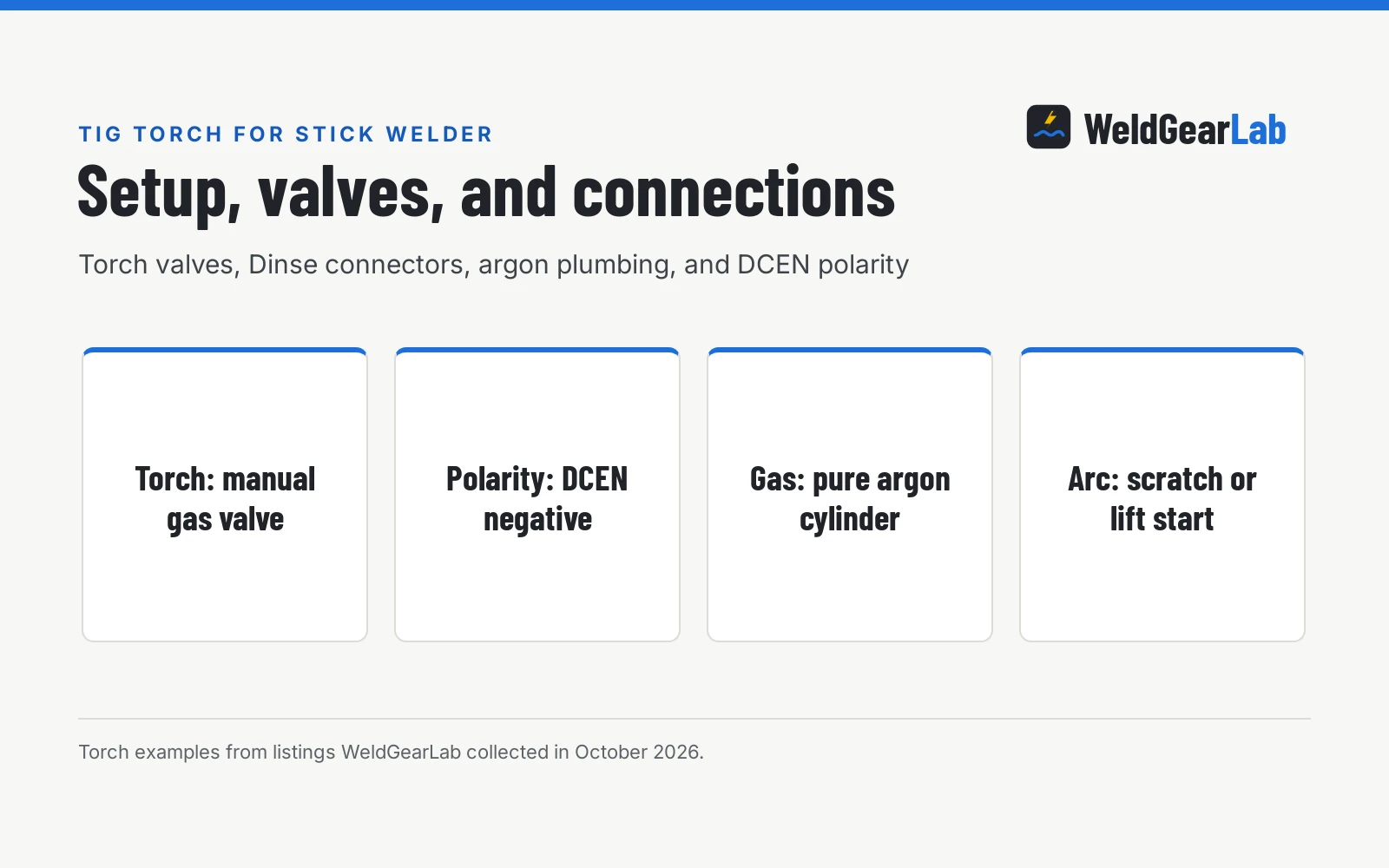
You can run TIG welding from a constant current DC stick machine by adding a tig torch for stick welder setup that controls gas right at the handle. Because a standard stick machine lacks an internal gas solenoid, you need a torch with a manual gas valve, wired DCEN negative and plumbed to an external argon cylinder. This scratch TIG setup welds steel and stainless cleanly without buying a dedicated TIG power source.
This guide links to our product roundups, where WeldGearLab gets a commission on purchases made through links on this page, and your price stays the same. Read our affiliate disclosure.
The difference in one paragraph
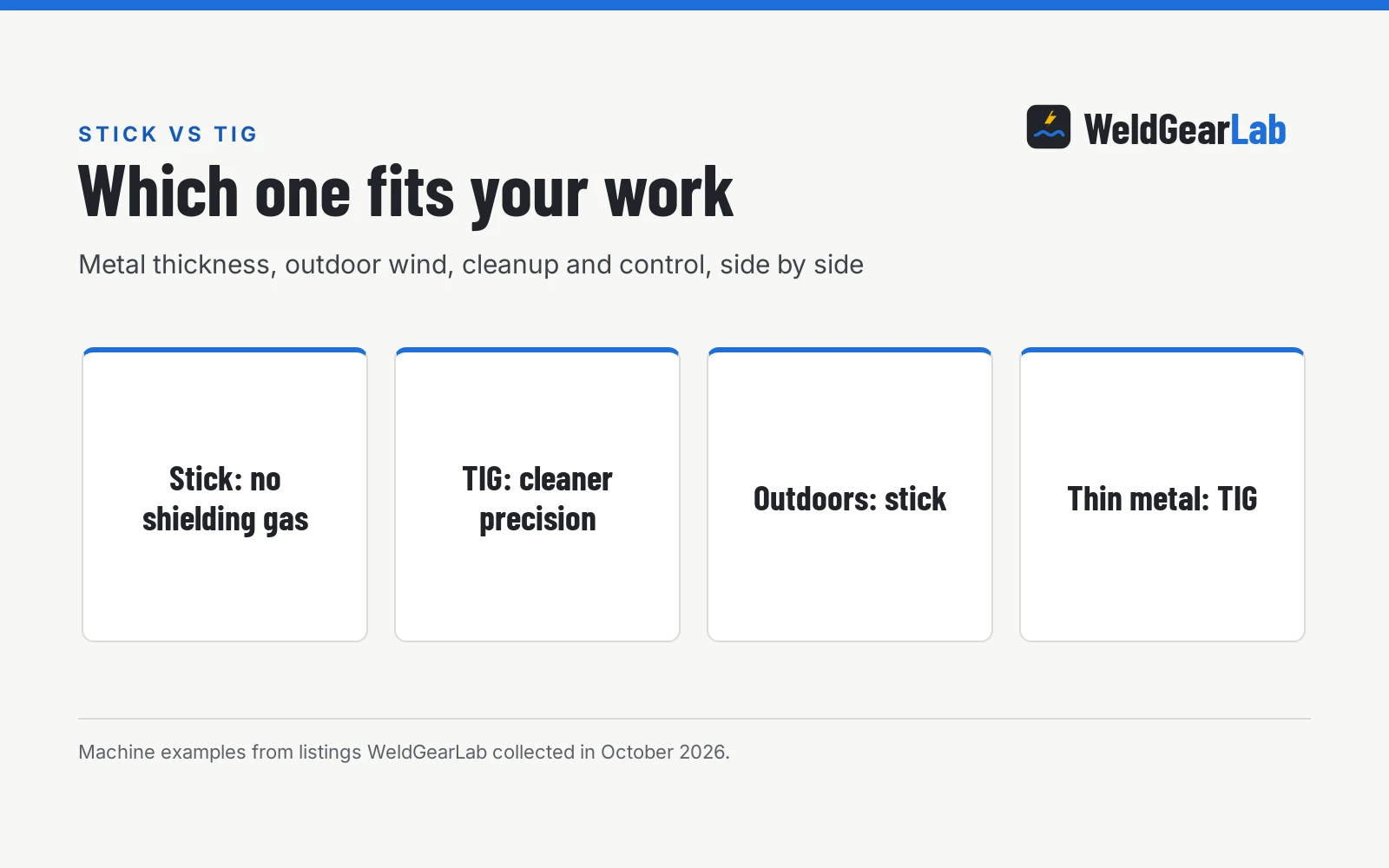
Stick welding uses flux-coated electrodes that create shielding gas and slag as they burn. TIG welding uses a non-consumable tungsten electrode shielded by pure argon to protect the puddle. When adapting a stick machine, the power source provides constant current, but the torch must carry the gas and provide manual valve shutoff because the machine lacks gas automation. You strike the arc by scratching or lifting the tungsten.
Side by side
| 17 Series Valve Torch | 26 Series Valve Torch | 9 Series Machine Torch | |
|---|---|---|---|
| Amperage rating | 150A rating | 200Amp rating | Compact / light duty |
| Cooling method | Air cooled | Air cooled | Air cooled |
| Gas valve configuration | Built-in manual valve (V/FV) | Built-in manual valve (V/FV) | Valveless (needs manual torch valve or external valve) |
| Consumable compatibility | WP-17/18/26 collets and cups | WP-17/18/26 collets and cups | Compact collets and cups |
| Gas fitting on cable | 5/8″-18 RH fitting | 5/8″-18 fitting | Standard inert gas fitting |
| Listing cable lengths | 12.5, 15-ft, or 25 feet | 15-ft power cable | 12.5 FT cable |
| Listing weight examples | 4 to 4.5 pounds package | 5.13 pounds package | 3.77 ounces head to 3 pounds package |
| Suitability for stick welder | General shop fab and tubing | Thicker plate and sustained passes | Thin sheet (only with gas valve added) |
Ratings reflect maker listings. Match your torch amperage capacity and cable length to your work layout and metal thickness.
What you need in a tig torch for stick welder
Converting a stick power source to scratch TIG requires hardware built for manual gas control. A standard machine-controlled torch cannot regulate gas on a stick power supply. Look for these core elements:
- Manual gas valve on the torch neck. Because your stick power source lacks an internal gas solenoid, the torch must feature an integrated manual valve (V or FV series). Opening the knob starts argon flow, and closing it shuts off gas when the puddle solidifies.
- Air-cooled torch body. Air-cooled torches cool themselves through ambient air and argon flow without external coolers. For comparison, CK Worldwide lists an 8 pounds package weight for its 20 series water-cooled torch with a 25′ cable, showing the added bulk of liquid cooling lines.
- Flexible torch neck. FV models bend to clear roll cages, brackets, and tight joints. MOTOKU lists a flexible neck on its WP-17FV head body rated for 150 amp service, and AMERIARC lists a flex neck on its 200Amp WP-26FV torch.
- Separate gas hose lead. A separate gas inlet connects the power block directly to your regulator. FEMEROL lists a separated gas hose and power cable on its WP-17V torch with a 5/8″-18 RH gas connection.
For dedicated machine setups, check our guide to the best TIG torch and see whether can you TIG weld with a stick welder for your work.
Torch sizes and amperage ratings
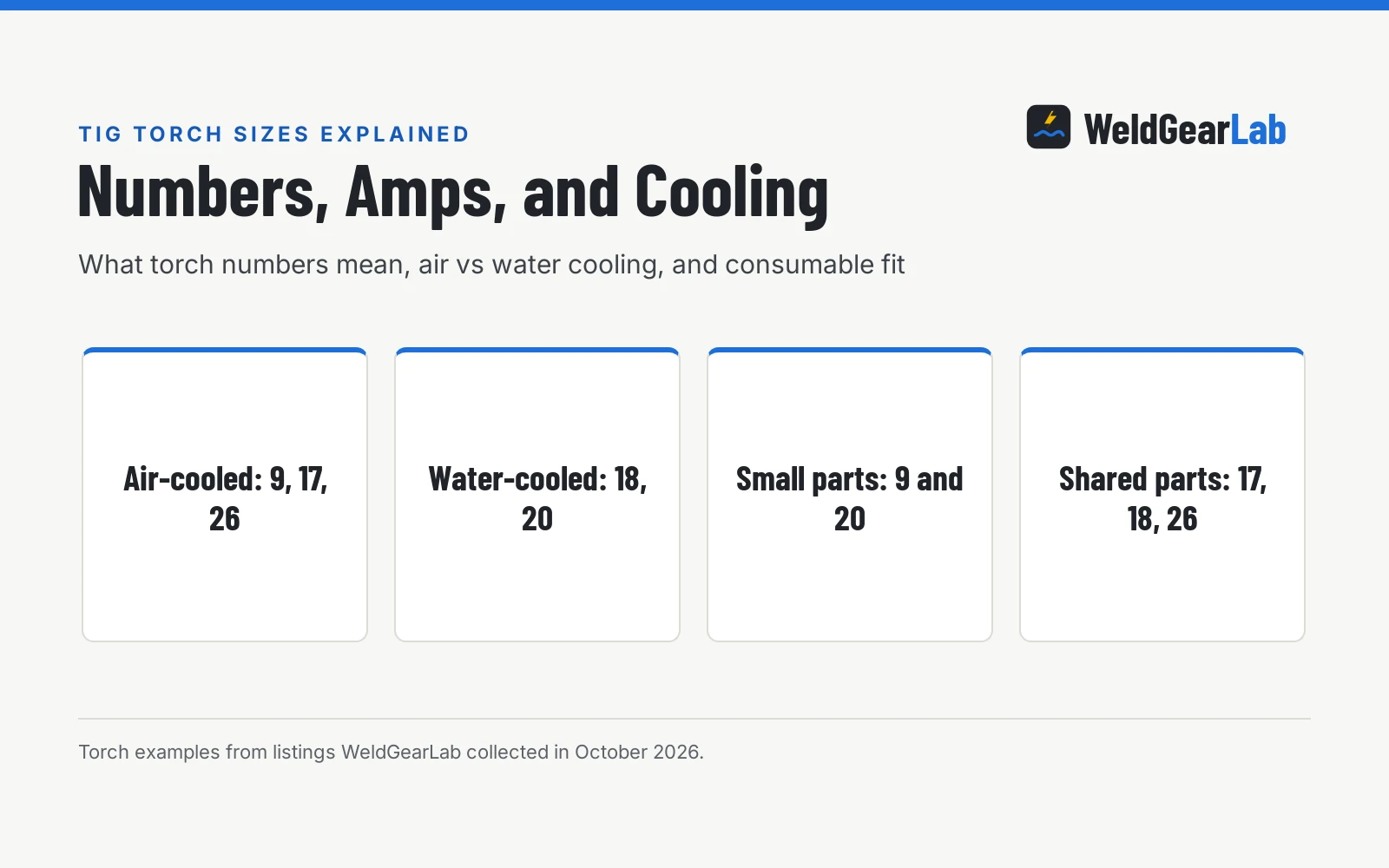
TIG torches use standardized series numbers that define physical size, weight, and thermal handling:
- 17 Series (150A rating). The standard shop choice provides balanced handling without wrist fatigue. SÜA lists a 150 Amp capacity for its 17FV torch; FEMEROL lists a 150A rating for its WP-17V model; and MOTOKU lists a 150 amp capacity for its WP-17FV head. This handles tubing and general fab cleanly.
- 26 Series (200A rating). The larger 26 series handles sustained passes on thicker plate. AMERIARC lists a 200Amp rating on its WP-26FV torch with a 15-ft power cable. The heavier neck prevents overheating during prolonged welds.
- 9 Series (compact rating). For tight spaces, small 9 series torches reduce weight. However, standard listings like the Lincoln Electric PTA-9 rigid head (on Amazon) model at 3 pounds with a 12.5 FT cable or the Cunyuer NR-9 swivel head body (on Amazon) at 3.77 ounces lack gas valves and require internal machine solenoids. On stick welders, choose a torch with an integrated manual valve or an external valve block.
To compare series sizes, see our guide on TIG torch sizes explained.
Connectors, Dinse plugs, and gas fittings
Connecting a torch requires matching the power connector to your machine terminal and plumbing argon to your regulator:
- Dinse 10-25 connectors. Small portable stick machines use compact 10-25 receptacles. FEMEROL lists a 10-25mm² connector plug on its 150A WP-17V torch, and SÜA offers Dinse 10-25 connectors with an 18″ gas hose.
- Dinse 35-70 and 35-50 connectors. Larger stick welders use heavy-duty twist-lock plugs. SÜA lists Dinse 35-70 connectors, while AMERIARC lists a 35-50 plug and an LC-40 terminal connector for its 150Amp WP-17FV torch.
- Stud and lug connectors. Traditional welders use threaded output studs. SÜA lists stud connectors with a 5/8″-18 RH female argon fitting that bolt directly onto output lugs.
- Argon line connections. Regulators use standard inert fittings. SÜA lists a 5/8″-18 RH male fitting on its 18″ gas hose, and FEMEROL lists a 5/8″-18 RH gas connection on its torch line.
To equip your cylinder, see our guide on gas regulator for welder choices.
Polarity, consumables, and torch setup
Correct polarity and assembly ensure clean arc ignition without melting your electrode:
- Connect for DCEN polarity. Plug your TIG torch into the negative (-) terminal and your ground clamp into the positive (+) terminal. TIG requires DCEN so arc heat enters the workpiece rather than melting the tungsten. See our guide on DC vs AC stick welding.
- Select proper tungsten and collets. WP-17 and WP-26 torches share the same consumable sizes. FEMEROL lists an electrode size range of 0.5-2.4MM and includes a 2.4mm collet body, while MOTOKU lists a 3/32″ gas lens setup. For electrode prep, check what color tungsten for steel and learn how to sharpen tungsten for TIG welding.
- Consumable kits and cups. WelderElite lists a 123-Piece kit with alumina nozzles, collets, and a #12 glass cup for WP-17, WP-18, and WP-26 torches. TimelyDu lists 57Y02 long, 57Y03 medium, and 57Y04 short back caps. Alumina cups provide dependable shielding, while gas lenses smooth gas coverage.
- Cable length selection. Cable length dictates reach around the shop. Lincoln Electric and SÜA list a 12.5 FT cable; AMERIARC lists a 15-ft cable; and CK Worldwide and SÜA list 25 feet lengths.
Striking and terminating the arc on a stick machine
Without a foot pedal, the torch electrode remains live while the machine is on. Manage the arc manually:
- Pre-flow gas coverage. Open the torch valve to start argon flow and purge air from the joint before striking.
- Striking the arc. Scratch the tungsten tip across the workpiece with a quick brushing stroke, then lift slightly to establish your arc gap. On machines with lift-arc, touch the tungsten to the work and pivot upward; compare starting methods in our guide on HF start vs lift arc TIG.
- Feeding filler and controlling heat. Dab filler wire into the puddle edge. Regulate heat through travel speed and torch angle since current remains constant.
- Breaking the arc and post-flow. Snap the torch cleanly away or roll off onto scrap copper to break the arc. Quickly hold the gas cup over the hot crater with the valve open until the metal cools, then close the valve.
Safety precautions. Scratch TIG produces high heat and bright radiation. Secure gas bottles, maintain shop airflow, wear a proper hood from our best welding helmet for TIG welding guide, and check our Safety Disclaimer.
FAQ for welders
Can you use any TIG torch on a stick welder?
No, standard machine torches lack the manual gas valve needed to control argon flow on a stick welder without a solenoid. You must choose a torch with an integrated manual valve and a power plug matching your machine terminal.
Why does a TIG torch for stick welding need a valve?
Stick welders have no internal gas solenoids or trigger circuits to automate gas delivery. A manual valve on the torch handle lets you start gas flow before striking and seal it after the puddle cools.
Can you weld aluminum with a TIG torch on a stick welder?
No, welding aluminum requires alternating current with continuous high frequency to break the oxide layer, which stick welders do not supply. Scratch TIG on a stick power source is suited for steel and stainless steel, not aluminum.
What polarity do you use for scratch TIG on a stick welder?
Connect the torch to the negative terminal and your ground clamp to the positive terminal for DCEN polarity. This puts most arc heat into the metal and prevents the tungsten electrode from melting.
Do you need a foot pedal for scratch start TIG?
No, scratch start TIG runs without a foot pedal or remote current throttle. You set machine amperage on the dial before welding and control heat input through torch angle and travel speed.
Related: can you TIG weld with a stick welder, best TIG torch, TIG torch sizes explained, best portable stick welder, and our welders directory. Also see our TIG welders hub.