What Color Tungsten for Steel: Best Electrodes for DC TIG
A practical guide to choosing what color tungsten for steel, comparing blue, red, gray, and purple electrodes for arc stability, tip life, and clean DC TIG welds.
 By WeldGearLab Editorial
Updated October 10, 2026
By WeldGearLab Editorial
Updated October 10, 2026
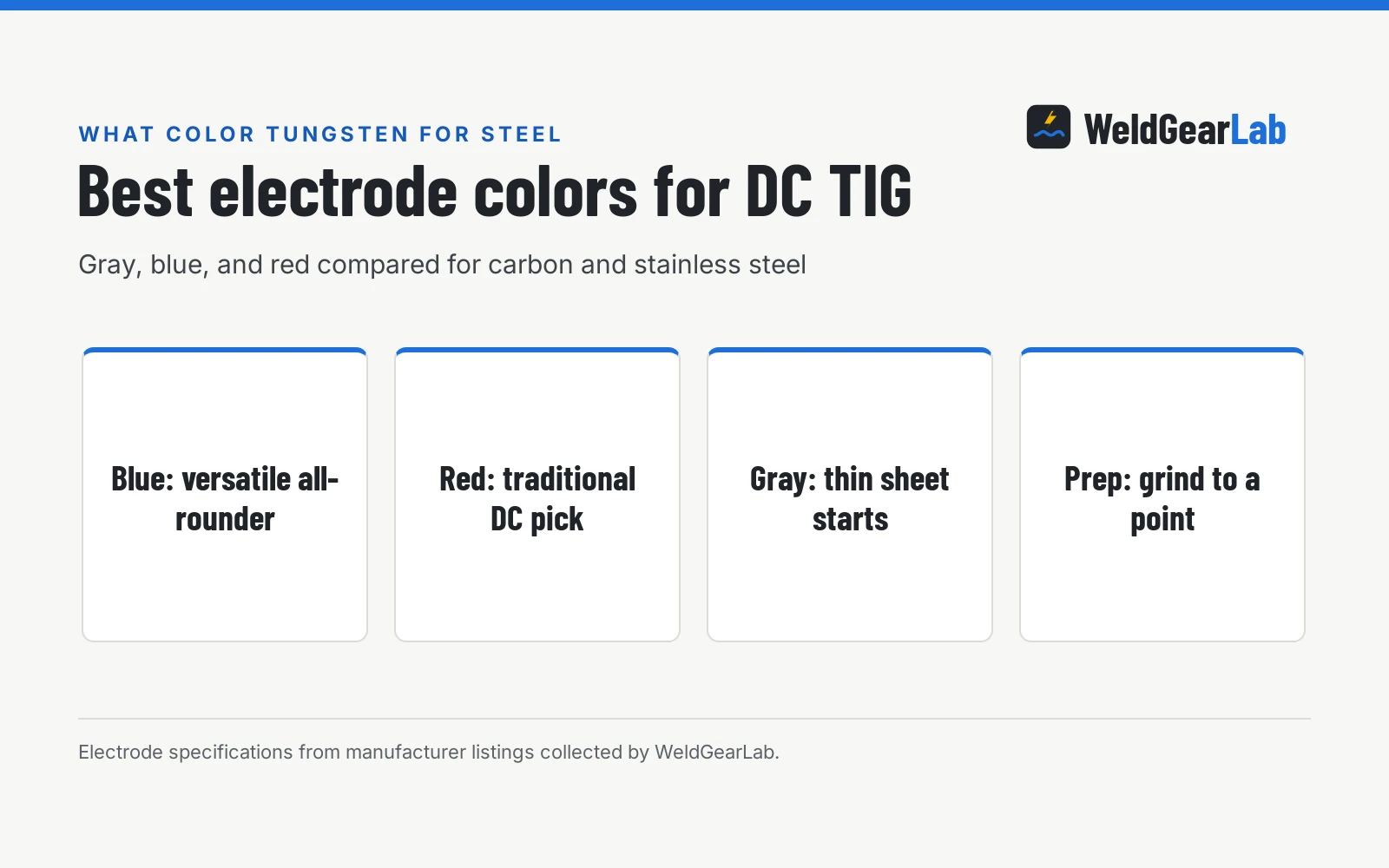
When deciding what color tungsten for steel, the primary choice for modern direct current TIG welding is blue (2% lanthanated), while red (2% thoriated) remains a traditional favorite. Direct current electrode negative is the standard polarity for mild carbon steel and stainless steel, requiring an electrode that holds a sharp conical point and strikes an arc reliably. Blue 2% lanthanated is a leading modern recommendation because it matches red in arc stability and tip life without the health concerns of radioactive thorium dust during grinding. Gray (2% ceriated) and purple rare earth blends also provide dependable performance, giving fabricators reliable non-radioactive options for thin sheet and heavy plate alike.
As an Amazon Associate I earn from qualifying purchases. This guide links to our product roundups, where WeldGearLab earns a commission when you buy through links, at no extra cost to you. Read our affiliate disclosure.
What color tungsten for steel should you choose?
Blue 2% lanthanated serves as a versatile, dependable electrode color for direct current steel welding. Blue strikes quickly at low amperage on thin sheet, holds a stable arc through moderate settings, and resists splitting on thicker plate. It preserves its ground point through extended welding sessions, reducing trips to the grinding wheel.
Red 2% thoriated remains common in older fabrication shops because it holds a durable point under heavy direct current. However, thorium oxide is mildly radioactive, creating an inhalation risk when sharpening the tip. Because blue lanthanated matches red performance on direct current without airborne radiation concerns, fabricators frequently choose blue to avoid airborne exposure during grinding.
Fabricators working on thin carbon steel sheet or light-wall stainless tubing can also achieve dependable results with gray 2% ceriated electrodes, which start smoothly at low amperage. Purple rare earth blend electrodes serve as another modern non-radioactive alternative, offering reliable direct current arc striking and durable tip life across carbon and alloy steels.
Side by side
| 2% Lanthanated (Blue) | 2% Thoriated (Red) | Rare Earth Blend (Purple) | |
|---|---|---|---|
| AWS Classification | EWLa-2 | EWth-2 | EWG |
| Current Type | DC and AC | DC | DC and AC |
| Arc Starting on Steel | Quick, dependable arc striking | Reliable, consistent arc striking | Fast arc striking without spreading |
| Tip Stability and Erosion | Low burn-off, no splitting | Low burn-off, resists splitting | Low burn-off, resists splitting |
| Steel Applications | Carbon steel and stainless steel | Carbon steel and stainless steel | Carbon steel and non-corrosive steel |
| Radioactivity | Non-radioactive | Contains trace thorium oxide | Non-radioactive |
| Grinding Safety | Standard shop dust collection | Dedicated dust exhaust recommended | Standard shop dust collection |
Manufacturer listings from ARCCAPTAIN and WelderElite cite compliance with standards such as AWS A5.12M/A5.12:2009 and DIN EN 26848. Always verify the color band on your packaging before prepping electrodes, and store different blends in separate containers to avoid cross-mixing in the shop.
Blue 2% lanthanated: the modern shop standard
Blue electrodes contain approximately 2% lanthanum oxide blended into tungsten. This rare earth addition lowers the work function of the metal, allowing electrons to emit freely from the tip into the welding arc. The result is quick, crisp high-frequency starts and smooth lift-arc ignition on direct current.
For steel fabrication, blue lanthanated offers distinct practical benefits:
- Universal polarity versatility. Blue electrodes transition smoothly between direct current for steel and alternating current for aluminum, provided you regrind the tip to suit each process. If your shop welds both steel frames and aluminum tanks, you can keep the same electrode alloy on hand. See our review of the best TIG welder for aluminum for AC/DC machine setups.
- Durable tip geometry. Lanthanum oxide disperses evenly throughout the tungsten matrix, resisting thermal erosion. Under moderate and heavy direct current, the ground point resists splitting, excessive erosion, or wandering.
- Stable arc direction. Blue electrodes direct heat in a narrow, consistent column straight into the joint root, preventing wandering arc strikes that mar the workpiece.
- Non-radioactive safety. Lanthanum presents no radioactive hazard during grinding, making shop dust control straightforward with standard dust collection.
WelderElite lists blue 2% lanthanated electrodes in 1/16 by 7 inch (1.6 mm by 175 mm) 10-packs rated for both direct current and alternating current operations. Standardizing on blue provides predictable bead shapes across carbon steel and stainless alloys.
Red 2% thoriated: the traditional direct current favorite
For decades, red 2% thoriated was the universal standard for direct current steel welding. The alloy contains roughly 2% thorium oxide, providing exceptional resistance to weld puddle contamination and maintaining a sharp point under demanding duty cycles.
ARCCAPTAIN lists red 2% thoriated electrodes in 3/32 by 7 inch (2.4 mm by 175 mm) 10-packs, noting their reliability and consistent performance on direct current applications including stainless steels and copper alloys. Many pipe welders learned on red tungsten and value its forgiving arc behavior on thick steel plate.
The downside of red tungsten is thorium oxide’s low-level radioactivity. Sharpening the tungsten on an abrasive wheel produces fine airborne dust, creating internal exposure risks over extended careers. Switching to blue lanthanated or purple rare earth blends eliminates this concern without sacrificing direct current arc quality on steel.
Gray ceriated and purple rare earth blends
Beyond blue and red, additional color bands serve useful roles in steel fabrication:
- Gray (2% ceriated). Ceria was among the earliest non-radioactive substitutes developed to replace thoria. Gray electrodes excel at low-amperage arc ignition, making them popular for thin sheet steel, small-diameter tubing, and automotive body panels. However, under heavy direct current heat, cerium oxide tends to migrate toward the tip, which can cause the point to split or degrade prematurely on thicker steel plate.
- Purple (rare earth blend). Purple electrodes combine a proprietary blend of rare earth oxides rather than a single additive. ARCCAPTAIN lists purple rare earth blend electrodes in 1/16 by 7 inch packs adhering to AWS A5.12M/A5.12:2009, engineered as direct replacements for 2% thoriated tungsten. These electrodes resist thermal shock, maintain low burn-off rates without spreading, and perform reliably on low-alloyed steels and non-corrosive stainless steels.
Electrode colors to avoid when welding steel
Certain tungsten colors are unsuited for direct current steel welding, leading to erratic arcs and poor penetration:
- Green (pure tungsten). Green electrodes contain no oxide additives. Pure tungsten has a higher work function and lower current capacity. On direct current steel, green struggles to strike an arc, suffers from severe arc wandering, and can spit tungsten inclusions into the molten puddle. Green is intended strictly for alternating current on older transformer welders where an electrode forms a ball for aluminum.
- Brown (zirconiated). Brown electrodes contain zirconium oxide and are formulated for alternating current welding on aluminum and magnesium alloys. On direct current steel, brown offers poor arc starting, wanders, and lacks the arc stability provided by lanthanated or ceriated electrodes. For guidance on non-ferrous alloys, read our guide on what color tungsten for aluminum.
How to grind and shape tungsten for steel
Proper tip preparation is vital for direct current welding on steel:
- Grind longitudinally. Always grind the electrode lengthwise along its axis, never across the diameter. Radial grinding rings force the arc to wander around the tip circumference. Longitudinal grinding lines guide electrons straight off the point into a focused, stable arc column.
- Grind a uniform conical taper. Grinding a smooth conical taper back from the tip shapes the arc column. A sharper taper eases arc starting at lower current, while a blunter taper carries higher amperage without tip degradation.
- Add a slight flat land. Lightly touch the point against the wheel to create a minuscule flat land. A needle-sharp point can break off or melt into the puddle upon arc strike. A tiny flat land stabilizes the arc root and prolongs tip life.
- Reserve a dedicated grinding wheel. Never sharpen tungsten on a general shop bench grinder used for steel brackets or aluminum parts. Embedded metallic debris contaminates the tungsten, creating arc wander and weld porosity. Reserve a clean abrasive wheel solely for tungsten electrodes.
For torch setup details, see our guide on TIG torch sizes explained.
Sizing, shielding gas, and shop safety
Matching electrode diameter to material thickness and welding current ensures proper current density. Reference listings highlight available sizes:
- 1/16 inch (1.6 mm). WelderElite and ARCCAPTAIN both package 1/16 by 7 inch electrodes, which suit lighter current applications on thin sheet and light tubing.
- 3/32 inch (2.4 mm). ARCCAPTAIN packages 3/32 by 7 inch red thoriated electrodes, a common diameter for mid-range direct current steel fabrication.
- Storage and larger diameters. Blue Demon lists storage tubes holding up to 10 pieces of tungsten sized 1/8 inch and smaller, using color-coded caps to prevent alloy mix-ups. Keeping electrodes in sealed polyethylene tubes shields ground tips from shop moisture, grease, and accidental chipping.
Shielding gas must always be pure argon for TIG welding carbon and stainless steel. Never use mixed MIG shielding gases containing carbon dioxide or oxygen; active gases will burn the tungsten tip and create severe porosity. Pair your gas setup with suitable filler metals from our guides to the best TIG rod for mild steel and the best TIG rod for stainless steel.
Dust control and eye protection. Always manage airborne dust when grinding electrodes, especially red thoriated varieties. Use local exhaust or a vacuum grinding shroud, and wear a well-fitting particulate respirator; explore our recommended picks for the best respirator for welding fumes. Wear safety glasses under your welding helmet when shaping tips, and ensure proper shade selection by consulting our review of the best welding helmet for TIG welding and our guide on what shade lens for TIG welding.
Frequently Asked Questions
Can you use green tungsten to weld steel?
No, green pure tungsten is not recommended for welding steel. Pure tungsten lacks oxide additives, causing it to struggle with arc ignition on direct current and spit tungsten into the molten puddle. On direct current steel joints, green tungsten creates an unstable, wandering arc that makes clean root penetration difficult.
Why are welders moving away from red tungsten?
Welders are transitioning away from red 2% thoriated tungsten primarily due to health concerns surrounding thorium oxide dust. Sharpening red tungsten generates fine radioactive airborne particles that pose an inhalation risk over time. Modern alternatives like blue 2% lanthanated and purple rare earth blends deliver equal or superior arc stability on steel without radioactive hazards.
Is blue or gray tungsten better for stainless steel?
Blue 2% lanthanated is generally the superior all-around choice for stainless steel because it handles both low and high current without premature tip degradation. Gray 2% ceriated starts smoothly at low amperage on thin stainless tubing, but blue maintains its ground point longer under sustained heat across varied thicknesses.
How should you grind tungsten for DC TIG on steel?
Tungsten for direct current steel welding should always be ground longitudinally to a sharp conical point. Grinding along the length guides electrons straight off the tip, producing a focused arc column that prevents wandering. Lightly dressing the point to create a microscopic flat land prevents the tip from breaking off into the puddle during arc starts.
Can you use the same tungsten for carbon steel and stainless steel?
Yes, both carbon steel and stainless steel run on direct current electrode negative and utilize the same electrode types. Blue 2% lanthanated, red 2% thoriated, and purple rare earth blends perform reliably on both metals when ground to a conical point. Ensure the electrode remains clean and uncontaminated by puddle dips in either material.
Related: TIG welders hub, AC vs DC TIG welding, what color tungsten for aluminum, best TIG rod for mild steel, and best TIG rod for stainless steel.
About the author
WeldGearLab Editorial is the editorial team behind WeldGearLab. We research product listings, specifications, safety listings and warranty terms, score every pick with the published Gear Score method, and correct errors when readers report them. We do not run our own shop trials; see How We Pick for exactly how picks are made.