Inverter Welder Pros and Cons: Which Fits Your Shop
Inverter welders offer low weight, smooth arc control, and efficient power draw, but electronic complexity and generator sensitivity remain practical trade-offs.

On this page
Top picks at a glance
As an Amazon Associate I earn from qualifying purchases.
- 1
 Siasky Mini Welding Machine9.5/10View on Amazon
- 2
 200A Stick Welder 110V9.4/10View on Amazon
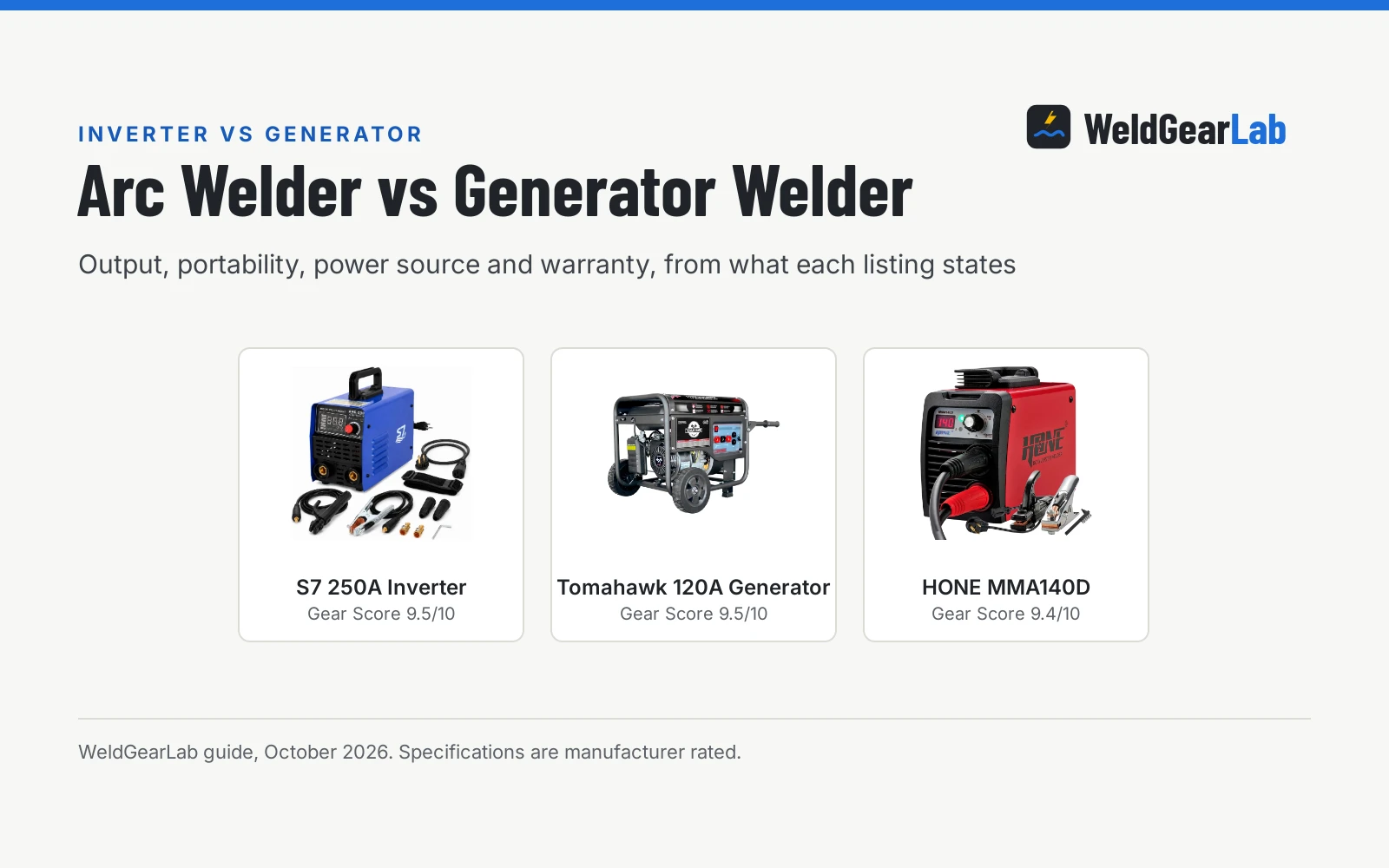
An inverter welder converts alternating current to direct current and uses high-frequency solid-state switching to produce a stable welding arc from a compact, lightweight unit. The main pros of an inverter welder are portable weight, lower electrical draw, and smooth arc control with automated hot start and anti-stick features. The primary cons are higher electronic sensitivity, circuit board replacement costs if a component fails, and vulnerability to voltage spikes from unfiltered generators. Understanding these inverter welder pros and cons helps home hobbyists, farmers, and mobile fabricators decide whether an electronic inverter or a traditional iron-core transformer best matches their workshop demands.
This guide links to our product roundups, where WeldGearLab gets a commission on purchases made through links on this page, and your price stays the same. Read our affiliate disclosure.
Inverter welder pros and cons in one paragraph
Traditional transformer welders rely on a heavy iron core and copper windings operating at utility line frequency to step mains voltage down to welding voltage. In contrast, an inverter welder rectifies alternating current into direct current, switches that power at high frequencies through insulated-gate bipolar transistors, and passes it through a much smaller transformer before rectifying it back to smooth DC welding current. This solid-state architecture reduces machine bulk dramatically while enabling microprocessors to monitor and adjust the arc continuously. You gain portable weight, cleaner arc starts, and lower power draw, balanced against circuit boards that require shielding from metal dust, moisture, and dirty generator power.
Side by side
| 110V Inverter Welder | Dual-Voltage Inverter | Transformer Welder | |
|---|---|---|---|
| Primary technology | Solid-state IGBT inverter | Solid-state IGBT inverter | Iron core and copper transformer windings |
| Portability and weight | Ultra-lightweight, easy one-hand carry | Compact, portable with shoulder strap or handle | Heavy and bulky, often requiring a dedicated cart or wheels |
| Input power supply | Standard 110V household outlets | Dual-voltage 110V or 220 volt supply | Often requires dedicated 220 volt shop circuits |
| Arc control and stability | Microprocessor control with hot start, arc force, and anti-stick | Microprocessor control with hot start, arc force, and anti-stick | Fixed magnetic core with standard step or tap adjustments |
| Electrical efficiency | High electrical efficiency, lower breaker load | High electrical efficiency across both voltages | Lower electrical efficiency with higher idle and running power draw |
| Generator power use | Requires clean, regulated power | Requires clean, regulated power | Tolerates dirty power and voltage fluctuations |
| Internal complexity and repairs | Complex printed circuit boards; board replacement | Complex printed circuit boards; board replacement | Simple electrical circuits; durable mechanical switches and coils |
| Stuck electrode behavior | Anti-stick cuts current when rod sticks for easy release | Anti-stick cuts current when rod sticks for easy release | No automatic anti-stick; rod can overheat until freed manually |
| Shop environment durability | Internal fans can pull metal grinding dust across boards | Internal fans can pull metal grinding dust across boards | Minimal electronics; highly tolerant of dirty or humid shop dust |
Operating characteristics reflect typical manufacturer specifications for workshop and field units. Always consult the rating plate on your machine and read the instruction manual for rated duty cycle limits and input voltage requirements before starting heavy repair projects.
When an inverter welder is the better choice
- Portability for mobile repairs. The primary advantage of an inverter stick welder is compact weight. Rather than wheeling a heavy machine across a yard or dragging long leads, you can carry an inverter directly to fence lines, trailers, and elevated equipment. For example, the Siasky mini stick welder (on Amazon) lists a weight of 3.3 pounds, and the TECWELD inverter welder (on Amazon) states a weight of 4.6 pounds with an included shoulder strap.
- Smooth arc control and starting assistance. Solid-state switching enables digital arc assistance that prevents common beginner frustrations. Automated hot start boosts current momentarily during arc ignition for effortless striking, while arc force increases amperage when voltage drops to prevent the rod from stubbing out in the molten puddle.
- Lower power draw on standard circuits. High electrical efficiency allows small inverters to run on standard household outlets without immediately tripping branch breakers. Units like the TORQBEAST specify operation on standard 110V power while providing an adjustable range from 20A to 120A for sheet metal and general maintenance.
- Dual-voltage versatility. Many portable inverters adapt across different jobsite receptacles. Dual-voltage models like the S7 and SOARFLY accept both 110V and 220V input power, letting operators run smaller electrodes on standard household outlets and switch to a 220 volt supply when higher output amperage is needed to burn thicker rods on heavy plate.
Our best portable stick welder guide covers compact inverter models suited for field maintenance and small fabrication jobs.
When a traditional transformer welder is the better choice
- Harsh, dusty shop environments. Inverters require internal cooling fans to keep power transistors within safe operating temperatures. In metal fabrication shops, these fans can draw conductive grinding dust and steel grit across circuit boards, causing short circuits. Transformer welders contain fewer sensitive electronic traces and tolerate dusty environments far better.
- Rough generator power in the field. Unregulated portable generators often produce voltage spikes, harmonic distortion, and unstable frequencies. While heavy copper windings in transformer welders absorb electrical surges without damage, voltage spikes can destroy sensitive inverter control boards.
- Long-term repair simplicity. When a traditional transformer welder malfunctions, diagnosing and repairing the machine typically involves straightforward contactors, heavy-duty switches, or simple diodes. In contrast, inverter failures usually involve surface-mount microprocessors or blown IGBT modules that require complete circuit board replacement.
- Moisture and humid storage. Storing welding equipment in unheated barns, damp sheds, or humid coastal areas exposes circuit boards to condensation and corrosion. Transformer welders feature heavy varnished windings that resist moisture far longer than delicate printed circuits.
To compare internal components and workshop durability in detail, read our inverter welder vs transformer welder breakdown.
How to tell what an inverter welder supports
Not every stick welder listing provides clear technical specifications. When evaluating an inverter stick welder, check the listing for these specific indicators:
- Input voltage and plug adapters. Check whether the machine is single-voltage or dual-voltage. The Klutch dual-voltage welder (on Amazon) lists 120/230V input and includes a 120V adaptor, while compact units like the Saker run on standard 110V power. Dual-voltage flexibility allows you to plug into standard household outlets or connect to a stick welder 220 volt receptacle.
- Electrode diameter and classification compatibility. Confirm that the machine supports the welding rods you plan to use. The SOARFLY listing states compatibility with E6010, E6013, E7018, and E308-16 rods in 2.5-3.2mm diameters, while the Hpoouo welder (on Amazon) lists support for 1/16-1/8 inch rods including E6010, E6011, E6013, and E308 electrodes. Note that while some listings claim compatibility with cellulosic E6010 electrodes, these rods require higher open-circuit voltage to maintain an arc than forgiving rutile rods like E6013.
- Duty cycle ratings. Look for rated duty cycle figures and the amperage at which they are measured. The TECWELD listing claims a 60% duty cycle, but the operating amperage is not stated. In budget inverter listings, duty cycle ratings often apply at moderate output rather than maximum amperage, so always verify whether a machine can sustain continuous welding at your intended working current.
- Output amperage range and controls. Examine the adjustment mechanism. Handheld units like the TOPYOUNG provide five current settings across a 20-120A output range, whereas digital machines like the TORQBEAST provide ±1A button control with an LED display.
Entry-level models like the Chicago Electric 80 amp inverter stick welder introduced hobbyists to lightweight arc welding, while current inverter designs offer wider current adjustments and digital readouts.
Generator power and electrical requirements
Running an electronic welding machine from field power requires careful attention to electrical quality. Traditional gas powered stick welder equipment or heavy transformer units tolerate irregular wave forms without incident. In contrast, operating a stick welder with generator power introduces risk if the generator produces unfiltered voltage spikes or high harmonic distortion. When powering an inverter welder in remote locations, select an inverter generator with clean power regulation or confirm that your generator delivers stable voltage before striking an arc. In the home workshop, ensure your dedicated branch circuit supplies adequate current to prevent breaker trips during high-amperage welds.
Are inverter welders better for home and farm shops?
For the majority of home hobbyists, automotive fabricators, and farm maintenance operators, an inverter welder provides superior practical utility compared to older iron-core machines. The lightweight construction allows you to move the machine between workbenches, equipment trailers, and outdoor project sites without fatigue. High-frequency arc stabilization also makes striking and maintaining an arc considerably easier for operators who weld infrequently. While battery powered stick welder units offer cordless mobility for remote emergency repairs, mains-powered inverter machines remain the standard workhorse for reliable fabrication.
For heavier agricultural repair projects, explore our best stick welder for farm use guide.
Electrical safety and workshop ventilation. Stick welding produces intense ultraviolet radiation, sparks, and metal fumes. Always wear a shade-appropriate welding helmet, flame-resistant welding gloves, and protective clothing during operation. Never weld in damp areas or stand on wet ground, and attach the ground clamp firmly to clean, unpainted steel. Maintain adequate cross ventilation or local exhaust to keep welding fumes away from your breathing zone, and keep a fire extinguisher readily accessible in your work area.
FAQ for welders
What is an inverter arc welder?
An inverter arc welder is a machine that uses solid-state electronic switches, such as IGBT transistors, to convert incoming utility power into high-frequency electricity before stepping it down. This high-frequency conversion allows the internal transformer to remain compact and lightweight compared to traditional iron-core welders. The resulting DC output produces a steady, stable arc suitable for stick and TIG welding.
How does an inverter stick welder work?
An inverter stick welder rectifies incoming AC power into DC, switches it at high frequencies through electronic transistors, and passes it through a small step-down transformer. Digital microprocessors monitor arc voltage and current continuously, making micro-second adjustments to maintain puddle control. This automated monitoring powers features like hot start for smooth arc ignition, arc force to maintain the puddle, and anti-stick to prevent electrode overheating when a rod sticks.
Are inverter welders better than transformers?
Inverter welders are better for portable maintenance, electrical efficiency, and smooth arc performance on standard household power. Traditional transformer welders remain superior for harsh environments with heavy grinding dust or rough generator power where mechanical durability outlasts delicate electronic circuit boards. For home shops and mobile farm repairs, modern inverters offer far greater everyday versatility.
Are inverter stick welders any good for farm repairs?
Yes, inverter stick welders excel at farm maintenance such as fixing broken gates, structural brackets, and machinery hitches. Their light weight lets you transport the welder directly onto a service truck or utility vehicle without requiring heavy lifting equipment. Dual-voltage models allow operators to handle light bracket fixes on standard household outlets and plug into a 220 volt circuit or clean generator when burning larger rods on heavy equipment.
How do you use an inverter welder?
To operate an inverter stick welder, attach the ground clamp firmly to bare metal on your workpiece and insert your chosen electrode into the holder. Set the current control according to your electrode diameter, strike the arc using a gentle scratching or tapping motion, and hold a tight, consistent arc length as the rod melts. Always keep protective gear in place and adhere to rated duty cycles during extended welding sessions.
Related: inverter welder vs transformer welder, best small inverter stick welders, DC vs AC stick welding, and the welders hub. Also see our guide on how to use a stick welder.