Flux Core Welding Pros and Cons: Which Fits Your Work
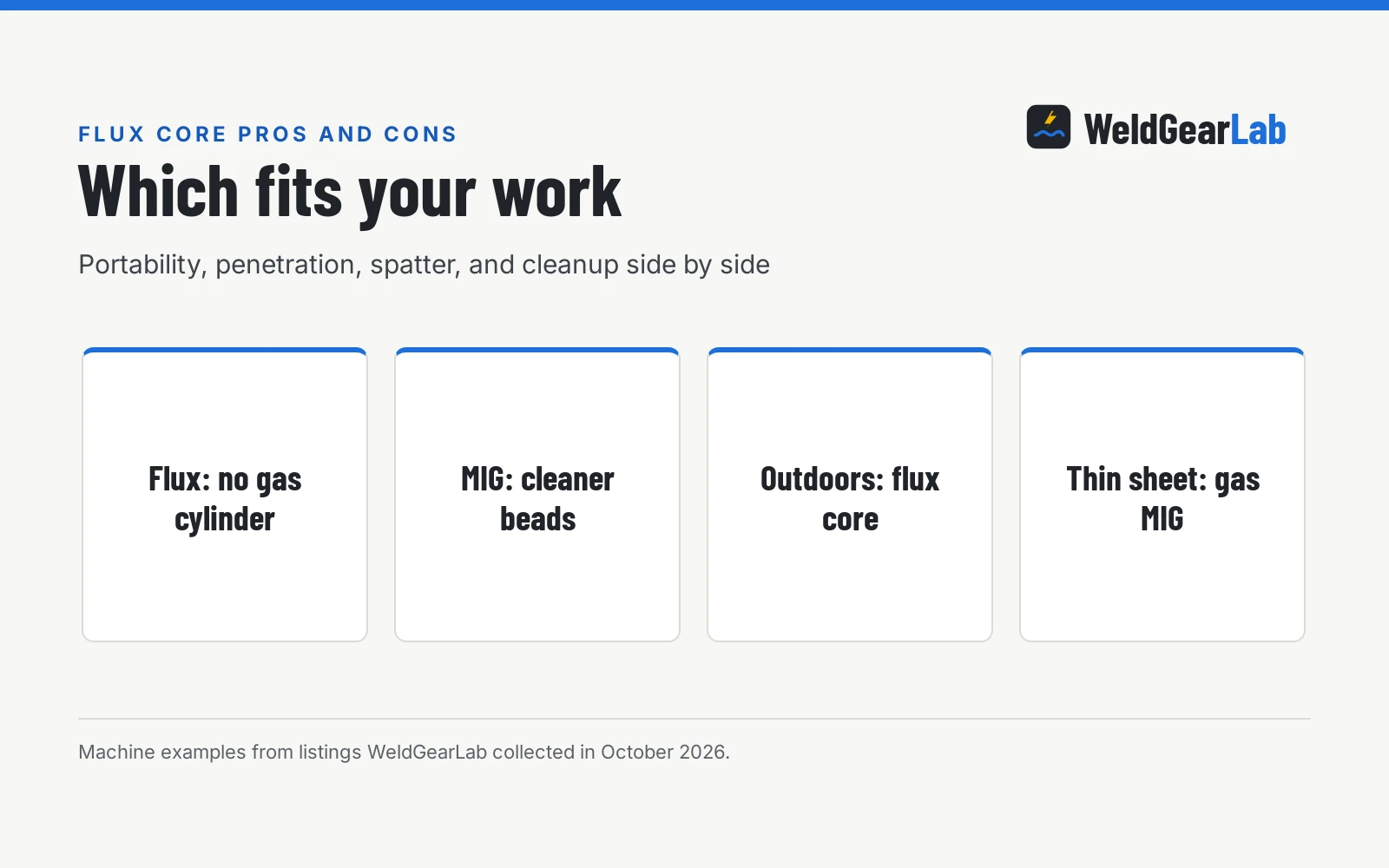
Flux core welding skips the gas cylinder and handles breezy outdoor repairs and dirty steel, but produces more spatter, smoke, and slag than gas-shielded processes.

On this page
Top picks at a glance
As an Amazon Associate I earn from qualifying purchases.
- 1
 Hobart Handler 125 Flux-Core Wire Feed Welder9.5/10View on Amazon
- 2
 DURATECH 125A MIG Welder9.7/10View on Amazon
- 3
 AZZUNO 3 in 1 MIG Welder 110V9.4/10View on Amazon
- 4
 135A MIG Welder 110V [Large LED Display] 3 in 1 Welding9.4/10View on Amazon
When you need to repair a broken equipment hinge in a breezy driveway or weld dirty angle iron on a farm trailer, weighing flux core welding pros and cons helps you choose the right process before you clamp your ground cable. Flux core welding delivers deep penetration without shielding gas bottles, making it portable and reliable in windy outdoor conditions. The tradeoff is heavier spatter, dense smoke, and a hard slag crust that requires thorough chipping and brushing on every bead. This guide breaks down the practical advantages, drawbacks, metal thickness limits, and machine choices for home and shop welding.
This guide links to our product roundups, where WeldGearLab gets a commission on purchases made through links on this page, and your price stays the same. Read our affiliate disclosure.
Flux core welding pros and cons in one paragraph
Self-shielded flux-cored arc welding runs a hollow steel wire filled with mineral fluxes and deoxidizers that vaporize in the arc to shield the molten puddle from atmosphere. This eliminates the expense, bulk, and transport hassles of high-pressure shielding gas cylinders, allowing sound welds even when outdoor wind blows away a gas plume. However, burning internal flux generates thick smoke and leaves a brittle slag layer covering the finished bead. While flux core provides strong arc heat on standard household circuits, that same heat makes welding thin sheet metal difficult without burn-through.
Side by side
| Job factor | Flux core advantages (Pros) | Flux core drawbacks (Cons) | Practical shop verdict |
|---|---|---|---|
| Shielding setup | No gas cylinder, regulator, or high-pressure hose required | Burns flux that produces heavy smoke and fume plumes | Best for outdoor or mobile work without gas transport |
| Outdoor usability | Breeze and wind do not blow away puddle shielding | Hot spatter and slag balls create fire hazards outdoors | Superior to gas MIG in drafty or outdoor field conditions |
| Surface tolerance | Tolerates moderate rust, mill scale, and primer on steel | Demands chipping hammer and wire brush work after every pass | Saves grinding time on dirty utility and farm steel |
| Joint penetration | Effective penetration on mild steel without gas shielding | High arc energy easily blows holes through thin sheet metal | Great for structural brackets but risky on body panels |
| Cleanup effort | Fast setup straight out of the box with wire loaded | Heavy BB spatter sticks to base metal and gun nozzles | Gas MIG is cleaner for visible or painted assemblies |
| Equipment mobility | Compact standalone machines easy to carry to job sites | Flux wire spools cost more per pound than solid steel wire | Lower starter equipment cost offset by higher wire cost |
| Material compatibility | Sound welds on mild steel and carbon steel | Cannot weld aluminum and risks cracking on cast iron | Best suited for carbon and mild steel repairs |
| Welding positions | Fast-freezing slag shelf supports flat, horizontal, and overhead joints | Slag entrapment risks require proper drag angle and travel speed | Follow drag angle technique to keep slag behind puddle |
Machine settings and polarity vary by wire type; always check the door chart inside your wire feed compartment. Self-shielded flux core wire typically runs on direct current electrode negative straight polarity with the torch negative, whereas solid wire with shielding gas runs on electrode positive reverse polarity.
When flux core is the better choice
- Outdoor and mobile repairs. Fences, gates, and trailer repairs often happen outside where wind blows away MIG shielding gas. Flux core generates its own gas shield inside the arc, keeping the puddle protected without wind screens.
- Rusty and scaled steel prep. While clean metal yields the soundest welds, field repairs do not always allow perfect grinding. Flux deoxidizers tolerate mill scale, moderate rust, and dirt better than solid wire.
- Maximum portability. Transporting a wire feed welder without a heavy gas cylinder, fragile regulator, and gas hose makes moving around a farm, shop, or job site much easier.
- Effective penetration on 120V power. Flux core wire has higher current density in its steel sheath than solid wire. The arc concentrates heat effectively, allowing compact household-voltage machines to weld mild steel up to a 3/16 inch plate without needing 240V service.
For mobile and outdoor work, our best flux core welder guide reviews standalone gasless machines.
When gas MIG or stick is the better choice
- Thin sheet metal and auto body panels. Flux core arcs burn hot. On thin sheet metal, gas MIG with solid wire and an argon-CO2 mix delivers lower heat, tighter puddle control, and less risk of burn-through.
- Clean appearance with minimal cleanup. Flux core creates heavy BB spatter and leaves a hard slag crust. When building furniture or decorative projects where appearance matters, gas MIG leaves a clean bead with zero slag to chip.
- Enclosed indoor spaces. Burning flux produces dense smoke and fumes. While all welding requires ventilation, running flux core inside a small garage fills the room quickly, making gas MIG more pleasant indoors.
- Welding aluminum. Self-shielded flux core wire for aluminum does not exist for portable wire welders. Aluminum requires an argon cylinder with a MIG spool gun or an AC TIG welder.
If clean beads and thin panels are your focus, see our how to choose a MIG welder guide and our review of the best 120V MIG welder models.
How to choose a 110V flux core welder
When choosing a wire feed welder that runs on household current, manufacturer specs show differences in amperage, metal thickness capacity, and machine weight. Matching these figures to your work ensures you buy the right machine.
The Forney Easy Weld 140-Amp machine (on Amazon) operates on a 120V household outlet and lists welding capacity from 24-gauge up to 1/4 inch thickness. For lighter repairs, the Hobart Handler 125 (on Amazon) delivers an amp range of 25-130A and lists capacity for 1/8 in steel with four voltage settings. If weight matters, the DURATECH 125A machine (on Amazon) weighs 10.5 lbs on 120V power and lists mild steel capacity up to a 3/16 inch plate. The AZZUNO 135A (on Amazon) unit operates on 110V, weighs 9 lbs, and states metal thickness up to 5/32″. The TASKZOOM 135A (on Amazon) unit features a 4.5″ screen and supports .030″ and 0.035″ wire on 110V power.
Check the wire drive rolls as well. Knurled drive rolls with serrated grooves grip tubular flux wire with light drive tension, preventing wire slippage without crushing the casing. While smooth V-groove rolls designed for solid wire can feed flux wire under careful adjustment, excessive tension risks deforming the tubular wire and causing erratic feeding.
Wire selection and polarity for flux core
Self-shielded flux core performance depends on matching your wire to the joint and setting proper polarity. A common gasless wire supplied with portable welders is AWS classification E71T-GS, included with the TASKZOOM 135A welder. The listing specifies this wire for single-pass applications on mild steel.
Wire diameter controls your amperage range and deposition. Common wire sizes include .030″ and .035″ wire, with .030″ offering easier control on thinner sheet and .035″ depositing heavier beads. Spool sizes range from compact 1lb and 2lb spools up to 2.2 pounds rolls.
Polarity is general practice for common gasless wires, which typically run on direct current electrode negative straight polarity. In this setup, the gun connects to the negative output lug and the work clamp connects to the positive terminal. Running self-shielded wire on reverse polarity creates heavier spatter, erratic arc action, and shallow penetration. Always verify the polarity chart on your wire spool and inside your machine door. Read our guide on what polarity for flux core welding and check our top picks for the best wire for gasless MIG welder.
Can one machine do both?
Yes, but you have to check machine specs carefully. Many budget wire welders advertised as MIG machines are strictly gasless flux core units that add stick and lift TIG modes, not gas MIG.
For example, the Sunstac 140A machine (11.24lb on 110V), the ARCCAPTAIN 145A unit (9.5 lbs on 120V), and the TORQBEAST 145A welder (7.16 lbs on 110v) are 3-in-1 units offering gasless flux core, stick, and lift TIG, but they lack a gas solenoid and gas inlet for solid wire MIG. If you want a machine that runs both gasless flux core and true gas MIG, look for an integrated gas valve or solenoid. The BILT HARD 250A multi-process welder supports both gas MIG and flux core on 110V/220V power with a stated 60% duty cycle at 250A for up to a 3/8″ plate. For a lighter shop unit, the Hobart Handler 125 includes a factory gas solenoid for future MIG conversion.
When running a true dual-mode welder, switching processes requires swapping your machine polarity leads, changing drive rolls from knurled to smooth groove, and connecting a gas hose and regulator for solid wire. Always follow safe shop habits: wear welding gloves, keep a fire extinguisher nearby, and work with adequate airflow. See our best welder for beginners guide and the welders hub for more setup tips.
FAQ for welders
Is flux core welding any good for home and farm repairs?
Yes, flux core welding produces strong, sound joints on mild steel when machine settings and polarity match the wire. It penetrates deeply and tolerates outdoor wind and dirty metal better than gas MIG. For farm equipment, gate repairs, and utility projects, it is a dependable, proven process.
Does a flux core welder need shielding gas?
Self-shielded flux core wire does not use external shielding gas or cylinders because flux ingredients inside the hollow wire vaporize to protect the puddle. However, dual-shield flux core used in industrial fab shops does require an external shielding gas bottle. For home and farm wire welders, flux core almost always means gasless self-shielded wire.
Is flux core welding good for auto body panels?
Flux core is difficult on thin auto body sheet metal because the high arc heat easily burns holes through thin panels. Gas MIG with solid wire and an argon-CO2 mix delivers cooler, cleaner beads with far less risk of burn-through. If using flux core on thin sheet, use short trigger pulses and allow the metal to cool between tacks.
Can a flux core welder weld aluminum or cast iron?
A standard flux core welder cannot weld aluminum because self-shielded aluminum flux wire is not made for hobby wire feed machines. Aluminum requires an argon gas setup with a spool gun or an AC TIG welder. Cast iron is also prone to heat cracking with flux core, making stick welding with nickel rods a better choice.
How do you spot weld or tack with a flux core welder?
To tack or plug weld with a small flux core machine like the Titanium 125, clamp your workpieces tight with zero gap. Position your wire stickout close to the joint, pull the trigger for a brief pulse to establish the puddle, and release before heat builds up. Always chip the slag crust off each tack before depositing subsequent passes.
Related: best flux core welder, what polarity for flux core welding, best wire for gasless MIG welder, and the welders hub. Also see our guides on is gasless MIG welding strong and how to choose a MIG welder.