Gasless MIG Welder Pros and Cons (2026)
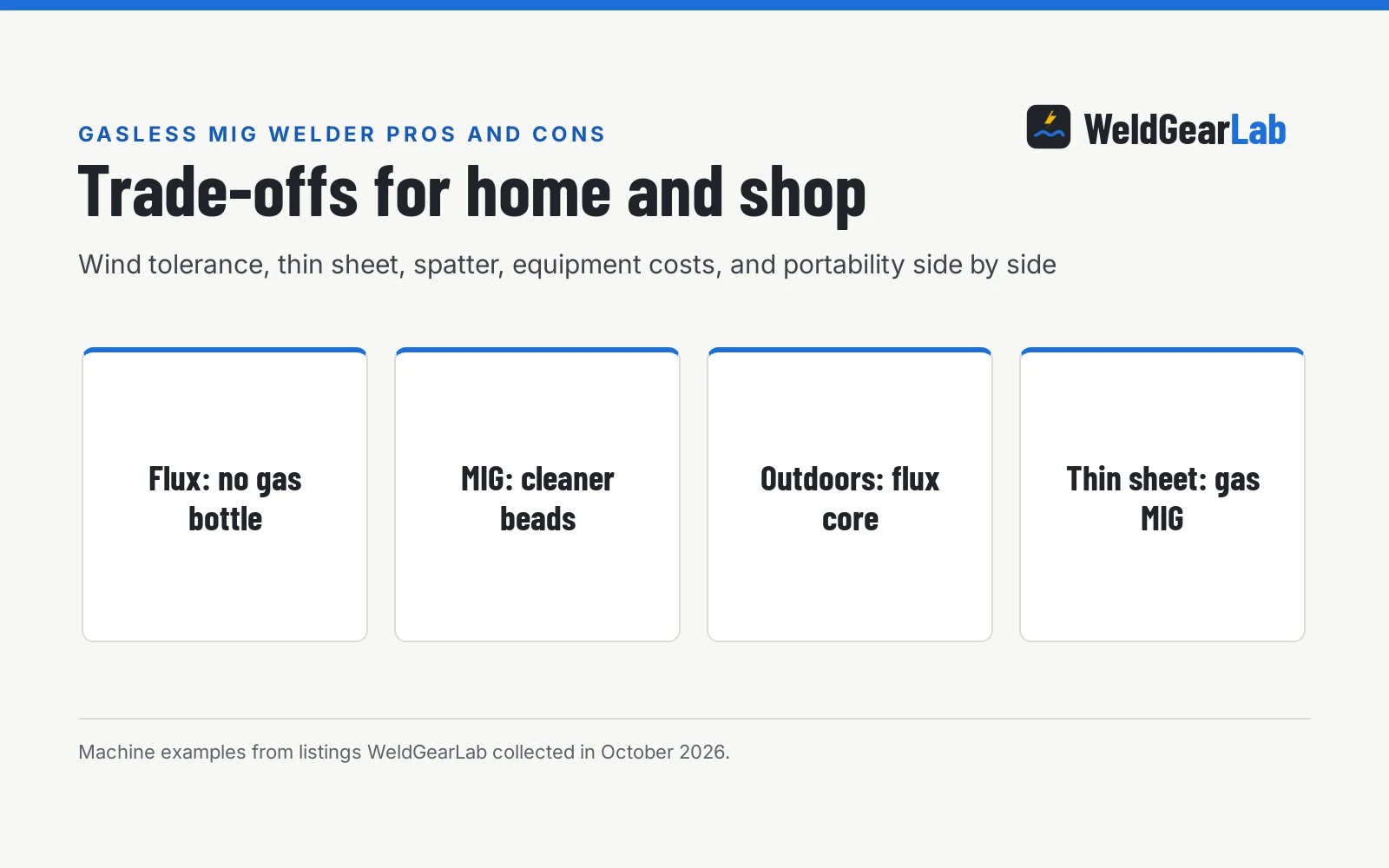
Gasless MIG welding skips bulky gas bottles for field portability and outdoor wind tolerance, but trades off clean beads on thin sheet metal.

On this page
Top picks at a glance
As an Amazon Associate I earn from qualifying purchases.
- 1
 Futelo 160A MIG Welder9.5/10View on Amazon
- 2
 DURATECH 125A MIG Welder9.7/10View on Amazon
When a cracked tractor bracket, a rusted utility trailer, or a broken farm gate lands on your fab bench, choosing the right welding process matters. Weighing gasless mig welder pros and cons helps you decide whether a self-shielded wire feed machine fits your repair workload or leaves you grinding spatter for hours. A gasless wire feed welder skips bulky compressed gas cylinders by running tubular wire filled with mineral flux that creates its own shielding vapor inside the arc. This setup delivers unmatched field portability and outdoor wind resistance, but trades off bead appearance, clean post-weld cleanup, and smooth control on thin sheet steel.
This guide links to our product roundups, where WeldGearLab gets a commission on purchases made through links on this page, and your price stays the same. Read our affiliate disclosure.
Gasless MIG Welder Pros and Cons Breakdown
A gasless wire welder, technically termed self-shielded flux-cored arc welding (FCAW-S), is often sold under the MIG label because it uses the same gun trigger and motorized wire drive mechanism. Instead of pushing solid steel wire through a bath of compressed shielding gas, the machine feeds a hollow wire packed with fluxing agents, deoxidizers, and arc stabilizers. As the wire melts into the puddle, the core vaporizes, forming a localized gas cloud that blocks atmospheric oxygen and nitrogen from contaminating the weld pool.
The core advantage is freedom from external gas support. You never lease high-pressure cylinders, transport heavy bottles in a truck bed, or watch your shielding gas blow away in an outdoor breeze. The trade-off is mechanical and aesthetic: vaporized flux produces a solid slag blanket over the bead and throws molten spatter across nearby base metal, requiring dedicated cleanup with a chipping hammer and wire wheel.
Side by side
| Feature | Gasless MIG (Flux Core) | Gas MIG (Solid Wire) | Shop Recommendation |
|---|---|---|---|
| Shielding method | Internal flux core vaporizes into shielding vapor | External cylinder (argon and CO2 mix) | Flux core for outdoor field work |
| Outdoor wind tolerance | Tolerates outdoor breezes without gas loss | Breeze blows shielding gas away, causes porosity | Flux core in breezy conditions |
| Pre-weld metal prep | Tolerates light rust and mill scale | Requires clean steel ground to bare metal | Gas MIG for spotless fabrication |
| Post-weld cleanup | Slag crust requires chipping hammer and brush | Minimal spatter, no slag coating to remove | Gas MIG when saving finishing time |
| Thin sheet metal | High burn-through risk from concentrated heat | Clean control and lower heat input on thin metal | Gas MIG for autobody and sheet panels |
| Equipment portability | Power source and wire spool only | Machine, gas cylinder, regulator, and hose | Gasless MIG for remote repairs |
| Torch polarity | DCEN (electrode negative, straight polarity) | DCEP (electrode positive, reverse polarity) | Swap machine polarity per wire |
| Aluminum capability | Not possible with flux-cored steel wire | Possible with spool gun and pure argon | Gas MIG with argon for aluminum |
Torch polarity is essential when running flux-cored wire. Self-shielded wire requires direct current electrode negative (DCEN, or straight polarity), where the gun lead connects to the negative terminal and the work clamp connects to the positive terminal. Solid wire with shielding gas runs direct current electrode positive (DCEP, or reverse polarity). Running flux wire on DCEP creates erratic arc action, excessive spatter, and shallow penetration. Most multi-process and gasless inverter machines include an internal or front-panel terminal lead to swap polarity inside the wire spool compartment.
When a gasless MIG welder is the better choice
- Outdoor repairs and windy job sites. A mild breeze that disperses cylinder gas and ruins solid wire welds has negligible effect on flux core. Farm equipment repairs, fence line fabrication, and mobile construction tasks stay shielded even in breezy conditions.
- Dirty, rusty, or painted steel. The flux inside the wire contains active deoxidizing compounds that tolerate light surface rust, mill scale, and residual coatings far better than bare solid wire.
- High portability without gas bottles. Skipping the gas bottle, regulator, and hose assembly allows you to carry the power supply directly to the workpiece. Handheld inverter units like the HIZONE 100A (on Amazon) weigh just 5.5 lbs, while compact shop boxes like the TORQBEAST 145A (on Amazon) (7.16 lbs) and Futelo 160A (on Amazon) (7.7 lbs) enable easy transport up ladders or into truck beds.
- Deeper penetration on thicker plate. On household current, flux-cored wire concentrates arc energy into the root of the joint more effectively than short-circuit solid wire. For instance, the DURATECH 125A (on Amazon) handles mild steel up to a 3/16 inch plate on 120V power, while the AWT 140A is rated up to 5/32 inch (4.0mm) mild steel on 110V.
Our best flux core welder guide reviews dedicated gasless machines for field repairs, while our best 120V MIG welder roundup examines units that operate directly from standard household outlets.
When gas MIG is the better choice
- Thin sheet metal and auto body repairs. Solid wire under gas shielding operates at lower arc voltages and cooler temperatures, reducing burn-through on thin automotive body panels. Flux core burns hotter and easily blows holes through thin gauge sheet steel.
- Finished appearance and minimal cleanup. Gas shielding leaves no crusty slag layer on the weld bead. Solid wire produces minimal spatter, saving hours of grinding on visible furniture, ornamental railings, and precision fabrication.
- Indoor shop environment. Solid wire MIG generates significantly less smoke and airborne particulate than self-shielded wire, keeping indoor garage and shop air clearer.
- Aluminum fabrication. Flux-cored steel wire cannot weld aluminum. Welding aluminum requires a spool gun running solid aluminum wire under pure argon shielding gas.
When fine bead appearance and fast cleanup take priority, exploring dedicated machines in our welders hub provides solid options for gas-shielded fabrication.
How a gasless MIG welder works
Understanding how a gasless MIG welder operates centers on wire construction and arc physics. The welding consumable, such as E71T-GS wire, is formed by rolling a flat steel strip around powdered flux core ingredients into a continuous tubular wire. As the trigger is pulled, motorized feed rolls push the wire through the gun liner to the contact tip.
When the wire touches the grounded base metal, an electric arc ignites. The intense heat melts the outer steel sheath to form the weld puddle while simultaneously vaporizing the inner core. These vaporized minerals form a dense shielding gas pocket directly over the arc zone, preventing air from causing porosity. Chemical scavengers in the flux bind with impurities and float to the surface, cooling into a protective glassy slag crust over the solidifying steel bead.
Because the hollow tubular wire is softer than solid steel wire, drive roll selection is critical. Smooth V-groove drive rolls designed for solid wire can crush flux core, causing erratic feeding or birdnesting inside the drive assembly. Gasless machines utilize knurled drive rolls, featuring fine serrated teeth that grip the wire without excessive clamping tension. Units like the WZWANCHI 135A (on Amazon) include dedicated drive wheels matched for flux-cored wire diameters.
Machine settings and welding technique
Setting up a gasless wire feed welder differs noticeably from dialing in a gas-shielded machine. Key setup parameters include:
- Wire diameter and spool capacity. Standard wire diameters include .030 inch and .035 inch, supported on machines like the TASKZOOM 135A, with larger units like the VEVOR 130Amp and Sefaspe 135A accommodating .040 inch (1.0mm) wire. Spool sizes range from 1lb spools on portable units up to 10lb spools on the Sefaspe 135A for extended shop work.
- Voltage and feed trimming. Synergic control systems automatically balance wire feed speed with selected amperage. Inverters like the TASKZOOM 135A allow manual voltage trimming from -1V to +1V, while the WZWANCHI 135A offers voltage adjustment up to ±3.0V to dial in bead profile and control spatter.
- Dragging technique. With gas MIG, pushing the torch forward provides good gas coverage. With flux core, you must always drag (pull) the gun. Pointing the gun back toward the puddle pushes molten slag over unbonded steel, causing slag inclusions. Dragging keeps the slag trailing behind the active arc.
- Stickout length. Flux-cored wire requires a longer electrical stickout than solid wire to allow the core to preheat before melting. Maintain a steady stickout distance between the contact tip and the workpiece to prevent tip burnback and arc stutter.
Excessive spatter often stems from improper voltage matching or dirty ground connections. Review our shop breakdown on why a MIG welder spatters for tuning solutions.
Safety considerations: fumes and slag
The burning flux chemicals in self-shielded wire create significantly denser fumes than gas-shielded processes. Never inhale the smoke plume directly. Position your body upwind during outdoor repairs, and ensure adequate cross-ventilation or mechanical fume extraction when welding inside a shop. Avoid welding galvanized steel with flux core unless the zinc coating is ground completely away, as vaporized zinc creates toxic metal fume fever.
Hot flux core slag presents a distinct hazard during cleanup. As the weld bead cools, brittle slag often cracks and pops off the bead under residual thermal stress. Always wear certified safety glasses beneath your welding helmet when chipping slag with a hammer or running a wire brush. Keep sparks away from dry grass, sawdust, and combustible shop materials, and inspect equipment grounded connections before striking an arc. The DURATECH 125A features CSA certification verifying electrical build standards, demonstrating the importance of electrical compliance on shop equipment.
FAQ for welders
How does gasless MIG welding work?
A gasless wire welder runs hollow tubular wire filled with mineral flux rather than solid wire. When the electric arc strikes the metal, the flux core melts and vaporizes into a localized gas shield that blocks oxygen and nitrogen from contaminating the puddle. The remaining flux components form a protective slag blanket over the cooling steel bead.
How to gasless MIG weld for beginners without burning through?
Beginners welding thin metal should use .030 wire, maintain a steady travel speed, and drag the torch rather than pushing it. Trigger pulsing or stitch welding helps control heat buildup on thin joints. If your machine features synergic control, dial the amperage to match the material thickness and keep your electrical stickout consistent.
Can a gasless MIG welder weld aluminum?
No, a gasless welder running steel flux-cored wire cannot weld aluminum. Aluminum welding demands clean inert shielding gas like pure argon and compatible solid aluminum wire. Attempting to run flux core on aluminum will contaminate the joint and ruin the weld.
Why does a gasless MIG welder require DCEN polarity?
Self-shielded flux core wire is engineered to melt and vaporize efficiently when the gun is connected to the negative terminal (straight polarity). DCEN focuses heat into the consumable wire tip, melting the flux properly and creating stable arc transfer. Running on positive polarity causes erratic feeding, heavy spatter, and weak penetration.
Can a gasless wire welder be converted to use shielding gas?
Dedicated gasless welders lack internal gas solenoids, hose fittings, and gas-compatible torches, making conversion impractical. If you plan to run solid wire with shielding gas in the future, select a dual-capability machine that includes gas connection ports and a gas solenoid valve.
Related: how to choose a MIG welder, best flux core welder, best 120V MIG welder, and the MIG welders hub. Also see our why a MIG welder spatters.