Best Welding Rod for Cast Iron (2026): 4 Nickel Picks Scored
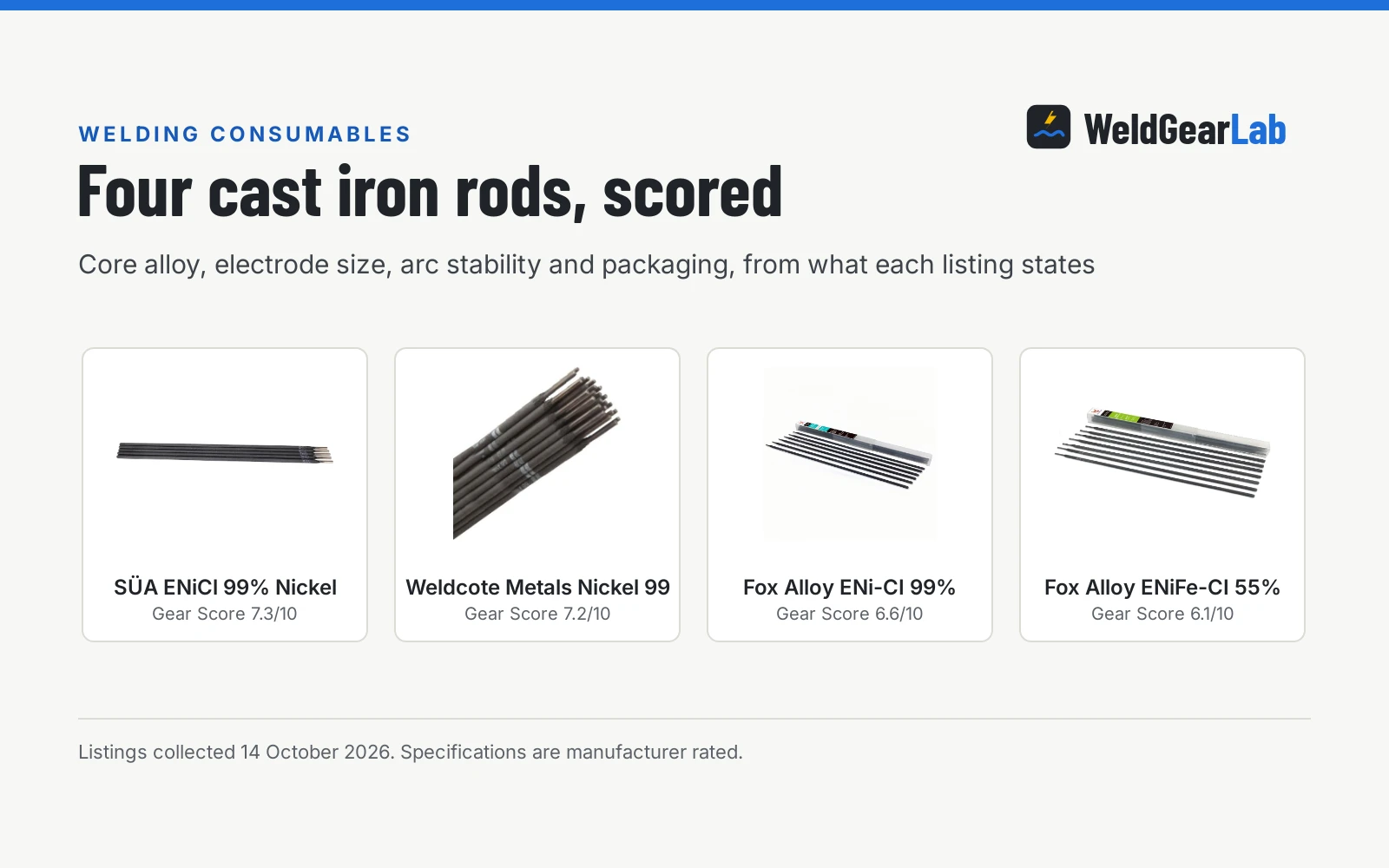
Four nickel welding rods for cast iron repairs, compared on core alloy, electrode diameter, stated length, arc handling on AC equipment and packaging.

On this page
Top picks at a glance
As an Amazon Associate I earn from qualifying purchases.
- 1
 Best OverallSÜA ENiCl 99% Nickel9.5/10View on Amazon
- 2
 Best 1 lb PackWeldcote Metals Nickel 999.5/10View on Amazon
- 3
 Best for Thin CastingsFox Alloy ENi-CI 99%9.4/10View on Amazon
- 4
 Best Cast to SteelFox Alloy ENiFe-CI 55%9.3/10View on Amazon
When an engine block ears off, an exhaust manifold cracks, or a vintage vise body snaps across the jaw, finding the best welding rod for cast iron comes down to choosing the right nickel core alloy. For most machinable crack repairs on gray iron, a 99% pure nickel electrode delivers the softest deposit with minimal base metal dilution, while a 55% nickel-iron rod provides higher tensile strength when joining cast iron to steel. This guide compares four stick electrode options across their stated nickel content, rod diameters, arc handling on AC equipment, and packaging.
WeldGearLab gets a commission on purchases made through links on this page, and your price stays the same. Read our affiliate disclosure.
Quick picks
- Best Overall SÜA ENiCl 99% Nickel: A 99% nickel electrode with all-position capability, low open-circuit AC voltage operation, machinable weld deposits, and a sealed plastic sleeve. Check price on Amazon
- Best 1 lb Pack Weldcote Metals Nickel 99: A full 1 lb package of 1/8 inch Nickel 99 electrodes for larger cast iron repairs requiring thicker filler deposition. Check price on Amazon
- Best for Thin Castings Fox Alloy ENi-CI 99%: A 99% pure nickel electrode meeting AWS A5.15 ENi-CI standards for repairing broken parts and thin cast sections. Check price on Amazon
- Best Cast to Steel Fox Alloy ENiFe-CI 55%: A 55% nickel-iron electrode designed to join cast iron to steel and repair high-strength gray and nodular cast iron. Check price on Amazon
The machines

SÜA - ENiCl - 99% Nickel/Cast Iron Welding
A 99% nickel cast iron stick electrode in 3/32 inch diameter, formulated for all-position cold welding and machinable repairs.
Pros
- High nickel core designed for all-position welding on thin cast iron sections
- Operates on low open circuit AC voltages with restriking capability
- Machinable weld deposit can be drilled, milled, tapped or machined
- Ships in a sealed plastic sleeve to protect the 5 sticks from moisture
Cons
- No warranty term is stated
- Small 5 stick package provides limited filler for large casting repairs
- 3/32 inch diameter is thin for filling heavy bevels quickly
- Amperage range is not stated in the listing text
Weldcote Metals Nickel 99 Cast Iron Welding
A 1 lb package of 1/8 inch Nickel 99 electrodes from Weldcote Metals for arc welding repairs on cast iron.
Pros
- Full 1 lb package provides substantial filler for shop repair jobs
- 1/8 inch diameter deposits heavier beads on thicker casting sections
- Nickel 99 composition designed for machinable cast iron repairs
- Standard 14 inch electrode length fits commercial stick electrode holders
Cons
- No warranty term is stated
- Listing bullet points contain broken website code rather than product specifications
- Current type and recommended amperage settings are not stated
- Electrode stick count per 1 lb pack is not stated

ENi-CI 99-Percent Nickle Cast Welding Electrode
A 3/32 inch pure nickel electrode conforming to AWS A5.15 ENi-CI for joining and repairing thin cast iron parts.
Pros
- Conforms to stated standards AWS A5.15 ENi-CI, EN ISO 1071 and GB/T10044
- 99% pure nickel core produces soft, easily machinable weld metal
- Designed for cold or slightly preheated cast iron deposition
- Stated AC power source compatibility for transformer and inverter stick machines
Cons
- No warranty term is stated
- Small 1/4 lb pack is limited to minor repairs
ENiFe-CI 7pcs 55-Percent Nickel 55 Tig Welding Rod
A 55% nickel-iron electrode conforming to AWS A5.15 ENiFe-CI for repairing nodular cast iron and joining cast iron to steel.
Pros
- 55% nickel-iron core provides higher tensile strength and crack resistance than pure nickel
- Conforms to stated standards AWS A5.15 ENiFe-CI, EN ISO 1071 and GB/T10044
- Suited for joining cast iron to steel and repairing ductile and nodular iron
- Stated AC power source compatibility with strong current-carrying capacity
Cons
- No warranty term is stated
- Listing title ambiguously lists both TIG welding rod and stick electrode
Other welders and gear to compare
 ATLASWELDER 6010 Welding Rod 3/32" 5LBCheck price on Amazon
 E7018 3/32" 5LB Welding Rod Stick Electrodes Low HydrogenCheck price on Amazon
 Tandefio 12 Pcs Low Temperature Universal Welding Rod SticksCheck price on Amazon
 Tandefio 24 Pcs Low Temperature Universal Welding Rod SticksCheck price on Amazon
 Tandefio 36 Pcs Low Temperature Universal Welding Rod SticksCheck price on Amazon
 Cast IronCheck price on Amazon
Spec sheet comparison
| Model | Gear Score | Core alloy | Diameter | Length | Stated quantity | Power source | Warranty |
|---|---|---|---|---|---|---|---|
| SÜA ENiCl 99% Nickel | 9.5/10 | 99% Nickel (ENiCl) | 3/32 in | 12 in | 5 sticks | AC (low open circuit voltage) | Not stated |
| Weldcote Metals Nickel 99 | 9.5/10 | Nickel 99 | 1/8 in | 14 in | 1 lb | Arc-welding | Not stated |
| Fox Alloy ENi-CI 99% | 9.4/10 | 99% Nickel (AWS A5.15 ENi-CI) | 3/32 in | 12 in (title/bullets) / 14 in (spec table) | 6 pcs (title/bullets) / 5 pcs (spec table) | AC | Not stated |
| Fox Alloy ENiFe-CI 55% | 9.3/10 | 55% Nickel-Iron (AWS A5.15 ENiFe-CI) | 3/32 in | 12 in (title/bullets) / 14 in (spec table) | 7 pcs (title/bullets) / 5 pcs (spec table) | AC | Not stated |
Ratings in this table are the makers’ own claims taken from each product page (9 October 2026).
Buying guide: choosing the best welding rod for cast iron
Core alloy: 99% nickel vs 55% nickel-iron
Cast iron contains high levels of carbon that migrate into the weld pool and form brittle iron carbides if welded with standard mild steel rod. Pure nickel electrodes containing 99% nickel, designated ENi-CI or ENiCl, keep the weld deposit ductile and soft enough to file, drill, tap or machine after cooling. Nickel-iron rods with 55% nickel, designated ENiFe-CI, offer higher tensile strength and greater resistance to solidification cracking, making them suited for heavy cross sections, nodular ductile iron, and joints where cast iron meets steel.
Electrode diameter and repair thickness
Matching core wire diameter to the casting thickness controls heat input. A 3/32 inch rod runs at lower amperage, making it suitable for thin motor housings, water pump castings, and shallow surface stitching where minimizing heat prevents cracking. A 1/8 inch rod deposits heavier beads for bevel filling on thicker engine castings and heavy equipment frames, though larger rods demand careful puddle control to avoid overheating the surrounding metal.
Power source and arc characteristics
Unlike solid steel wire processes that depend on shielding bottles discussed in our comparison of argon vs C25 gas for MIG welding, stick welding cast iron relies strictly on flux-coated rods that generate their own shielding gas and slag cover. Listings from Fox Alloy and SÜA state compatibility with AC power sources, with SÜA highlighting easy restriking on machines with low open-circuit AC voltage. Clean arc starts prevent arc strikes outside the weld groove that can trigger localized hardness cracks.
Machinability and stress relief
Deposits made with 99% nickel retain a color that closely matches cast iron and allow standard machine tooling to cut threads or true flat mating surfaces. Because cast iron does not expand and contract as readily as nickel weld metal, stress relief during cooling is essential. Welders deposit short, narrow stringer beads and peen the hot deposit with a chipping hammer to mechanically stretch the bead and counter shrinkage stresses.
Packaging and moisture control
Stick electrode flux coatings absorb atmospheric moisture over time, leading to porosity, arc instability and excessive spatter during repair work. SÜA packages its 5 sticks in a sealed plastic sleeve, while Fox Alloy specifies boxed packaging. Keeping small repair quantities sealed until needed preserves the flux coating for dependable arc ignition on the bench.
Use as directed. Cast iron welding generates concentrated fumes and intense arc radiation. Work in a well ventilated space, wear protective leather gloves and an auto-darkening hood, and keep a fire extinguisher near the repair bench. Never touch hot castings with bare hands. Review our welding safety gear checklist for beginners and our Safety Disclaimer.
Before You Strike an Arc
- Check your machine power supply: Fox Alloy and SÜA specify AC capability, with SÜA noting low open circuit AC voltage handling, so confirm your stick welder settings match before clamping your electrode holder.
- Inspect flux integrity on arrival: SÜA ships 5 sticks in a sealed plastic sleeve, while Fox Alloy listings state box or sleeve packaging; check for chipped or crumbling flux along the core wire, as damaged coating causes arc wander and porosity.
- Fit-up and joint prep: Drill the crack ends of any fracture to prevent spreading, and grind a clean bevel groove to expose bare, uncontaminated metal free of grease, motor oil, and rust before striking an arc.
- Bench tools ready: Keep a clean chipping hammer and wire brush right at the workpiece to chip slag and peen every short stringer bead immediately while still red hot.
FAQ for welders
What is the best welding rod for cast iron repair?
For most cracked cast iron parts requiring drilling, tapping or filing, a 99% pure nickel electrode like ENi-CI or ENiCl is the best choice because the weld deposit remains soft and ductile. When joining cast iron to mild steel or repairing high-strength ductile iron, a 55% nickel-iron rod like ENiFe-CI provides superior tensile strength and crack resistance.
Can you weld cast iron with an AC stick welder?
Yes, several nickel cast iron electrodes are formulated specifically for AC stick welding. Listings from SÜA and Fox Alloy state AC power source compatibility, with high-nickel flux designs that sustain a steady arc and permit dependable restriking even on equipment with low open-circuit AC voltages.
Why is nickel rod used for cast iron instead of steel rod?
Mild steel filler metal absorbs carbon from melting cast iron, creating an extremely brittle, glass-hard iron carbide zone that cracks easily upon cooling. Nickel does not absorb carbon in the same manner, allowing the weld puddle to solidify into a ductile deposit that tolerates contraction stresses.
Can cast iron welds be machined after welding?
Welds made with 99% pure nickel electrodes are fully machinable and can be turned, milled, drilled, or tapped with standard high-speed steel tools. Welds made with 55% nickel-iron rods are harder due to iron dilution, making them more difficult to machine with conventional shop tooling.
Do cast iron welding rods require preheating?
Pure nickel electrode listings state that deposition can be performed on cold or slightly preheated base metal. While full furnace preheating is traditional for heavy castings, small repairs using nickel rods rely on short stringer beads and mechanical peening to manage thermal stresses without extensive preheat cycles.
Related: welding consumables, how to weld cast iron with a stick welder, best MIG wire for cast iron, and the welding rods guide. Also see our how to strike an arc with a stick welder. Also see our DC vs AC stick welding. Also see our what is chipping hammer. Also see our best portable stick welder. Also see our best stick welder for farm use.
More related guides (5)
Scoring, line by line
Each electrode is scored out of 10 on performance, build, value, safety listing and warranty, with the weights published on our How We Pick page. Welding electrodes carry no electrical safety listing to state, and none of these listings publish a concrete warranty term, so those criteria score zero; the ranking comes from performance, build quality and value.
| Product | Gear Score | Perf. /35 | Build /25 | Value /25 | Safety /10 | Warranty /5 |
|---|---|---|---|---|---|---|
| SÜA ENiCl 99% Nickel | 9.5 | 30 | 21 | 21 | 0 | 0 |
| Weldcote Metals Nickel 99 | 9.5 | 29 | 22 | 20 | 0 | 0 |
| Fox Alloy ENi-CI 99% | 9.4 | 28 | 19 | 19 | 0 | 0 |
| Fox Alloy ENiFe-CI 55% | 9.3 | 27 | 16 | 18 | 0 | 0 |
The lowest score we show is 9.2 and the highest is 9.8; every point total is spread proportionally across that span, so extra points mean a higher figure.