Welding Rods Guide: Types, Numbers, and Selection
Stick welding electrodes differ by tensile strength, welding position, flux coating, and polarity, which determines how each rod runs on clean, dirty, or structural steel.

On this page
Top picks at a glance
As an Amazon Associate I earn from qualifying purchases.
- 1
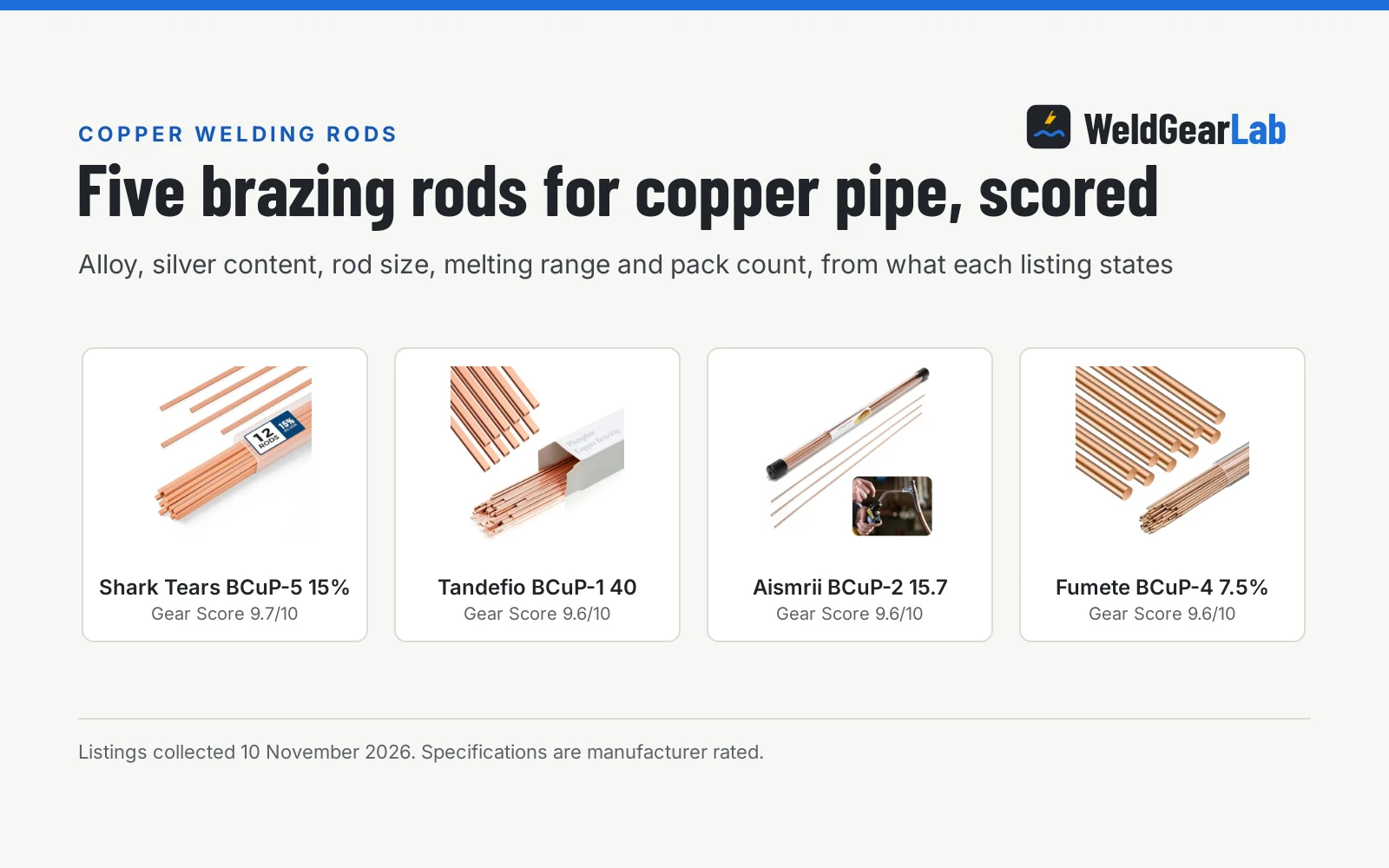
 12 pcs Brazing Rods AWS BCuP-5 15% Silver Solder Phos Copper9.7/10View on Amazon
- 2
 Tandefio Brazing Rods AWS Bcup-1 40 Sticks9.6/10View on Amazon
- 3
 Brazing Rods9.6/10View on Amazon
When you have broken farm machinery, cracked trailer steel, or a shop fabrication project on the bench, picking the right stick electrode decides whether your bead holds under load or cracks under stress. This welding rods guide explains how shielded metal arc welding electrodes work, what the printed classification numbers mean, and how flux coating designs determine arc penetration, puddle freeze, and required welder polarity. Shielded metal arc welding relies on a flux-covered consumable wire that creates its own shielding gas and protective slag as you burn the electrode, keeping atmospheric contamination out of the molten puddle.
This guide links to our product roundups, where WeldGearLab gets a commission on purchases made through links on this page, and your price stays the same. Read our affiliate disclosure.
The classification system in one paragraph
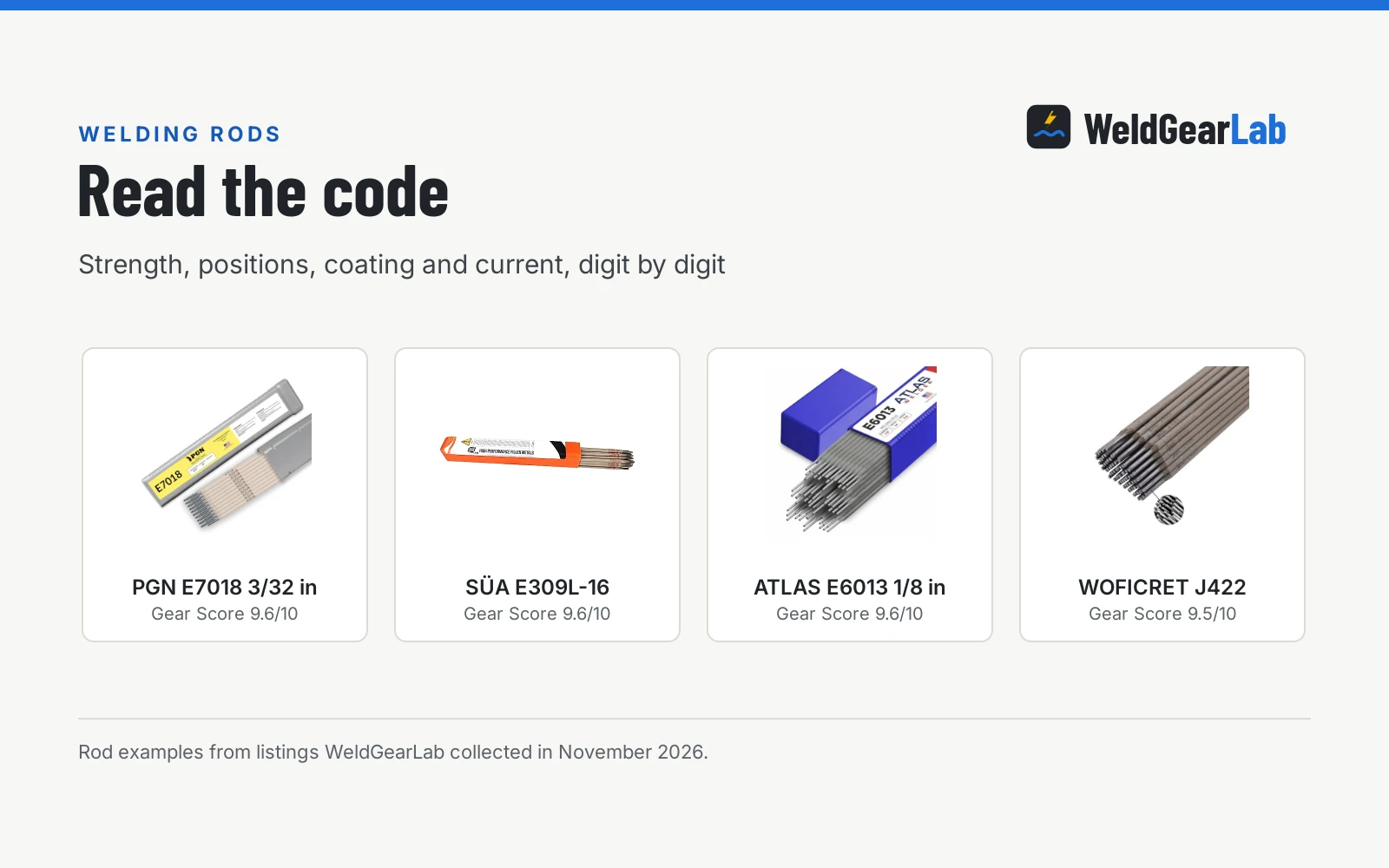
Every stick welding electrode carries an American Welding Society designation stamped near the grip end. The initial letter stands for electrode. The leading digits indicate the minimum tensile strength of the deposited weld metal, expressed in thousands of pounds per square inch. The next digit designates the welding positions the electrode supports, distinguishing between all-position electrodes and those restricted to flat joints and horizontal fillets. The final digit, read alongside the preceding position digit, identifies the chemical flux coating formula, the type of arc shielding produced, and the compatible electrical welding current and polarity.
Welding rods guide: side by side comparison
| Fast freeze (E6010 / E6011) | Fill freeze (E6013) | Low hydrogen (E7018) | |
|---|---|---|---|
| Flux coating | Cellulose sodium or potassium | Rutile (titania) | Basic low hydrogen, iron powder |
| Arc drive and penetration | Aggressive arc, deep penetration | Soft arc, shallow penetration | Smooth, quiet arc, medium penetration |
| Joint prep and dirty steel | Tolerates rust, mill scale, and paint | Works best on clean metal, slag peels off cleanly | Needs clean joint, sensitive to moisture |
| Welding position | All positions, fast freezing puddle | All positions, easy sheet control | All positions except vertical down |
| Slag and cleanup | Thin, light slag, chips easily | Dense slag, peels off cleanly | Heavy slag, often curls up on cool |
| Power supply polarity | E6010 runs DCEP; E6011 runs AC or DCEP | Runs on AC, DCEP, or DCEN | Runs on DCEP or AC (electrode specific) |
| Storage and moisture | Normal shop conditions | Normal shop conditions | Sealed can or rod oven to avoid moisture pickup |
| Common applications | Field repair, farm machinery, root runs | Light fabrication, sheet metal, gates | Structural joints, heavy equipment, trailers |
Current settings and polarity requirements depend directly on the flux formulation of the electrode; always confirm the operating parameters stamped on the electrode packaging before striking an arc. Most stick welding power supplies allow quick polarity changes by swapping the electrode holder lead and work clamp lead between positive and negative output lugs.
When fast-freeze electrodes are the right choice
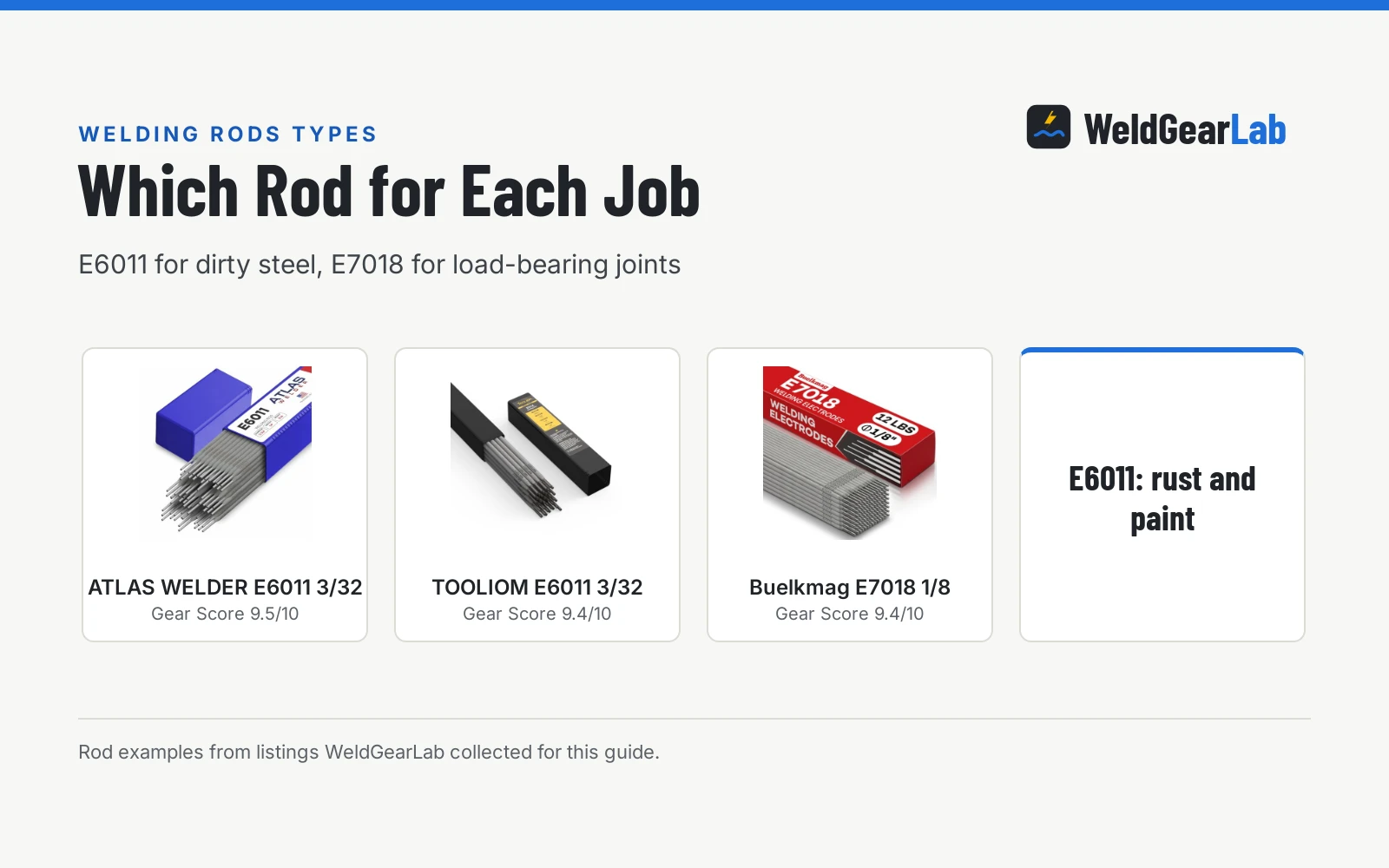
Fast-freeze electrodes feature high cellulose coatings that produce a forceful, digging arc with a light slag layer that solidifies rapidly. These characteristics make them the standard choice for out-of-position welding, pipe joints, and dirty metal where deeper root penetration is essential.
- Dirty, rusty, or oily steel. Cellulose flux generates a forceful gas plume that burns through surface rust, mill scale, and light paint, which suits field repairs on agricultural implements.
- Out-of-position joints. Because the puddle solidifies rapidly, the molten metal will not sag or drip when pulling vertical-up beads or welding overhead.
- Root pass penetration. The focused arc digs deep into tight root openings, bridging gaps and achieving full joint penetration on open root pipe welds.
- Quick slag cleanup. The thin, friable slag layer chips off rapidly with a standard chipping hammer and wire brush.
Our best stick welder for farm use roundup reviews machines capable of running aggressive cellulose electrodes, while our how to stick weld rusty metal guide provides practical prep strategies for uncleaned salvage iron.
When low-hydrogen electrodes are the right choice
Low-hydrogen electrodes use a mineral flux coating enriched with iron powder to produce smooth, ductile welds with exceptional crack resistance. They represent the primary specification for structural steelwork, heavy plate fabrication, and high-strength repair tasks.
- Structural steel and heavy plate. Mineral flux minimizes diffused hydrogen in the molten deposit, preventing underbead cracking on thick sections and rigid restrained assemblies.
- High tensile strength and ductility. Low-hydrogen rods are chosen for structural steelwork and heavy plate fabrication where strength and ductility matter.
- Smooth bead appearance. The arc burns softly with minimal spatter, depositing a uniform, slightly convex bead suitable for visible fabrication.
- Heavy protective slag. A thick slag blanket insulates the cooling puddle and frequently curls away from the bead on its own as the joint cools.
Proper storage is essential because exposed flux absorbs moisture from humid air; check our guide on how to store 7018 rods without a rod oven and read our overview on what does 7018 mean on a welding rod for full code definitions.
When fill-freeze electrodes fit light shop work
Fill-freeze electrodes employ rutile flux coatings containing titanium dioxide, producing a gentle arc with shallow penetration and a fluid puddle. These rods excel at sheet metal fabrication, decorative metalwork, and quick hobby repairs where burning through thin stock is the main concern.
- Thin sheet metal and light tubing. Shallow penetration prevents blow-through on light-gauge steel and automotive body brackets.
- Effortless arc striking and restriking. Rutile coatings establish an electric arc easily without aggressive pecking, making restrikes on short tack welds straightforward.
- Stable performance on low open-circuit voltage. These electrodes run smoothly on small home-shop welders that lack the open-circuit voltage required by cellulose rods.
- Aesthetic weld profile. The fluid puddle wets out smoothly along joint toes, leaving flat, ripple-free beads with minimal surface spatter.
When deciding between different electrode characteristics for utility fabrication, see our 6013 vs 7018 welding rod comparison to match bead shape to metal thickness.
Matching electrode coatings to machine power
Not every stick welding machine can run every rod successfully. The electrical design of your power supply determines which flux formulations will maintain a steady arc without extinguishing or sticking continuously.
- Direct current electrode positive (DCEP). Also known as reverse polarity, DCEP directs the electrode as the positive pole, producing deep penetration, consistent arc stability, and smooth bead profiles on structural low-hydrogen electrodes and heavy repair rods.
- Direct current electrode negative (DCEN). Also known as straight polarity, DCEN directs the electrode as the negative pole, providing a faster electrode burn-off rate with shallower penetration into the workpiece, which helps prevent burn-through on thin sheet assemblies.
- Alternating current (AC). Alternating current reverses direction constantly, eliminating arc blow caused by magnetism in heavy steel plate. Electrodes formulated with potassium arc stabilizers sustain a continuous arc through each zero-voltage crossing on utility AC transformer welders.
- Open circuit voltage limitations. Cellulose electrodes require higher open circuit voltage to ionize the arc stream. Basic transformer buzz boxes often struggle to maintain an arc with pure DC cellulose rods, whereas specialized AC cellulose rods incorporate stabilizing flux additives.
For dedicated advice on selecting rods suited to transformer buzz boxes, explore our best welding rods for AC welder recommendations.
Can one rod handle every farm and shop repair?
No single stick electrode can handle every welding condition encountered in a workshop or field environment. Fast-freeze cellulose rods penetrate rusty plate but lack the low-hydrogen chemistry needed to prevent cracking in heavy restrained structural joints, while low-hydrogen electrodes provide superior crack resistance but demand rigorous joint cleanliness and dry storage.
For most home, farm, and maintenance shops, the practical solution is stocking a balanced pair of electrode types. Keep a supply of fast-freeze cellulose rods on hand for tackling dirty fence lines, rusted machinery brackets, and out-of-position root beads. Complement them with hermetically sealed cans of low-hydrogen rods reserved for heavy structural hitches, trailer tongue repairs, and clean fabrication jobs. Check our curated list of the best welding rods for mild steel to build out your shop supply.
Fume and slag safety. Stick welding generates heavy fumes and airborne spatter. Low-hydrogen and cellulose flux produce smoke that requires adequate workshop ventilation or an outdoor setup with your head positioned outside the rising plume. Chipping hot slag presents a severe eye hazard because brittle slag can fly unexpectedly as it cools; keep safety glasses on under your welding hood whenever you strike or chip. Clear dry grass and combustible clutter from your welding area before striking an arc. Consult our welding safety gear section for protective apparel recommendations.
FAQ for welders
What is the easiest welding rod for a beginner to use?
Rutile-coated electrodes like E6013 are widely considered the simplest electrodes for novices to master. The soft arc strikes easily without sticking, operates reliably on basic utility welders, and produces minimal spatter. Shallow penetration also reduces the risk of burning holes through lighter practice plates.
Why does a welding rod keep sticking to the steel?
Welding rods freeze to the workpiece when the machine amperage is set too low or when the electrode is shoved into the puddle too quickly before an arc column is established. Striking the rod with a match-scratch motion rather than a straight downward tap helps prevent sticking. Read our detailed guide on why does my welding rod keep sticking for troubleshooting machine arc force and technique.
Can you use 7018 welding rods without an oven?
Low-hydrogen electrodes can be used directly from freshly unsealed, airtight cans for non-critical repairs and general hobby work. Once exposed to ambient humidity, the mineral coating gradually absorbs moisture, which can introduce porosity and hydrogen embrittlement into structural welds. For non-code shop tasks, buying small sealed containers and using them promptly avoids the need for a dedicated rod oven.
What is the difference between 6010 and 6011 electrodes?
Both electrodes feature cellulose flux coatings and produce deep, digging penetration through rust and mill scale with a fast-freezing puddle. E6010 is formulated with sodium cellulose and runs exclusively on direct current electrode positive, whereas E6011 incorporates potassium salts to stabilize the arc on alternating current welders as well as direct current. Consult our 6011 vs 7018 welding rod comparison for in-depth arc behavior analysis.
How do you know which electrode diameter to select?
Electrode diameter should match the thickness of the base metal and the heat capacity of your power supply. Thinner core wires operate on low welding current to prevent burn-through on light sheet, while thicker core wires carry higher current and deposit more filler metal per minute on heavy structural plate. When welding thick steel bevels, a smaller diameter electrode is commonly used for the initial root pass, followed by larger rods for fill and cap passes.
Related: best welding rods for mild steel, best welding rods for AC welder, best stick welder for farm use, and the stick welders hub. Also see our welding consumables hub.