Welding Rods Number Meaning: What the Codes Mean
The code on a carbon steel stick rod spells out its strength, positions, coating and current, and four real listings show how to read it.

On this page
Top picks at a glance
As an Amazon Associate I earn from qualifying purchases.
- 1
 PGN E7018 Welding Rod 3/32" 10LB9.6/10View on Amazon
- 2
 SÜA - E309L-16 - Stainless Steel Welding Electrode9.6/10View on Amazon
- 3
 ATLASWELDER 6013 Welding Rod 1/8" 5LB9.6/10View on Amazon
- 4
 WOFICRET J422 Welding Rods, Mild Steel Electrodes9.5/10View on Amazon
A rod box prints a code on every stick, and that code tells you what the rod is made for before you strike an arc. Welding rods number meaning is simple once the pattern clicks: on carbon steel E codes, the letters name the process, the opening digits name the strength, the next digit names the positions, and the last digits name the coating and the current. Read the code and you know whether the rod suits the joint on the bench.
This guide links to our product roundups, where WeldGearLab gets a commission on purchases made through links on this page, and your price stays the same. Read our affiliate disclosure.
PGN E7018 Welding Rod 3/32" 10LB
A 3/32 inch by 14 inch low-hydrogen rod in a 10 pound pack, rated by the listing at 70,000 psi tensile strength for structural steel.
Pros
- 70,000 psi tensile strength stated
- Low-hydrogen, iron powder coating
- AC/DC, all-position use stated
- 10 pound pack, 3/32 by 14 inch size stated
Cons
- No warranty stated
- No storage or drying instructions stated
- One size only: 3/32 inch by 14 inch
- No other pack size in this listing
SÜA - E309L-16 - Stainless Steel Welding Electrode
A stainless electrode in 3/32 inch by 12 inch, 2 pound pack, with 0.04 percent carbon and most deposits over 8 FN for joining stainless to stainless or to mild steel.
Pros
- Low carbon content stated at 0.04 percent
- Most weld deposits over 8 FN stated
- Sizes 3/32 and 1/8 inch, packs 0.5, 2 and 4.4 pound
- Lists the stainless grades it joins, 309L, 304L, 308L, 310, 316L, 321 and 347
Cons
- No tensile strength stated
- No warranty stated
- No current type stated
- Quantity per pound is in a picture, not in the text
ATLASWELDER 6013 Welding Rod 1/8" 5LB
A 1/8 inch by 14 inch carbon steel rod in a 5 pound pack, for all-position stick welding with smooth arc and fast slag removal, per the listing.
Pros
- Diameters 3/32 or 1/8 inch, length 14 inch stated
- Packs of 5 and 10 pound stated
- All-position use: flat, horizontal, vertical and overhead
- Smooth arc and fast slag removal, per the listing
Cons
- No tensile strength stated
- No warranty stated
- No current type stated
- No coating type stated
WOFICRET J422 Welding Rods, Mild Steel Electrodes
A 1.0 mm mild steel rod in a 50 piece pack, listed as similar to E6013, for all-position stick welding on sheet metal and light structural work.
Pros
- Listed as similar to E6013
- All-position welding: flat, vertical, overhead
- 50 piece pack stated
- Smooth arc starts and minimal spatter, per the listing
Cons
- Part number reads 10MM while the title states 1.0mm
- No length stated
- No tensile strength stated
- No warranty stated
Welding rods number meaning, digit by digit
Carbon steel stick rod codes follow one pattern, and the E7018 listing shows it best. The E marks an electrode for stick welding. The digits after it name the tensile strength: the E7018 listing states 70,000 psi, which matches the strength digits in its code. The next digit names the positions the rod runs in, and the last digits name the coating and the current it runs on.
The letter and the strength
The E at the start marks an electrode, and the digits that follow name the strength of the weld metal. The E7018 listing states 70,000 psi tensile strength, so the strength digits in E7018 are the strength number on that listing. The E6013 listing states no tensile strength, so its code reading stops at the pattern: the digits name the strength, and the listing leaves the number to the standard. The E309L-16 listing states no tensile strength either; its code carries a different kind of information, the L and the 16. The L is covered below; the listing does not explain the 16.
The E6013 listing names the family outright: E6010, E6011, E6013 and E7018, all stick welding electrodes.
Positions: the next digit
Every rod in this guide names all-position use. The E6013 listing states flat, horizontal, vertical and overhead. The E309L-16 listing states all position welding, and the J422 listing states flat, vertical and overhead. The E7018 title calls it all-position, while its bullets name flat, vertical and horizontal. In the E6013 and E7018 codes, the digit after the strength names those positions, so a rod that lists every position carries the all-position digit.
The J422 listing states all-position welding too, and says the rod is similar to E6013.
Coating and current: the last digits
The last digits name the coating and the current the rod runs on. The E7018 listing states a low-hydrogen, iron powder coating and AC/DC use, so its code ends in the digits for that coating and current. The E309L-16 listing states low carbon content of 0.04 percent, which is what the L marks, and most weld deposits over 8 FN. The E6013 and J422 listings state no coating and no current type, so their last digits stay unread on the listing alone.
Side by side
| E6013 | E7018 | E309L-16 | J422 | |
|---|---|---|---|---|
| Strength stated | Not stated | 70,000 psi | Not stated | Not stated |
| Positions | Flat, horizontal, vertical, overhead | Flat, vertical, horizontal | All position | Flat, vertical, overhead |
| Current | Not stated | AC/DC | Not stated | Not stated |
| Diameter | 3/32 in or 1/8 in | 3/32 in | 3/32 in or 1/8 in | 1.0 mm |
| Length | 14 in | 14 in | 12 in or 14 in | Not stated |
| Pack | 5 LB or 10 LB | 10 LB | 0.5, 2 or 4.4 LB | 50 pcs |
| Steel | Carbon steel | Structural steel | Stainless steel | Mild steel |
Only one listing here states a tensile strength number: the E7018 at 70,000 psi. The other listings state diameters, packs, and lengths where given, so read the carbon steel codes for the strength and the listing for the size.
Rods that show the code in action
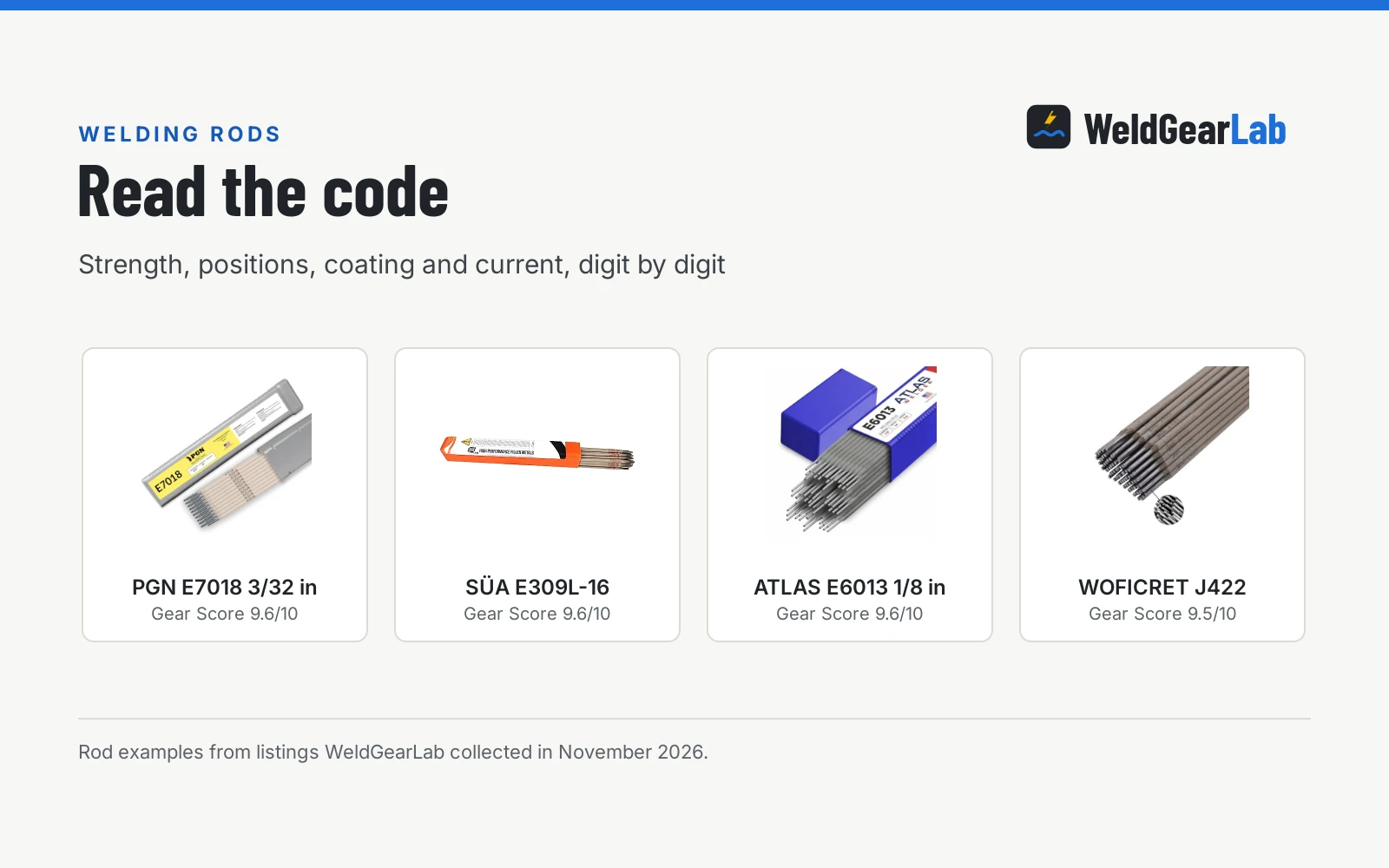
Each rod below shows one part of the code on a real listing: the E7018 shows the strength number, the E309L-16 shows the low carbon mark, and the E6013 and J422 show the positions.
How to pick a rod from the code
Match the code to the joint, then check the size. Read the strength digits against the steel: the E7018 listing names structural steel, pipeline welding and heavy machinery, while the J422 listing names sheet metal and light structural work. Read the positions against the joint: the E6013, E309L-16 and J422 listings name overhead among their positions, and the E7018 title calls it all-position while its bullets name flat, vertical and horizontal. Then check the diameter and length on the listing: 3/32 inch or 1/8 inch and 12 inch or 14 inch on the three E rods, while the J422 states 1.0 mm and no length.
When the listing stays silent on a digit, say so and move on: the E6013 and J422 listings state no tensile strength, and the E309L-16 listing states no current type. Check the manufacturer’s data before buying for critical work.
Arc flash, fumes and fire. Stick welding throws arc light, fumes and hot slag. Wear a helmet and safety glasses, keep your head out of the plume, and clear dry grass and anything flammable from the area. Check the machine’s door chart or manual for the settings your rod needs.
FAQ for welders
What do the numbers on a welding rod mean?
On carbon steel E codes, the letters and digits name the process, the strength, the positions and the coating and current. The E7018 listing states 70,000 psi tensile strength, which matches the strength digits in its code, and the listings here name all-position use. The L in E309L-16 marks the low carbon content the listing states at 0.04 percent.
What is the difference between E6013 and E7018?
The E7018 listing states 70,000 psi tensile strength, a low-hydrogen iron powder coating and AC/DC use, aimed at structural steel and pipeline welding. The E6013 listing states diameters of 3/32 inch or 1/8 inch, a 14 inch length and packs of 5 or 10 pound, aimed at automotive repairs, gates, railings and sheet metal. The E6013 listing states no tensile strength, so compare them on what each listing states, not on the code alone.
What does the L mean in E309L-16?
The L marks low carbon. The listing states low carbon content of 0.04 percent, which preserves the corrosion resistant properties of the weld deposit and gives a higher ferrite content than standard 309-16. Most weld deposits are over 8 FN, per the listing.
Can I use E6013 on stainless steel?
Not on the listings here. The E6013 listing names carbon steel and uses such as gates, railings and sheet metal. For stainless, the E309L-16 listing names 309 and 309L to itself and to grades such as 304L, 308L, 310, 316L, 321 and 347, as well as to mild and carbon steels.
What size welding rod do I need?
It depends on the joint and the machine, and the listings here give the sizes to choose from: 3/32 inch or 1/8 inch diameter, 12 inch or 14 inch long, and 1.0 mm on the J422. The E7018 listing states 3/32 inch by 14 inch. Check the machine’s door chart or manual for the size your machine runs.
Related: 6013 welding rod uses, size of welding rod, best all around stick welding rod, and the welding consumables hub.