What Is Chipping Hammer: Slag Removal, Types, and Shop Guide
A chipping hammer removes hardened slag and spatter from stick and flux core welds using pointed and chisel ends designed for shop and field metal clean-up.

On this page
Top picks at a glance
As an Amazon Associate I earn from qualifying purchases.
- 1
 ESTWING Welding/Chipping HammerView on Amazon
- 2
 Welding Chipping Hammer with Coil Spring HandleView on Amazon
- 3
 Arc-Zone 500g Dual-Head Chipping Hammer with CoolHand SpringView on Amazon
- 4
 VASTOOLS Welding Chipping Hammer and Wire Brush SetView on Amazon
- 5
 ZOENHOU 6 PCS 10.5" Welding Chipping Hammer with Coil SpringView on Amazon
- 6
 VASTOOLS Welding Chipping Hammer with Coil Spring HandleView on Amazon
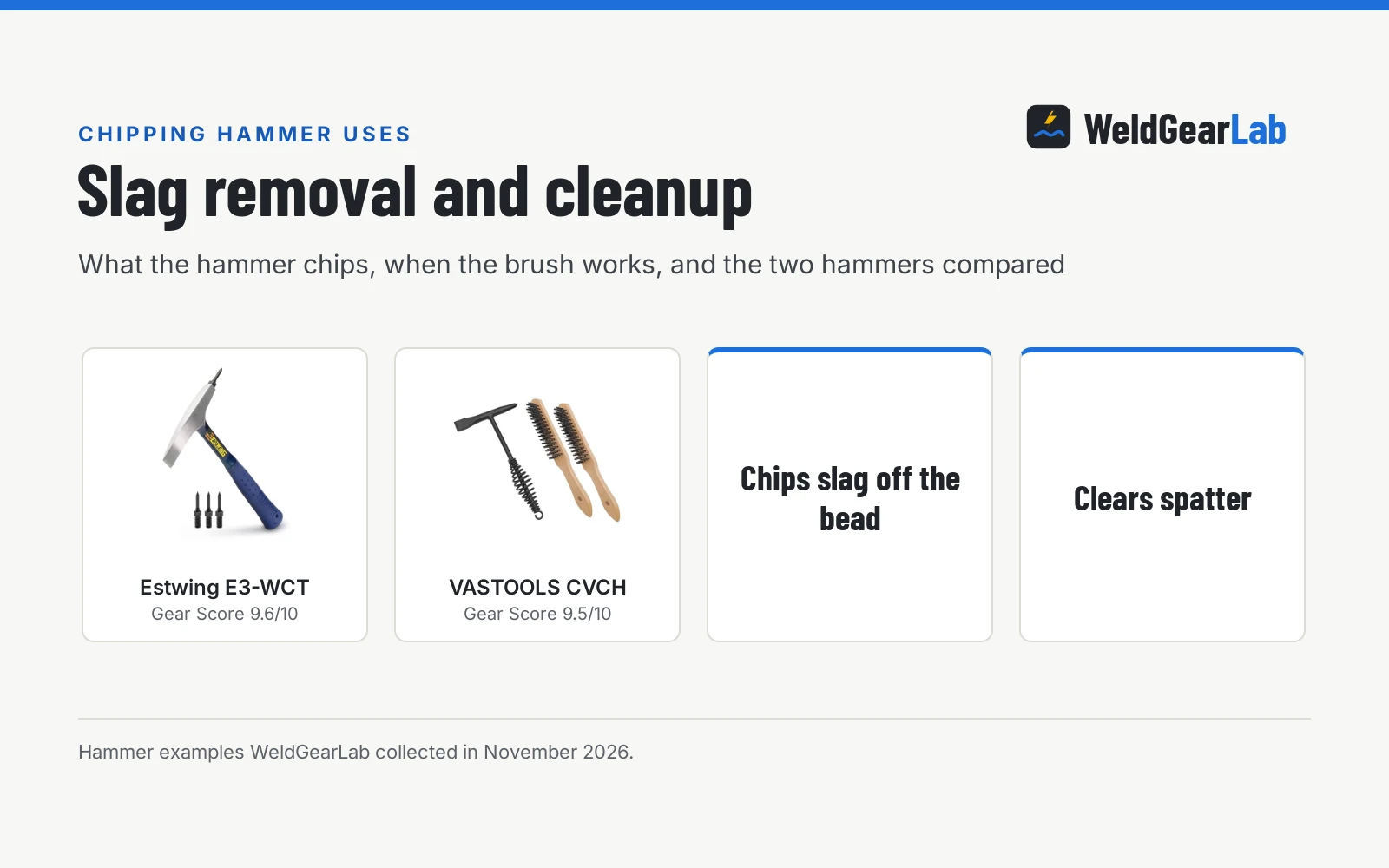
When you pull your hood up after running a stick electrode across plate or running gasless wire on a farm repair, a dark glass crust covers the seam. Before inspecting bead contour or laying another pass, that shell has to come off. Understanding what is chipping hammer design comes down to one job: it is a dedicated welding hand tool built with pointed and chisel ends to fracture and clear hardened slag.
Other welders and gear to compare
 ESTWING Welding/Chipping HammerCheck price on Amazon
 Welding Chipping Hammer with Coil Spring HandleCheck price on Amazon
 Arc-Zone 500g Dual-Head Chipping Hammer with CoolHand SpringCheck price on Amazon
 VASTOOLS Welding Chipping Hammer and Wire Brush SetCheck price on Amazon
 ZOENHOU 6 PCS 10.5" Welding Chipping Hammer with Coil SpringCheck price on Amazon
 VASTOOLS Welding Chipping Hammer with Coil Spring HandleCheck price on Amazon
This guide links to our product roundups, where WeldGearLab gets a commission on purchases made through links on this page, and your price stays the same. Read our affiliate disclosure.
What is chipping hammer role on the welding bench
Stick and flux-cored arc welding generate a molten flux blanket over the puddle to shield liquid steel from atmospheric oxygen and nitrogen. As the puddle solidifies, that flux cools into an oxidized glass crust known as slag. Standard claw or ball peen hammers have broad faces that crush slag into the bead rather than lifting it.
A chipping hammer solves this by combining dual specialized ends on one head: a beveled flat chisel on one end and a tapered conical pick on the other. Listings reflect this geometry across various weights. For instance, Estwing publishes a 14 oz model with a 7/8-inch chisel side, while Klein Tools lists a 10-ounce head on a 7-inch steel head. Light, controlled taps fracture the brittle casing along the weld toes.
Side by side
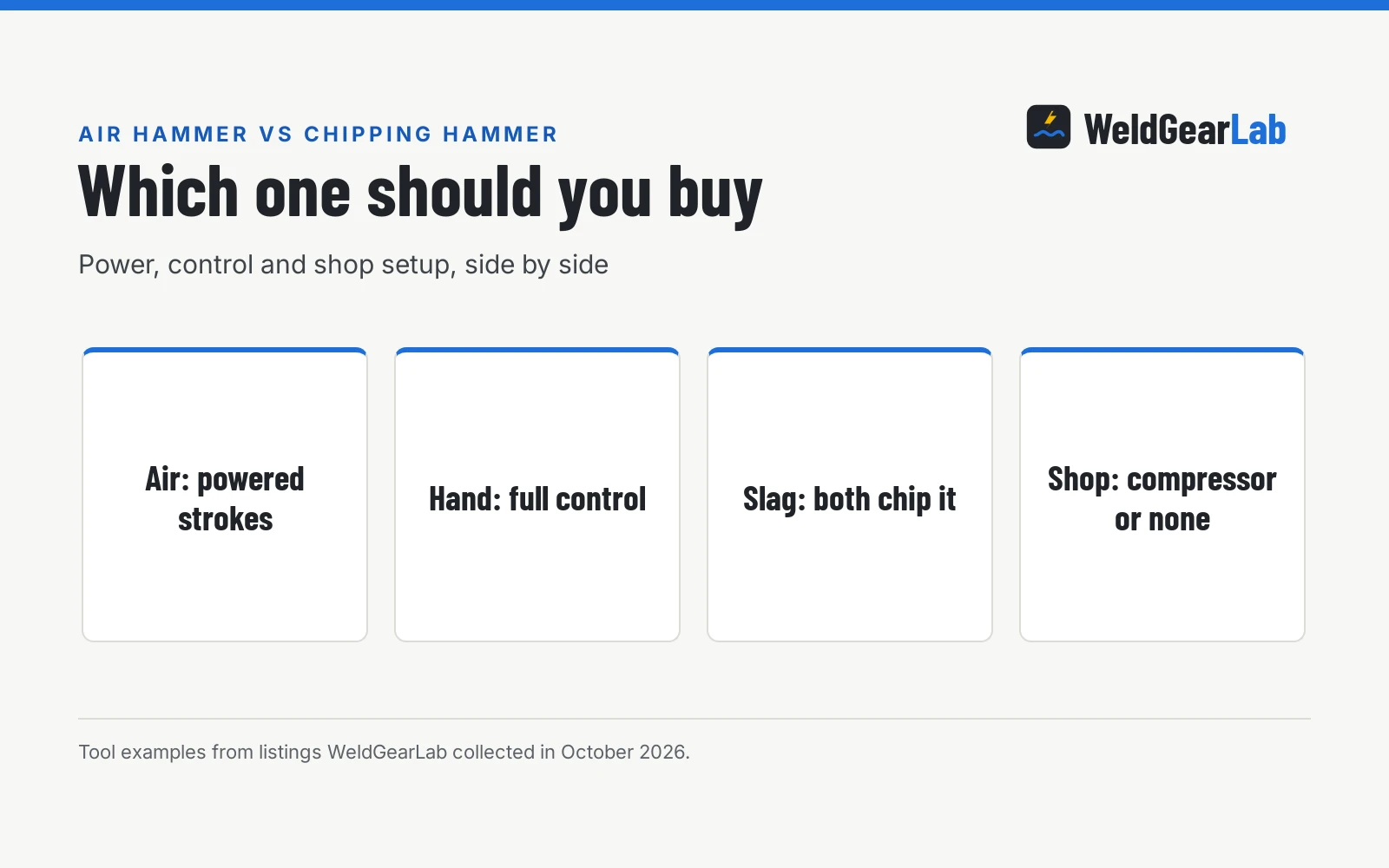
| Coil spring handle | Solid steel with shock grip | Fiberglass handle | |
|---|---|---|---|
| Handle material | Tapered spiral wire coil over solid steel rod | Forged or welded steel shank with molded synthetic grip | High-strength fiberglass core with rubberized overmold |
| Vibration damping | Radial wire coil flexes to dissipate impact shock before reaching hand | Molded elastomer grip absorbs striking vibration directly | Composite fiberglass matrix dampens impact shock naturally |
| Heat resistance | All-metal construction tolerates direct contact with warm weldments | Synthetic grip requires reasonable distance from red-hot metal | Composite resin jacket must stay clear of direct open arc spatter |
| Weight balance | Weight concentrates in forged head for forward striking momentum | Weight distributes evenly along steel handle and shaft | Balanced feel with lightweight handle and heavy striking head |
| Storage and hanging | End loop on spring handle hangs over cart hooks or shop pegs | Hanging hole through base of handle or dedicated tether slot | Lanyard hole through base of grip for storage pegs |
| Typical shop role | Field repairs, mobile stick welding, and dirty farm equipment | Production fabrication benches, structural work, and shop welding | Demolition, maintenance kits, and general multi-tool shop tasks |
Selecting a handle style depends on your bench environment. Coil spring handles resist radiant heat during heavy multipass welding, while steel shanks with cushioned grips offer comfort during long fabrication shifts.
Chipping hammer head designs: chisel vs point
Standard slag hammers combine dual striking geometries for different bead profiles:
- Beveled flat chisel. The chisel end features a straight edge aligned vertically or horizontally with the handle. It acts as a wedge to lift broad sheets of slag on groove welds and weave caps without gouging base metal. Listings publish specific blade widths: Estwing specifies a 7/8-inch wide chisel blade, while VASTOOLS publishes a 0.9-inch chisel width on its 10.5-inch hammer.
- Conical point (pick). The tapered point concentrates impact onto a small surface area to fracture stubborn slag in groove roots, fillet corners, and crater tie-ins. Because it penetrates recesses that a flat blade cannot reach, it is essential for clearing root passes before running fill passes.
Our best chipping hammer guide covers dedicated slag removal tools for shop and field work.
Handle styles and vibration damping
Chipping slag involves repetitive impacts that send shock up the tool into the welder’s hand and wrist. Makers address this fatigue with distinct handle styles:
- Spiral coil spring handles. Classic slag hammers feature a tapered spring steel coil wrapped around a central rod. Arc-Zone lists a 500g model with a spring steel handle, and Bamboo’s Grocery LoKii publishes a 0.27 kg model with a spiral handle. The open wire coil flexes to dissipate impact shock, and its all-metal build will not melt near hot steel.
- Steel handles with cushioned grips. Steel slag hammers often add an ergonomic sleeve to dampen vibration. Estwing builds one-piece forged steel tools and states its molded vinyl grip reduces impact vibration by 70%. Other steel tools use cushioned sleeves; N NOAH lists a 28oz tool with a 14-ounce header (1.8 pounds overall) featuring a shock-reduction grip, while Klein Tools lists a 1.3 pounds model with a heat-resistant grip.
- Fiberglass handles. Maintenance sets like the MAXPOWER 500g chipping hammer (on Amazon) feature an 11.5-inch fiberglass handle that dampens shock well during mixed shop tasks.
How to use a chipping hammer step by step
Chipping slag correctly preserves bead appearance and keeps joints sound. Follow these shop steps on the bench:
- Let the bead cool. Never strike glowing metal. As the weld cools, differential thermal contraction loosens the slag bond. On clean steel, cooling slag often crackles and lifts on its own.
- Position your safety gear. Keep safety glasses on and stand with your head to the side of the weld line rather than directly above it.
- Address the bead toe with the chisel. Lay the chisel flat against the base metal at a shallow angle to the toe. Use light wrist taps along the boundary to wedge the blade under the slag sheet.
- Clear tight pockets with the pick. Switch to the pointed end for corners, crater tie-ins, and narrow root recesses. Light taps shatter trapped glass.
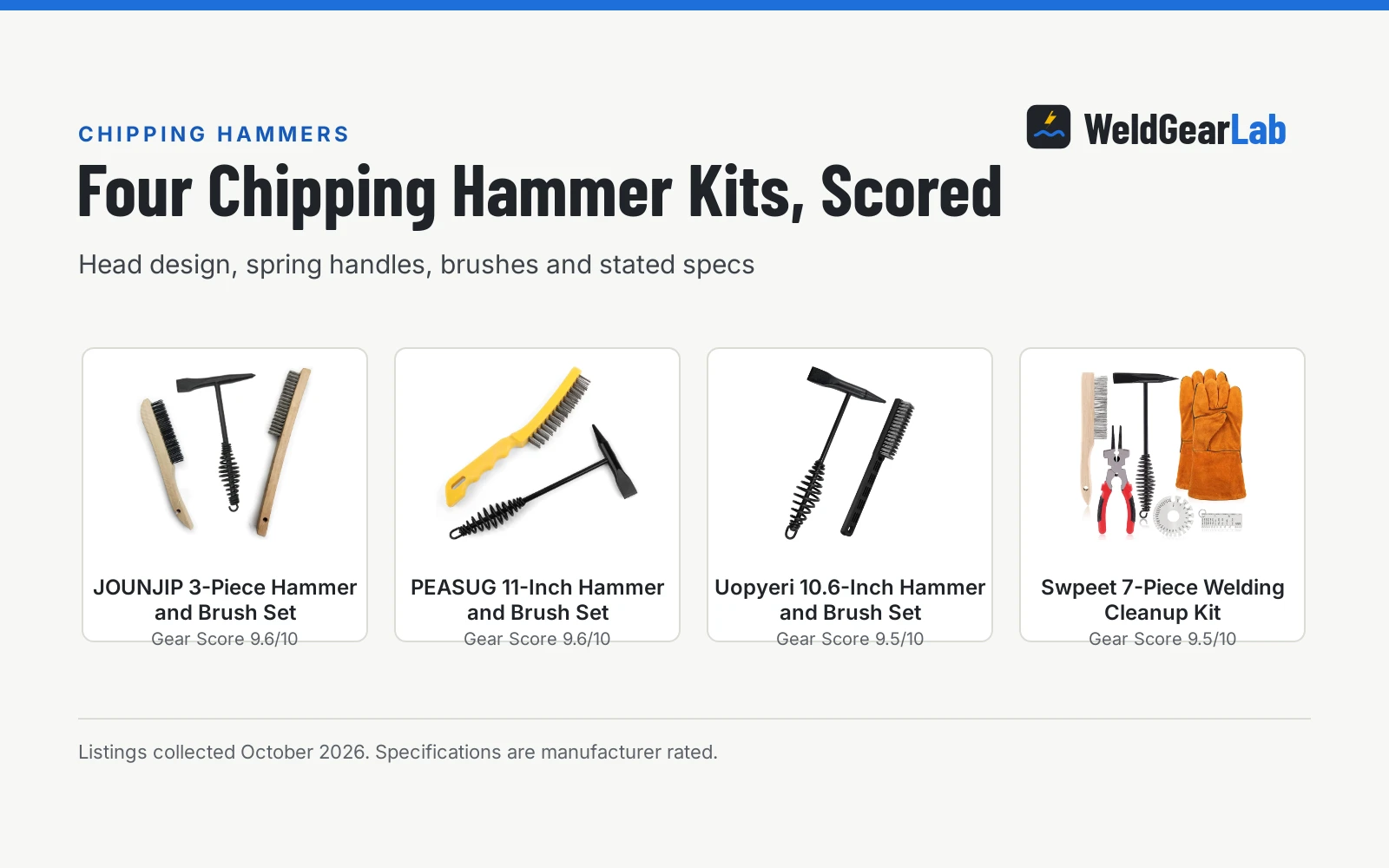
- Finish with a wire brush. A chipping hammer fractures bulk slag, while a wire brush removes fine dust. Sets like PEASUG combine an 11-inch hammer with a 10.5-inch wire brush, while Mardatt pairs a 10.4-inch (26.5 cm) hammer with a 9.8-inch (25 cm) wire brush to clean metal before the next pass.
If you are setting up your shop for stick work, check our guide on how to use stick welder equipment, as well as our roundup of the best portable stick welder options for field repairs.
Slag removal on stick vs flux core welds
Slag behavior changes between welding processes and electrode chemistries:
Stick welding (SMAW). Stick electrodes produce a substantial slag blanket. Rutile rods leave a friable slag that flakes off under light chisel taps. Basic low-hydrogen rods produce dense slag that peels cleanly when heat input is dialed in, though undercut can lock it into the toes. Cellulosic rods leave a thin, fast-freezing layer that chips readily. Explore rod properties in our stick welders hub and our guide to shop welders.
Flux-cored arc welding (FCAW). Self-shielded wire leaves a thin, brittle crust and fine spatter. Chipping along the toe exposes bead uniformness and tie-in before subsequent passes or painting. Review our picks for the best flux core welder for outdoor repairs.
Safety precautions and flying slag hazards
Chipping slag carries hazard because cooling metal and slag contract at different rates. That differential thermal stress can cause hot glass shards to pop off the bead spontaneously before a hammer strikes.
Always keep impact-rated safety glasses on beneath your hood, and never chip welds with unprotected eyes. For full workshop protection, consult our welding safety gear checklist for beginners and review our guide to the best stick welding helmet for hoods featuring dedicated grind modes.
FAQ for welders
Can I use a regular carpenter hammer to chip welding slag?
Carpenter claw hammers have broad, smooth faces that compact brittle slag into the solidified bead rather than lifting it. They also lack the narrow chisel and pick ends required to reach tight fillet corners.
Why does weld slag stick so hard to the bead?
Slag sticks when welding settings cause undercut, poor toe tie-in, or severe freeze lines. Allowing the joint to cool slightly allows differential contraction to loosen the bond naturally.
Do you need a chipping hammer for MIG welding?
Solid wire MIG uses external shielding gas and creates no slag crust, so a chipping hammer is unnecessary. However, gasless flux-cored wire uses internal flux that leaves a brittle slag layer requiring hammer cleanup.
What is the difference between a vertical and horizontal chisel on a chipping hammer?
A vertical chisel aligns with the handle to slice along longitudinal weld seams. A horizontal chisel sits perpendicular to the handle like an adze, offering downward scraping leverage across wide caps.
How do you remove slag from deep root passes where a chisel cannot fit?
Use the pointed conical end to strike directly into the root opening. Light tapping shatters the trapped glass core so a narrow wire brush can sweep it clean before fill passes.
Related: best chipping hammer, how to use stick welder, best portable stick welder, best flux core welder, and the stick welders hub. Also see our guide to the best stick welding helmet.