Cast Iron vs Steel Welding Table: Which One Should You Buy?
Cast iron tops are flatter and steadier; steel tops are lighter and portable. How the two compare, and what to read in a steel top listing.

On this page
Top picks at a glance
As an Amazon Associate I earn from qualifying purchases.
- 1
 WEN Bench Vise9.3/10View on Amazon
- 2
 Welding Table Fixture Pins 12 Pcs 5/8 x 1 x 1.5 Stop9.4/10View on Amazon
- 3
 2” Gray Cast Iron Mini Table Clamp Bench Vise 2” mini viseView on Amazon
- 4
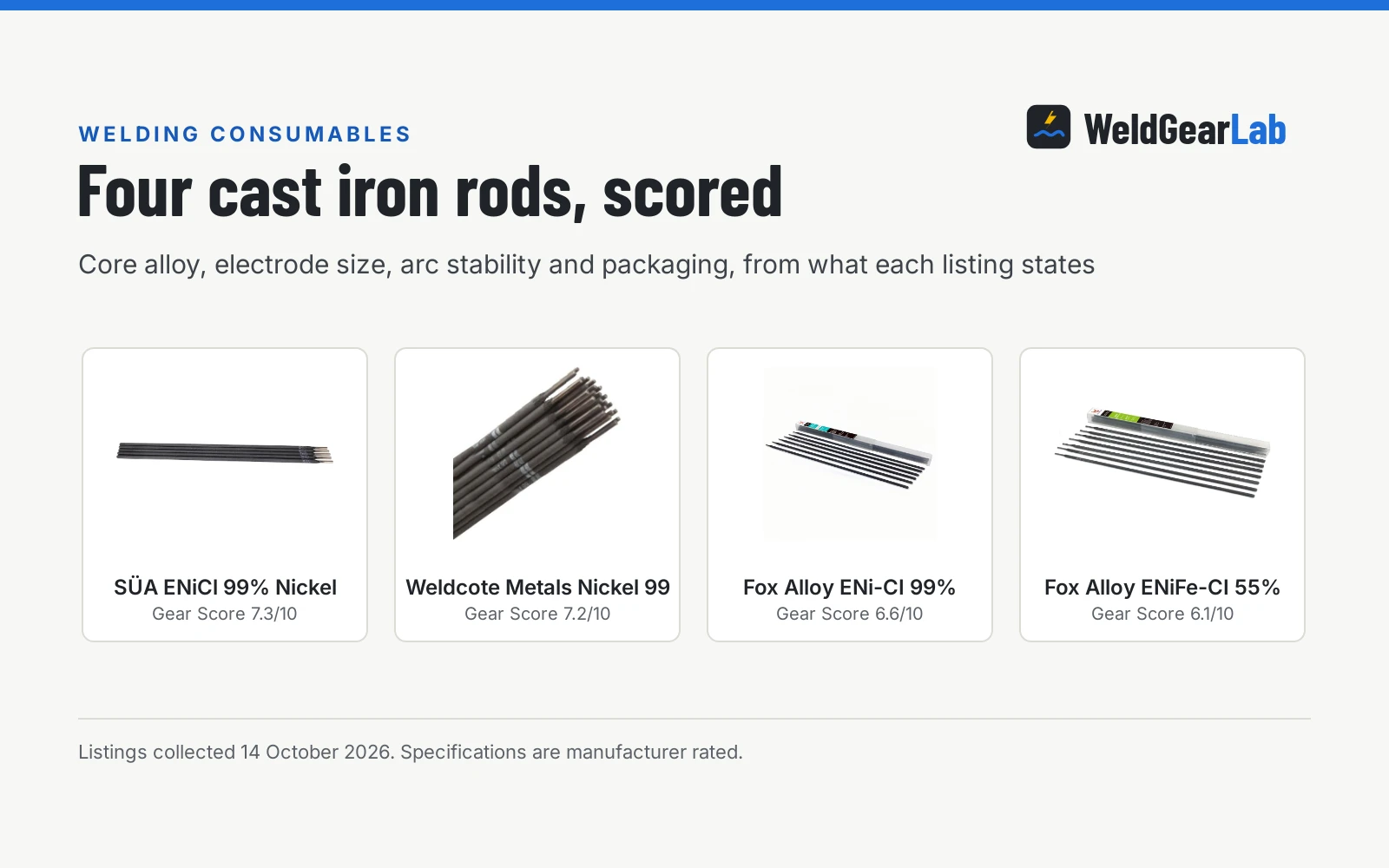
 Weldcote Metals Nickel 99 Cast Iron Welding Electrode RepairView on Amazon
- 5
 E4303 Welding Rods 1/8"x14"View on Amazon
- 6
 ENi-CI 10pcs Pure Nickel Cast Iron Welding Electrodes 1/8'' *View on Amazon
- 7
 ENiFe-CI Nickel-Iron Cast Iron Welding RodsView on Amazon
- 8
 ENiFe-CI Nickel-Iron Welding Rods 3/32"x12"View on Amazon
Your next project is a trailer gate frame, and it has to hang square or every weld after it fights you. That is the real question behind cast iron vs steel welding table: which top keeps your fit-up true while you tack it together. Cast iron wins on flatness and stability. Steel wins on weight and portability. Steel tops dominate the folding and rolling tables home shops actually buy, so this guide compares the two materials and shows what to pull from a steel top listing.
Other welders and gear to compare
 2” Gray Cast Iron Mini Table Clamp Bench Vise 2” mini viseCheck price on Amazon
 Weldcote Metals Nickel 99 Cast Iron Welding Electrode RepairCheck price on Amazon
 E4303 Welding Rods 1/8"x14"Check price on Amazon
 ENi-CI 10pcs Pure Nickel Cast Iron Welding Electrodes 1/8'' *Check price on Amazon
 ENiFe-CI Nickel-Iron Cast Iron Welding RodsCheck price on Amazon
 ENiFe-CI Nickel-Iron Welding Rods 3/32"x12"Check price on Amazon
This guide links to our product roundups, where WeldGearLab gets a commission on purchases made through links on this page, and your price stays the same. Read our affiliate disclosure.
The difference in one paragraph
Cast iron tops are cast, then machined flat, which gives a stable surface that soaks up heat from long welds and resists warping. Steel tops are plate, cut and welded or bolted to a frame; the listings state material lines like Carbon Steel, Alloy Steel, or Carbon Steel + Galvanized. Cast iron is the heavier, flatter, more permanent choice. Steel is the lighter one you see on the folding and rolling tables that fill home shops.
Cast Iron vs Steel Welding Table: The Flatness Question
Flatness is the whole argument. A cast top arrives machined, so parts sit true and clamps hold angles you can trust. Steel plate starts life flat too, but thin plate moves: repeated heat in one spot, a heavy drop, or a flexing frame will bow it, and then your fit-up lies to you. The Klutch listing states a 4mm thick top on a 40in. x 24in. table that weighs 113 pounds. That is a sturdy plate table, and it is still plate, not a machined casting.
Where steel fights back is the fixture pattern. The VEVOR 36 x 24 in. table lists 0.63 in. fixture holes spaced 2 inches apart, and the Goplus 42 x 21 in. table lists 0.7 in. holes, on tables rated at 800 and 1000 pounds of load capacity. A regular hole grid plus clamps can square work even when the plate is not perfect. That is where the home shop market sits: folding, rolling steel tops with fixture holes and adjustable height.
Side by side
| Cast iron top | Steel top | Why it matters | |
|---|---|---|---|
| Top construction | Cast, then machined flat | Steel plate; the Klutch listing states a 4mm thick top | Machined flatness is the baseline for square fit-up |
| Table weight | Heavy by nature; no cast iron weight stated | Stated item weights run 34.8 to 113 lb: VEVOR lists 34.8, 39.2, 45.2 and 58 lb, Klutch lists 113 lb | Weight is stability you do not have to bolt down |
| Load capacity | Not stated for cast iron | Stated capacities run 350 to 1000 lb: Olympia lists 350 lb, Goplus lists 1000 lb | Capacity should clear your heaviest workpiece |
| Fixture holes | Not stated for cast iron | 0.63 in. holes spaced 2 in. apart on the VEVOR 36 x 24 and 44 x 21; 0.7 in. holes on the Goplus 42 x 21 | A hole grid turns clamps into a squaring system |
| Heat behavior | Soaks up heat and resists warping; spatter sticks to bare iron | Thin plate can bow when heat parks in one spot; spatter grinds off plate | Heat is what moves a top out of flat |
| Portability | Rarely portable; built to live in one spot | Foldable tops from 30 x 20 to 44 x 21 in., heights from 25 to 37 in. across the VEVOR and YESWELDER listings | A table you move has to be a weight you can move |
When cast iron is the better choice
- Fit-up that has to be true. Frames, gates, and anything with miters: a machined top gives you a reference surface you can trust.
- Heavy work in one spot. If the table never moves, mass is free stability and you never fight a rocking leg.
- Heat soak. Long beads on thick stock: cast iron takes the heat without the top oil-canning under your part.
When steel is the better choice
- You move the table. The Goplus 42 x 21 in. table folds, carries a handle, and lists a 1000 lb capacity at 42 lb of table weight. The VEVOR 44 x 21 in. folds with a 500 lb capacity at 45.2 lb. That is a shop table you can carry to the job.
- Height and angle change. The YESWELDER 20 x 30 in. table adjusts from 30 to 37 inches, and the VEVOR 30 x 20 tilts to 0, 30 and 90 degrees. Cast iron tables rarely fold or tilt like this.
- Parts and replacements. Steel tops are what most home shops buy, and what the clamp and fixture makers build for.
How to read a steel top listing
Here is what to pull from a steel top listing before you buy:
- Material line. The listings state Carbon Steel, Alloy Steel, or Carbon Steel + Galvanized. The line names the top material, not its thickness.
- Top thickness. Rarely stated. The Klutch listing is the one that names 4mm. No number means you are guessing, so treat it as plate and weigh the stated item weight.
- Hole size and spacing. 0.63 in. holes on 2 in. centers is the common pattern here, and it suits standard fixturing clamps.
- Capacity against table weight. A 1000 lb capacity on a 42 lb table is a rating for the frame and top together, not a promise the top stays flat at that load.
Our best welding table size guide and how thick a welding table top should be go deeper on sizing and plate.
What to check before you buy
- Measure your longest part. A 44 x 21 in. top holds a long rail; a 30 x 20 in. top is a bench, not a frame table.
- Check the floor. Adjustable or stabilizer feet matter more than top material on an uneven garage slab.
- Plan the ground clamp. Clamp to the workpiece or a bare spot on the table, and see our welding magnets for squaring for holding angles during tacking.
- Keep spatter off. Anti-spatter spray on a steel top saves grinding later; on cast iron it keeps the machined surface clean.
FAQ for welders
Can you weld directly on a cast iron welding table?
Yes, but spatter sticks to bare cast iron and pocks the machined surface, so coat it with anti-spatter spray first. Ground the clamp to the workpiece itself, not through the spray film.
Will a steel welding table top warp?
Thin plate can move when you park heat in one spot or drop heavy stock on it. These plate tops sit on folding tables, so check flatness now and then with a straightedge and re-square your work before tacking.
Do welding magnets work on both cast iron and steel tops?
Yes, magnets grip both. They hold parts at angle during tacking; they do not replace clamps on a long weld.
Are fixture holes worth it?
A regular hole pattern turns the top into a squaring system: drop in clamps and stops and your angles repeat from part to part. The 0.63 in. holes on 2 in. spacing suit common fixturing clamps.
Which top is better for TIG welding?
Either works for TIG; the choice is about the work, not the process. Pick cast iron for a permanent flat reference, steel for a table you fold up and roll out of the way.
Related: solid steel vs perforated welding table, fixture table vs steel plate welding table, cast iron vs steel welding square, how to keep a welding table from warping, and how to build a welding table.