How Thick Should a Welding Table Top Be: Plate Thickness Guide
A welding table top should be at least 0.12 in thick for general home fabrication and 3/16" with stiffening ribs for precision clamping, while light mobile work can use sheet steel.
 By WeldGearLab Editorial
Updated October 10, 2026
By WeldGearLab Editorial
Updated October 10, 2026
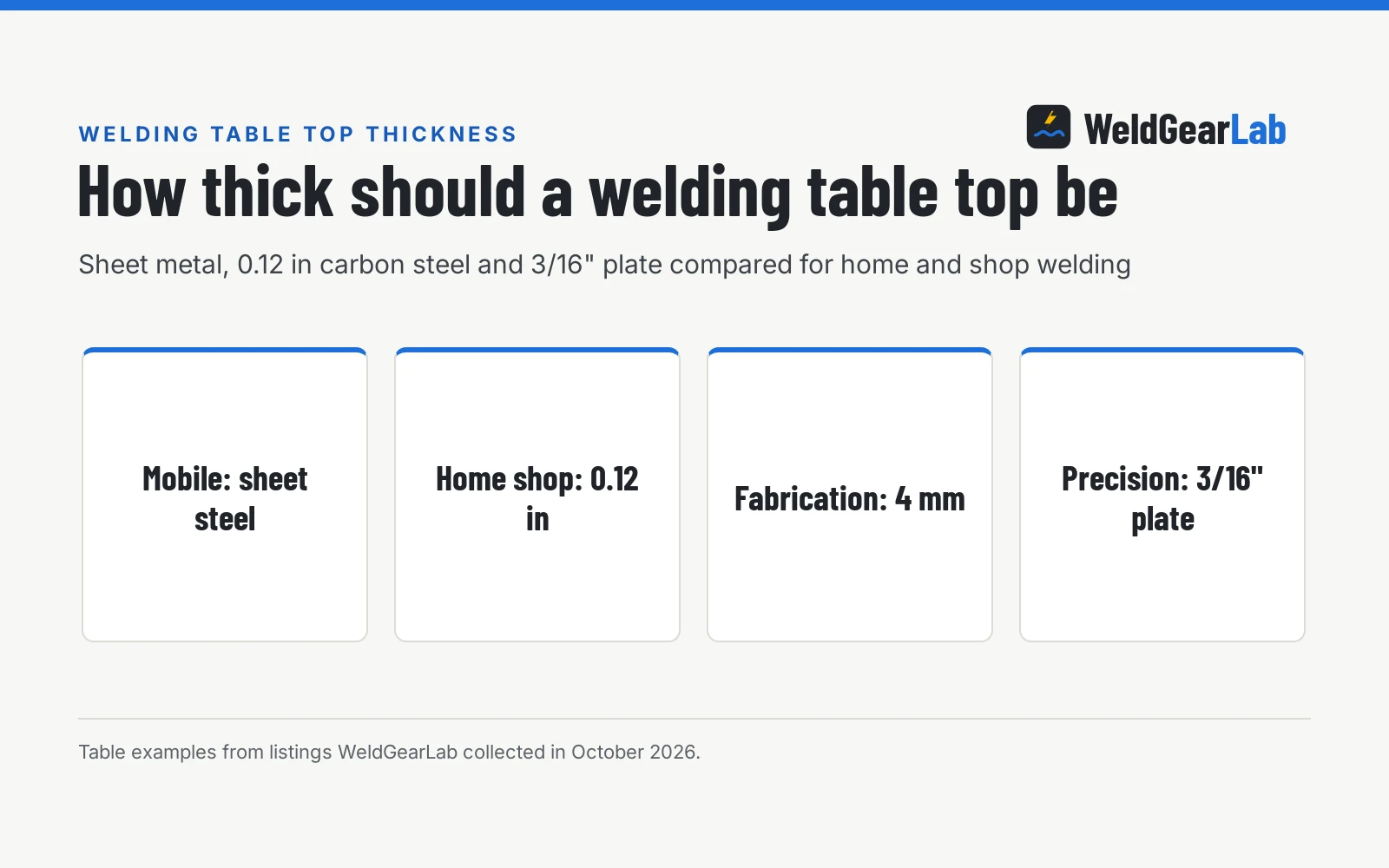
How thick should a welding table top be depends on the clamping force your work demands, the heat of your welding processes, and whether your bench must remain portable. For light hobby repairs and mobile work, sheet metal tops provide a functional surface that keeps bench weight low. For general home fabrication, steel plate measuring 0.12 in to 4 mm thick provides adequate rigidity for clamping square tube and flat bar. For precision fixture work where parts must remain flat under heavy clamping pressure, a 3/16″ steel top supported by engineered stiffening ribs prevents heat warping and surface dishing. This guide compares standard table top thicknesses across current listings to help you choose the right surface for your shop.
As an Amazon Associate I earn from qualifying purchases. This guide links to our product roundups, where WeldGearLab earns a commission when you buy through links, at no extra cost to you. Read our affiliate disclosure.
How thick should a welding table top be
A welding table top must stay flat under heat and resist deflection when you clamp workpieces down. Portable folding benches often use sheet metal tops where listings do not state a specific plate thickness, relying on folded edges to support loads between 500 lbs and 1000 lbs. Dedicated fabrication benches from brands like WORKPRO and Pohadr list a 0.12 in carbon steel top, while Cxforste lists a 4 mm thick steel top for increased stiffness. When you move to precision modular fixture tables, CertiFlat lists a 3/16″ HRPO steel surface engineered with tab and slot stiffening ribs to maintain flatness within +/- .003″ tolerance. Heavy production facilities often use thick steel plate, but for home garages and small shops, a top between 0.12 in and 3/16″ delivers practical rigidity without creating an immovable bench.
Side by side
| Sheet metal folding tops | 0.12 in to 4 mm plate | 3/16″ precision plate | |
|---|---|---|---|
| Table top steel thickness | Not stated in listings | 0.12 in to 4 mm | 3/16″ HRPO steel |
| Representative listings | VEVOR 44″ x 21″, Goplus 42″ x 21″ | WORKPRO 36″ x 18″, Pohadr 36″ x 24″, Cxforste 36″ x 24″ | CertiFlat ProTop 24″ x 48″ and 36″ x 48″ |
| Stated load capacity | 500 lbs to 1000 lbs | 800 lbs to 2000 lbs | Heavy-duty leg base kit |
| Bench weight | 42 pounds to 45.2 pounds | 68.3 pounds to 69.2 pounds | Heavy shop fixture kit |
| Fixture holes and clamping | Tool slots, 0.63″ to 0.7″ holes | 5/8″ fixture holes, 2 in spacing | Precision holes, tab and slot ribs |
| Heat resistance and flatness | Prone to heat warping under arc heat | Handles tacking and light passes | Engineered ribs control warping (+/- .003″) |
| Mobility and storage | Foldable legs, 4-level to 7-level height | Stationary legs or 4 casters | Stationary workshop fixture |
| Best suited for | Light repairs and mobile jobs | General home shop fabrication | Precision welding and square frames |
Load ratings and steel gauges vary widely across published listings, and makers measure capacity differently. Cxforste, for instance, lists a 2000 lbs load capacity in its product description while its specification table lists 800 lbs. Tyfnry specifies an 800 lbs static capacity alongside a 600 lbs dynamic capacity on its 36″ x 18″ workbench. Always check whether stated capacities reflect distributed static weight or working dynamic loads before mounting heavy assemblies or hammering on your tabletop.
When a thinner top is the practical choice
- Mobile and job-site repairs. If you need to fold your table into a vehicle or roll it out of the way in a shared garage, a thinner top keeps overall bench weight low. Goplus lists a bench weight of 42 pounds and VEVOR lists 45.2 pounds on its foldable carbon steel bench, making transport straightforward.
- Light clamping and tacking. For small brackets, ornamental ironwork, and light tubing, moderate clamping force is all you need to hold parts in alignment while tacking.
- Lower shop footprint. Folding models like the Generic table fold down with a stated 60% volume reduction to fit into tight storage spaces.
- Budget-conscious setup. Pre-formed sheet benches and light plate tops provide an affordable entry point for hobby welders who do not need heavy fixture clamping.
Our best welding table under 500 guide reviews affordable options for home garages, including folding workbenches and compact rolling carts.
When a thicker plate is necessary
- Heavy fixture clamping. Using screw clamps or sliding bar clamps in fixture holes creates significant leverage. Pohadr and Cxforste provide 5/8″ fixture holes, and thicker steel prevents the rim of each hole from flaring or stretching under high clamp torque.
- Heat absorption on long passes. Continuous arc welding inputs significant thermal energy into the tabletop. Thicker plate absorbs and diffuses heat more evenly, reducing local thermal distortion and preventing the surface from dishing.
- Hammering and mechanical forming. Aligning stubborn steel joints frequently requires striking pieces with a hammer or mallet. A thin top will dent or bow, whereas a rigid plate maintains its flat plane under impact.
- Square frame assembly. Building square gates, furniture bases, and chassis components requires a rigid, unyielding surface to ensure corners remain true. Our roundup of angle clamps for welding covers tools that lock corners tight against a flat table.
How to check tabletop thickness in listings
Online product descriptions frequently highlight overall load ratings while glossing over the actual thickness of the tabletop steel. To verify what you are getting before buying, look for these specific details in published listings:
- Explicit decimal or fractional thickness. Reliable listings state exact material dimensions. WORKPRO lists a tabletop thickness of 0.12 in, Pohadr specifies a 0.12″ carbon steel top, and CertiFlat specifies 3/16″ HRPO steel. If a listing uses vague terms like heavy-duty without a figure, write the maker to confirm or assume it is stamped sheet metal.
- Frame thickness specifications. A thick top needs a rigid subframe to stay flat. Cxforste states a 4 mm thick steel top paired with a 2 mm thick frame, indicating structural support under the working plate.
- Total bench weight versus dimensions. Bench weight is a dependable indicator of plate thickness. A 36″ x 24″ table like Cxforste lists an item weight of 68.3 pounds and VEVOR lists 69.2 pounds on a bench of the same surface area. If a table of that size lists a total weight of 30 pounds, like the Tyfnry model, the steel is thin.
When a listing does not state a steel thickness, do not assume it uses heavy plate. Check the shipping weight and look for under-table ribbing in the product diagram.
Why stiffening ribs matter as much as thickness
Increasing plate thickness is not the only way to achieve a flat, rigid welding surface. Solid steel plate is heavy and expensive. A well-engineered subframe with interlocking stiffening ribs can make a thinner plate perform like a much heavier slab. CertiFlat uses this approach on its ProTop tables, combining 3/16″ HRPO steel with proprietary tab and slot ribs to maintain a surface tolerance of +/- .003″ across 1152 sq inches on its 24″ x 48″ model and 1728 sq inches on its 36″ x 48″ model. The vertical ribs resist bending moments when clamps pull against the plate, preventing the center of the table from sagging during assembly.
Can a lighter table handle heavy fabrication?
A lighter welding table with a 0.12 in top or sheet metal surface can handle small fabrication projects if you modify your technique. Distribute clamping pressure using wood or steel scrap blocks under clamp pads, place heavy weldments directly over the support legs rather than in the unsupported center, and allow tack welds to cool before laying continuous beads. For dedicated home shop work where space allows a permanent bench, exploring our guide to the best welding table for a home shop will help you select a rolling or fixed platform with the load capacity your work requires.
Galvanized coatings and workshop safety. Several portable tables in published listings, including models from Goplus and Generic, feature galvanized or zinc-coated tops for weather resistance. Welding directly onto zinc coatings produces hazardous zinc oxide fumes. Before welding on a galvanized surface, grind the coating back to bare steel at the joint area, work with active ventilation or an appropriate welding respirator, and keep your face out of the rising plume. Never clamp your ground lead over painted or heavily coated surfaces; attach your ground clamp to clean, bare metal. For complete safety practices, see our guide on how to set up a welding area in a home garage.
Frequently Asked Questions
Can you weld on a thin sheet metal table?
You can weld light projects on thin sheet steel tables if you keep heat input low and avoid aggressive clamping. However, thin sheet tops can dish or buckle when exposed to sustained arc heat or heavy hammer blows. For general fabrication, a thicker top provides greater durability and stays flat longer.
Is a thicker welding table top always better?
Thicker plate steel offers superior rigidity, heat resistance, and clamping strength, but it adds substantial weight and cost. A massive solid plate table is difficult to move around a small garage or job site. For mobile work and general hobby projects, a mid-weight top or a ribbed plate delivers adequate stiffness without excessive bulk.
Why do some tables use 0.12 in steel instead of heavy plate?
Makers like WORKPRO and Pohadr list a 0.12 in carbon steel top to balance workbench stability with manageable weight. A 0.12 in plate resists light tack welding and clamping loads while keeping bench weight manageable for easy assembly and repositioning. Heavy production shops require thicker plate, but 0.12 in suits everyday home repairs.
Why are stiffening ribs used beneath welding tables?
Stiffening ribs are structural steel webs welded or slotted beneath the tabletop plate to prevent sagging and flex. CertiFlat listings feature engineered tab and slot ribs beneath a 3/16″ HRPO steel surface, which maintains a flat plane across the bench. This ribbed structure provides the rigidity of much thicker plate without adding excessive dead weight.
How do fixture holes affect welding table thickness?
Fixture holes require sufficient sidewall thickness so clamps and hold-down bolts do not deform the edges under pressure. Tables with 5/8″ fixture holes, such as models from Pohadr and Cxforste, perform best when the plate is thick enough to support clamping torque. Thinner sheet tops can distort around hole edges if clamps are tightened too aggressively.
Related: best welding table for a home shop, best welding table under 500, angle clamps for welding, and the welding tables and carts hub. Also see our guide on quick clamps for welding.
About the author
WeldGearLab Editorial is the editorial team behind WeldGearLab. We research product listings, specifications, safety listings and warranty terms, score every pick with the published Gear Score method, and correct errors when readers report them. We do not run our own shop trials; see How We Pick for exactly how picks are made.