What Is a CNC Plasma Table: How It Works and What It Does
A CNC plasma table uses computer control, a motorized gantry, and a plasma torch to cut flat metal sheets into precise shapes for shop fabrication.

On this page
Top picks at a glance
As an Amazon Associate I earn from qualifying purchases.
- 1
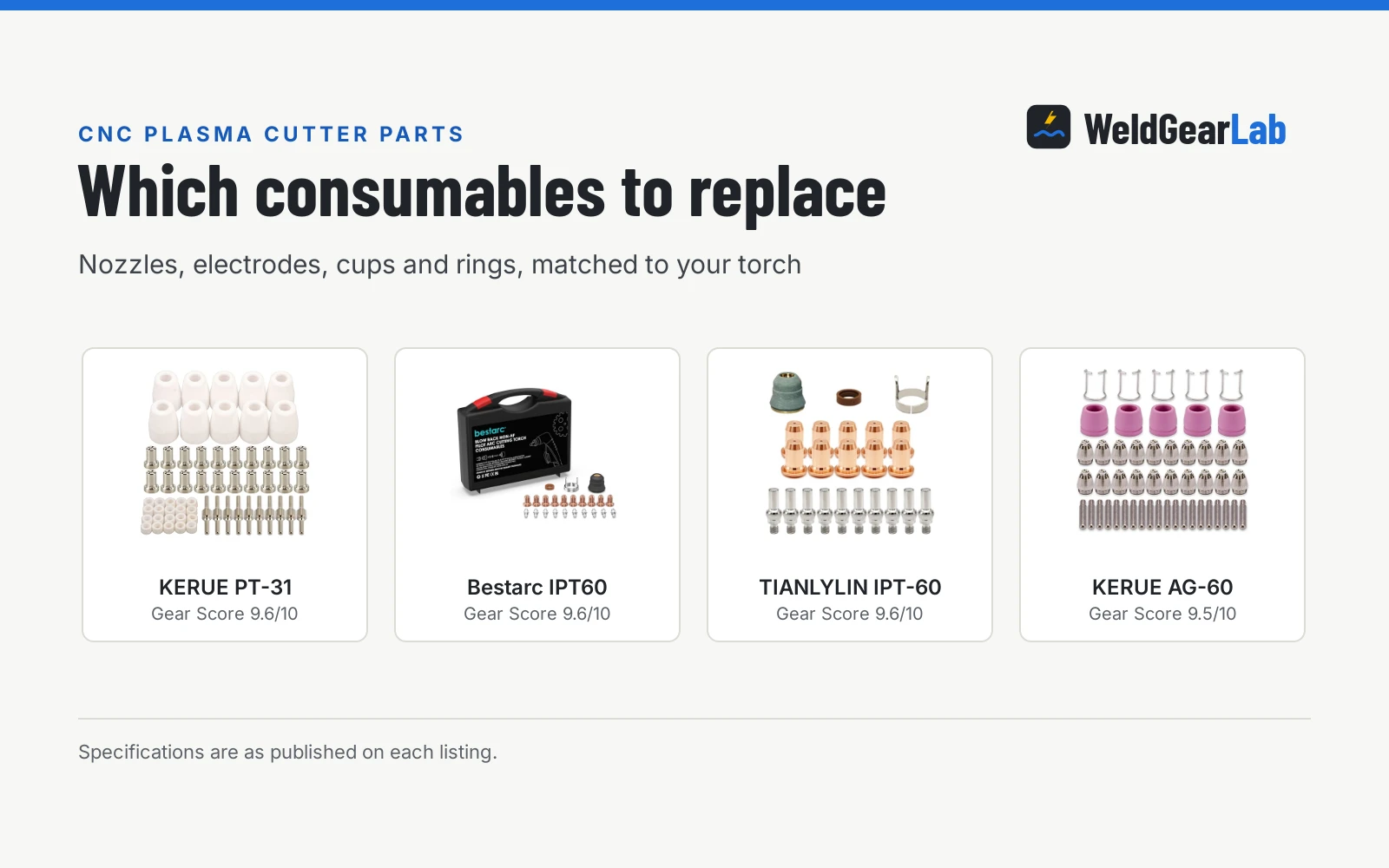
 60pcs PT-31 Nickel Plated Extended Air Plasma Cutting Nozzle9.6/10View on Amazon
- 2
 Bestarc Blow Back Plasma Cutter Torch Consumables9.6/10View on Amazon
- 3
 TIANLYLIN 23 Pcs IPT-60 Plasma Cutter Torch Consumables Kit9.6/10View on Amazon
When you are tracing gussets, brackets, or tab plates on the fab bench with soapstone and cutting each piece with an angle grinder or hand torch, edge cleanup takes more time than welding the joint. If you find yourself asking what is a cnc plasma table, the direct answer is that it is a computer-controlled machine table that moves a plasma torch over flat metal sheet to cut precise profiles automatically. A motion controller reads digital cut paths from a computer file and drives motors along the gantry rails while firing the plasma arc. That setup turns complex sheet metal designs into clean, repeatable parts without hand tracing, template guides, or hours spent grinding edges flat.
This guide links to our product roundups, where WeldGearLab gets a commission on purchases made through links on this page, and your price stays the same. Read our affiliate disclosure.
What is a CNC plasma table in one paragraph
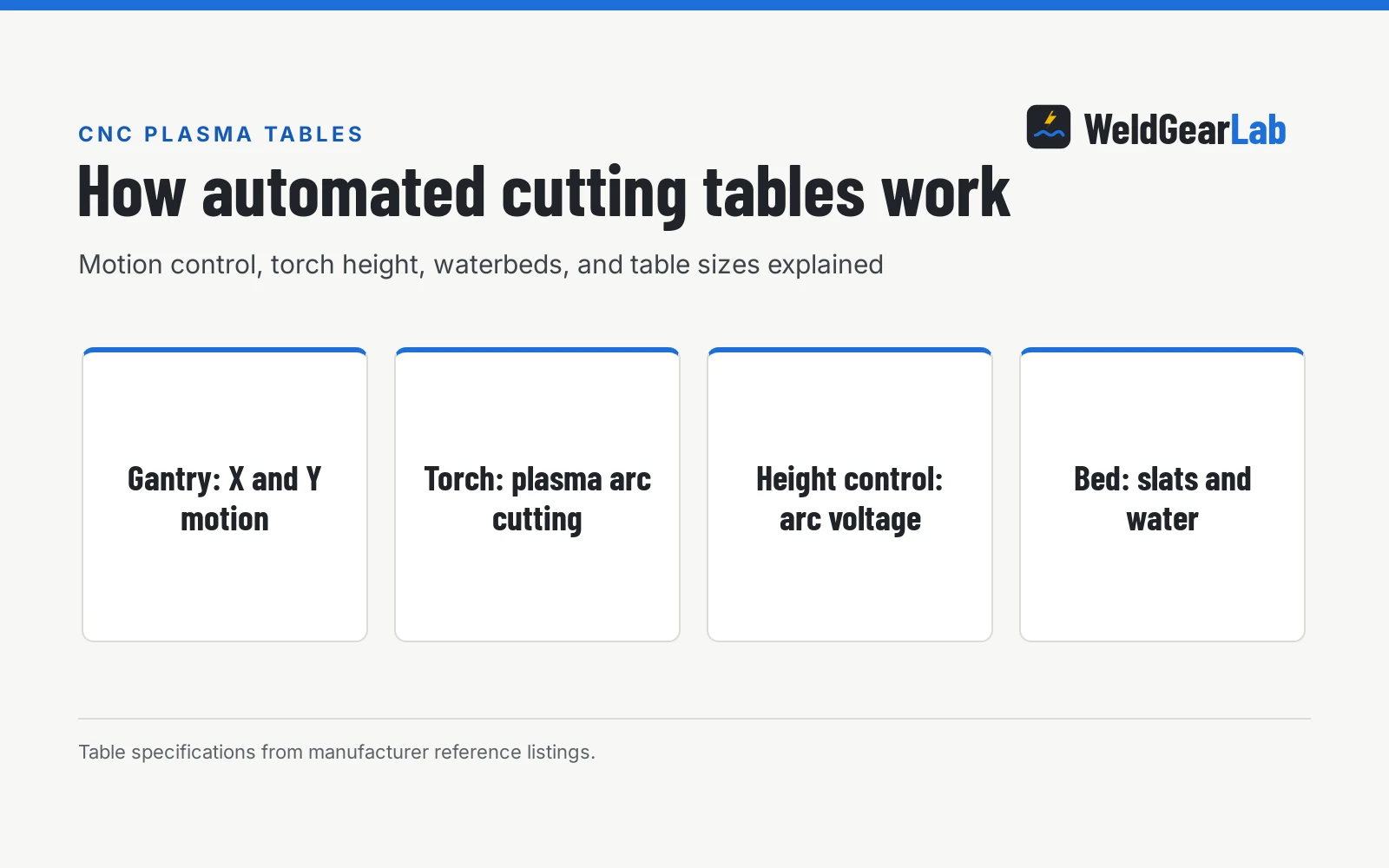
A plasma power supply creates an electrical arc through a constricted nozzle with compressed air, ionizing the gas into high-temperature plasma that melts metal and blows molten slag through the bottom of the cut kerf. On a manual cutting setup, an operator guides the torch nozzle across the plate by hand. On a CNC plasma table, a rigid gantry carries the plasma torch along the X and Y axes above a bed of steel slats. A digital motion controller regulates travel speed, coordinates directional changes, and commands arc ignition. On tables equipped with automatic torch height control, the system monitors electrical arc voltage during cutting and raises or lowers the torch to maintain the correct standoff distance even across uneven plate.
Side by side
| Handheld torch | Compact CNC table | Full-sheet CNC table | |
|---|---|---|---|
| Torch guidance | Manual by operator hand | Motorized gantry along X and Y axes | Motorized gantry along X and Y axes |
| Motion and path accuracy | Varies with operator skill and guide straightedges | Repeatable computer path from digital cut files | Repeatable computer path from digital cut files |
| Torch height control | Manual standoff held by hand or drag shield | Manual height setting or optional automatic THC | Automatic torch height control standard or optional |
| Working envelope | Limited only by torch lead length | Sized for small plates, such as 24″ x 24″ or 4X4 | Sized for standard sheets, such as 49″ x 96″ or 5×10 |
| Fume and spark control | Open spark scatter across the shop floor | Waterbed tray or downdraft table on equipped models | High-capacity waterbed or downdraft table |
| File and controller interface | None, requires soapstone layout and manual marking | Dedicated standalone controller with USB or external PC | Dedicated standalone controller with USB or external PC |
| Plate handling and weight support | Supported on external fab benches or floor | Light to medium sheet and plate brackets | Heavy structural plate and full raw sheets |
| Best suited applications | Quick field cuts, demolition, beveling, scrap prep | Custom brackets, tabs, small signage, hobby parts | Full-sheet nesting, bumpers, trailers, production runs |
Cut quality on any automated table depends on clean, dry air, correct amperage, and matching travel speed to plate thickness. Always consult the cut charts in your plasma power supply manual for recommended torch standoff, air pressure, and feed rates before cutting production parts.
When handheld plasma is the better choice
- Field repairs and mobile jobs. Fixing equipment on a farm, cutting off rusted trailer tongue bolts, or slicing scrap in an equipment yard. A portable handheld plasma cutter runs anywhere you have electricity and an air compressor.
- Demolition and salvage cutting. Sectioning truck frames, cutting pipe at compound angles, or slicing salvage steel where dimensional accuracy does not matter.
- Quick single cuts. Trimming a single piece of angle iron or notching a flange takes seconds with a hand torch without drawing CAD files or loading digital cut paths into a controller.
- Three-dimensional work and tubing. Hand torches reach into cramped chassis areas, cut formed structural shapes, and trim installed assemblies that cannot sit flat on a table bed.
Our plasma cutter types guide explains how arc start, air supply, and pilot arc systems differ across handheld units.
When a CNC plasma table is the better choice
- Repeat parts and production brackets. Cutting matching sets of suspension tabs, gussets, base plates, or frame stiffeners where every hole and edge must align consistently.
- Intricate sheet metal art and signage. Piercing letters, fine scrollwork, and detailed contours that are challenging to cut smoothly by hand.
- Bolt holes and interior cutouts. Cutting round holes, slots, and interior notches cleanly in flat plate, reducing secondary drilling operations.
- Edge finish and reduced grinding. Stable gantry travel speed and proper torch standoff keep the arc perpendicular, which minimizes dross and bevel for faster fit-up.
To keep cut edges clean and minimize bottom dross on automated cuts, see our shop advice on how to reduce dross when plasma cutting.
How to tell what a table supports
Not every CNC plasma cutting system arrives with the same equipment in the crate. Some listings provide a standalone mechanical table, while others bundle a machine torch, plasma power supply, and consumables. When evaluating a table listing, check these core specifications:
- Cutting area and travel limits. Check both the outer table frame footprint and the usable torch travel on the X and Y axes. For example, Eastwood lists a 4X4 table with torch travel of 49.2″ on the X-Axis and 43.3″ on the Y-Axis, while Baileigh lists a 24″ x 24″ cutting area on its PT-22 model. Travel limits determine the maximum part size you can profile without repositioning the sheet.
- Controller type and computer requirements. Look at whether the system requires an external laptop running third-party software or includes an onboard dedicated controller. Eastwood listings feature a dedicated controller with an LCD screen and USB slot that operates without an external computer, whereas STV Motorsports notes its SparX510 runs on Windows-based software.
- Torch height control and waterbed inclusion. Automated torch height control samples arc voltage to keep the torch at the proper height across warped plate. Listings from Eastwood and STV Motorsports highlight automatic torch height control, and Eastwood includes waterbeds with stated fluid capacities such as 10 Gal on its 2×2 model and up to 67 gallons on its 4X8 table.
Most automated gantries use a straight cylindrical machine torch for perpendicular mounting, though some tables provide interchangeable mounts to hold either a machine torch or a standard hand torch, as Baileigh states for its PT-22. Make sure the table package states whether a machine torch is included or if you need to supply your own CNC-ready plasma cutter.
Which table size fits your shop
For home garages and small fab shops with limited floor space, a compact table like the Eastwood 2×2 table (on Amazon) or Baileigh PT-22 (on Amazon) offers a 24″ x 24″ cut area. This size fits custom brackets, tabs, exhaust flanges, and small signage without consuming valuable shop floor space.
A 4X4 table provides a larger working envelope for suspension arms, skid plates, fire pits, and artistic panels while fitting into a standard garage bay. However, check stated travel limits against your raw stock dimensions: while Eastwood names its model a 4X4 table, its listed travel is 49.2″ on the X-Axis and 43.3″ on the Y-Axis, meaning full 4′ wide sheets require slight trimming or repositioning to cut the entire width.
Production shops and equipment builders benefit from full-size tables that take standard sheet stock directly from the steel supplier without pre-cutting. Eastwood lists a 4X8 table with a 49″ x 96″ cutting area that supports a total weight of 1,543 lbs, while STV Motorsports lists a 5×10 table capable of handling 3/4” steel plates. Full-sheet capacity saves material prep time and increases part yield per sheet.
Can one plasma cutter do both?
Yes, many fabricators use a single plasma power supply for both hand cutting and automated table work, but the machine must support CNC integration. A CNC-capable plasma cutter needs a rear CNC interface port to send arc transfer signals and receive start commands from the table controller. In data listings, the Eastwood CNC Cut 40 and CNC Cut 60 operate on dual-voltage 120V or 240V circuits and feature pilot arc ignition that starts the arc without touching the plate. When switching between hand cutting and table work, fabricators often swap between a handheld torch and a dedicated straight machine torch, or use a table with torch holders that accept both styles, as Baileigh notes on its PT-22.
If you are choosing a power supply for table cutting or shop fab, check our guide to mid-range plasma cutters for capable dual-voltage units, or read our overview on what size plasma cutter to choose for your plate thickness requirements.
Plasma cutting ventilation and eye protection. Automated plasma cutting generates fine metal fumes, ozone, and intense ultraviolet radiation. A waterbed table captures a large portion of airborne dust and sparks, but indoor shops still require adequate shop ventilation or local exhaust systems. Never look directly at the plasma arc without proper shaded eye protection; see our guide on what shade lens for plasma cutting for recommended shade levels. Always wear hearing protection around high-velocity cutting nozzles, keep dry compressed air delivered through dedicated filtration, and clear all combustible materials and solvent containers away from the cutting bed.
FAQ for welders
What does a CNC plasma table do?
A CNC plasma table cuts flat conductive metals into custom parts by following computer-programmed paths. It automates the motion of a high-temperature plasma torch across the X and Y axes of a cutting bed. This allows fabricators to cut brackets, base plates, gussets, and decorative metal signs with consistent edges and accurate hole locations.
What metals can you cut on a CNC plasma table?
A CNC plasma table cuts any electrically conductive metal, including mild carbon steel, stainless steel, and aluminum. The plasma process relies on an electrical circuit established between the torch electrode and the metal plate on the table slats. It cannot cut non-conductive materials like wood, plastic, or glass.
Do you need a computer connected to a CNC plasma table?
It depends on the table controller design. Some systems require an external Windows laptop or desktop running motion control software during operation. Other models, such as Eastwood Versa-Cut tables, include a dedicated standalone controller with an LCD screen and USB port that reads cutting files directly from a flash drive without an attached computer.
Why do CNC plasma tables use waterbeds?
A waterbed sits directly beneath the cutting slats to catch hot sparks, falling slag, and metal dust as the plasma jet cuts through the plate. Water absorbs a significant amount of airborne smoke and reduces thermal distortion on thin sheet metal. It also dampens the loud hiss of high-pressure compressed air escaping the torch nozzle.
What is torch height control on a CNC plasma table?
Automatic torch height control, often called THC, monitors the electrical cutting arc voltage between the torch and the workpiece during the cut. Because arc voltage changes with the distance between the torch tip and the plate, the controller raises or lowers the Z-axis motor in real time to maintain a constant standoff distance. This prevents torch collisions with warped sheet metal and preserves consumable life.
Related: plasma cutters hub, plasma cutting consumables guide, what size air compressor for a plasma cutter, and our air dryer filter picks. Also see our guide on entry-level plasma cutters.