Plasma Table vs Water Table: Which One Should You Buy?
Dry plasma tables and water tables manage cutting fumes, heat distortion, and shop cleanup differently, and each suits distinct shop spaces and cutting workloads.

On this page
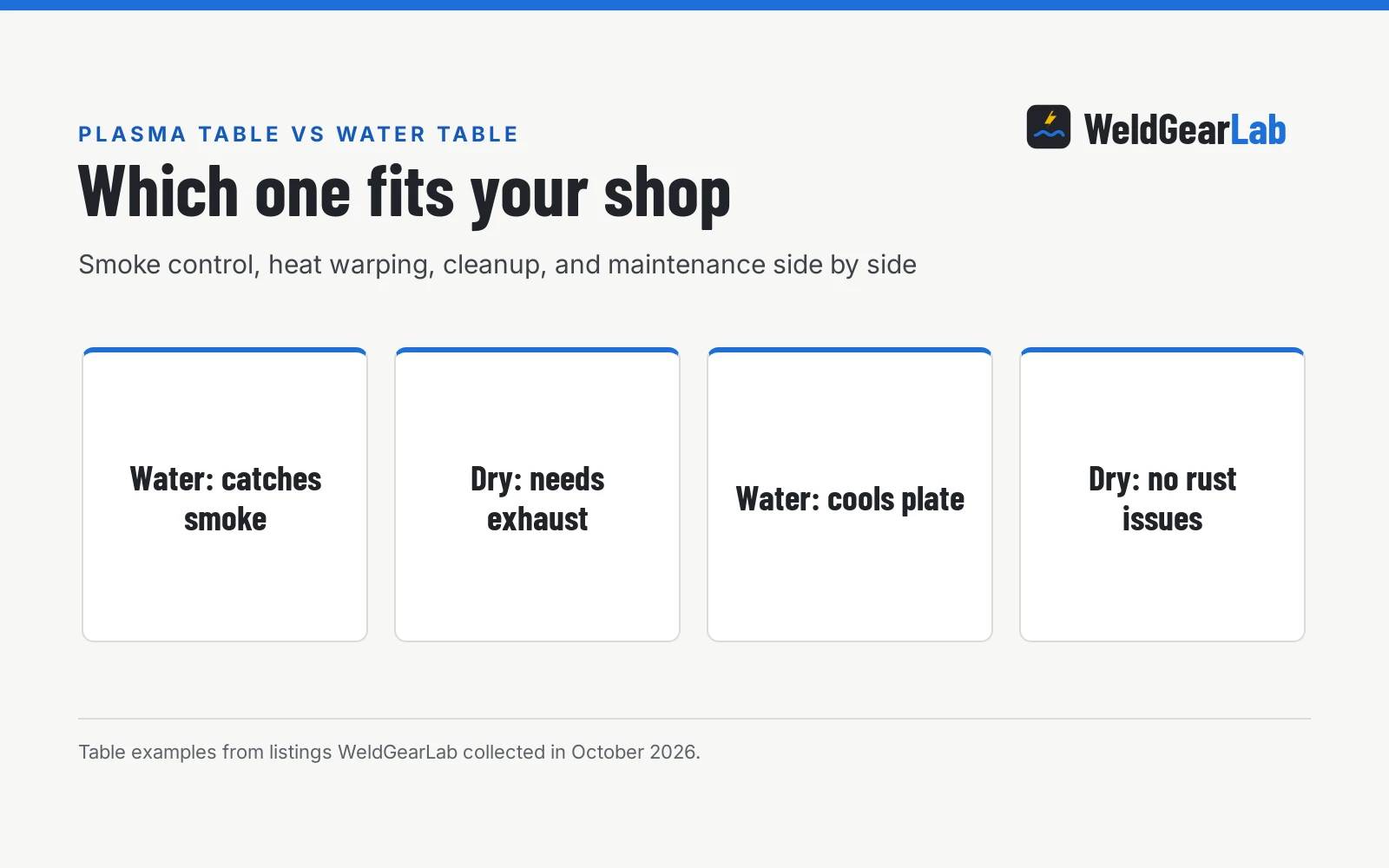
When comparing a plasma table vs water table, the core distinction comes down to how your shop captures heat, sparks, and airborne fumes during cutting. A dry plasma table vents fumes into the room or uses a ducted downdraft exhaust system to pull smoke outside, whereas a water table uses a shallow fluid tray directly below the cutting slats to trap smoke and quench slag immediately. For home garages and small shops without dedicated outdoor exhaust ducting, a water table provides instant smoke capture and reduces plate warping on sheet metal. A dry plasma table avoids rust and water maintenance, making it better for heavy structural plate or unheated spaces.
As an Amazon Associate I earn from qualifying purchases. This guide links to our product roundups, where WeldGearLab gets a commission on purchases made through links on this page, and your price stays the same. Read our affiliate disclosure.
The difference in one paragraph
Plasma cutting forces an electric arc through compressed gas, melting metal and blowing molten dross out the bottom of the kerf. That process throws violent spark spray and fills the shop with fine metallic smoke. A dry plasma table supports the workpiece on steel slats over an open catch tray or a tapered downdraft plenum that requires an exhaust blower to vent fumes outside. A water table places a tray of water directly beneath the slats so the water touches or sits just under the plate. The water bath absorbs the plasma jet energy, quenches sparks instantly, traps particulate matter before it enters the air, and dissipates heat to keep thin sheet metal from bowing.
Side by side
| Open dry table | Downdraft table | Water table | |
|---|---|---|---|
| Fume and smoke control | Escapes into shop air; needs area ventilation | Exhaust blower pulls smoke outside via ducting | Water catches smoke and airborne particulate at the arc |
| Spark and slag containment | Sparks fall through slats into dry catch tray | Sparks pulled into downdraft plenum and tray | Water tray quenches sparks and catches hot slag instantly |
| Thermal distortion on thin sheet | High heat buildup; sheet prone to bowing | Airflow provides slight cooling; still warps thin sheet | Water bath cools plate, keeping thin sheet flat |
| Small part recovery | Parts rest on slats or fall into dry tray | Parts fall into dry plenum cleanout door | Parts drop into water tray and require fishing out |
| Plate corrosion and rust | Parts stay dry with zero water contact | Parts stay completely dry | Wet parts develop flash rust without drying or additives |
| Noise level | Arc sound only; no blower noise | High noise from arc plus continuous exhaust blower fan | Reduced noise; water muffles arc sound and needs no blower |
| Winter unheated shop | Unaffected by freezing temperatures | Unaffected by freezing temperatures | Water tray can freeze unless drained or treated |
| Aluminum cutting safety | Safe with normal shop dust control | Safe with proper dry dust collection airflow | Molten aluminum in water can generate trapped hydrogen |
Water containment and dry downdraft exhaust represent distinct approaches to managing torch emissions and shop cleanliness. Your available floor space, electrical hookups, wall ducting options, and metal thickness dictate which setup functions smoothly on your shop floor.
Plasma table vs water table: key shop trade-offs
Choosing between both designs involves balancing fume extraction, thermal distortion, cleanup routines, and seasonal shop conditions.
Fume and smoke control. A water table places a shallow fluid tray directly below the cutting slats. A dry table allows smoke to billow freely unless paired with a powerful downdraft fan and dedicated exterior venting.
Thermal distortion on sheet metal. The intense heat of a plasma arc creates localized stress in thin plate, causing parts to twist or lift off the slats. Water in direct contact with the underside of the sheet pulls heat out immediately, keeping the material flat and stable. On a dry table, heat accumulates across the workpiece, increasing the risk of torch collisions if cut geometry bows upward.
Slag cleanup and drop parts. Heavy dross and severed internal drop parts fall down between the slats. On a dry table, scrap lands in a dry steel catch pan where you can sweep it out or grab small parts without getting wet. On a water table, small drop parts that fall between slats sink into sludge at the bottom of the pan, requiring magnets or splash-heavy reaching into dirty fluid to retrieve them.
Shop noise levels. The plasma cutting arc produces significant acoustic noise, but a high-volume industrial downdraft exhaust blower adds substantial continuous motor and air roar. A water table helps muffle torch arc noise and avoids the continuous roar of an exhaust blower fan because it relies on passive fluid containment.
When a water table is the better choice
- Indoor garage and basement shops. If your cutting area lacks outside wall access for an exhaust duct, a water tray prevents dense smoke clouds from filling enclosed spaces.
- Thin sheet metal and artwork. Rapid fluid cooling prevents thin steel and decorative shapes from curling under cutting heat, preserving edge accuracy and flat fit-up.
- Sparks and shop fire safety. Water snuffs sparks the instant they penetrate the kerf, keeping flammable debris on surrounding benches from catching fire.
- Lower overall noise. Cutting over fluid eliminates the continuous roar of an exhaust blower motor, making long cutting sessions easier on your ears.
If you need a reliable power supply to pair with a shop table, our best portable plasma cutter guide highlights versatile dual-voltage machines suited for fabrication benches.
When a dry plasma table is the better choice
- Plate that must stay completely dry. Structural plate, weld prep components, and precision bevels avoid surface rust and require zero post-cut drying.
- Unheated winter workshops. Water tables pose freezing risks in unheated pole barns during winter freezes, while dry tables remain unaffected by sub-zero temperatures.
- Frequent small part cutting. Fast retrieval of small bracket blanks and tabs is simpler when parts drop into a dry scrap tray rather than murky water.
- Cutting aluminum plate. Molten aluminum reacting with submerged water can generate trapped hydrogen bubbles under the sheet, an explosive hazard that dry tables avoid.
To keep cut edges clean and square across dry cutting operations, consult our guide on how to reduce dross when plasma cutting.
How table styles and sizes compare in practice
Fabrication shops run both manual cutting benches and automated gantry tables, with dimensions tailored to available floor space and sheet sizes.
For manual torch work, slatted cutting stands provide a sturdy cutting surface and a slag tray to catch falling debris. The Quaintfab cutting table listing publishes a 32″ H x 21″ W x 30″ L frame with 23 replaceable slats, an integrated slag catch tray, and a 250 pound capacity. Similarly, the Hymula table listing provides a 32″ H x 21″ W x 30″ L carbon steel frame rated for a 250 lbs load across 23 replaceable slats, adding a 21″ x 11.5″ auxiliary folding worktable with 0.62″ diameter holes spaced 1.96″ apart and a 21″ x 9.5″ x 0.4″ foldable side tray for torch storage.
Automated cutting demands rigid motion control alongside slag management. The Eastwood Versa-Cut 2’X2′ CNC Plasma Table set listing publishes 24″ on the X-Axis and 24″ on the Y-Axis torch travel, lists an item weight of 149 pounds, and pairs with a 40A plasma cutter. For larger workpieces, the Eastwood Versa Cut 4X4 CNC Plasma Table listing expands travel to 49.2″ on the X-Axis and 43.3″ on the Y-Axis with an item weight listed at 149 pounds, running with a 60-amp cutter rated to slice up to 7/8-inch thick metal.
Before investing in an automated gantry, review our guides on how to use a CNC plasma table and the CNC plasma vs plasma cutter difference to understand torch controls and gantry motion.
FAQ for welders
Can you cut aluminum over a water table?
Cutting aluminum on a water table carries a safety risk because molten aluminum particles react with water to produce hydrogen gas. If that hydrogen collects in pockets beneath a large plate, an arc pierce can ignite it. Fabricators who cut aluminum over water maintain fluid aeration, use bubbling systems, or keep the plate elevated to prevent gas pockets.
Do cut parts rust immediately on a water table?
Bare steel parts will develop flash rust rapidly if left wet on the slats or sitting in the fluid tray. Most shops add chemical rust inhibitors or washing soda to the water bath to protect steel plate and the table frame. Wiping parts down with a dry rag and applying protective oil immediately after cutting prevents corrosion.
Does a water table replace a shop respirator?
A water table does not eliminate all airborne fumes. Fine particulate and ozone still escape around the torch nozzle during piercing and rapid cutting. Wearing an appropriate welding respirator provides respiratory protection against residual airborne particulates, especially in enclosed shops with limited cross-ventilation.
How often does a cutting table tray need cleaning?
Cleaning frequency depends on your cutting volume and the amperage of your torch. Dry slag trays fill with heavy dross chunks that should be emptied whenever slag piles up near the slat underside. Water tables accumulate thick sludge that requires periodic pumping, muck removal, and water replacement to avoid foul odor and bacterial growth.
Can a dry plasma table be converted to a water table?
Many fabricators add a shallow steel water pan beneath existing table slats to gain smoke suppression without buying a new table. The conversion requires fully welded water-tight seams, a drain port, and corrosion-resistant treatment on the steel tray. Ensure the table frame and legs can support the substantial added weight of standing water.
Related: what is a CNC plasma table, plasma cutting consumables guide, best plasma cutter for farm use, and the plasma cutters hub.