What Shade for Plasma Cutting?
Learn what shade for plasma cutting protects your eyes across different cutting tasks, when shade 5 or shade 9 fits your torch, and how to choose the right gear.
 By WeldGearLab Editorial
Updated October 9, 2026
By WeldGearLab Editorial
Updated October 9, 2026
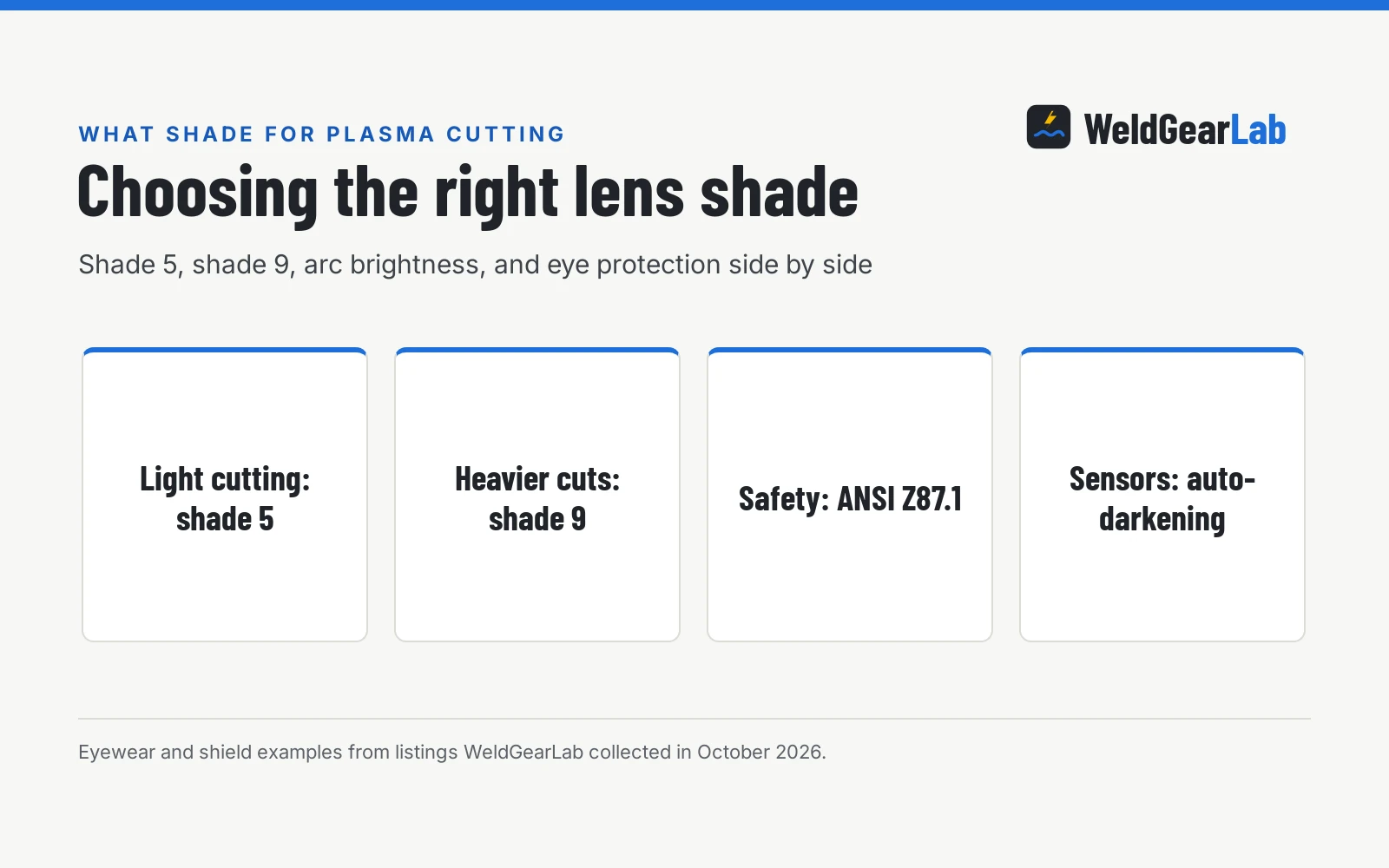
For most handheld shop cutting, what shade for plasma cutting comes down to shade 5 or shade 9 depending on how much current your torch draws and how bright the plasma column becomes. Shade 5 is standard for lower-current cutting and light sheet trimming, providing glare reduction while keeping your cut line visible. Higher-current cutting produces a substantially brighter arc that calls for shade 8 or shade 9 protection in a full shield or helmet. This guide breaks down lens selection across different cutting setups and explains how to keep your eyes safe on every cut.
As an Amazon Associate I earn from qualifying purchases. This guide links to our product roundups, where WeldGearLab earns a commission when you buy through links, at no extra cost to you. Read our affiliate disclosure.
What shade for plasma cutting in one paragraph
A plasma torch ionizes compressed gas into a high-velocity plasma stream that melts and blows metal away, producing intense optical radiation and high heat. Lower current levels emit moderate visible glare along with ultraviolet and infrared radiation that shade 5 lenses filter comfortably. Higher output levels produce a much more intense arc that requires shade 8 or shade 9 filtration to prevent eye strain and flash burns. If your view feels washed out or your eyes feel tired after cutting, your lens is too light; if you cannot see the torch tip or cut path, your lens is too dark.
Side by side
| Shade 5 (light cutting) | Shade 8 (medium cutting) | Shade 9 (heavy cutting) | |
|---|---|---|---|
| Primary cutting task | Lower-current manual cutting and thin sheet trimming | Mid-current cutting and medium sheet fabrication | Higher-current cutting and heavy plate severing |
| Arc glare reduction | Moderate visible glare and radiant heat reduction | Strong visible glare and optical radiation filtering | Dark filtration for intense arc glare and radiation |
| Cut line visibility | Clear visibility of scribed lines under shop lighting | Balanced view of cut path under active arc lighting | Dark view requiring intense arc or focused work light |
| Common gear options | Safety glasses, cutting goggles, face shields, hoods | Dual-lens glasses, variable goggles, cutting hoods | Auto-darkening hoods, variable goggles, filter plates |
| Typical machine mode | Low-output cutting or dedicated torch cutting mode | Variable cutting mode on select goggles and hoods | Cutting or low-end welding mode on auto-darkening hoods |
| Stated impact standard | ANSI Z87.1 or CSA Z94.3 impact compliance | ANSI Z87.1 or CSA Z94.3 impact compliance | ANSI Z87.1 or CSA Z94.3 impact compliance |
| Facial skin protection | Requires separate face shield or bib against sparks | Full shield or helmet recommended for face coverage | Full helmet recommended to block arc radiation |
| Optical radiation protection | Infrared and ultraviolet protection for light cutting | Enhanced optical filtration for medium arc output | Heavy optical filtration for bright high-current arcs |
Shade numbers indicate optical density: higher numbers block more visible light. Always verify the shade markings on your lens or shield against your cutting current, and consult your machine manual or torch chart for specific recommendations.
When shade 5 is the better choice
- Light handheld cutting. Thin gauge sheet metal and quick trimming where torch current remains low.
- Enhanced cut line visibility. Lighter tint makes it easier to trace scribed lines, templates, and chalk marks in typical shop lighting.
- Compact eyewear compatibility. Shade 5 is widely available in lightweight safety glasses and cutting goggles that fit comfortably in tight spaces.
- Multi-task metal fabrication. Suitable for oxy-fuel torch cutting, torch brazing, and light plasma cutting without needing a dark welding lens.
If you cut with a dedicated plasma unit, our plasma cutter for metal guide covers shop machines designed for clean metal fabrication.
When shade 9 is the better choice
- High-current severing. Thick steel plate, structural sections, and extended cuts where the plasma arc produces intense visible and ultraviolet glare.
- Prolonged cutting sessions. Extended arc time increases cumulative optical radiation, making darker filtration essential to prevent eye fatigue.
- Full-face radiation shielding. High-amperage plasma arcs generate intense radiant heat and ultraviolet radiation, making full helmet coverage important to protect facial skin from radiation burns.
- Air carbon arc gouging or high-amperage plasma. Heavy gouging and high-output cutting create extreme glare where shade 9 or darker delivers necessary protection.
How to check lens ratings and specs
Protective eyewear and cutting shields vary widely in optical filtration and coverage. Look for these checkable details in manufacturer listings:
- Exact shade designation. Fixed-shade safety glasses state their optical rating directly. Hobart lists shade 5 mirrored polycarbonate lenses, while LPSAFP lists switchable dual-lens eyewear with shade 5 (5% visible light transmission) and shade 8 (1% visible light transmission). For arc welding, PACIFIC PPE notes that users should search for shade 10.
- Stated impact standards. Look for markings indicating verified optical and impact compliance. Gateway Safety and Jackson list compliance with ANSI Z87.1 and CSA Z94.3 standards, while 3M lists its Solus 2000 series as meeting the impact-rated protector requirement of the ANSI-ISEA Z87.1-2020 standard.
- Ultraviolet filtration ratings. Quality lenses state their radiation absorption. Miller lists 99.9% ultraviolet light protection, Gateway Safety lists 99.99% protection, and 3M lists U6 rated lenses that absorb 99.9% of UVA, UVB, and UVC rays between 200 nm and 380 nm.
- Stated dimensions and weight. Form factor determines comfort during long jobs. Hobart lists safety glasses measuring 6 x 1.9 x 1.9 inches at 2.24 ounces, Miller lists glasses measuring 7.6 x 3.2 x 1.8 inches with a 3.2 inches temple-to-temple width, and Jackson lists its Quad 500 shield at 8.53 inches long by 8.24 inches wide weighing 0.91 kg.
Always inspect the physical stamp on the lens frame or filter cartridge to confirm the shade and impact rating before striking an arc.
Safety glasses vs full welding helmets
Shade 5 safety glasses protect your eyes from optical radiation and direct spatter, but they leave your cheeks, neck, and ears exposed. Plasma cutting expels high-velocity molten dross and hot sparks that easily bounce off workpieces. For quick cuts on light sheet, shade 5 safety glasses or a face shield like the Jackson Quad 500 provide lightweight comfort and wide peripheral vision. For high-output cutting, gouging, or working out of position, a full welding helmet is essential to shield your entire face and neck from burns and arc reflection.
Can an auto-darkening helmet handle cutting?
Yes, and for many home fabricators an auto-darkening hood is the most versatile solution. Modern auto-darkening lenses frequently feature a dedicated cutting mode covering variable shades. For example, Meonum lists welding goggles with 3 mode functions covering shade 4 for grinding, DIN5 to DIN9 for cutting, and DIN9 to DIN13 for welding, using 2 sensors and switching in 5/10,000 of a second. Investing in a quality hood allows you to switch between welding and plasma cutting with a simple dial adjustment; see our best auto darkening welding helmet guide for top-rated models.
Plasma cutting safety hazards. Plasma arcs produce intense ultraviolet radiation, toxic metal fumes, and airborne sparks. Always work in a well-ventilated space or outdoors to avoid inhaling fume plumes, especially on galvanized or coated metals. Keep fire extinguishers accessible and clear flammable materials from the cutting zone. Never look directly at an unshielded plasma arc, and wear flame-resistant clothing and leather gloves alongside your rated eye protection. Check your equipment manual for specific operating procedures.
Frequently Asked Questions
Can I use shade 5 safety glasses for all plasma cutting?
Shade 5 safety glasses are appropriate for lower-current cutting on light sheet metal. When cutting thicker plate at higher current, the plasma arc generates substantially more radiant energy, requiring shade 8 or shade 9 protection in a full helmet to prevent flash burns and eye fatigue.
What is the difference between plasma cutting shade 5 or 9?
The difference lies in optical density and arc glare reduction. Shade 5 provides lighter filtration suitable for lower-current cutting, allowing sufficient ambient light through so you can easily track cut lines in the shop. Shade 9 blocks significantly more radiant energy, shielding your eyes from the intense glare and radiation generated during high-current cutting.
Can I use clear safety glasses for plasma cutting?
Clear safety glasses do not provide adequate visible glare filtration for plasma cutting. Even if clear lenses offer ultraviolet absorption, they fail to protect against the bright visible flash and infrared radiation of the plasma column. Always use rated lenses marked shade 5 or darker.
Why do my eyes hurt after plasma cutting?
Eye pain or a gritty sensation after cutting typically indicates photokeratitis, commonly known as arc eye or flash burn. This occurs when your lens shade is too light for the cutting current or when you view the arc without adequate side protection. Switch to a darker shade such as shade 8 or shade 9 and wear full-face protection.
Can I use my standard welding helmet for plasma cutting?
Yes, provided your welding helmet has a dedicated cutting mode or adjusts down to the shade your current requires. Many auto-darkening helmets feature a cutting mode covering DIN5 to DIN9, allowing you to select shade 5 for light sheet or shade 9 for heavier cuts. Standard fixed-shade helmets rated shade 10 are generally too dark for light cutting, obscuring the cut path.
Related: how to use an auto darkening welding helmet, plasma cutter for metal, what size plasma cutter do I need, and the welding helmets hub. Also see our plasma cutters hub.
About the author
WeldGearLab Editorial is the editorial team behind WeldGearLab. We research product listings, specifications, safety listings and warranty terms, score every pick with the published Gear Score method, and correct errors when readers report them. We do not run our own shop trials; see How We Pick for exactly how picks are made.