TIG Welding Settings for Sheet Metal: Setup and Tuning Guide (2026)
How to dial in TIG welding settings for sheet metal to control heat input, prevent burn-through, and maintain clean arc stability on thin stock.

On this page
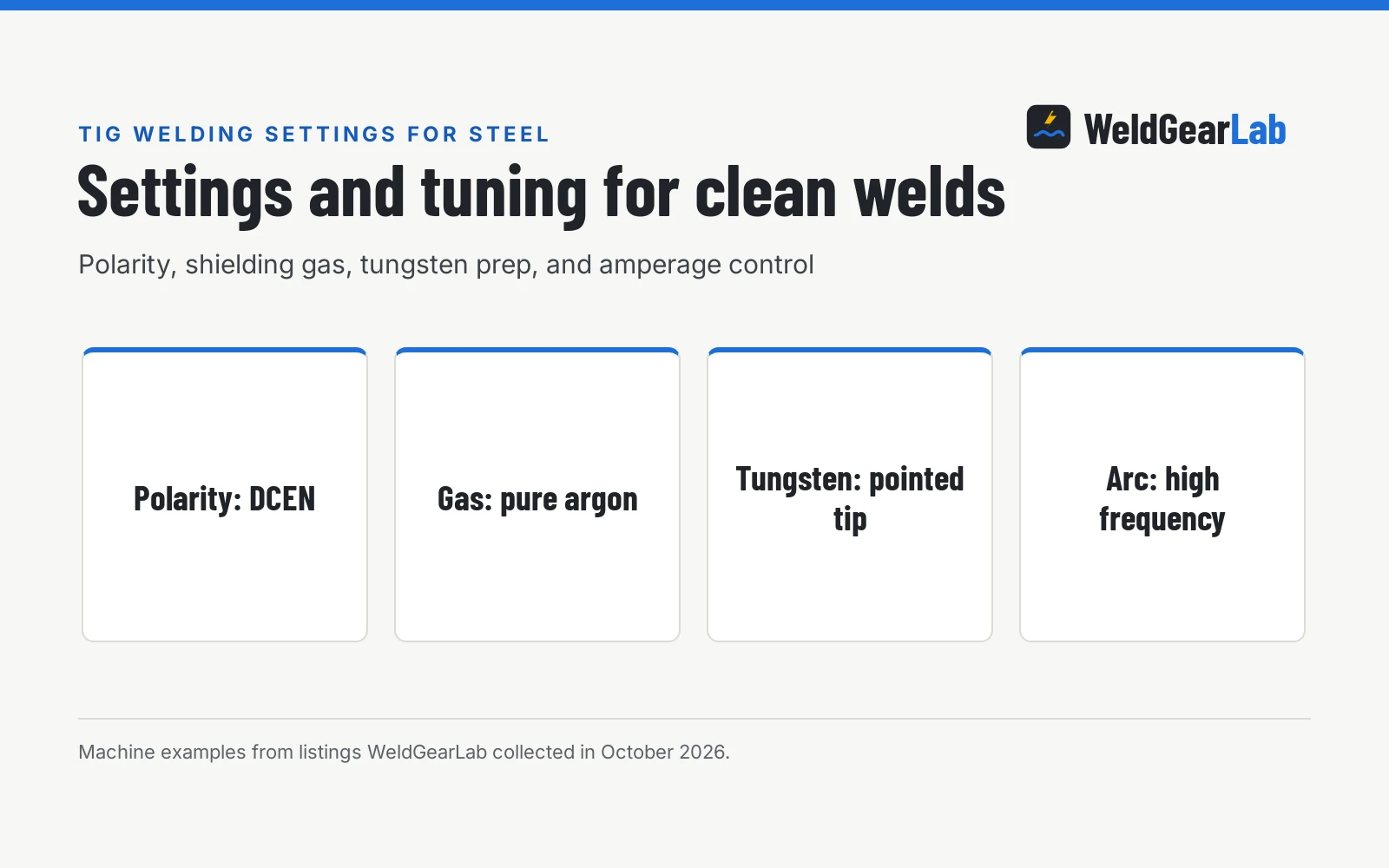
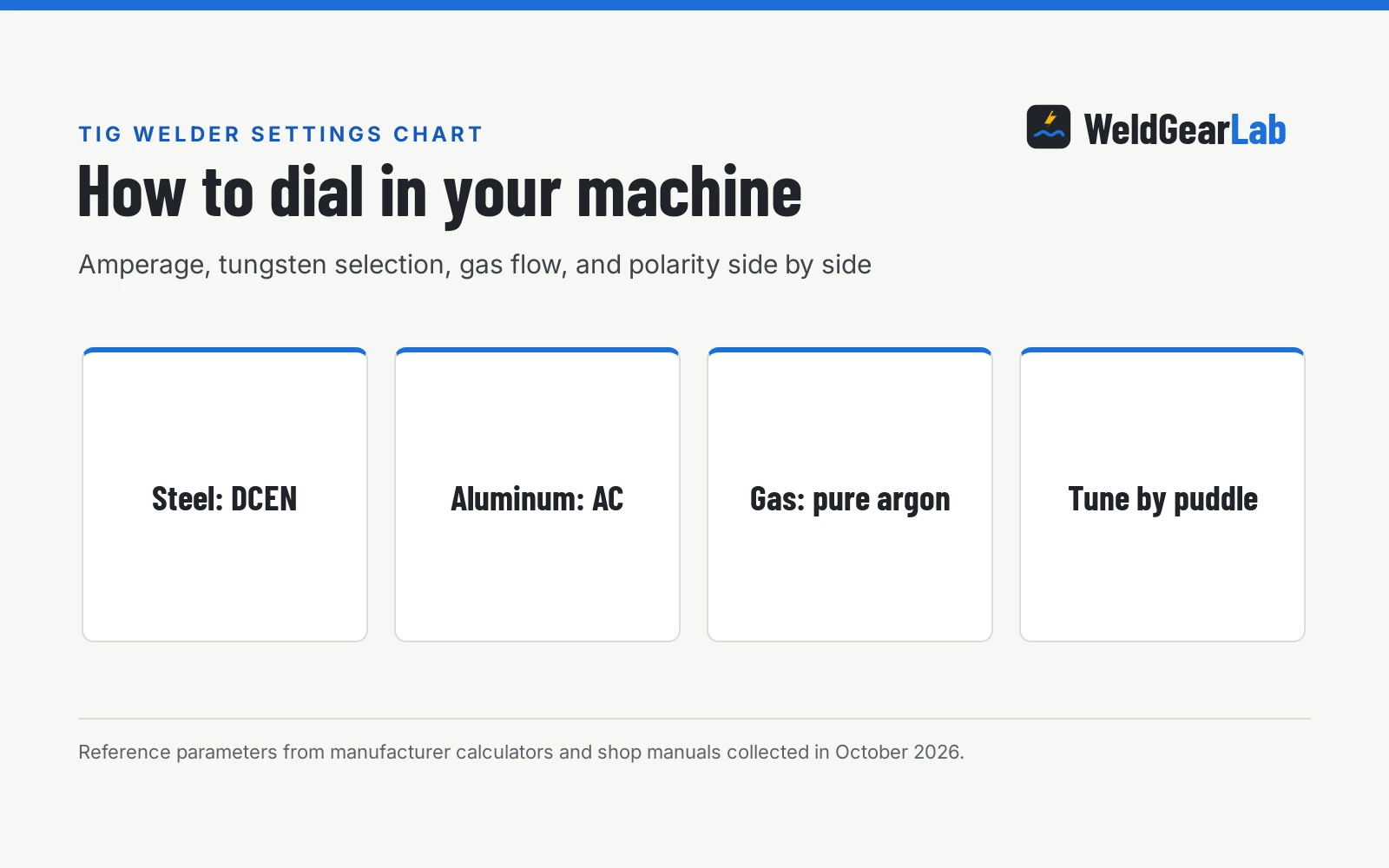
When thin sheet metal sits on the bench, striking a TIG arc demands far more restraint than welding structural plate. The key tig welding settings for sheet metal require direct current electrode negative (DCEN) polarity for steel, low base amperage dialed through a foot pedal or finger switch, pure argon shielding gas, a sharp tungsten electrode, and brisk travel speed. Because thin sheet has minimal mass to absorb heat, energy concentrates along the joint instantly. Running excessive current or lingering in a single spot causes immediate burn-through and severe warping. Dialing in your machine establishes a small, controllable puddle that fuses clean seams with minimal panel distortion.
As an Amazon Associate I earn from qualifying purchases. This guide links to our product roundups, where WeldGearLab gets a commission on purchases made through links on this page, and your price stays the same. Read our affiliate disclosure.
TIG welding settings for sheet metal
TIG welding thin sheet is a constant battle against heat accumulation. If heat builds up faster than the metal conducts it away, the puddle expands uncontrollably, sags beneath the seam, and drops out, leaving a blowout that ruins the workpiece.
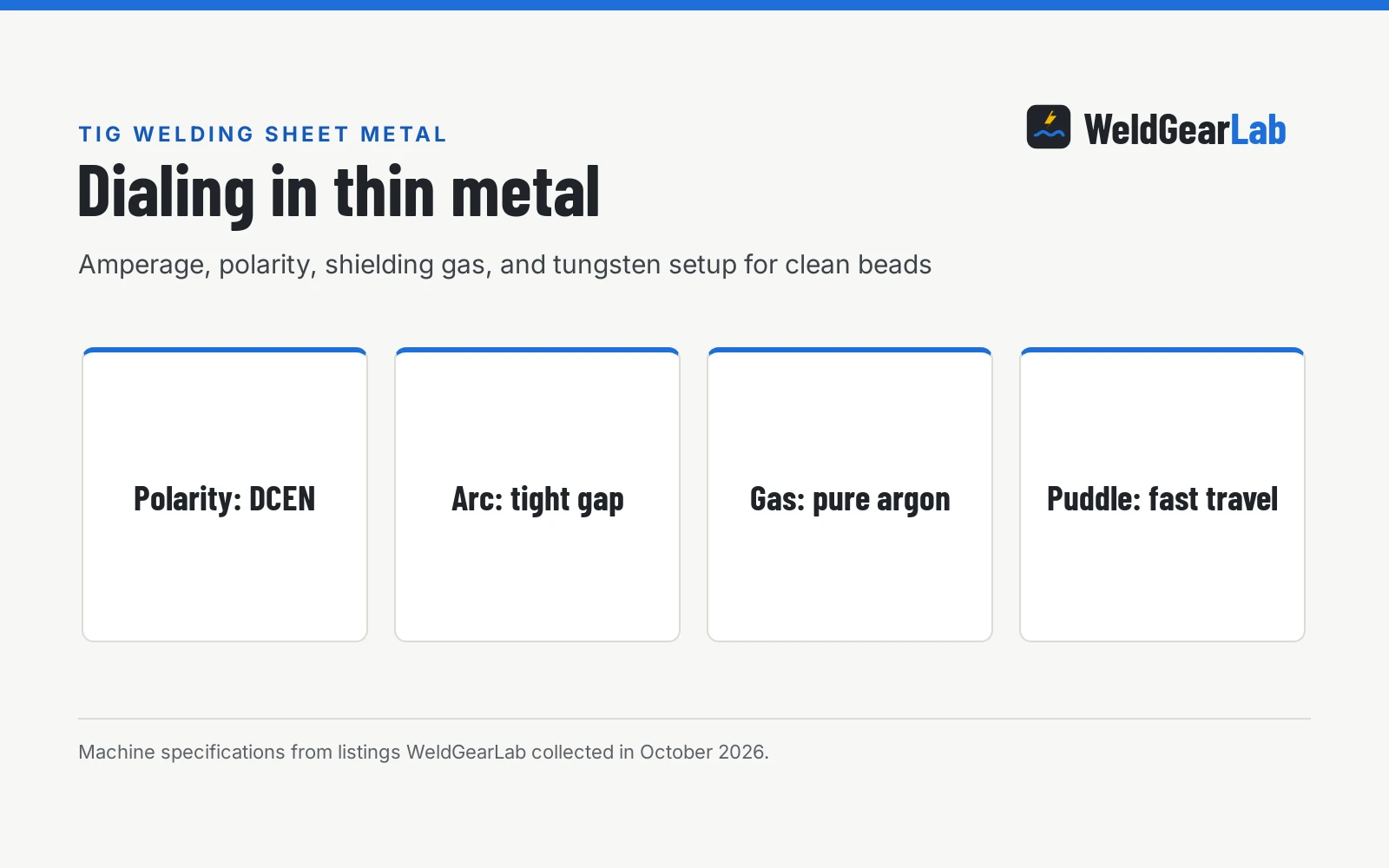
Dial in these core parameters to protect thin sheet:
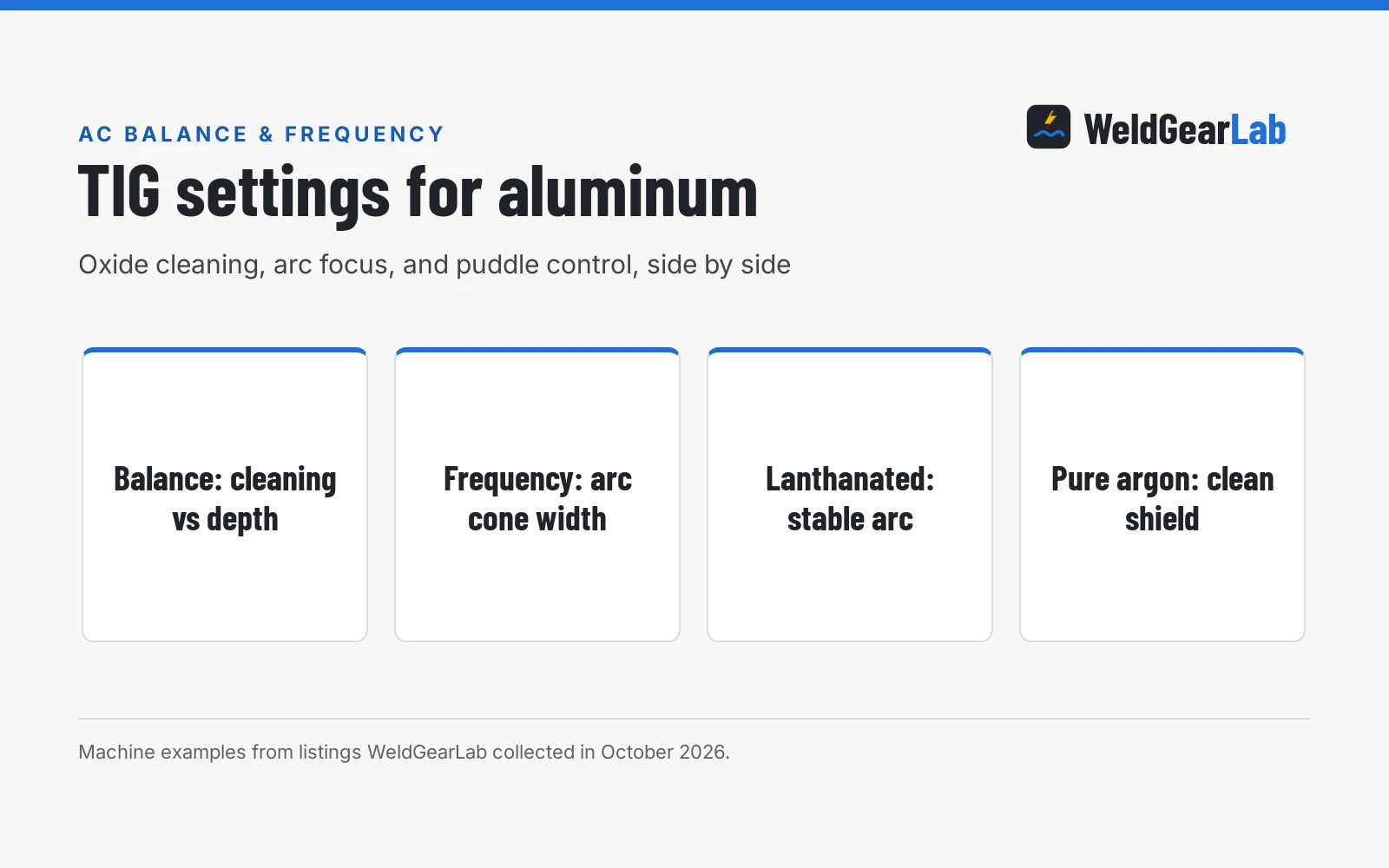
- Current and polarity. Run direct current electrode negative (DCEN) on carbon steel and stainless sheet to direct heat into the joint while keeping the electrode cool. Use alternating current (AC) on aluminum to clean off surface oxides.
- Amperage and puddle start. Set your machine’s peak amperage low so flooring the pedal will not blow through. Form a tiny puddle instantly, add filler only if necessary, and begin traveling immediately.
- Arc length. Keep a tight arc gap. A long arc raises voltage, broadens the arc cone, spreads heat across the panel, and causes blowouts. A tight gap focuses heat into a narrow seam.
- Travel speed. Move fast and maintain a steady cadence. Hesitation overheats the base metal, while brisk travel allows the puddle to freeze quickly behind the torch.
Side by side
| Carbon Steel Sheet | Stainless Steel Sheet | Aluminum Sheet | |
|---|---|---|---|
| Current and polarity | DCEN (direct current electrode negative) | DCEN (direct current electrode negative) | AC (alternating current) |
| Arc ignition | High frequency (HF) or lift TIG | High frequency (HF) or lift TIG | Continuous high frequency on AC |
| Shielding gas | Pure argon | Pure argon | Pure argon |
| Tungsten electrode tip | Ground to a sharp point | Ground to a sharp point | Slightly blunted or balled tip |
| Filler rod addition | Autogenous or thin filler rod | Autogenous or thin filler rod | Requires filler rod on every seam |
| Post gas flow | Shields pool until discoloration stops | Shields pool until discoloration stops | Shields pool until puddle freezes |
| Heat input control | Low base amperage with rapid travel | Low heat input to prevent warping | Higher initial amperage to establish puddle, then taper |
| Backing and heat sinks | Steel bench or copper chill blocks | Copper or aluminum chill blocks | Stainless or copper backing bars |
Polarity and arc behavior differ between steel and aluminum sheet. Steel and stainless run on continuous DCEN with a pointed tungsten, whereas aluminum demands AC to strip surface oxide films. Keeping heat input low remains the primary goal across all thin metals.
Amperage control and arc starting
Fine current regulation is essential on thin sheet. Machines that surge at low amperage blow through edges immediately. Welding thin panels also demands helmet sensitivity; for example, the Tefuawe auto-darkening lens listing notes a 2 Amp TIG rating for low-current arc sensing, ensuring the cartridge stays dark during low-amperage bench work.
Compact inverters provide wide output ranges. The HZXVOGEN TIG200 listing states an output up to 200A with dual voltage support for 110/220V power and an 80% duty cycle rating. Sheet metal work relies on the lower end of that range. Using high-frequency (HF) arc ignition avoids touching tungsten to the plate, eliminating contamination and scratch marks.
Advanced controls offer a major edge on thin panels. The PUWU CT-416G combo machine features 200A output with pulse TIG capability and 2T/4T trigger operation. Pulse TIG alternates between peak and background current, allowing the puddle to cool between pulses to minimize distortion. See our guide to pulse TIG welding for thin metal.
Controlling current during the pass is critical. While a foot pedal suits bench work, out-of-position welds make pedals awkward. The Pidnsrozo torch switch (on Amazon) features a 25FT cable with a 14-PIN connector for Miller style torches, providing an on/off trigger directly on the handle. Learn more in how to TIG weld without a foot pedal.
Shielding gas flow and post gas settings
Shielding gas protects the puddle and electrode from atmosphere. Pure argon is standard for mild steel, stainless steel, and aluminum. Never use active gases containing carbon dioxide or oxygen on TIG welds, as they burn up the tungsten and contaminate the weld.
Gas flow must remain laminar. Excessive flow causes turbulence that pulls air into the shield, creating porosity; review our advice in TIG welding argon flow rate. In the PUWU CT-416G package, the maker supplies transparent gas tubing with a 0.4 m extension for leak-free regulator connections.
Post gas flow shields the crater and hot tungsten as they cool. Cutting off gas prematurely causes oxidation and crater cracking. The HZXVOGEN TIG200 provides adjustable post gas settings ranging from 1-10 seconds of post gas delay, keeping the bead shielded until the metal cools.
Gas lenses outperform standard collets by smoothing gas into a uniform column. Consumable sets from RX WELD include stubby gas lens kits with #10 cup and #12 cup sizes for WP-17, WP-18, and WP-26 torches. This improves tungsten stickout and puddle visibility; see our roundup of the best TIG gas lens kit options.
Torch setup and tungsten selection
Torch size affects hand control along narrow seams. RIVERWELD offers components for 9 series air-cooled torches and 20 series water-cooled torches, along with 25 series torches (including WP-9, WP-20, and WP-25 models). A compact 9 series torch is lightweight and maneuvers easily on sheet metal. See our guide on TIG torch sizes explained, or check the best TIG torch picks.
Clearance is vital inside tight fab enclosures. The RIVERWELD kit (on Amazon) includes 41V33 short, 41V35 middle, and 41V24 long back caps. A 41V33 short back cap lowers the torch profile so you can fit inside tight sheet metal boxes without striking opposing walls.
Tungsten preparation governs arc focus. Grind electrodes longitudinally so grind marks run parallel to the shaft. A sharp, needle-like tip concentrates the arc directly into the seam, narrowing the heat zone; read our guide on what color tungsten for steel.
Organized leads prevent dragging across bench corners. The YESWELDER BT-3.7 cable cover provides a 12 feet (3.7m) zippered jacket that protects lines from sharp edges. Resting the torch on a magnetic stand, such as the Themethla magnetic torch holder (on Amazon), keeps hot consumables safe between tacks.
Tuning settings for 1mm stainless steel
Thin stainless steel has low thermal conductivity and high thermal expansion. Heat concentrates along the joint rather than dispersing, causing rapid distortion and sugaring if the backside oxidizes.
When setting up for 1mm stainless steel, use DCEN polarity, a sharp tungsten, and a tight arc. Travel fast. With tight fit-up, autogenous welding fuses the edges without filler wire, minimizing heat. When adding wire, use thin filler so it melts easily without extra amperage.
Backing bars make a huge difference on 1mm stainless. Clamping copper or aluminum chill blocks behind the joint draws heat away quickly and blocks oxygen from the root. Read our tutorial on how to TIG weld thin stainless without warping.
Fit-up and tack welding sheet metal
No machine setting fixes poor fit-up on sheet metal. Gaps cause the arc to burn away edges instead of fusing them. Shear panels square, deburr thoroughly, and clamp parts with zero air gap along the joint.
Place small, firm tacks close together along the seam to lock alignment and counter contraction. Tap each tack flat with a planishing hammer before running the final bead so the torch passes over them smoothly without snagging.
FAQ for welders
How do you set up a TIG welder for thin sheet metal?
Set DCEN for steel or AC for aluminum, connect pure argon, and install a finely pointed tungsten. Set amperage low, start with high frequency, and control heat with a foot pedal or finger switch while maintaining brisk travel speed.
What are the key TIG welder settings for welding stainless sheet?
Use DCEN polarity, pure argon, and minimal amperage to limit warping on stainless sheet. Keep a tight arc gap, travel briskly, and clamp copper chill blocks behind the joint to draw away heat and prevent sugaring.
What shielding gas is required for TIG welding sheet metal?
Pure argon is standard across mild steel, stainless, and aluminum sheet metal. Avoid mixtures with carbon dioxide or oxygen, which destroy the tungsten electrode. Keep gas flow laminar to avoid air-pulling turbulence.
Can you TIG weld sheet metal without a foot pedal?
Yes, you can weld sheet metal without a pedal using a torch finger switch or 2T/4T trigger settings. A finger switch starts and stops the arc on out-of-position welds where pedals are difficult to operate.
What does a TIG welder do differently on thin metal compared to MIG?
TIG isolates heat input from filler metal addition, giving you direct control over the molten pool. Unlike MIG, which feeds wire continuously under preset voltage, TIG allows autogenous fusion and narrow, spatter-free seams.
Related: best entry level TIG welder, best TIG welder for aluminum, pulse TIG welding for thin metal, and the welders guide. Also see our guide on how to TIG weld thin stainless without warping.