Pulse TIG Welding for Thin Metal: Setup, Settings, and Technique (2026)
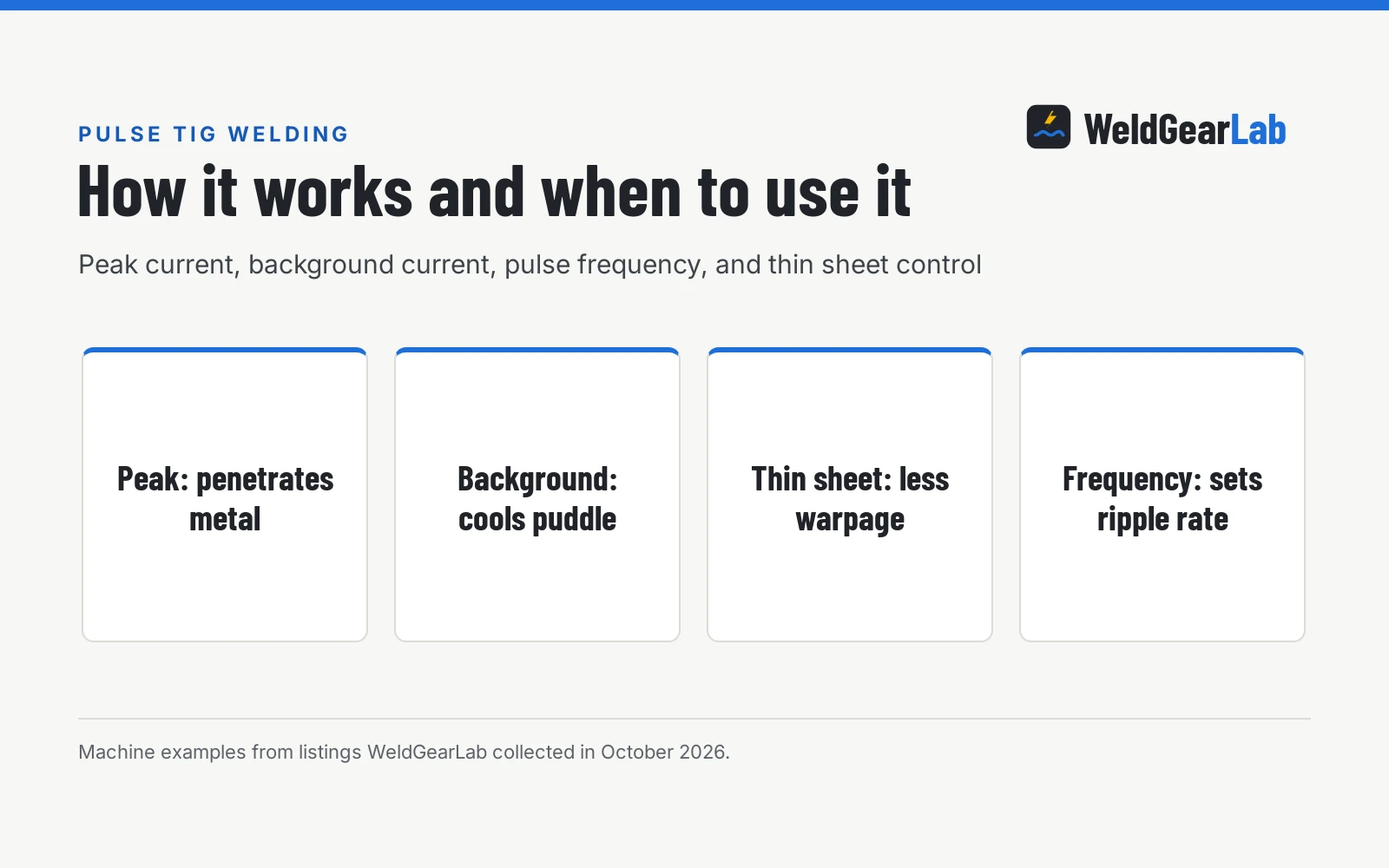
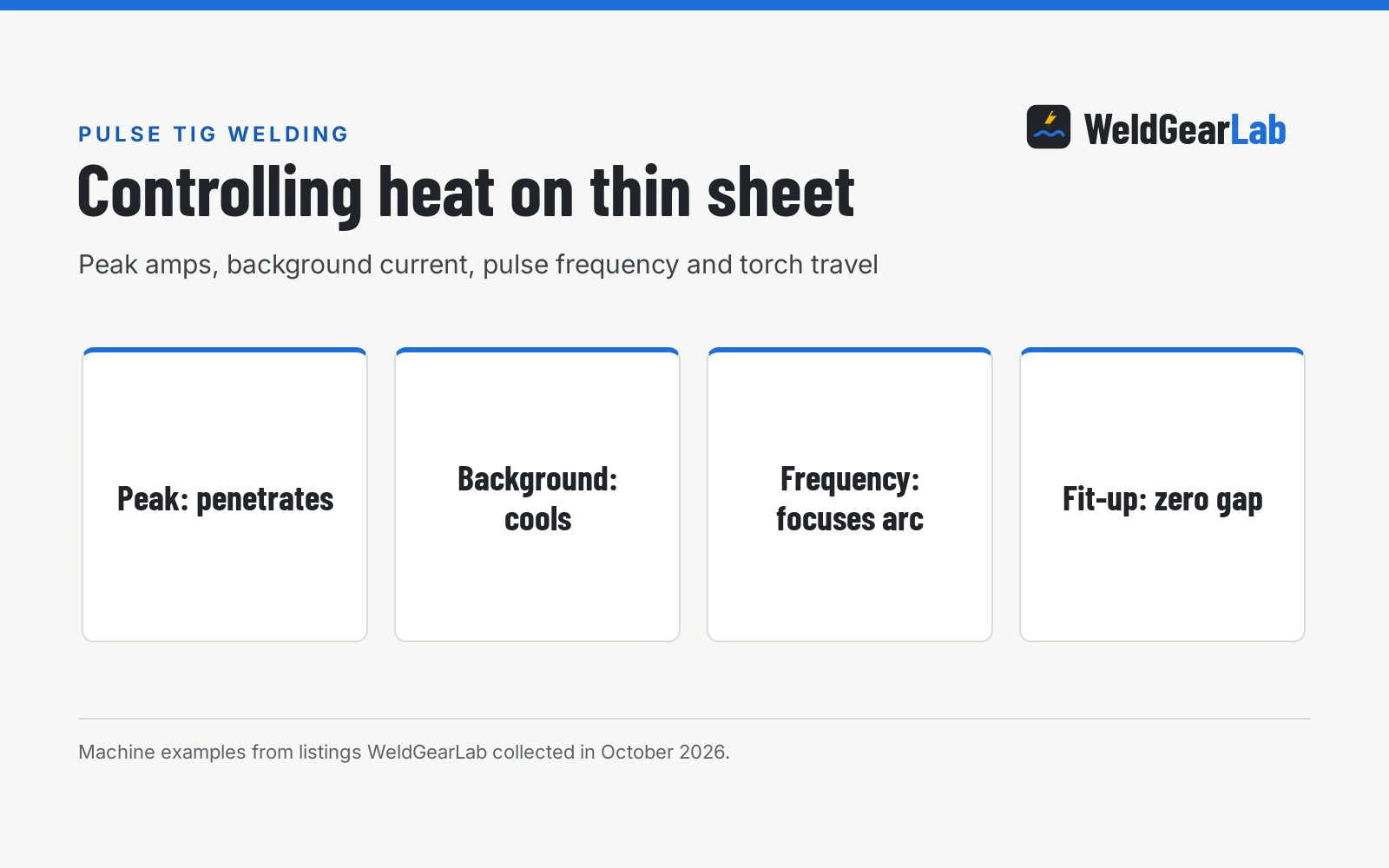
Pulse TIG welding cuts heat input on thin sheet metal to stop burn-through and distortion by alternating between peak and background amperage.

On this page
Pulse tig welding for thin metal prevents burn-through and distortion by pulsing between a high peak amperage that melts the base metal and a low background amperage that lets the puddle cool. On thin sheet metal and lightweight tubing, continuous heat from standard TIG can quickly overheat the joint, leading to edge drop, warpage, or blowouts. Pulsing regulates arc energy across timed cycles so you get full penetration while keeping total heat input low. This guide covers how to set peak and background current, choose pulse frequency, and prep your torch for clean welds on thin stock.
As an Amazon Associate I earn from qualifying purchases. This guide links to our product roundups, where WeldGearLab gets a commission on purchases made through links on this page, and your price stays the same. Read our affiliate disclosure.
Pulse tig welding for thin metal in one paragraph
Standard DC TIG delivers a steady stream of heat that rapidly accumulates in thin sheet metal. Because thin stock lacks mass to draw heat away from the weld zone, the puddle can quickly expand, risking burn-through holes or panel distortion. Pulsed TIG solves this problem by cycling between distinct current levels: a peak amperage that strikes hard to break surface tension and fuse the root, followed immediately by a lower background amperage that allows the molten puddle to partially freeze and shed thermal energy. By tailoring the balance between peak duration, background level, and cycle speed, you control average heat without sacrificing arc stability or puddle fluidity.
Side by side
| Standard DC TIG | Low-Frequency Pulse TIG | High-Frequency Pulse TIG | |
|---|---|---|---|
| Arc delivery | Continuous steady amperage | Slow pulses for manual dipping rhythm | Rapid pulses for tight arc focus |
| Heat input | Continuous heat builds up quickly | Low average heat as puddle cools between pulses | Concentrated heat with minimal thermal spread |
| Burn-through risk | High on thin sheet metal | Low as puddle cools between peak pulses | Low due to narrow, focused energy transfer |
| Warping and distortion | High due to wide heat-affected zone | Low due to reduced average heat input | Very low due to pinpoint arc cone |
| Arc stiffness | Arc can wander at low amperage | Moderate arc stiffness | Extremely stiff and directional arc cone |
| Puddle control | Puddle remains molten continuously | Puddle cools partially between pulses | Puddle stays small and tightly contained |
| Travel pacing | Operator sets speed manually | Pulse rhythm sets clear cadence for filler dips | Fast travel speed with steady torch motion |
| Primary use on thin metal | Straight runs on heavier gauge sheet | Manual filler rod additions on sheet joints | Autogenous seams and precision cosmetic welds |
Settings vary depending on machine controls, joint fit-up, and material type; always confirm polarity, gas flow, and safety procedures in the machine manual before striking an arc. On thin gauge projects, tight joint fit-up without any gap is essential to prevent edge burn-back.
When pulse TIG is the better choice
- Thin sheet metal and auto body repair. Lower average heat helps prevent blowouts and panel warping on lightweight sheet steel and delicate fabrication.
- Stainless steel fabrication. Stainless steel conducts heat poorly and distorts readily under steady heat; pulsing narrows the heat-affected zone and preserves corrosion resistance.
- Tight outside corner joints. Edge joints melt down quickly under continuous amperage; pulses provide targeted heat to tie the seam together cleanly.
- Out-of-position welding. Rapid puddle freezing keeps the molten pool small and manageable when working vertical-up or overhead, stopping the puddle from sagging.
- Visual travel pacing. Low-frequency pulses establish an unmistakable rhythm for timing filler rod additions, producing uniform bead ripples with minimal cleanup.
For shop fabricators comparing dedicated TIG setups, our best entry level TIG welder guide reviews versatile machines suited for home garages and small shops.
When standard DC TIG is the better choice
- Thick plate and structural steel. Heavy sections demand continuous heat input to achieve deep penetration and maintain travel speed.
- Simple tacking on heavy fit-ups. Brief continuous tacks require no pulse parameter tuning when assembling stout structural components.
- Basic machines without pulse controls. Standard TIG allows straightforward operation with a single amperage dial, reducing setup time when working materials that are not heat sensitive.
When welding aluminum sheet, alternating current is typically required to clear surface oxides; see our review of the best TIG welder for aluminum for dedicated AC/DC power sources.
How to dial in pulse settings step by step
Tuning a pulse arc involves balancing core parameters to match sheet thickness and joint design:
- Peak amperage. Set peak current high enough to establish a molten puddle instantly upon arc strike. Because the peak current only pulses for a fraction of each cycle, setting it higher than continuous DC amperage provides immediate root fusion without heat soaking the entire workpiece. On the AHP welder (on Amazon), minimum start amperage reaches down to 5 amps on DC and 20 amps on AC, allowing gentle arc initiation on delicate stock.
- Background current. Background amperage maintains arc stability while the puddle cools. Adjust background low enough to let the molten pool chill between pulses, but high enough that the arc does not sputter or snuff out.
- Pulse frequency. Frequency measures how many pulse cycles occur each second. The AHP welder covers a pulse frequency range from 0.5 to 200 Hz. Low frequencies around the bottom of the range create distinct, stacked-coin ripples, giving you a visible pulse rhythm for dipping filler metal. Higher frequencies towards the upper range constrict the arc cone, boosting arc stiffness and pinpointing heat directly along the seam.
- Pulse width (duty cycle). Pulse width controls the percentage of time each cycle spends at peak amperage versus background current. Allocating less time to peak current drops the overall heat input into the base metal, preventing edge slump on thin sheet.
Dialing in pulse parameters on scrap coupons takes patience. Some modern inverters help speed up shop workflow; for instance, the AZZUNO TIG-200L features memory storage to save and recall up to 10 custom parameter sets once you find the ideal combination for recurring jobs. For a comprehensive overview of machine setup, consult our TIG welder settings chart.
Torch setup and shielding gas for thin metal
Achieving clean results on thin sheet requires precise shielding gas coverage and clean arc focus. Keep these torch essentials in mind:
- Shielding gas selection. Pure argon gas is standard for both carbon steel and stainless sheet. Argon provides smooth arc starts, reliable atmospheric shielding, and a calm puddle. For example, the ANDELI TIG-250MPL (on Amazon) listing specifies pure argon gas for clean bead color.
- Gas pre-flow and post-flow. Set adequate pre-flow to purge the torch cup before the high-frequency arc initiates, and post-flow to shield the cooling crater and tungsten electrode. The AHP welder lists pre-flow and post-flow settings adjustable from 0 to 10 seconds.
- Gas lens collet bodies. Replacing standard collet bodies with a gas lens screens out turbulence and delivers laminar gas flow, keeping the puddle and tungsten clean even with longer electrode stickout. Explore our guide to the best TIG gas lens kit for shop torch upgrades.
- Tungsten prep. Grind tungsten longitudinally to a fine, sharp point. A sharp taper creates a narrow, focused arc column that directs heat precisely into the seam rather than spreading heat across thin sheet edges.
- Torch switch modes. Inverters such as the PUWU CT-416G and YESWELDER TIG-220P-PRO (on Amazon) support 2T and 4T torch modes. The 4T mode allows welders to release the torch trigger during long runs on sheet metal, cutting hand fatigue and improving travel consistency. For remote foot control, YESWELDER provides a dedicated 5-pin foot pedal interface.
Can one machine handle thin sheet and heavy plate?
Yes. Modern dual-voltage inverters offer wide output ranges that transition from delicate sheet metal work on household power to thicker plate fabrication on shop circuits. For example, AHP lists a 150 amp output on 120v and a full 225 amp output on 240v. Similarly, YESWELDER’s TIG-220P-PRO delivers up to 220 amps with dual voltage 110V/220V operation while weighing just 13.6 lb, making it portable between garage benches and field jobs. A dual-voltage power source lets you run lower amperages for thin sheet on a standard 110V or 120V household circuit, then connect to a 220V or 240V outlet when heavier metal demands the machine’s maximum output.
Shop safety and gas handling. Working with high-frequency arcs, inert shielding gas, and thin metals requires proper shop precautions. Always secure compressed argon cylinders upright with a safety chain. Ensure steady shop ventilation or fume extraction to keep welding plumes away from your breathing zone, and wear clean leather gloves and eye protection when grinding tungsten electrodes or handling sheared sheet edges. See the OSHA welding overview and our Safety Disclaimer.
FAQ for welders
How do you set pulse TIG welding for thin metal?
Begin by setting peak amperage high enough to form a puddle quickly without lingering, then set background current low enough to allow the puddle to cool between cycles. Adjust pulse frequency to suit your joint type, choosing lower frequencies for manual rod dipping or higher frequencies for arc stiffness. Fine-tune the pulse width so that peak duration provides adequate penetration without accumulating excess heat in the sheet.
What is pulse width in TIG welding?
Pulse width, often called duty cycle or peak on-time, is the percentage of time each pulse cycle spends at peak amperage versus background amperage. Decreasing pulse width shortens peak time, reducing total heat input into the base metal to protect thin sheet edges. Increasing pulse width extends peak time, generating a wider molten pool and deeper penetration when joining heavier material.
Can you use pulse TIG welding on thin aluminum?
Yes, provided your welder features alternating current output with pulse controls. Aluminum transfers heat rapidly and melts quickly once the surface oxide is broken, which makes thin sheet susceptible to sudden burn-through. An AC machine with pulse capability limits overall heat buildup while the AC arc cleans surface oxides on delicate aluminum panels.
Why is pulse TIG preferred for thin stainless steel?
Stainless steel expands significantly and retains heat, making it prone to severe warping, oxidation, and sugaring on unshielded root sides. Pulsed TIG creates a narrow heat-affected zone that minimizes thermal distortion and preserves the corrosion-resistant properties of the metal. For step-by-step guidance on preventing warpage on sheet stainless, read our guide on how to TIG weld thin stainless without warping.
Do you need a foot pedal for pulse TIG welding?
While a foot pedal allows real-time amperage adjustments as heat builds up, it is not strictly required if your machine features integrated pulse programming and torch switch modes like 2T and 4T. Setting exact peak, background, and frequency parameters on the front panel delivers consistent pulsing from start to finish. A torch trigger switch lets you maintain a steady grip and uniform torch angle along thin sheet seams.
Related: what is pulse TIG welding, how to TIG weld thin stainless without warping, TIG welder settings chart, and the welders hub. Also explore our TIG welders guide.