Best 6013 Welding Rod for Thin Metal (2026): 3 Stick Electrodes Scored
Three 6013 stick welding electrodes for thin metal and sheet fabrication, compared on rod diameter, operating amperage, weld positions, and stated warranty terms.

On this page
Top picks at a glance
As an Amazon Associate I earn from qualifying purchases.
- 1
 Best for Thin SheetHot Max 22075 1/16-Inch9.5/10View on Amazon
- 2
 Best All-Around 3/32″Forney 30305 3/32-Inch9.4/10View on Amazon
- 3
 Best US-Made PickHobart H117125-RDP 5/64-Inch9.4/10View on Amazon
When you have thin sheet metal clamped to the welding bench, an auto body patch, or light square tubing to stitch together, standard stick electrodes can blow holes through the steel before you establish a puddle. Finding the best 6013 welding rod for thin metal comes down to selecting a small core diameter that runs at low amperage with shallow penetration and a soft arc. This guide compares three 6013 stick electrodes on rod diameter, operating current, position flexibility, and stated warranty coverage to keep you from burning through light-gauge work.
WeldGearLab gets a commission on purchases made through links on this page, and your price stays the same. Read our affiliate disclosure.
Quick picks
- Best for Thin Sheet Hot Max 22075 1/16-Inch: A 1/16-inch diameter rod running at 20-40 amps, delivering the lowest heat input for thin sheet metal, backed by a stated 30-day warranty. Check price on Amazon
- Best All-Around 3/32″ Forney 30305 3/32-Inch: A 3/32-inch general-purpose rod rated for 35-125 amps, all-position welding with shallow penetration, and a 90-day warranty. Check price on Amazon
- Best US-Made Pick Hobart H117125-RDP 5/64-Inch: A 5/64-inch electrode made in the United States, running on AC, DCEP or DCEN with 60,000 PSI tensile strength. Check price on Amazon
The machines

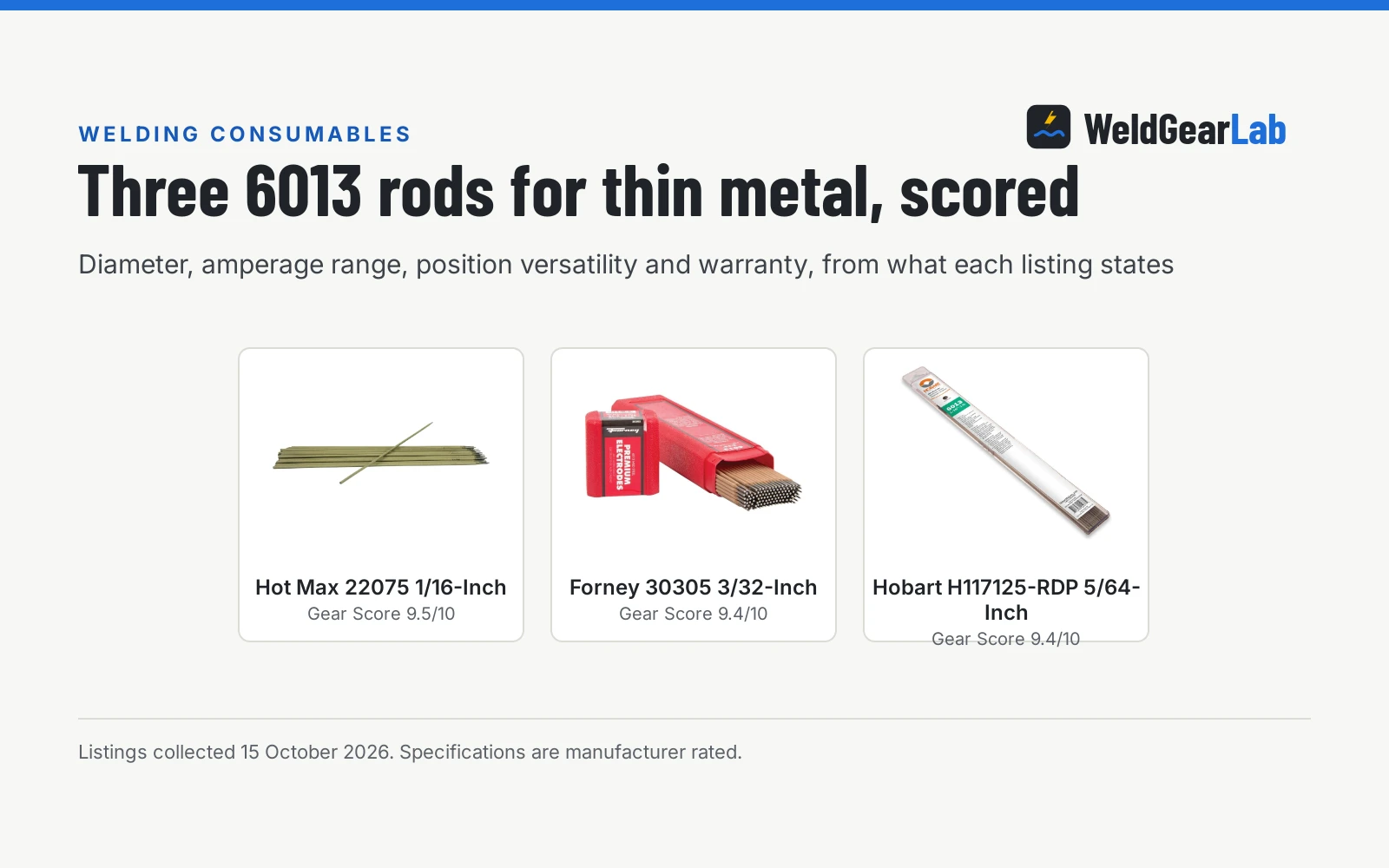
Hot Max 22075 1/16-Inch E6013 1# ARC Welding
A 1/16-inch E6013 stick electrode rated for 20 to 40 amps in a 1-pound pack, with a stated 30-day warranty.
Pros
- 1/16-inch diameter runs at a stated 20 to 40 amps for low heat input on thin metal
- 1-pound package size suits small repairs without storing excess rods
- Listing states a 30-day warranty
- 10 x 1.5 x 1.5 inch package dimensions for compact shop storage
Cons
- Listing includes an erroneous Max RPM: 10,000 bullet copied from power tool specs
- Does not state AC or DC polarity compatibility in the listing
- 30-day warranty is the shortest stated term among warranted rods here
Forney 30305 E6013 Welding Rod, 3/32-Inch
A 3/32-inch E6013 mild steel electrode in a 5-pound pack, rated for all positions on AC or DC, with a 90-day warranty.
Pros
- 3/32-inch size with a stated 0.09-inch thickness suits all-position thin metal fabrication
- Runs on either AC or DC power sources with shallow penetration
- Spec table states an amperage range of 35-125 A with 80 A amperage capacity
- Carries a stated 90-day warranty against manufacturer defects
Cons
- Spec table contains severe contradictions, listing E6010, deep penetrating pipe electrode, and 1/8-inch diameter
- Spec table lists available package weight as 10 Pound while title and bullets state 5 pounds

Hobart H117125-RDP 6013 Stick Welding Electrode
A 5/64-inch 6013 electrode manufactured in the United States, rated for 60,000 PSI across AC, DCEP, and DCEN polarities.
Pros
- 5/64-inch diameter offers a narrow arc suited for sheet metal between 1/16-inch and 3/32-inch sizes
- Runs on AC, DCEP, or DCEN polarities in all positions
- Rated for 60,000 PSI tensile strength on carbon steel
- Listing states United States as the country of origin
Cons
- Operating amperage range is not stated in the listing
- No warranty term is stated in the listing
- Weight discrepancy between 1 lb in included components, 0.5948 lbs package weight, and 6.4 ounces item weight
- Small 1-pound pack is limited for larger shop fabrication jobs
Other welders and gear to compare
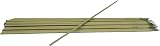
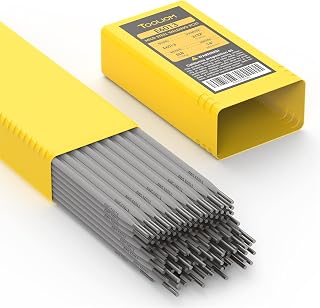 TOOLIOM E6013 Welding Rod Carbon Steel Stick ElectrodesCheck price on Amazon
 E6013 Welding Rod 3/32″Check price on Amazon
 Victory Welding Alloys 7014 Welding Rod 3/32" E7014 3/32" 5Check price on Amazon
 ER70S-6 TIG Welding Rod 1/16" x 16"Check price on Amazon
 Low Temperature Universal Welding RodsCheck price on Amazon
Spec sheet comparison
| Model | Gear Score | Diameter | Amperage range | Pack weight | Current type | Tensile strength | Warranty |
|---|---|---|---|---|---|---|---|
| Hot Max 22075 1/16-Inch | 9.5/10 | 1/16 in | 20-40 A | 1 lb | Not stated | Not stated | 30 Day |
| Forney 30305 3/32-Inch | 9.4/10 | 3/32 in | 35-125 A | 5 lb | AC or DC | 60,000 PSI | 90 days |
| Hobart H117125-RDP 5/64-Inch | 9.4/10 | 5/64 in | Not stated | 1 lb | AC, DCEP or DCEN | 60,000 PSI | None stated |
All specs here repeat what the maker rates and the listing prints, copied down 15 October 2026.
Buying guide: choosing the best 6013 welding rod for thin metal
Core diameter and metal gauge
Core diameter dictates heat concentration and minimum practical operating current. A 1/16-inch rod like the Hot Max 22075 runs at 20 to 40 amps, making it the top choice for automotive sheet and thin ductwork where excess heat causes immediate burn-through. A 5/64-inch electrode like Hobart’s H117125-RDP offers a middle ground for light-gauge repairs, while 3/32-inch rods provide versatile all-position performance on light sheet and 1/8-inch steel. The larger 1/8-inch diameter deposits heavier beads and should be reserved for thicker sections rather than thin sheet.
Operating amperage and burn-through risk
Amperage settings control the puddle size and thermal distortion across your workpiece. Using an electrode that specifies a clear low-end operating range allows you to set your welding machine to deposit a clean bead without melting the joint edges away. Hot Max lists a 20-40 A range, while Forney’s 30305 lists 35-125 A with an 80 A capacity rating.
AC versus DC polarity on sheet metal
The 6013 flux formulation contains rutile and potassium arc stabilizers, allowing it to ignite and maintain an arc on alternating current or direct current. On DC machines, running direct current electrode negative (DCEN, straight polarity) deposits less heat into the base metal, providing shallow penetration that helps prevent blowing through thin joints. DCEP (reverse polarity) yields slightly deeper penetration for tighter joints, while AC provides a balanced arc on compact utility transformers with low open-circuit voltage.
Electrode condition and coating integrity
Because rutile flux coatings absorb ambient moisture over time, inspect electrodes as soon as you open the package. Look for uniform flux thickness along the core wire, intact flux around the strike tip, and an absence of cracking or spalling. Damaged flux produces an erratic arc, spatter buildup, and inconsistent slag coverage that can trap impurities in shallow sheet metal welds.
Use as directed. Stick welding thin metal produces hot slag, UV radiation, and fumes. Always wear a shade-appropriate welding helmet, leather gloves, and flame-resistant shop clothing. Ensure adequate ventilation or use a respirator when welding carbon steel, and keep a fire extinguisher near the bench. See the OSHA welding overview and our Safety Disclaimer.
Before You Strike an Arc
- Check your power source compatibility: the Hobart listing confirms operation on AC, DCEP, or DCEN.
- Inspect the electrode flux coating upon arrival for shipping cracks, chipping, or broken tips before chucking a rod into your stinger.
- Confirm the rod diameter on the package matches your workpiece thickness, saving narrow 1/16-inch or 5/64-inch rods for sheet metal patches.
- Tighten your ground clamp to clean, bare steel to prevent arc wander and hard starts on low-amperage sheet welds.
FAQ for welders
Why is 6013 considered the best welding rod for thin metal?
The 6013 electrode features a rutile-based flux coating that creates a soft, stable arc with shallow penetration. This shallow penetration reduces heat input into the base steel, helping welders join thin sheet metal and light tubing without blowing holes through the joint. It also strikes and restrikes easily, even on low open-circuit voltage machines.
What diameter 6013 rod should I use on sheet metal?
For thin sheet metal and light repairs, smaller diameters like 1/16-inch and 5/64-inch are ideal because they operate at lower amperages. A 3/32-inch rod is versatile for general light fabrication on light sheet or 1/8-inch material. Rods sized 1/8-inch run hotter and deposit heavier beads, making them risky for very thin sheet.
Can you run 6013 rods on an AC stick welder?
Yes, 6013 electrodes are formulated to run smoothly on alternating current as well as direct current. The potassium and rutile arc stabilizers in the coating maintain a steady arc when the AC current crosses zero. Several listings here specifically highlight dependable arc stability on small AC utility welders.
What polarity is best for thin metal stick welding with 6013?
When running a DC stick machine on thin metal, DCEN (direct current electrode negative) directs more heat to the electrode and less into the base metal, minimizing the chance of burn-through. DCEP (electrode positive) provides slightly deeper penetration, which suits tighter fit-ups or slightly thicker stock. AC works reliably when using a basic transformer machine without polarity switching.
How do you prevent burn-through when stick welding thin steel?
Use a tight arc length, keep your travel speed brisk, and ensure tight joint fit-up with minimal gaps. Tilting the rod slightly forward and dragging rather than pushing helps freeze the puddle quickly. Selecting a smaller electrode diameter running at the lower end of its amperage range is the most reliable way to avoid blowing through.
Related: can you stick weld thin metal, welding rod amperage chart, DC vs AC stick welding, why does my welding rod keep sticking, how to strike an arc with a stick welder, and the welding consumables hub.
Scoring, line by line
Each welding rod is scored out of 10 on performance, build, value, safety listing, and warranty, with the weights published on our How We Pick page. Stick welding electrodes have no electrical safety listing or laboratory certification to state in their listings, so every product here scores zero on safety; the ranking comes from performance, build quality, value, and stated warranty terms.
| Product | Gear Score | Perf. /35 | Build /25 | Value /25 | Safety /10 | Warranty /5 |
|---|---|---|---|---|---|---|
| Hot Max 22075 1/16-Inch | 9.5 | 30 | 20 | 20 | 0 | 2 |
| Forney 30305 3/32-Inch | 9.4 | 28 | 19 | 20 | 0 | 2 |
| Hobart H117125-RDP 5/64-Inch | 9.4 | 27 | 20 | 19 | 0 | 0 |
A pick’s weighted total decides where it lands between a 9.2 floor and a 9.8 ceiling, and a bigger total never produces a smaller number.