TIG Welding Settings for Steel: Setup and Tuning Guide (2026)
How to set up DCEN polarity, pure argon shielding gas, tungsten electrodes, and amperage control for clean TIG welds on steel in the home shop.

On this page
Top picks at a glance
As an Amazon Associate I earn from qualifying purchases.
- 1
 YESWELDER 200A AC/DC Aluminum Tig Welder TIG-200P ACDC TIG9.5/10View on Amazon
- 2
 YESWELDER Tig Welding Torch WP-17FV Gas-Valve Head Flexible9.5/10View on Amazon
- 3
 ARCCAPTAIN ER4043 Aluminum TIG Welding Rod9.4/10View on Amazon
When clamping steel tubing or flat bar to the fab bench, getting the right tig welding settings for steel starts with configuring your power source for direct current electrode negative (DCEN) and running pure argon shielding gas. You match the arc amperage to the metal thickness, grind the tungsten electrode to a tapered point, and set post gas flow to protect the molten puddle as the steel cools. This guide covers the machine controls, gas flow, tungsten preparation, and amperage settings for clean, sound steel joints in the home shop and garage.
This guide links to our product roundups, where WeldGearLab gets a commission on purchases made through links on this page, and your price stays the same. Read our affiliate disclosure.
TIG welding settings for steel in one paragraph
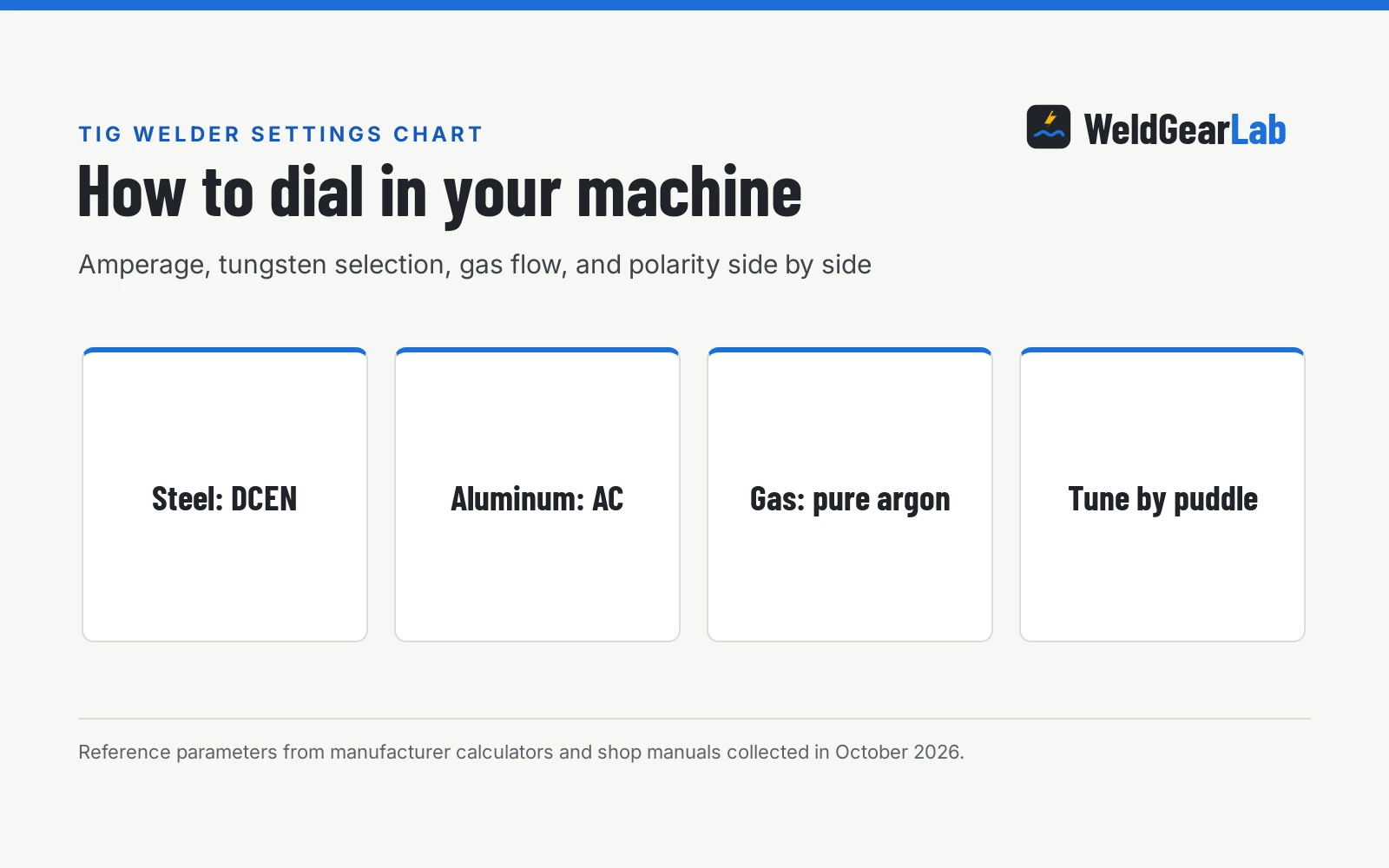
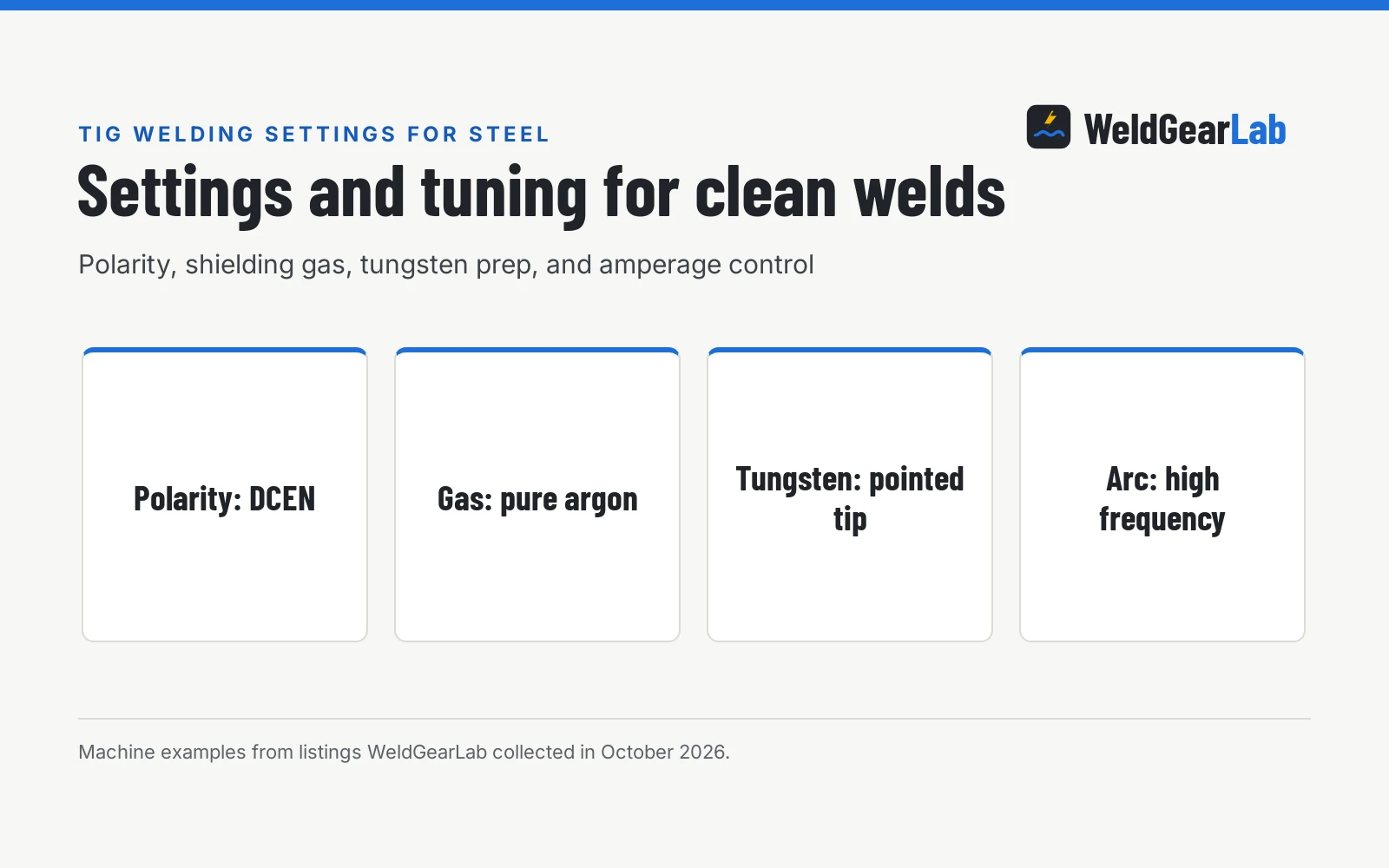
To TIG weld carbon, mild, or alloy steel, set your machine to DCEN, which directs heat into the workpiece rather than the torch. Connect the torch to the negative terminal and the work clamp to the positive terminal. Thread pure argon shielding gas through your torch, select a pointed tungsten electrode, and initiate the arc using high frequency or lift arc ignition. Adjust machine amperage according to stock thickness so the arc forms a controllable puddle without blowing through the joint, and keep the torch stationary under post gas flow until the puddle and tungsten cool below oxidizing temperatures.
Side by side
| Carbon and mild steel | Stainless steel | Aluminum | |
|---|---|---|---|
| Current and polarity | DCEN (electrode negative) | DCEN (electrode negative) | AC (alternating current) |
| Shielding gas | Pure argon | Pure argon | Pure argon |
| Tungsten electrode shape | Ground to a tapered point | Ground to a sharp tapered point | Rounded or slightly balled tip |
| Heat control | Moderate heat tolerance | Low heat input to prevent warping | Rapid heat dissipation, fast travel |
| Arc start method | High frequency or lift start | High frequency or lift start | High frequency arc start |
| Cleaning action | Not required for steel | Not required for steel | AC balance cleans oxide layer |
| Post flow gas protection | Shield puddle until cooled | Extended post flow to avoid color loss | Shield puddle until cooled |
| Backing purge | Not needed for general fab | Recommended on sanitary tube or open seams | Not typical for general joint work |
| Filler metal type | Mild steel filler rod | Stainless steel matching filler rod | Aluminum filler rod |
Polarity remains direct current electrode negative across carbon steel, mild steel, and stainless steel fabrication. While steel alloys share direct current electrode negative power and pure argon shielding gas, stainless steel retains heat longer than mild steel and distorts readily, demanding tighter heat control and extended post gas protection. Aluminum requires switching to alternating current to break through its surface oxide layer.
When mild steel is on the bench
Mild steel is the everyday metal for shop repairs, brackets, frames, and utility projects. It forgives minor variations in travel speed better than stainless steel, but it still demands clean prep and deliberate heat control:
- Joint preparation. Grind away all mill scale, rust, paint, and oil back to shiny bare metal before striking an arc. Any residual scale contaminates the tungsten and causes porosity in the bead.
- Tungsten electrode grind. Grind the tungsten tip along the length of the electrode to produce a clean taper. Longitudinal grind lines keep the arc steady and focused directly into the joint root.
- Filler metal selection. Feed a dedicated mild steel filler rod into the leading edge of the puddle. Keep the hot tip of the filler wire inside the shielding gas cone to prevent atmospheric oxidation.
- Puddle control and travel speed. Establish the puddle quickly, add filler metal in smooth dips, and move steadily along the seam. Lingering in one spot builds excess heat and produces a wide, dull bead.
Our best TIG rod for mild steel guide covers filler metal selection, and our best entry level TIG welder roundup scores machines for home fabrication.
When stainless steel is on the bench
Stainless steel fabrication requires a more disciplined approach to heat management. Stainless steel has lower thermal conductivity and higher thermal expansion than mild steel, meaning heat concentrates near the arc and warps thin assemblies quickly:
- Managing heat input. Keep the arc tight and travel promptly. Excessive heat cooks out the chromium content, causing corrosion resistance to drop and leaving a dark, oxidized weld surface.
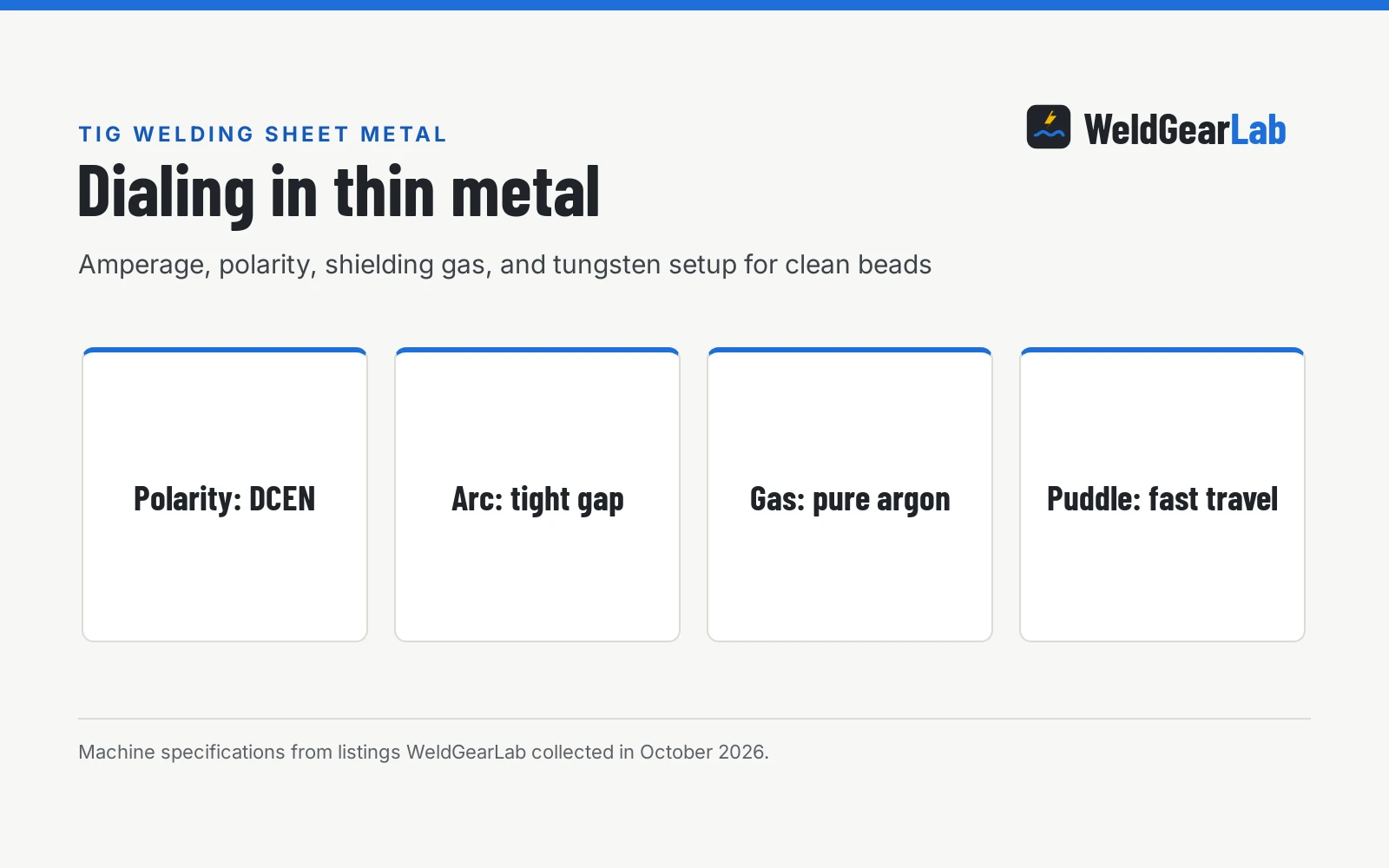
- Settings for thin sheet. Dial machine amperage down when handling sheet metal. For tight joints like tig welder settings for 1mm stainless steel, use low background amperage or pulse settings if your machine includes pulse mode, keeping heat input minimal to prevent warping.
- Shielding gas coverage. Maintain pure argon coverage over the hot bead until it cools below oxidizing temperatures. Use a larger gas lens cup to provide a wide blanket of argon over the seam.
- Backing gas protection. On open root welds or thin stainless tubing, oxygen inside the tube reacts with the molten root to form rough, crusty sugaring. Run a separate argon purge line inside the workpiece on sanitary joints.
Read our guide on how to TIG weld thin stainless without warping and compare options in our best TIG rod for stainless steel review.
How to set up the machine and torch
Getting dependable welds requires setting up your power source, cabling, torch hardware, and control switches to match the job. Review these key hardware settings before powering on:
- Output polarity. Always connect your TIG torch to the negative terminal and your ground clamp to the positive terminal for DCEN welding on steel. Reverse polarity concentrates heat into the tungsten electrode, melting the tip almost immediately.
- Arc starting method. High frequency arc start initiates the arc without touching tungsten to metal, preserving the sharp electrode point. On machines without high frequency, lift start allows establishing the arc by touching lightly and lifting. Compare arc characteristics in our HF start vs lift arc TIG guide.
- Remote amperage control. A foot pedal allows adjusting amperage on the fly to control puddle size. When working out of position or on a chassis where a pedal is awkward, a torch mounted switch provides clean remote triggering. For welders with remote trigger receptacles, the Pidnsrozo torch switch (on Amazon) listing provides a 25FT cable with a 14-PIN connector for fingertip on-off arc control. The PUWU multi-process listing specifies 2T/4T display modes to control torch trigger latching during long seams.
- Torch sizing and cooling. Compact air-cooled torches like the WP-9 or mid-size WP-17 torches handle light shop fabrication, while higher-amperage work uses heavy air-cooled WP-26 torches or compact water-cooled WP-20 torches. Check our best TIG torch guide for torch series comparisons.
- Machine amperage capacity. Shop inverter capacities vary across models. For example, the HZXVOGEN 200A listing claims an 80% duty cycle at 200A on dual 110/220V power circuits, while the PUWU combo listing also states a 200A maximum output on 110V/220V power. Browse our best TIG welder for automotive fabrication roundup for shop power options.
- Helmet lens settings. Ensure your auto-darkening helmet senses low amperage arcs reliably. The Tefuawe auto-darkening lens listing states 2 Amp TIG detection, designed to detect subtle low-amperage arcs without flickering. See our best welding helmet for TIG welding guide for hood choices.
Which gas and cup size to run
Gas flow and torch consumables dictate arc stability and puddle purity. Unlike MIG welding, TIG welding on steel uses an inert shielding gas rather than active gas mixtures:
- Shielding gas selection. Always run pure argon. Never use CO2 or mixed argon/CO2 shielding gases, as active gases burn the tungsten electrode and destroy the arc within seconds. Reference guides like the Miller 3-in-1 calculator pack help verify recommended parameters across processes.
- Gas flow rate tuning. Adjust your regulator flowmeter to deliver smooth, laminar flow from the cup. Insufficient flow permits surrounding atmosphere to oxidize the puddle, while excessive flow causes turbulence that draws air into the arc envelope.
- Cup size and gas lenses. Standard collet bodies produce less laminar coverage than gas lenses, which use fine mesh screens to project a smooth column of gas shielding. The RX WELD accessory kit lists #10 cup and #12 cup glass options, while the YESWELDER 123 (on Amazon) pcs kit includes glass cups designed for clear puddle and tungsten visibility.
- Tungsten electrode selection. For DC welding on steel, select an electrode formulated for DC arc stability. The RX WELD listing references 2% thoriated tungsten for electrical conductivity across DC and AC processes; on steel in DCEN, pointed thoriated, ceriated, or lanthanated electrodes maintain a stable arc column. Consult our guide on what color tungsten for steel for electrode comparisons.
- Post gas timing. Post gas shields both the molten weld puddle and the hot tungsten electrode while they cool below oxidizing temperatures. The HZXVOGEN machine listing specifies a post gas delay adjustable from 1-10 seconds to protect the joint during cooling.
Can one machine handle both?
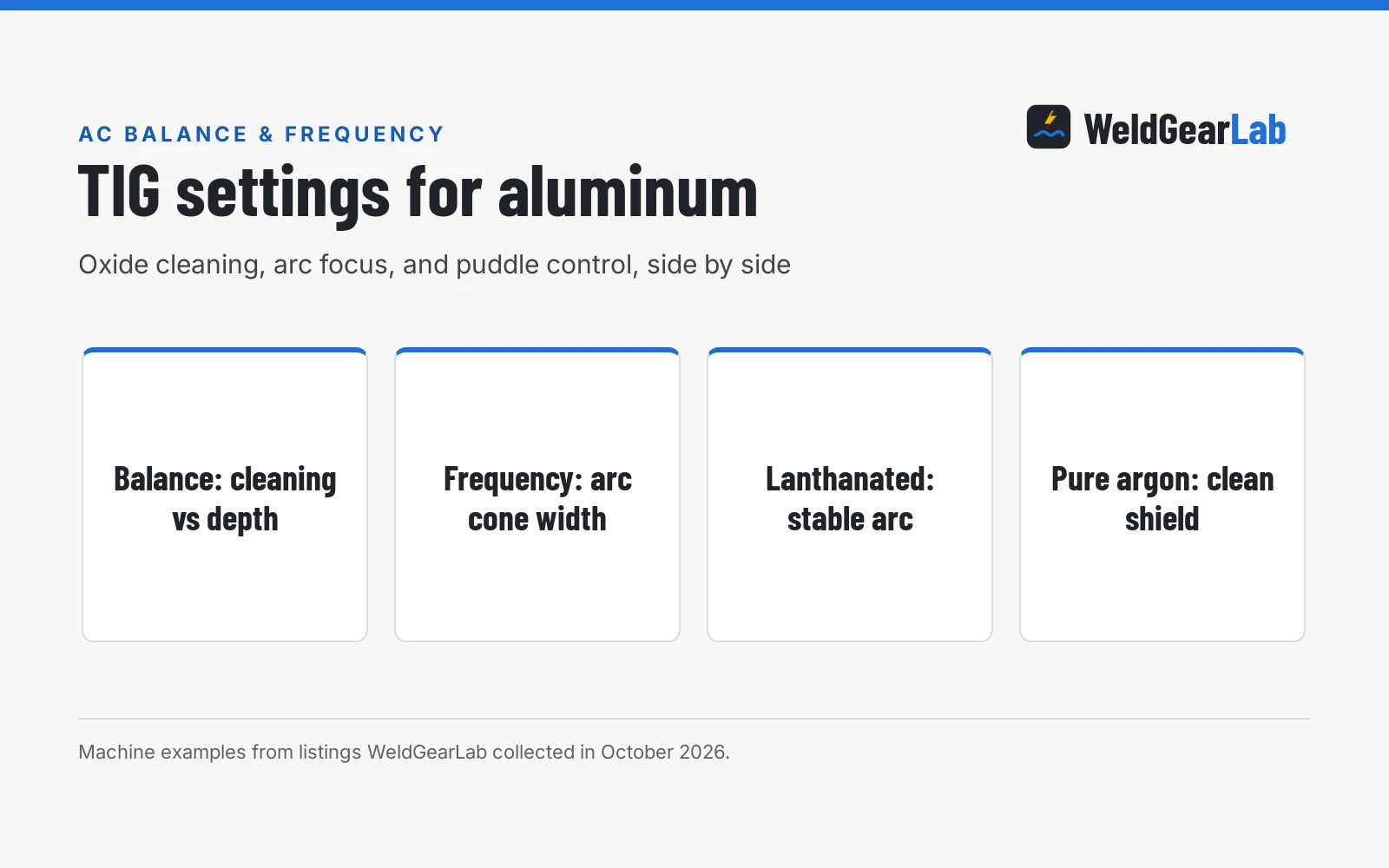
Many fabricators ask if a single welder can handle both steel and aluminum. A standard DC TIG welder handles carbon steel and stainless steel by adjusting amperage and filler rod. However, aluminum requires alternating current (AC) to clean away tough surface oxides. If you plan to fabricate aluminum alongside steel, invest in an AC/DC capable power source; see our comparison of AC vs DC TIG welding and our roundup of the best TIG welder for aluminum.
Multi-process machines provide another practical route for home shops. For example, the PUWU 6-in-1 combo integrates high frequency TIG, pulse TIG, stick, and plasma cutting into a single enclosure, running on dual 110/220V power.
Shop safety practices. TIG arcs generate intense ultraviolet radiation that causes arc flash burns rapidly; wear proper leather gloves, flame resistant sleeves, and an auto-darkening hood. Keep your head clear of the rising fume column and ensure your workspace has continuous ventilation. Secure compressed gas cylinders upright with a safety chain, and check fittings with leak detection solution. Review our welding safety gear checklist for beginners and follow standard OSHA workplace precautions.
FAQ for welders
What polarity should you use for TIG welding steel?
Steel is welded using direct current electrode negative (DCEN). Connecting the torch to the negative terminal concentrates the heat into the workpiece for deep penetration. Electrode positive (DCEP) overheats the tungsten tip and should be avoided.
Which shielding gas is best for steel TIG welding?
Pure argon is the standard shielding gas for TIG welding mild steel and stainless steel. It provides smooth arc ignition, reliable atmospheric shielding, and a stable arc column. Never use MIG shielding mixes containing carbon dioxide, as they destroy the tungsten electrode.
What are the settings for 1mm stainless steel?
Welding 1 mm stainless steel sheet requires low amperage output, a sharp tungsten point, and high frequency arc starting to avoid sticking the electrode. Travel promptly to keep heat input low, and maintain generous post gas coverage to prevent oxidation and discoloration along the joint.
Why do you need post gas flow on steel?
Post gas keeps shielding gas flowing over the puddle and hot tungsten electrode after the arc extinguishes. Without post flow, hot steel absorbs atmospheric oxygen, resulting in porosity, brittleness, and contaminated tungsten that requires regrinding.
Can you use a steel TIG setup on aluminum?
A DC TIG power source set up for steel cannot weld aluminum effectively because DC does not break up the tough aluminum oxide layer. Welding aluminum requires an AC TIG welder with adjustable balance control, though both materials share pure argon shielding gas.
Related: best entry level TIG welder, best TIG torch, best TIG welder for automotive fabrication, the TIG welders hub, and the general welders guide. Also see our guide on what color tungsten for steel.