MIG Welder Settings for 1/8 Inch Steel
Learn proper MIG welder settings for 1/8 inch steel, covering wire selection, machine voltage, wire feed rate, shielding gas, and joint preparation.
 By WeldGearLab Editorial
Updated October 9, 2026
By WeldGearLab Editorial
Updated October 9, 2026
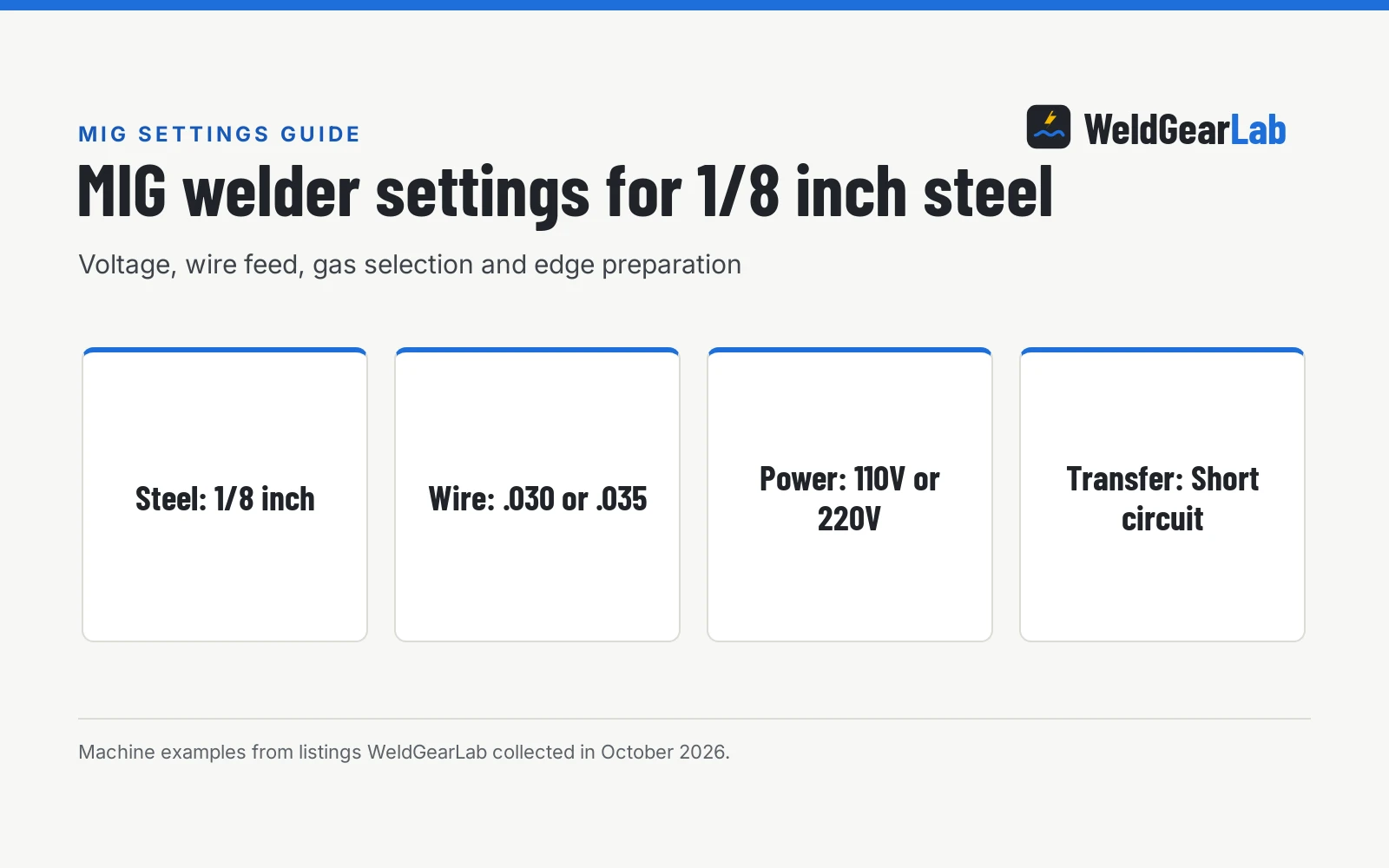
Proper mig welder settings for 1/8 inch steel require using .030 or .035 inch wire with sufficient heat to achieve full joint penetration without cold lap. For mild steel of this thickness (approximately 3 mm or 11 Gauge), a welder must supply enough current to wet the molten puddle cleanly into both base edges while maintaining a stable, smooth arc. On a 110V or 120V household unit, welding 1/8 inch steel pushes a compact machine near its upper output limits, whereas on a 220V or 240V supply, a dual-voltage workshop machine operates with comfortable headroom. Achieving sound welds comes down to balancing arc voltage, wire feed speed, clean shielding gas coverage, and proper joint fitup.
As an Amazon Associate I earn from qualifying purchases. This guide links to our product roundups, where WeldGearLab earns a commission when you buy through links, at no extra cost to you. Read our affiliate disclosure.
MIG welder settings for 1/8 inch steel
Steel measuring 1/8 inch thick is a standard material in home fabrication, trailer repairs, brackets, and farm equipment. It represents the upper practical limit for compact 110V wire feed machines and an ideal baseline for dual-voltage workshop welders. Achieving sound welds on 1/8 inch plate requires understanding how current and voltage work together in gas metal arc welding.
In MIG welding, wire feed speed directly dictates welding amperage, while voltage controls arc length, puddle fluidity, and bead profile. If your voltage is set too low for your wire feed rate, the solid wire stubs against the cold metal, generating harsh spatter and creating a ropy, crowned bead that lacks root fusion. Conversely, excessive voltage paired with inadequate wire speed produces an unstable arc, excessive undercut along the toe lines, and potential burn-through. The goal is a steady, balanced condition where the wire melts smoothly into the molten pool with minimal spatter.
Side by side
| 110V Gas MIG | 220V Gas MIG | Gasless Flux Core | |
|---|---|---|---|
| Steel thickness | 1/8 in (3 mm) | 1/8 in (3 mm) | 1/8 in (3 mm) |
| Machine output demand | Near top machine output | Moderate mid-range output | Moderate to high output |
| Recommended wire size | .030 inch solid | .030 or .035 inch solid | .030 inch flux core |
| Shielding method | Argon and CO2 mix | Argon and CO2 mix | Internal wire flux |
| Torch contact tip | .030 tip | .030 or .035 tip | .030 tip |
| Machine polarity | DCEP (electrode positive) | DCEP (electrode positive) | DCEN (electrode negative) |
| Joint edge preparation | Slight root gap or bevel | Square butt or tight fit | Square butt or slight gap |
| Single-pass penetration | Full penetration on clean joint | Deep penetration with reserve power | Deep penetration with high heat |
Always treat manufacturer door charts and published specifications as your baseline starting points. Machine designs vary between tapped transformer units and digital inverter power sources, so minor adjustments will always be required to match your wire batch, travel angle, and line voltage.
Selecting wire diameter for 1/8 inch steel
Choosing between .030 inch and .035 inch solid wire is the initial decision when configuring a MIG welder for 1/8 inch steel. Both wire sizes can produce sound, code-quality joints, but each size behaves differently across various machine power classes.
For operators running on 110V or 120V circuits, .030 inch wire is almost universally preferred. Because smaller diameter wire has a smaller cross section, it reaches the required current density at lower total amperage. This enables lower-amperage machines to maintain a stable, penetrating arc without immediately tripping household circuit breakers or exceeding low duty cycle ratings. For example, BESTMIG rates its 145A multi-process unit on 110V and 220V power for mild steel up to 3 mm thick (2/5 in capacity) using .030 inch wire. Similarly, YESWELDER provides replacement gun assemblies rated at 100A (with an 8 ft cable) and 150A (with a 10 ft cable) that come equipped with .030 inch contact tips specifically for smooth wire feeding.
On 220V or 240V equipment, .035 inch wire becomes an attractive option. The heavier wire delivers higher deposition rates and fills heavier fillet joints with fewer passes. However, .035 inch wire demands higher current from the power supply to establish a stable short-circuit transfer. If your power source has limited amperage output, .035 wire can struggle to wet out, leading to cold lap at the weld toes. For detailed wire options, see our guide to the best MIG wire for mild steel.
Dialing in voltage and wire feed speed
Finding the correct mig voltage for 1/8 steel requires balancing your machine’s voltage selector against the wire feed rate until you achieve a smooth short-circuit transfer. In short-circuit MIG, the wire makes physical contact with the molten pool dozens of times per second, creating a distinct, high-frequency buzzing sound similar to frying bacon.
When establishing your settings, set your voltage tap or digital dial to the manufacturer’s recommended level for 1/8 in stock. Next, initiate an arc on clean scrap steel and fine-tune the wire feed speed dial. If you feel the welding gun pushing back against your hand with repeated mechanical kicking, the wire feed speed is too high relative to the voltage. Back off the wire feed dial slightly until the popping ceases and the arc stabilizes. If the arc appears erratic, sounds hollow, or burns back toward the copper contact tip, your wire feed speed is too low or your voltage setting is excessively high. You can explore troubleshooting tips in our guide covering why your MIG welder spatters.
110V versus 220V power for 1/8 inch steel
Input power plays a decisive role in how easily a machine handles 1/8 inch plate. On a 110V line, a welder must operate near its absolute ceiling to deliver the necessary heat. For instance, PONEY lists its FCW-135 compact welder at 135A on 110V input, specifying mild steel capability up to 1/8 in (3 mm). Operating at this upper boundary means the unit runs against its duty cycle quickly, requiring frequent cooling pauses during long seams.
Stepping up to a 220V or 240V circuit changes the operating dynamics completely. On 220V power, the machine draws fewer input amps while delivering robust welding current with superior arc stability and duty cycle headroom. For example, PONEY specifies that its dual-voltage 165A machine (MIG-165) handles 3 mm (0.12 in) butt joints on 110V power, but expands to 4 mm (0.16 in) butt welds and 6 mm (0.24 in) fillet joints when connected to 220V. Similarly, YESWELDER lists its dual-voltage DP200 welder for 120V and 240V operation with automated parameter matching across different plate thicknesses. If you are shopping for a workshop upgrade, compare models in our guide on 120V vs 240V MIG welders and our roundup of the best budget MIG welders.
Shielding gas and polarity
Clean shielding gas is vital when MIG welding 1/8 inch mild steel with solid wire. The standard gas blend consists of argon mixed with carbon dioxide. This mixture produces a tight, controllable arc with minimal spatter and smooth bead tie-in. Pure carbon dioxide can also be used as a budget-conscious alternative; while carbon dioxide provides deep penetration, it increases spatter and creates a rougher bead face.
Ensure your machine polarity is set correctly for your selected process. Solid wire with external shielding gas requires Direct Current Electrode Positive (DCEP), where the welding torch connects to the positive terminal and the work clamp connects to the negative terminal. Running solid wire on straight polarity (DCEN) causes severe arc wandering, heavy spatter, and poor penetration. Keep gas nozzles clear of spatter using a dedicated tool, such as the 8-inch nickel-plated pliers from Goldland-WELD PROTECT, to maintain smooth gas coverage and prevent air contamination. To diagnose gas-related weld defects, consult our guide on what causes porosity in MIG welds.
Joint preparation and gun technique
Proper joint preparation is just as critical as machine voltage when welding 1/8 inch steel. Even the most precise machine settings will fail if the arc must burn through heavy mill scale, rust, cutting oil, or paint. Clean the joint edges down to bright, bare metal using a dedicated grinder or flap disc before striking an arc. You can practice on pre-cut coupons, such as the bestarc 11 Gauge mild steel plates (measuring 2 by 4 inches, or 50 by 100 mm, with a stated 3 mm thickness), to verify bead profile and penetration prior to final fabrication.
For butt joints in 1/8 inch steel, a tight square edge fitup can work well on 220V machines. However, on lower-powered 110V units, leaving a slight root gap (approximately the thickness of your .030 inch wire) or grinding a slight bevel along the seam promotes full root penetration without requiring multiple passes. Maintain a short wire stickout from the contact tip to the puddle, and hold the gun at a slight push angle along the travel direction. Pushing directs shielding gas ahead of the weld puddle, keeping the joint clean and flattening the bead crown.
Frequently Asked Questions
Can a 110V MIG welder handle 1/8 inch steel?
Yes, a 110V MIG welder can weld 1/8 inch steel if the machine delivers adequate output, such as the 135A rating PONEY specifies for mild steel up to 1/8 in. However, the welder will operate near its maximum capacity, which lowers duty cycle and requires careful travel speed to ensure full root penetration. For continuous fabrication, a 220V power supply provides significantly better penetration reserve.
Is .030 or .035 wire better for 1/8 inch steel?
For 110V and 120V welders, .030 inch wire is generally preferred because it requires less current to melt off cleanly and establish a stable puddle. On higher-output 220V machines, .035 inch wire works well for heavy fillet welds and offers faster joint filling. Beginners typically achieve more consistent results on 1/8 inch plate using .030 wire.
What does MIG voltage for 1/8 steel actually control?
In MIG welding, voltage controls arc length and the overall profile of the weld bead. Higher voltage flattens the molten puddle and improves tie-in along the joint edges, while lower voltage creates a taller, narrower bead. Voltage must always be balanced against wire feed speed to prevent spatter or stubbing.
Do I need to bevel 1/8 inch steel before MIG welding?
Square butt joints with tight fitup can achieve full penetration on 220V machines running adequate amperage. On 110V welders operating near their upper capacity, grinding a slight bevel or leaving a small root opening helps the arc fuse the entire joint thickness. Thorough joint cleaning down to bare metal is essential regardless of joint style.
Why is my weld piling up instead of flattening on 1/8 inch steel?
A tall, narrow bead that piles up without wetting into the base metal usually indicates that your voltage is too low or your wire feed speed is too high. Cold base steel, improper gun angle, or traveling too quickly can also prevent the puddle from washing flat. Increasing voltage slightly and slowing travel speed allows the pool to spread evenly.
Related: how to choose a MIG welder, running a MIG welder on a household circuit, and our MIG welders hub.
About the author
WeldGearLab Editorial is the editorial team behind WeldGearLab. We research product listings, specifications, safety listings and warranty terms, score every pick with the published Gear Score method, and correct errors when readers report them. We do not run our own shop trials; see How We Pick for exactly how picks are made.