120V vs 240V MIG Welder: Which One Fits Your Work
A 120V MIG welder runs on ordinary household outlets for sheet metal and light repair, while a 240V machine delivers the amperage and duty cycle needed for thicker steel in a dedicated shop.
 By WeldGearLab Editorial
Updated October 9, 2026
By WeldGearLab Editorial
Updated October 9, 2026
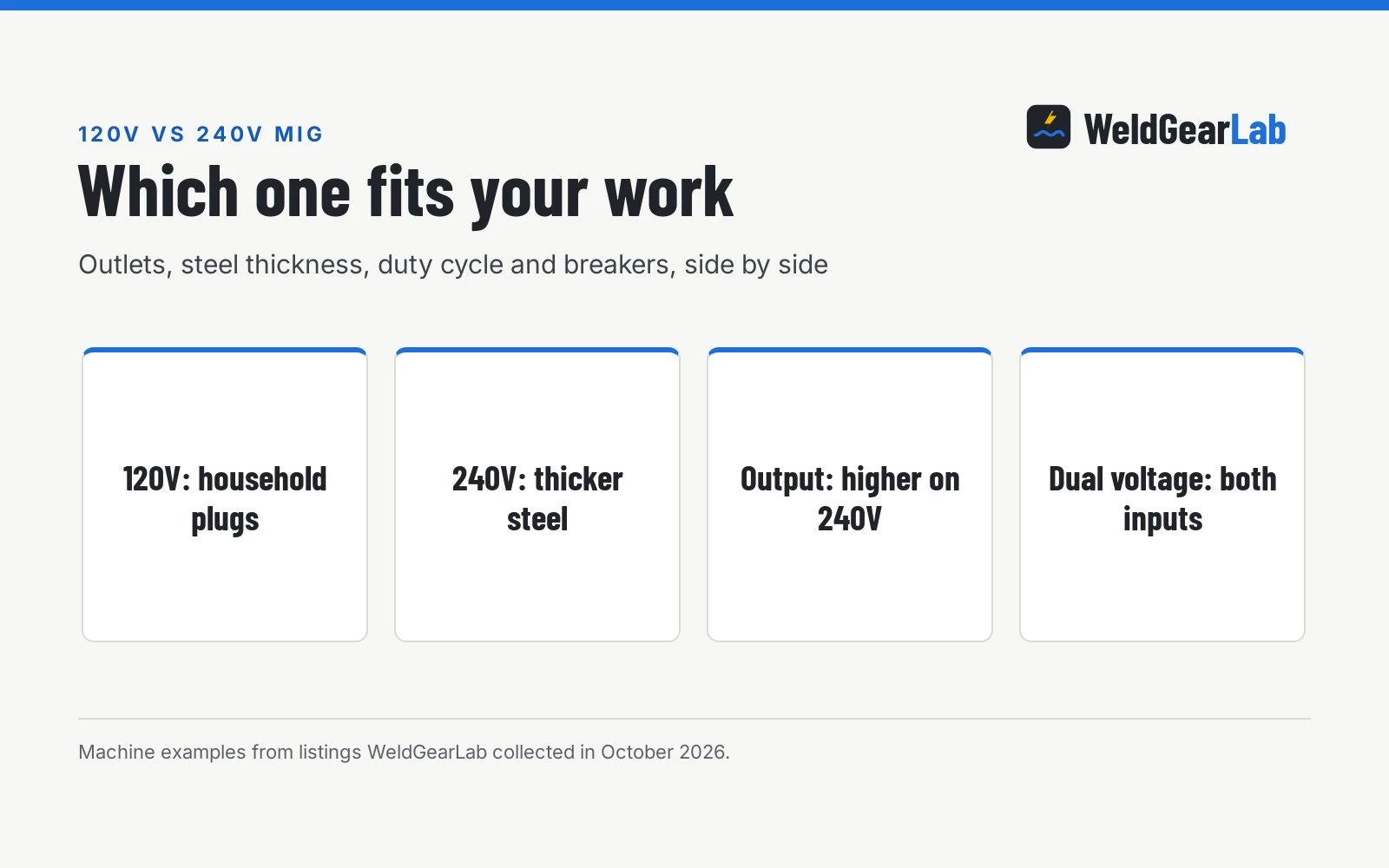
A 120v vs 240v mig welder comparison comes down to available electrical power, output amperage, and metal thickness. A 120V MIG welder plugs into an ordinary household receptacle for sheet metal, auto body repairs, and light fabrication. A 240V MIG welder requires a dedicated workshop circuit, delivering the higher amperage and duty cycle needed for thick steel plate and heavy shop projects. For many home garages, a dual-voltage unit provides the flexibility to run on standard household outlets today and switch to a 240V supply when larger projects demand it.
As an Amazon Associate I earn from qualifying purchases. This guide links to our product roundups, where WeldGearLab earns a commission when you buy through links, at no extra cost to you. Read our affiliate disclosure.
120V vs 240V MIG Welder: The Difference in One Paragraph
The difference between a 120V and a 240V MIG welder is available electrical power. A 120V machine draws current from an ordinary branch circuit, limiting total welding output and duty cycle. That makes it practical for portable repairs, hobby brackets, and automotive body panels. A 240V machine connects to a higher-voltage supply, allowing the transformer or inverter to generate higher sustained amperage for deep penetration on thick plate and structural tubing. Many modern units support dual voltage, operating across both inputs with a simple adapter plug.
Side by Side
| Dedicated 120V | Dedicated 240V | Dual Voltage (120V/240V) | |
|---|---|---|---|
| Power input | Standard 120V household receptacle | Dedicated 240V workshop receptacle | Both 120V and 240V via adapter cable |
| Maximum mild steel thickness | Up to 3/16 inch plate (DURATECH, Eastwood on 120V) | Up to 5/16 inch plate (Eastwood on 240V) | 3/16 inch on 120V up to 5/16 inch on 240V (Eastwood) |
| Output amperage range | Up to 125A or 140A (DURATECH 125A, Eastwood 30-140 Amps) | 180A to 250A on listed models (Eastwood, Reboot) | 30-140 Amps on 120V up to 180A, 205A, or 250A on 240V (Eastwood, ARCCAPTAIN, Reboot) |
| Duty cycle | 30% at 90 Amps (Eastwood 120V rating) | Longer arc time at moderate amperage | Varies with input voltage and output amperage |
| Circuit requirement | Standard branch circuit (15A to 20A) | Dedicated 240V branch circuit and breaker | Runs on standard circuit or dedicated 240V outlet |
| Portability | High (DURATECH lists 10.5 pounds) | Stationary shop use | Portable with flexible plug options (ARCCAPTAIN lists 10 pounds) |
| Sheet metal and auto body | Controlled low heat for 24 gauge sheet (Eastwood) | Capable when voltage and wire speed are dialed down | Welds thin sheet on either input (Eastwood lists 24 gauge) |
| Aluminum welding | Limited by available heat | Handles aluminum with spool gun (Eastwood, Reboot) | Supports spool gun for 14 gauge to 1/4 inch aluminum (Eastwood, Reboot) |
Ratings vary between manufacturers, so always check the door chart and data plate on your specific machine. Dual-voltage machines provide automatic voltage sensing or include a dedicated adapter cord to move between wall outlets safely.
When a 120V MIG Welder Is the Better Choice
- Everyday household outlets. You can plug directly into a garage, basement, or barn receptacle without paying to install a dedicated circuit.
- Thin sheet metal and auto body repair. Welding thin panels requires modest amperage that stays well within what a household outlet can supply. The Eastwood MIG 180 listing rates mild steel down to 24 gauge, showing that light sheet work does not demand high-voltage power.
- Portability around the property. A dedicated 120V machine is easy to carry to a driveway or shed. For example, the DURATECH 125A listing weighs 10.5 pounds and includes a 15A to 20A plug adapter.
- Light home DIY and farm maintenance. For lawn equipment, gates, and small brackets, a 120V machine provides plenty of strength. The DURATECH 125A listing notes capacity up to 3/16 inch steel plate.
Our best 120V MIG welder guide reviews compact machines that run on standard household receptacles.
When a 240V MIG Welder Is the Better Choice
- Thicker steel fabrication. Higher input voltage allows the machine to deliver the amperage needed to penetrate thicker plate. The Eastwood MIG 180 listing specifies mild steel capacity up to 5/16 inch on 240V, compared to 3/16 inch on 120V.
- Higher duty cycle at moderate amperage. Because a 240V supply draws fewer amps from the electrical circuit to produce a given welding current, the machine can maintain longer continuous weld beads before hitting thermal limits. The Eastwood spec table shows a duty cycle of 30% at 90 Amps on a 120V circuit with an output range of 30-140 Amps, while 240V power allows output up to 180A.
- Heavy shop projects and structural work. Trailers, heavy hitches, and implement repairs demand deeper weld pools. Higher-output machines like the Reboot RBM2500 PRO deliver up to 250A on 240V power to weld 1/4 inch steel.
- Welding aluminum. Aluminum requires rapid heat input because of high thermal conductivity. The Reboot RBM2500 PRO listing rates aluminum capacity at 3/16 inch, and the Eastwood MIG 180 lists aluminum from 14 gauge to 1/4 inch with an optional spool gun.
For a detailed breakdown of duty cycles across different power levels, see our guide on welding duty cycle explained.
How Power Input Affects Duty Cycle and Output
A welder running on a 120V supply is constrained by the maximum power a standard household circuit can supply. When pushed to its upper limits on 120V, the welder operates near maximum capacity, which limits duty cycle and can trip circuit breakers. Connecting to a 240V supply doubles the available input voltage, allowing the power supply to deliver higher amperage and sustain longer welding periods at moderate power levels.
Listing specifications illustrate this difference clearly. On mild steel, the PONEY 165A listing specifies maximum capacity at 110V as 3 mm (0.12 in) for butt joints and 5 mm (0.20 in) for fillet joints. When switched to a 220V input, that same machine increases mild steel capacity to 4 mm (0.16 in) on butt welds and 6 mm (0.24 in) on fillet welds. For thicker metal, higher input voltage provides the sustained current needed for deeper penetration.
Breaker and Circuit Requirements
Before buying a welder, examine your workshop electrical supply. A dedicated 120V welder or a dual-voltage unit on household power plugs into an ordinary receptacle, but running near maximum output can push a general branch circuit past its rating. The Eastwood MIG 180 listing notes an amperage draw of 20 Amps on 120 Volts. If other garage appliances share that same branch circuit, the breaker may trip during long beads.
A 240V welder requires a dedicated high-voltage circuit with an appropriate receptacle. Installing this outlet requires space in your electrical service panel and dedicated wiring run by a qualified professional. However, once that circuit is available, a 240V connection supports larger machines without straining household lighting or convenience circuits. If you are uncertain whether your existing wiring can support a wire feed welder, read our guide on whether you can run a MIG welder on a 15 amp circuit.
Can Dual-Voltage Welders Run Both?
Yes. Many modern inverter wire feed machines feature dual-voltage capability, allowing you to weld on standard household outlets and plug into 240V shop power when heavier projects require it. The ARCCAPTAIN MIG205DP Pro listing notes dual voltage 120V/240V operation to handle light DIY tasks on household power or reach full 205A output on a workshop supply. Similarly, the BESTMIG 145A listing includes a 120V-240V adapter cable in the package, and the Reboot RBM2500 PRO incorporates auto-sensing circuitry to adjust voltage automatically.
Choosing a dual-voltage model avoids outgrowing your equipment. You can start with basic household repairs today and unlock maximum amperage later without buying another welder. To compare versatile options within a reasonable budget, check our guide to the best budget MIG welders, or read our overview on how to choose a MIG welder.
Electrical safety and workshop precautions. Welding involves electric shock hazards, intense ultraviolet radiation, and hot spatter. Always connect machines to properly grounded receptacles and keep power cords away from hot metal and sharp edges. Clear flammable materials from the work area, position a fire extinguisher nearby, and work with adequate ventilation to keep welding fumes away from your breathing zone. Before adjusting internal drive rollers or swapping torch consumables, turn off the power switch and unplug the machine. Read our 120V vs 240V welder guide for more details on workshop electrical power.
Frequently Asked Questions
Can I plug a 120V MIG welder into a standard household outlet?
Yes, dedicated 120V machines and dual-voltage welders with 120V adapter cords plug directly into ordinary household wall receptacles. However, because a welder pulls substantial current under load, plugging into a shared branch circuit can trip the breaker when other tools or lights run simultaneously. A dedicated circuit provides the most consistent performance for welding.
Can a 120V MIG welder weld 1/4 inch steel?
Most 120V listings do not recommend single-pass welding on 1/4 inch steel. The Eastwood MIG 180 listing rates 120V output for mild steel up to 3/16 inch, while reaching up to 5/16 inch on a 240V supply. While you can bevel thick plate and make multiple passes with flux-cored wire, a 240V supply is the proper choice for reliable penetration on 1/4 inch steel.
What are the main advantages of a dual-voltage MIG welder?
A dual-voltage welder gives you the flexibility to work anywhere an ordinary wall receptacle exists, while keeping high amperage available for the shop. Machines like the BESTMIG 145A include a 120V-240V adapter cord so you can swap power sources without rewiring the machine. This allows you to upgrade your electrical service later without purchasing a new welder.
Does a 240V MIG welder use more electricity than a 120V machine?
A 240V welder does not inherently consume more total energy for the same weld. Because power equals voltage multiplied by amperage, a machine operating on 240V draws fewer amps from the wall to generate equivalent arc wattage. This reduced amperage draw creates less heat in the electrical circuit wiring and provides better electrical efficiency.
Can I weld aluminum on a 120V MIG welder?
Welding aluminum requires rapid heat input because aluminum dissipates thermal energy much faster than steel. The Eastwood MIG 180 listing rates aluminum welding from 14 gauge to 1/4 inch when paired with an optional spool gun on dual-voltage power. Attempting to weld aluminum on a low-output 120V machine often results in a cold puddle and poor fusion.
Related: how to choose a MIG welder, best 120V MIG welder, 120V vs 240V welder, welding duty cycle explained, and the MIG welders category. Also see our comparison on flux core vs MIG welding.
About the author
WeldGearLab Editorial is the editorial team behind WeldGearLab. We research product listings, specifications, safety listings and warranty terms, score every pick with the published Gear Score method, and correct errors when readers report them. We do not run our own shop trials; see How We Pick for exactly how picks are made.