TIG Welding Aluminum Settings AC Balance and Frequency
How AC balance and frequency work together when TIG welding aluminum, how to set cleaning and arc focus for your joint, and where to start on a new machine.
 By WeldGearLab Editorial
Updated October 9, 2026
By WeldGearLab Editorial
Updated October 9, 2026
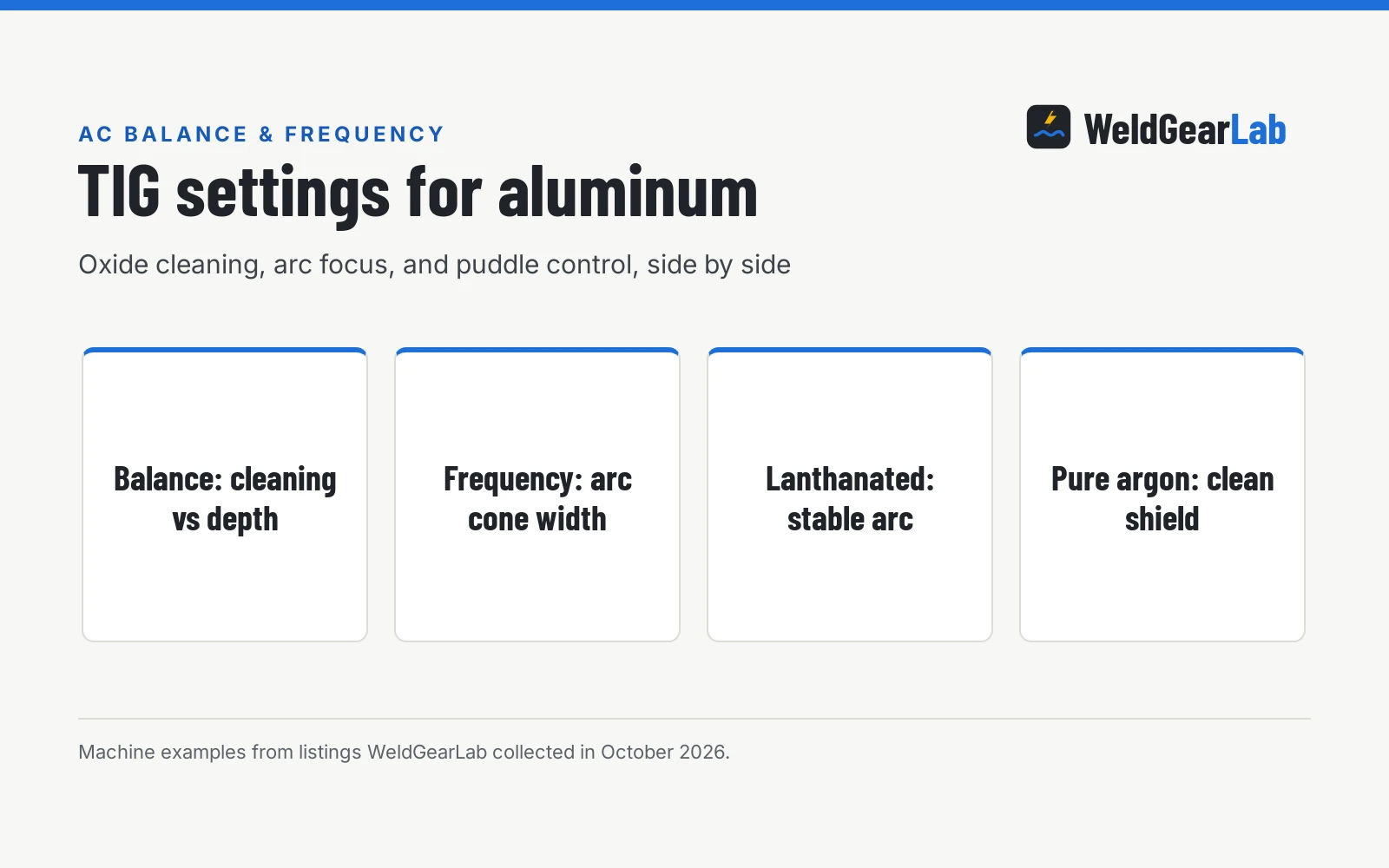
Dialing in your tig welding aluminum settings ac balance and frequency requires coordinating oxide cleaning with arc focus so the puddle wets smoothly without burning through or contaminating the tungsten. On an alternating current machine, AC balance controls the split between cleaning surface oxide and driving penetration, while AC frequency sets how rapidly the arc alternates to dictate arc cone width. Setting AC balance biased toward electrode negative penetration and matching AC frequency to your joint geometry gives you a clean, controllable puddle.
As an Amazon Associate I earn from qualifying purchases. This guide links to our product roundups, where WeldGearLab earns a commission when you buy through links, at no extra cost to you. Read our affiliate disclosure.
The core settings in one paragraph
Aluminum forms a tenacious surface oxide skin that melts much higher than the raw metal beneath it. Direct current electrode negative cannot break this oxide skin, while direct current electrode positive overheats the tungsten. Alternating current solves this dilemma: the electrode positive half-cycle cleans away surface oxide, while the electrode negative half-cycle drives heat into the metal for penetration. AC balance adjusts the split between these half-cycles, while AC frequency controls how many cycles occur each second to shape the arc cone.
Side by side
| Setting | Primary function | When increased | When decreased |
|---|---|---|---|
| AC Balance (% EN) | Regulates oxide cleaning versus penetration depth | Drives deeper penetration, narrows bead width, and keeps tungsten cooler | Expands the etched oxide cleaning zone to remove heavier surface oxide |
| AC Frequency (Hz) | Controls arc cone width, directional stiffness, and puddle agitation | Constricts arc into a tight, stiff column for inside corners and thin sheet edges | Broadens the arc cone for a softer, wider puddle wash on open joints |
| Welding Current (Amps) | Controls overall heat input into the aluminum workpiece | Enables deeper fusion and faster travel speeds on thicker sections | Prevents excessive melt-through and heat distortion on thin sheet |
| Gas Post-Flow (Seconds) | Protects cooling tungsten and molten crater from oxidation | Keeps argon shielding over the hot electrode and crater until solid | Reduces argon consumption on short tack welds once the puddle solidifies |
| Pulse Frequency (Hz) | Cycles between peak and background amperage to manage heat | Provides tighter ripple spacing and precise thermal control on thin joints | Produces distinct, wider puddle freeze ripples on decorative beads |
Dialing in an alternating current welder means balancing cleaning against penetration while matching the arc cone to your joint fitup. Setting balance biased toward penetration preserves your tungsten point, while higher frequencies stabilize the arc in tight spaces.
How AC balance controls cleaning and penetration
When TIG welding aluminum, having your ac balance explained clearly helps prevent puddle contamination and ruined tungsten tips. During the electrode negative cycle, electrons flow into the workpiece, generating deep penetration. During the electrode positive cycle, electrons flow toward the tungsten while gas ions scour the surface, lifting the refractory oxide skin through cathodic cleaning.
Too much cleaning action causes severe drawbacks: heat builds inside the tungsten, causing the tip to melt, split, or form an uncontrollable molten ball, while leaving an excessively wide frosted etching band beside the bead. Conversely, inadequate cleaning prevents the puddle from wetting, leaving floating black oxide specks. Unlike steel which runs on direct current, aluminum requires alternating current; see our comparison of AC vs DC TIG welding for how polarities behave.
Welder displays differ: some show electrode negative percentage (higher numbers mean more penetration), while others show electrode positive percentage (higher numbers mean more cleaning). Check your manual, then bias the dial toward penetration, adding cleaning only if visible oxide specks linger on the puddle.
How AC frequency shapes the arc cone
While AC balance dictates how heat splits between the plate and the tungsten, AC frequency dictates how many times polarity reverses each second. Standard utility power alternates at a fixed cycle rate, but modern inverters allow operators to adjust alternating frequency across a wide spectrum.
Raising AC frequency narrows the arc cone into a tight, stiff column. This directs heat straight into the root of an inside corner fillet or lap joint without wandering, while puddle agitation helps freeze the puddle quickly to prevent burn-through on thin edges. Lowering AC frequency broadens the arc cone, creating a softer, wider puddle wash that suits flat butt joints and heavier sections.
TIG welding aluminum settings ac balance and frequency setup
Setting up your machine involves coordinating current, balance, and frequency. Begin by degreasing the joint with solvent, then mechanically brush the aluminum using a dedicated stainless steel wire brush that has never touched carbon steel.
For your electrode, choose a Blue 2% Lanthanated tungsten. Midwest Tungsten Service lists Blue 2% Lanthanated tungsten electrodes in 0.040 inch and 3/32 inch sizes complying with AWS standard A5.12M/A5.12:2036. Inverters do not require a balled tip; grinding a tapered point with a small flat end delivers excellent arc stability on alternating current.
Machine output determines material capability. VEVOR lists its ACDC TIG-200 at 200A and states it handles 1/4 inch aluminum and 3/8 inch low carbon steel. PUWU lists its PM-ACDC 205PRO at 205Amp with capacity for aluminum up to 1/4 inch (6 mm) and mild steel up to 3/8 inch (10 mm). When running on household circuits, available voltage limits output; AHP lists the Alpha-TIG 225Xi at 150 amp output on 120v and 225 amp output on 240v, with an AC minimum start current of 20 amps (DC 5 amps). Start biased toward penetration, use a moderate frequency, and raise frequency if the arc wanders in corners. When selecting a machine, our best TIG welder for aluminum guide reviews capable AC options.
Which shielding gas and filler rod to choose
Pure argon is the standard shielding gas for AC TIG welding on aluminum in home and small shops. Reactive gases containing carbon dioxide or oxygen must never be used because they instantly oxidize the puddle and destroy the tungsten. Proper gas post-flow protects the hot tungsten and crater as the arc terminates; AHP lists pre-flow from 0 to 10 seconds and post-flow from 0 to 10 seconds on the Alpha-TIG 225Xi.
Selecting filler metal depends on the base alloy. SÜA lists ER4043 with 5% silicon, featuring a melting range of 1065 °F to 1170 °F for base alloys including 6061, 6063, 5052, 3004, and 3003. SÜA also lists ER5356 with 5% magnesium, featuring a melting range of 1060 °F to 1175 °F for alloys such as 5050, 5052, 5083, 5356, 5454, and 5460, stating it is not suitable for sustained service temperatures above 150°F (65°C). SÜA provides rods in 36 inch lengths across diameters including 0.045 inch, 1/16 inch, 3/32 inch, 1/8 inch, 5/32 inch, and 3/16 inch. For alloy selection, see our breakdown of the best TIG rod for aluminum. For torch motion, see our guide on welding aluminum with a TIG welder.
How machine waveform settings affect the bead
Modern inverters offer selectable waveforms that alter the transition between polarities; PUWU and VEVOR each list 9 waveform options on their AC TIG machines. Advanced square wave provides rapid zero-crossing for maximum stability and fast puddle freezing. Sine wave provides a softer arc reminiscent of legacy transformers. Triangular wave drops peak amperage rapidly; PUWU states triangular waves reduce heat input effectively so the weld forms rapidly, helping on thin sheet metal. For heat cycling, AHP lists a pulse frequency range from 0.5 to 200hz on the Alpha-TIG 225Xi to pulse between peak and background current.
Matching torch hardware to machine output prevents overheating. Alffun lists consumable sets fitting WP-17, WP-18, and WP-26 torches with 1/16 inch, 3/32 inch, and 1/8 inch collets and collet bodies, along with 10N series nozzles including 10N47, 10N48, 10N49, and 10N50. PUWU includes a WP-17 torch with its PM-ACDC 205PRO. To match your torch to your amperage, see our guide on TIG torch sizes explained.
Aluminum welding safety. Alternating current TIG welding on aluminum generates intense ultraviolet radiation from the reflective metal surface. Always wear full leather sleeves or a protective jacket, and protect your eyes with a responsive hood from our best welding helmet for TIG welding lineup. Review your protective gear with our welding safety gear checklist for beginners. Secure pure argon cylinders upright with a chain, and weld in a well-ventilated space.
Frequently Asked Questions
What happens if AC balance has too much cleaning action?
Excessive electrode positive cleaning directs too much heat into the tungsten rather than the workpiece. This causes the tungsten tip to melt, split, or ball excessively, destabilizing the arc while leaving a wide, dull frosted etching band along the bead.
Why does aluminum require alternating current for TIG welding?
Aluminum develops a surface oxide layer that melts at a far higher temperature than the underlying metal. Alternating current provides cathodic cleaning during the electrode positive half-cycle to shatter this oxide layer, while the electrode negative half-cycle drives penetration.
What does increasing AC frequency do during aluminum welding?
Increasing AC frequency forces the arc to alternate faster, constricting it into a narrower, stiffer cone. This directional focus helps operators direct heat accurately into tight fillet corners without arc wander and limits heat buildup on thin sheet.
What tungsten electrode works best for AC TIG welding on aluminum?
A Blue 2% Lanthanated tungsten electrode delivers reliable arc starts and holds a ground point on modern AC inverter machines. Midwest Tungsten Service lists Blue 2% Lanthanated tungsten electrodes in 0.040 inch and 3/32 inch sizes for AC and DC applications.
How do I know whether my welder displays balance as EN or EP?
Manufacturers calibrate balance controls differently on front panels. Some machines display the percentage of electrode negative time, while others display electrode positive cleaning; always check your manual or door chart to confirm which polarity your dial adjusts.
Related: what is pulse TIG welding, best TIG torch, what shade lens for TIG welding, and the TIG welders hub.
About the author
WeldGearLab Editorial is the editorial team behind WeldGearLab. We research product listings, specifications, safety listings and warranty terms, score every pick with the published Gear Score method, and correct errors when readers report them. We do not run our own shop trials; see How We Pick for exactly how picks are made.