Portable Band Saw vs Reciprocating Saw: Which One Should You Buy?
Portable band saw vs reciprocating saw: the band saw makes clean, square cuts in metal stock, while the reciprocating saw tears through demolition and awkward material. How they differ, and what four band saw listings state.


On this page
Top picks at a glance
As an Amazon Associate I earn from qualifying purchases.
- 1
 DEWALT9.5/10View on Amazon
- 2
 Reciprocating Saw Blades9.7/10View on Amazon
- 3
 WEN Portable Band Saw for Metal9.5/10View on Amazon
- 4
 MAXXT 2-in-1 Band Saw with Table Saw BaseView on Amazon
- 5
 VEVOR Portable Band SawView on Amazon
- 6
 PowerSmart Portable Band SawView on Amazon
A portable band saw vs reciprocating saw choice comes down to the cut you need. A portable band saw makes clean, straight, square cuts in metal stock: conduit, threaded rod, unistrut, angle iron and pipe. A reciprocating saw tears through demolition and awkward material fast, with rough cuts you clean up later. For fab work where the cut edge matters, the band saw is the answer. For tear-out where speed matters, the reciprocating saw is.
Other welders and gear to compare
 MAXXT 2-in-1 Band Saw with Table Saw BaseCheck price on Amazon
 WEN Portable Band Saw for MetalCheck price on Amazon
 VEVOR Portable Band SawCheck price on Amazon
 PowerSmart Portable Band SawCheck price on Amazon
 DEWALTCheck price on Amazon
This guide links to our product roundups, where WeldGearLab gets a commission on purchases made through links on this page, and your price stays the same. Read our affiliate disclosure.
Portable band saw vs reciprocating saw in one paragraph
A portable band saw runs a continuous toothed band in one direction, so the teeth shear the metal steadily and the cut stays square to the stock. A reciprocating saw drives a short blade back and forth, which cuts aggressively in any direction but leaves a rough, wandering edge. The band saw is a fabrication tool; the reciprocating saw is a demolition tool that also cuts metal. All four listings in this guide are band saws: the DEWALT DCS377B, the Makita XBP03Z, the Milwaukee 2729-20 and the Milwaukee 6232-21. The reciprocating saw side below describes the general tool only, with no figures from a reciprocating saw listing, and every figure belongs to one of those four named band saw listings.
Side by side
| Aspect | Portable band saw | Reciprocating saw | Notes |
|---|---|---|---|
| Cut action | Continuous band loop | Push-pull stroke | General tool difference |
| Cut quality in metal | Clean, straight, square | Rough and fast | General tool difference |
| Overhead and one-handed work | The DEWALT states one-handed and overhead cutting with its guard | Common in demolition positions | Listing claim vs general practice |
| Compact capacity | The DEWALT states 1-3/4 in; the Makita states 2-1/2 in | No figure in these listings | Listing figures |
| Deep cut models | The Milwaukee 2729-20 and 6232-21 are titled deep cut | No figure in these listings | Listing titles |
| Warranty | DEWALT and Makita state 3-year limited; the Milwaukee 2729-20 states 5 years | No figure in these listings | Listing figures |
Listing All specs here repeat what the maker rates and the listing prints, copied down 20 October 2026. The reciprocating saw column describes the general tool, and every figure in the band saw column belongs to a named listing.
When a portable band saw is the better choice
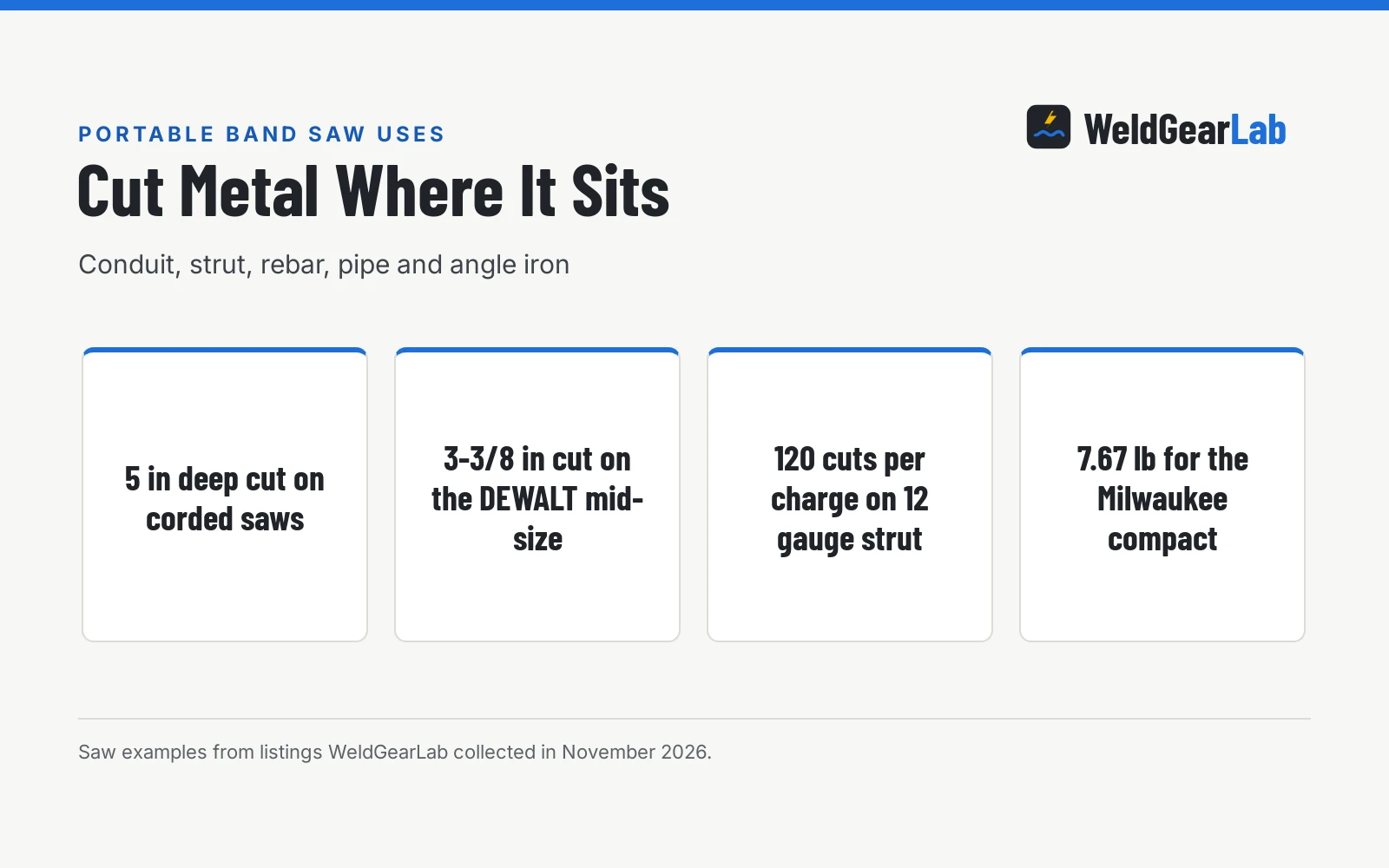
- Clean cuts in metal stock. Conduit, threaded rod, unistrut, copper pipe, angle iron and channel are the Makita XBP03Z’s stated uses. If the cut edge shows in the finished work, the band saw’s square cut saves fitting time.
- One-handed and overhead cuts. The DEWALT DCS377B states one-handed and overhead cutting with its integrated guard, at a listed 7.7 pounds. Cutting installed pipe and strut overhead is band saw work.
- Deep cuts in heavy stock. The Milwaukee 2729-20 and 6232-21 are titled deep cut band saws, the 2729-20 on M18 at a listed 13.6 pounds with a stated 5 year tool warranty, the 6232-21 on 120V at a listed 21.9 pounds.
- Repeatable square cuts. The continuous band tracks straight where a reciprocating blade wanders, so stacked cuts in the same stock match.
See our deep cut vs compact band saw guide for how the two band saw sizes differ.
When a reciprocating saw is the better choice
- Demolition. Tearing out old pipe, studs, brackets and exhaust beats the band saw’s slow steady cut; speed wins and the edge does not matter.
- Awkward material. Flush cuts, plunge cuts and cuts in material you cannot fit inside a band saw’s frame are reciprocating saw territory.
- Blade variety. Reciprocating blades swap quickly for wood, nails, metal and demolition, while changing a band saw blade takes more work.
- One tool for tear-out. If the job is removing things rather than fabricating things, the reciprocating saw is the single tool.
Corded or cordless, and what the listings state
The Milwaukee 6232-21 states a 120V 11A rating, a corded unit with the stated 21.9 pounds to show for it. The Milwaukee 2729-20 states an M18 cordless build at 13.6 pounds with a stated 5 year tool warranty, the longest stated warranty here. The DEWALT DCS377B states 7.7 pounds with one-handed and overhead cutting, and the Makita XBP03Z states 9 pounds with a 32-7/8 in 14TPI blade. Corded suits a bench station where the saw lives; cordless suits a jobsite where the cut moves. Match the stated power source to where you cut most.
Reading a band saw listing
Four listings, four band saws, and a few things worth checking before you buy:
- Capacity. The DEWALT states 1-3/4 in and the Makita states 2-1/2 in of cutting capacity. Match the capacity to the largest stock you cut.
- Power source. The Milwaukee 6232-21 is an 11A 120V unit, but its spec table lists battery powered; trust the 120V figure, so this is a corded saw. The other three are cordless on 20V or 18V.
- Surface recommendation. The Milwaukee 2729-20’s spec table lists a wood surface recommendation against its deep cut metal band saw title; the title wins.
- Warranty. The DEWALT and Makita state a 3-year limited warranty, the Milwaukee 2729-20 states a 5 year tool warranty, and the 6232-21 states only a limited warranty with no term.
- Blade in the box. The DEWALT states a 14/18 TPI blade and a blade tracking wrench included; the Makita states a 32-7/8 in 14TPI blade and a hex wrench. Blades are consumables, so check the tooth count against your material.
FAQ for welders
Can a reciprocating saw cut metal as cleanly as a band saw?
No. The push-pull stroke wanders where the band saw’s continuous loop tracks straight, so the reciprocating saw leaves a rough edge that needs cleanup.
Which of these band saws states the longest warranty?
The Milwaukee 2729-20 states a 5 year tool warranty. The DEWALT and Makita state 3-year limited warranties, and the Milwaukee 6232-21 states a limited warranty with no term.
Which is the lightest band saw here?
The DEWALT DCS377B lists 7.7 pounds, then the Makita XBP03Z at 9 pounds, the Milwaukee 2729-20 at 13.6 pounds and the Milwaukee 6232-21 at 21.9 pounds.
Can I use a band saw one-handed?
The DEWALT DCS377B states one-handed and overhead cutting with its integrated guard, and the Makita notes suitability for one-handed operation per ANSI standard 60745-2-20. Keep the other hand clear of the blade path.
What is wrong with the Milwaukee 6232-21 listing?
Its spec table lists battery powered against the 120V 11A rating, so the voltage figure wins and this is a corded unit.
Related: reciprocating saw vs hacksaw for metal, hacksaw vs band saw for metal, portable band saw vs angle grinder and plasma cutter vs band saw.