Portable vs Stationary Band Saw: Which One Should You Buy?
A portable band saw travels to the work while a stationary saw waits at the bench; this guide compares both styles with facts from three real listings.


On this page
Top picks at a glance
As an Amazon Associate I earn from qualifying purchases.
- 1
 DEWALT9.5/10View on Amazon
- 2
 MAXXT Band Saw with Lightweight Aluminum Base9.7/10View on Amazon
- 3
 WEN Portable Band Saw for Metal9.5/10View on Amazon
- 4
 MAXXT 2-in-1 Band Saw with Table Saw BaseView on Amazon
- 5
 VEVOR Portable Band SawView on Amazon
- 6
 PowerSmart Portable Band SawView on Amazon
- 7
 9 Inch Benchtop Band Saw for WoodworkingView on Amazon
The portable vs stationary band saw question comes down to where the cutting happens. If the stock is already installed, up a ladder, or out at the fence line, a portable band saw travels to the work. If you cut the same lengths again and again at a bench, a stationary saw earns its floor space. This guide compares the two styles side by side, with facts pulled from three real listings, so you can match the saw to the work you actually do.
Other welders and gear to compare
 MAXXT 2-in-1 Band Saw with Table Saw BaseCheck price on Amazon
 WEN Portable Band Saw for MetalCheck price on Amazon
 VEVOR Portable Band SawCheck price on Amazon
 PowerSmart Portable Band SawCheck price on Amazon
 DEWALTCheck price on Amazon
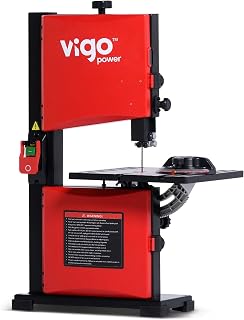 9 Inch Benchtop Band Saw for WoodworkingCheck price on Amazon
This guide links to our product roundups, where WeldGearLab gets a commission on purchases made through links on this page, and your price stays the same. Read our affiliate disclosure.
The portable vs stationary band saw question, answered in one paragraph
A portable band saw is a handheld frame with the blade running between two wheels. You carry it to the stock and cut in place, which suits installed pipe, strut, and stock that will not come to the shop. A stationary band saw is fixed to a stand or bench with a table and a vise. You bring the stock to the saw, which suits repeated straight cuts in one location. Portable saws run cordless on batteries or corded at 120 volts, while stationary saws stay plugged into shop power. Every listing in this guide is a portable saw, so the stationary side is described from what that design means in practice; confirm any stationary model’s stated specs in its own listing before you buy.
Side by side
| Portable band saw | Stationary band saw | What the listings state | |
|---|---|---|---|
| Design | Carried to the cut with one or two hands | Bolted to a stand or bench; the stock moves through the blade | All three listings are portable deep-cut saws |
| Power | Cordless batteries or a 120V cord | Corded shop power | 18 volts and 20 volts cordless; 11 amps at 120 volts corded; 180 watts and 1320 watts stated |
| Weight | Carries overhead and up ladders; the cordless examples state 13.6 and 14.5 pounds | Stays put; moving it takes planning | 13.6, 14.5 and 21.9 pounds stated |
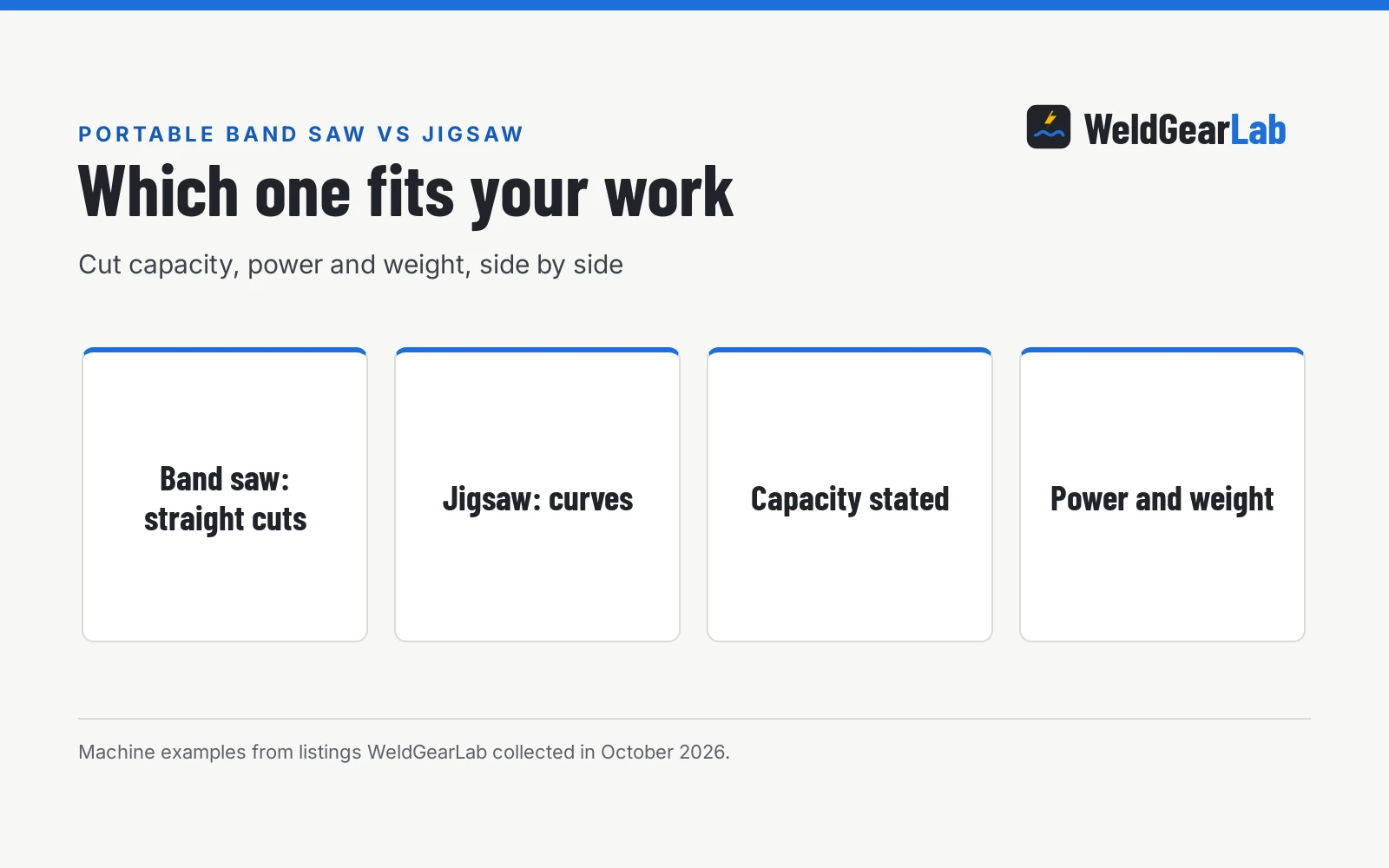
| Cut capacity | Deep-cut frames handle pipe and strut; one listing states 4 in. pipe and double strut | Throat depth and table size set what fits | 4 in. cutting capacity stated on the DEWALT listing |
| Blade | Short blades; these listings state 24 and 70 teeth | Longer blades with more teeth in the cut | High speed steel blade material stated on two listings; 4, 5 and 18.11 inch blade lengths |
| Safety features | Brake and dual-switch activation appear on portable listings | Guards and a vise; check the listing | A brake is stated on the Milwaukee M18; dual switch activation on the DEWALT |
| Best for | Job site, farm and install work, cutting stock in place | Shop production and repeated straight cuts | The Milwaukee M18 states a 5-year tool warranty |
The three listings covered here are the Milwaukee 2729-20 M18 Fuel deep cut saw, the Milwaukee 6232-21 deep cut saw with case, and the DEWALT DCS376B 20V MAX XR saw. Their stated weights run 13.6 to 21.9 pounds, and their stated power runs from 18 volts cordless to 11 amps at 120 volts. Use the rows above to decide which style fits your work before you compare individual models.
When a portable band saw is the better choice
- Installed stock. Pipe, strut and angle that are already bolted up cannot come to a bench saw. A portable saw cuts them where they sit.
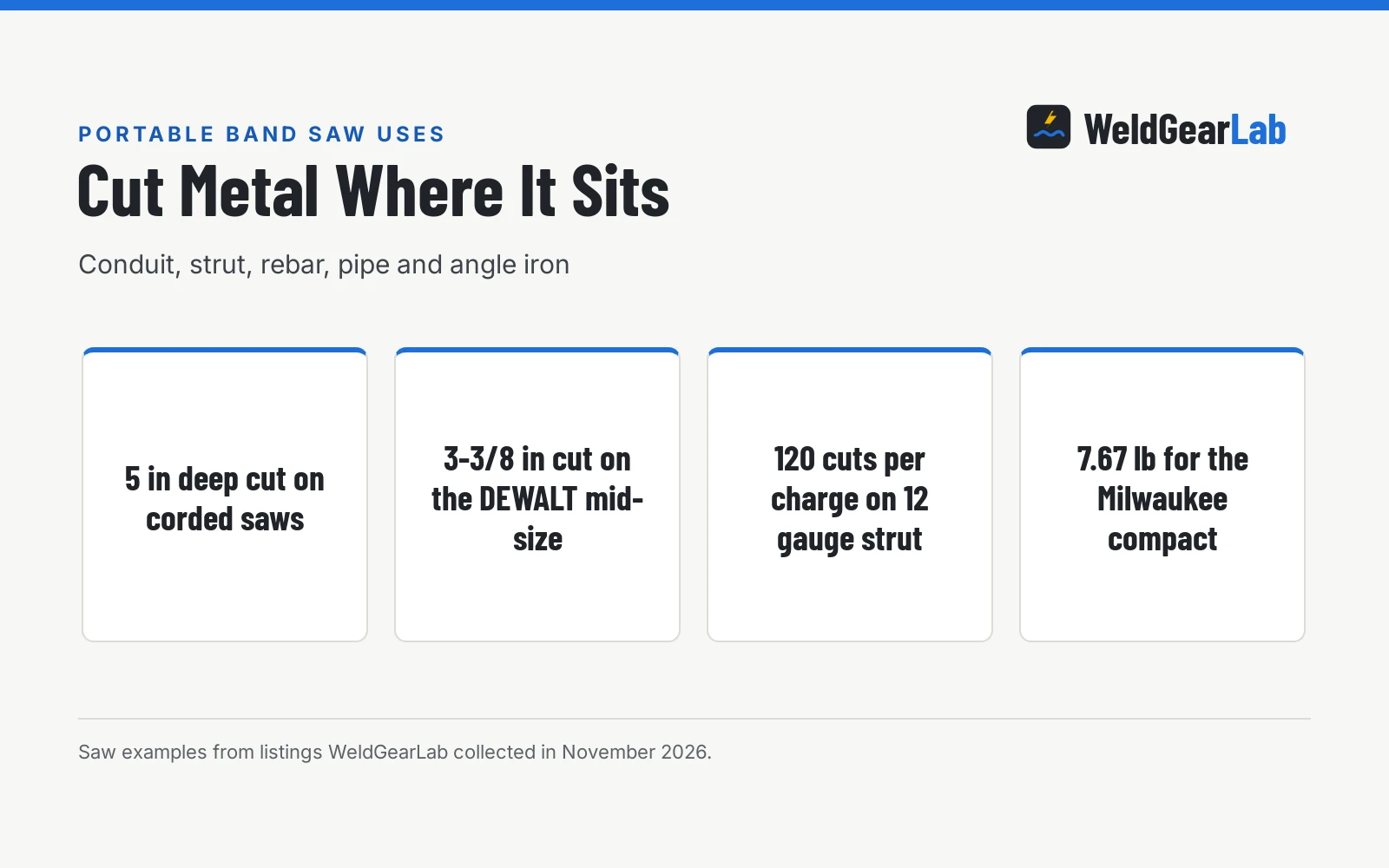
- Job site and farm work. Fence lines, equipment repairs and installs happen far from the shop. The cordless listings state 13.6 and 14.5 pounds, which carries overhead without a fight.
- One-off cuts. A handful of cuts to fit a repair does not justify clearing floor space for a stationary saw.
When a stationary band saw is the better choice
- Repeated straight cuts. Cutting the same lengths all day is faster and straighter with a vise and a table holding the stock.
- Bigger stock. When the stock’s size or length makes a handheld saw hard to hold steady, a fixed saw wins.
- Shop production. If the saw lives in one bay and the work comes to it, a stationary saw stays set up and ready.
Three listing examples, ranked
Scored on stated specs, warranty terms and listing quality, these three portable saws rank as follows.
- Milwaukee 2729-20 M18 Fuel deep cut band saw. The listing states an 18 volt cordless drive, 180 watts, a 5 inch blade with 70 teeth in high speed steel, a blade brake, and a 5-year tool warranty, the only concrete warranty term among the three. Stated weight is 13.6 pounds.
- DEWALT DCS376B 20V MAX XR band saw. The listing states a 20 volt brushless drive, 4500 rpm, a 4 in. cut capacity that covers 4 in. Sch 40 pipe and double strut, dual switch activation, and a hang hook. The same bullets also state 5 in. cutting capacity, so treat the smaller figure as the safe one. Stated weight is 14.5 pounds, and the blade is 4 inches with 24 teeth.
- Milwaukee 6232-21 deep cut band saw with case. The bullets state an 11 amp port saw, and the spec table lists 120 volts, 1320 watts, an 18.11 inch blade with 24 teeth, and 21.9 pounds. It ranks last because the listing contradicts itself: the spec table says battery powered while the volts and amps say corded, and the title says 6232-21 while the spec table’s model number says 5619-20. The warranty is a limited warranty with no term stated.
How to read a band saw listing
Listings mix solid specs with sloppy data. Check these before you buy:
- Power, stated twice. Volts, amps and watts should agree. The Milwaukee 6232-21 spec table says battery powered, but the bullets say 11 amps and the voltage is 120 volts, so it reads as a corded saw. Trust the title and bullets over the spec table.
- Blade facts. These listings state 24 and 70 teeth, blade lengths of 4, 5 and 18.11 inches, and high speed steel blade material on two of the three. Match the blade to the metal you cut.
- Cut capacity with a condition. The DEWALT bullets name 4 in. Sch 40 pipe and double strut, but also state 5 in. cutting capacity elsewhere in the same bullets. When a listing gives two capacities, plan around the smaller one. A bare number with no material stated means less.
- Warranty with a term. The Milwaukee M18 listing states a 5-year tool warranty. The other two state a limited warranty with no term, which counts for nothing when you compare.
- Model number agreement. The Milwaukee 6232-21 title and the spec table’s 5619-20 model number do not match. When the title and the spec table disagree, confirm which model you are actually buying.
A running band saw blade keeps cutting after you let go of the trigger when the saw has no brake. Clamp the stock so it cannot shift, keep both grips firmly in your hold, and let the blade feed at its own pace. Wear eye protection, keep the work area clear, and disconnect the battery or unplug the cord before a blade change. See the OSHA welding overview and our Safety Disclaimer page.
FAQ for welders
Can a portable band saw replace a stationary band saw?
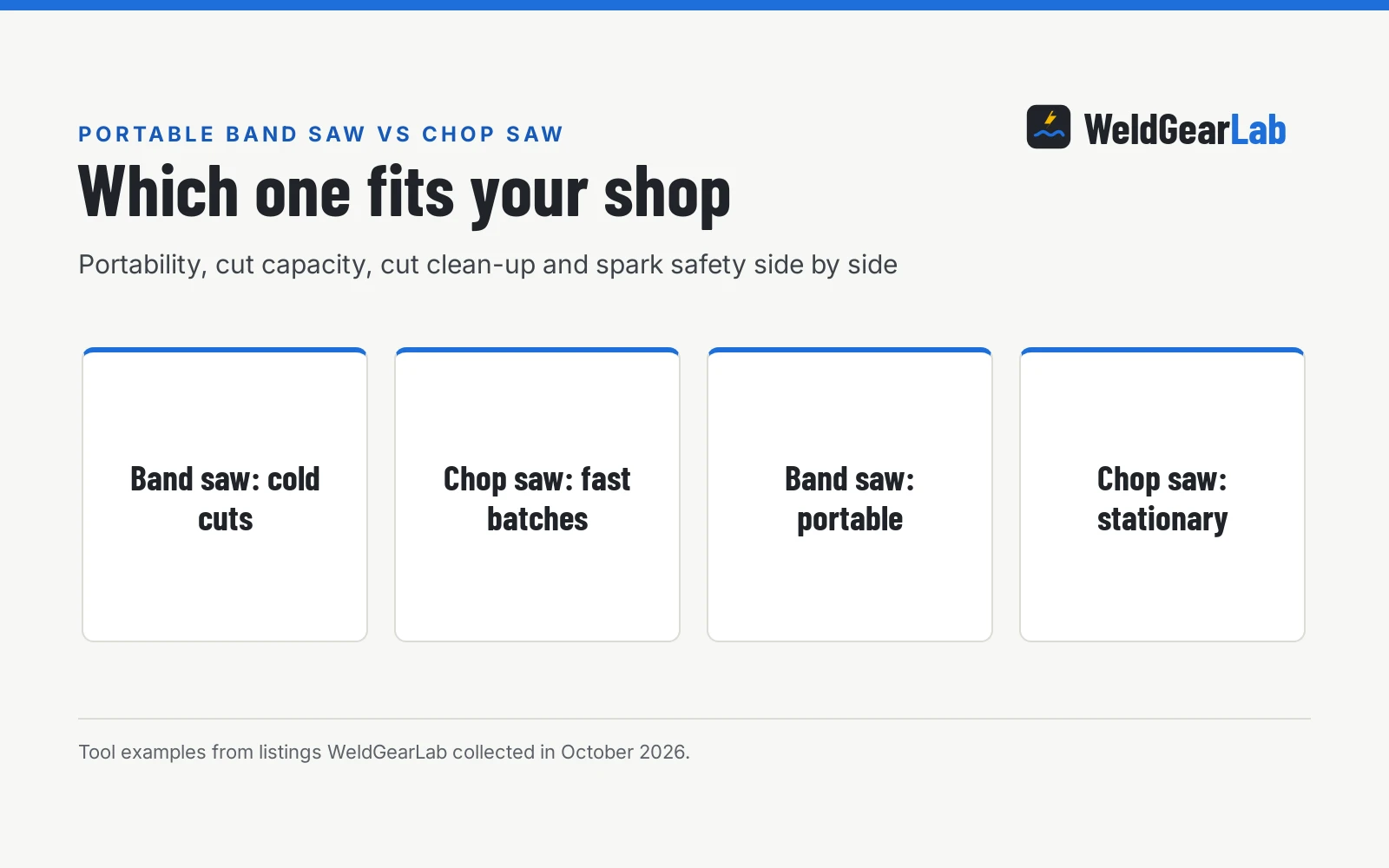
For one-off cuts and installed stock, yes, because a portable saw goes where a stationary saw cannot. For repeated straight cuts in the shop, a stationary saw with a vise and table makes the work faster and more consistent. Most small shops that cut in both places end up wanting one of each.
What does the tooth count on a band saw blade mean?
Tooth count is stated per blade: 24 teeth on two of these listings and 70 on the third. Coarser teeth clear thick stock faster, while finer teeth suit thinner stock and leave a cleaner edge. Match the blade to the thickness you cut most.
Should I buy a cordless or a corded portable band saw?
The cordless listings state 18 and 20 volts with weights of 13.6 and 14.5 pounds, which suits overhead and ladder work. The corded listing states 11 amps at 120 volts and 1320 watts with a 21.9 pound weight, which suits long cutting sessions where a battery would run down. Pick cordless for mobility and corded for all-day run time.
Why does one listing say battery powered and 120 volts at the same time?
Because the spec table is wrong. The Milwaukee 6232-21 bullets state an 11 amp port saw and the voltage is 120 volts, which means corded, while the battery powered label in the spec table contradicts it. Trust the title and bullets over the spec table, and confirm with the seller before you buy.
What should a band saw warranty state?
A concrete term. The Milwaukee M18 listing states a 5-year tool warranty, which you can compare against anything else. A limited warranty with no term stated tells you nothing, so weigh it as zero when you compare listings.
Related: diamond vs abrasive cut off wheel, step drill bit vs twist drill bit, best mini tube cutter, and best grinding wheel 4 inch.