Portable Band Saw vs Angle Grinder: Which One Should You Buy?
Portable band saw vs angle grinder: a toothed blade that tracks straight against a freehand abrasive disc, compared on cut quality, capacity, power, weight and versatility.

On this page
Top picks at a glance
As an Amazon Associate I earn from qualifying purchases.
- 1
 DEWALT9.5/10View on Amazon
- 2
 DEWALT Angle Grinder Tool9.7/10View on Amazon
- 3
 MAXXT 2-in-1 Band Saw with Table Saw BaseView on Amazon
- 4
 WEN Portable Band Saw for MetalView on Amazon
- 5
 VEVOR Portable Band SawView on Amazon
You have a rack of steel tube and angle iron to cut to length, and the portable band saw vs angle grinder question is really about how clean the cut has to be. A portable band saw cuts with a toothed blade that tracks straight, so the cut lands square with little cleanup. An angle grinder cuts with an abrasive disc you steer freehand, which is faster to set up and far more versatile, but the cut can wander. If the job is stock to length, square and true, pick the band saw. If the job is cutting plus grinding, beveling and cleanup, pick the angle grinder.
Other welders and gear to compare
 MAXXT 2-in-1 Band Saw with Table Saw BaseCheck price on Amazon
 WEN Portable Band Saw for MetalCheck price on Amazon
 VEVOR Portable Band SawCheck price on Amazon
 DEWALTCheck price on Amazon
WeldGearLab gets a commission on purchases made through links on this page, and your price stays the same. Read our affiliate disclosure.
Portable Band Saw vs Angle Grinder: The Core Difference
A portable band saw is a cutting-only machine: a loop of toothed blade runs between two wheels and pulls a straight kerf through the stock. An angle grinder is a spinning abrasive disc on a right-angle head: it cuts, but it also grinds, bevels, strips and polishes with different wheels. The rest of this guide compares them with concrete figures from the portable band saw listings we reviewed; no angle grinder figures appear in the listings, so that side is described without numbers.
Portable Band Saw vs Angle Grinder: Side by Side
| Factor | Portable band saw | Angle grinder | Read |
|---|---|---|---|
| Cut style | Toothed blade, straight kerf | Abrasive disc, freehand | Square cuts favor the saw |
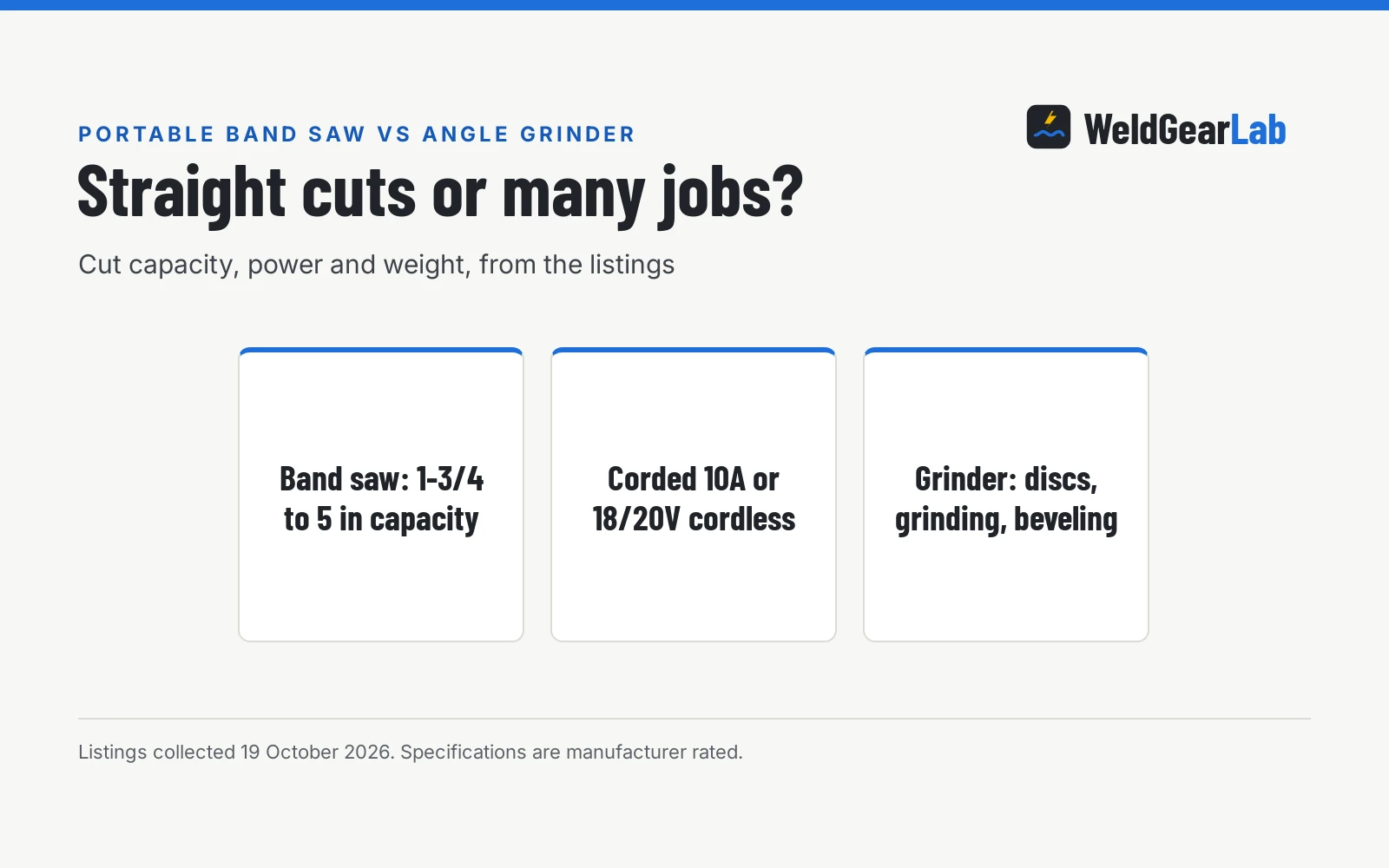
| Cut capacity | 1-3/4 to 5 in (listed) | Not stated | Match the saw to your stock |
| Power | 10A corded or 18V/20V cordless (listed) | Not stated | Corded for the bench, cordless for the field |
| Weight | 7.3 to 21.9 lb (listed) | Not stated | Lighter for overhead work |
| Sparks and heat | Fewer sparks, burr-free kerfs (listed) | Not stated | Cooler cuts need less cleanup |
| Also does | Cutting only | Grinding, beveling, wire wheels | One tool, two jobs |
Figures are from the listings reviewed, collected 19 October 2026; a figure from one listing describes that listing only. Angle grinder figures are not in the listings.
When a Portable Band Saw Is the Better Choice
- Square cuts in stock. Bar, tube, pipe, angle and strut come out square, ready for fit-up and welding.
- Clean edges. The Bosch listing promises clean cuts with fewer sparks and almost no rework for burrs; the MAXXT listing says its kerfs are smooth and burr-free.
- Overhead and tight spots. The DEWALT DCS377B and Makita XBP04Z listings are built for one-handed and overhead cutting; the Bosch weighs 7.3 lb.
- Deep cuts. The DEWALT DCS376B lists 5 in capacity and cuts 4 in Sch 40 pipe and double strut; the MAXXT lists a 5 in deep cut.
See our best cordless band saw roundup and the portable band saw vs chop saw comparison.
When an Angle Grinder Is the Better Choice
- One tool, many jobs. Cutting discs, grinding wheels, flap discs, wire wheels and cutoff work all run on one head.
- Beveling and weld prep. Grinding a bevel or cleaning mill scale is grinder work; a band saw cannot grind.
- Tight budgets and small shops. One grinder with a stack of discs covers jobs that would need several dedicated saws.
- Flush cuts and notches. Freehand disc work reaches places a band saw frame cannot.
See cut off tool vs angle grinder and die grinder vs angle grinder.
What the Listings Say About Portable Band Saws
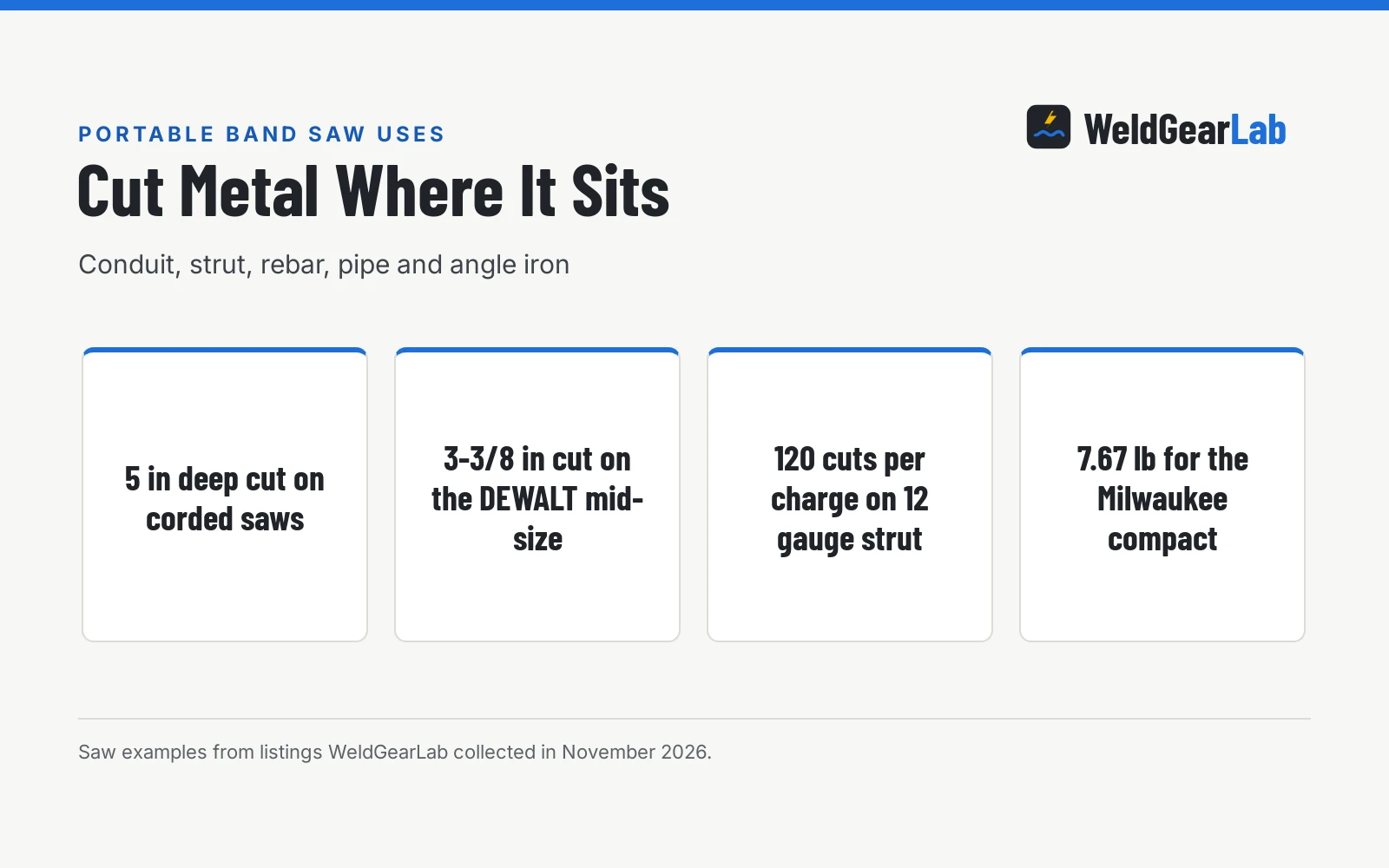
The band saw listings split into compact cordless saws and deeper-cut saws. Compact class: the DEWALT DCS377B is a 20V MAX compact saw with 1-3/4 in capacity, built for one-handed and overhead cutting with a variable speed trigger and speed dial. The Makita XBP04Z is an 18V LXT compact saw with 2-5/8 x 2-5/8 in capacity and 0-630 ft/min variable blade speed, with constant speed control and overload protection. The Bosch GCB18V-2N is an 18V compact saw at 7.3 lb with 2-1/2 in capacity, and the maker claims it is up to 60% lighter and 40% more compact than standard deep-cut saws. The Milwaukee M18 compact kit ships with two 3.0 Ah batteries and weighs 7.7 lb.
Deeper-cut class: the DEWALT DCS376B is a 20V MAX XR saw with 5 in capacity, rated for 4 in Sch 40 pipe and double strut. The Milwaukee 6232-21 is a deep cut saw weighing 21.9 lb. The MAXXT is a corded 10A saw with a 5 in deep cut, variable speed and 0 to 45 degree cutting angles, in a lightweight aluminum body with a table saw base.
Buying Advice: Capacity, Power and Weight
Match capacity to your stock first. The compact listings cut 1-3/4 to 2-5/8 in, which covers tube, conduit and small angle. The deeper listings reach 5 in, which covers 4 in Sch 40 pipe and double strut on the DEWALT DCS376B. If your stock is bigger than 5 in, neither class here covers it; a horizontal band saw is the next step. See horizontal vs vertical metal band saw.
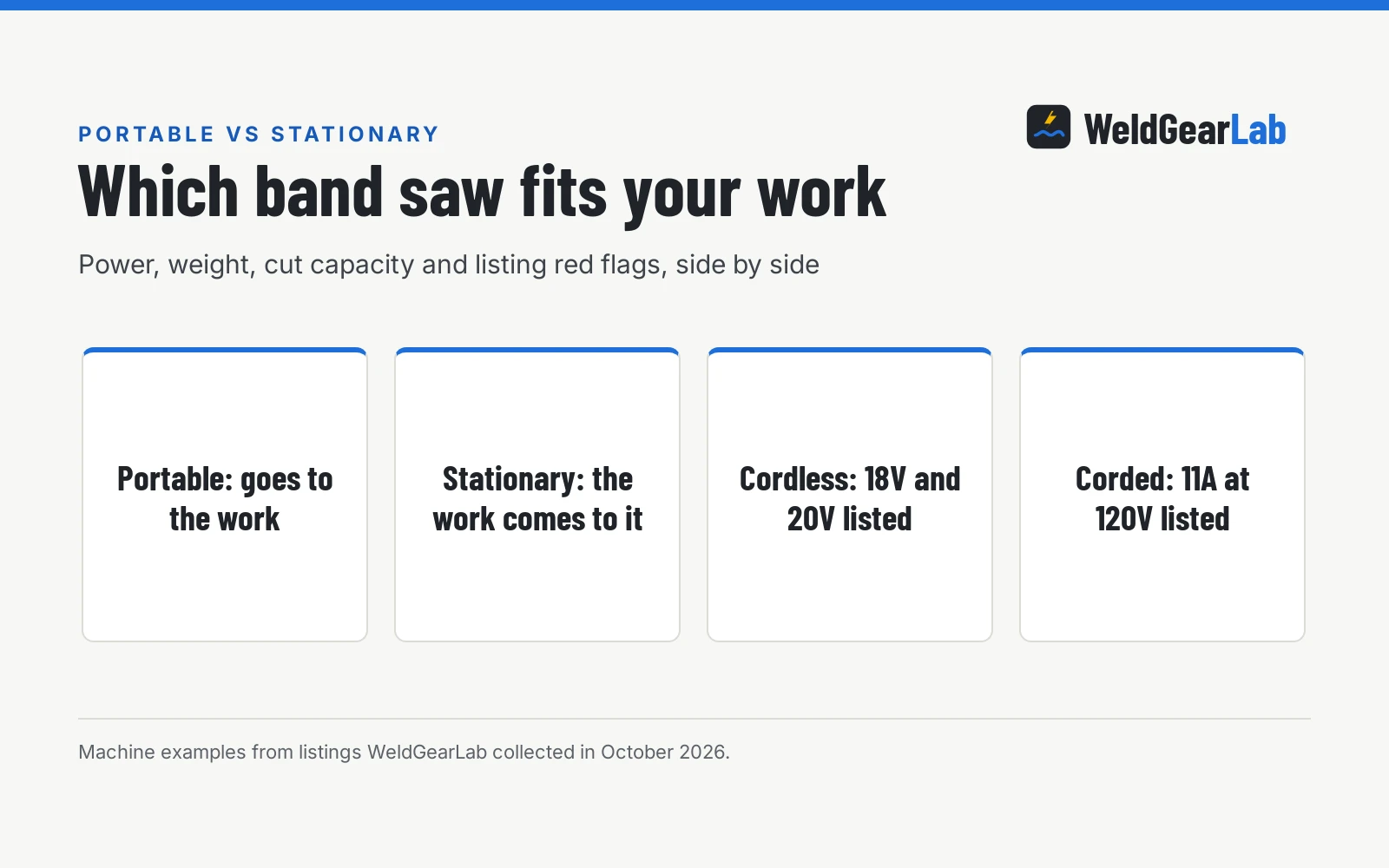
Then pick corded or cordless. The MAXXT runs corded at 10A for the bench. The cordless listings run 18V or 20V MAX, with the Milwaukee kit including two 3.0 Ah batteries. Cordless wins for field and overhead work; corded never needs a battery swap.
Weight decides overhead comfort. The Bosch at 7.3 lb and the Milwaukee compact kit at 7.7 lb are the light end; the Milwaukee 6232-21 deep cut at 21.9 lb is the heavy end. For overhead cutting, the DEWALT DCS377B and Makita XBP04Z listings both call out one-handed operation.
Blade and speed matter for metal. The Makita lists 0-630 ft/min variable speed with constant speed control under load; the DEWALT DCS377B has a variable speed trigger and speed dial. Check the blade spec before cutting thin-wall tube.
FAQ for welders
Can a portable band saw replace an angle grinder?
For cutting stock to length, yes. For everything else a grinder does, no. A band saw cannot grind a bevel, strip mill scale or run a wire wheel. Most shops that can afford both keep both.
Which cuts squarer, a band saw or an angle grinder?
The band saw. Its toothed blade tracks straight through the stock, so bar, tube and angle come out square. An angle grinder cuts freehand with a disc, which wanders, especially on long cuts.
Which is safer?
Both demand respect, guards and eye protection. A band saw throws fewer sparks and runs cooler, with the blade guarded; the Bosch listing notes clean cuts with fewer sparks. An angle grinder throws sparks and dust, and a damaged disc can fail, so the guard stays on and the disc stays rated for the tool.
Corded or cordless portable band saw?
The listings cover both. Corded, like the 10A MAXXT, suits the bench where power is always there. Cordless, like the 18V and 20V MAX listings, suits field, ladder and overhead work; the Milwaukee kit brings two 3.0 Ah batteries. Buy into the battery platform you already own.
What size portable band saw do I need?
Match the capacity to your biggest common stock. The compact listings here cut 1-3/4 to 2-5/8 in; the deeper listings reach 5 in. If you cut 4 in Sch 40 pipe, the DEWALT DCS376B listing rates exactly that.
Related: portable band saw vs cold cut saw, the metal fab tools hub and best angle grinder with speed control.