Portable Band Saw vs Cold Cut Saw: Which One Should You Buy?
Portable band saw vs cold cut saw: handheld bandsaws against cold cut chop saws on cut quality, speed, edge finish, blades and where each works best.


On this page
Top picks at a glance
As an Amazon Associate I earn from qualifying purchases.
- 1
 DEWALT9.5/10View on Amazon
- 2
 Evolution S6CCS-Li Loaded Kit9.6/10View on Amazon
- 3
 MAXXT 2-in-1 Band Saw with Table Saw BaseView on Amazon
- 4
 VEVOR Portable Band SawView on Amazon
- 5
 WEN Portable Band Saw for MetalView on Amazon
- 6
 PowerSmart Portable Band SawView on Amazon
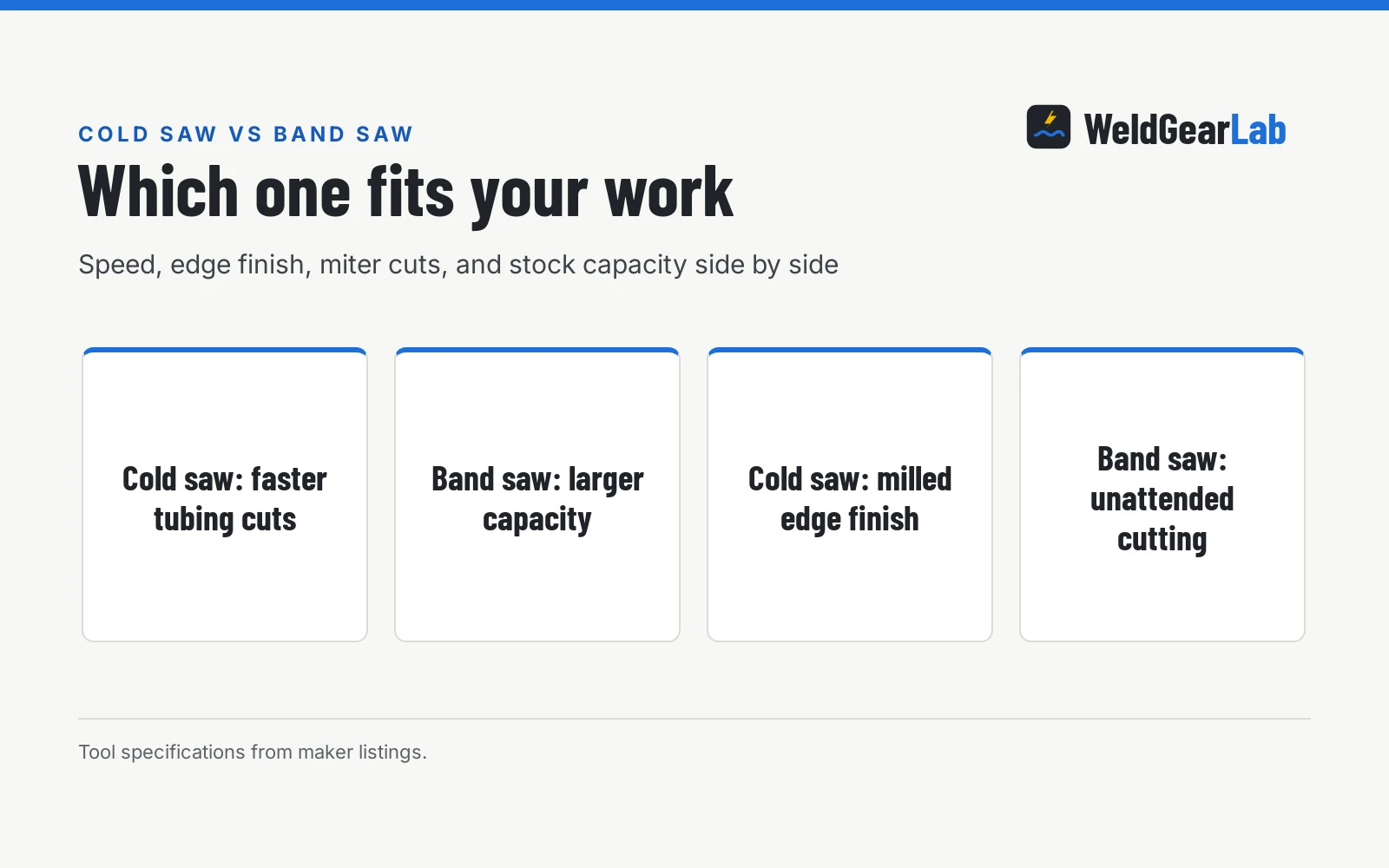
Portable band saw vs cold cut saw is the choice between a one-handed cutting tool you take to the work and a chop-style saw that brings the work to the blade. A portable band saw cuts quietly with little spark and leaves a narrow kerf; a cold cut saw spins a carbide blade at low speed for chop cuts in tube and bar. For field work, overhead cuts and installed pipe, the portable band saw is the tool; for repetitive chop cuts in the shop, the cold cut saw is the station tool.
Other welders and gear to compare
 MAXXT 2-in-1 Band Saw with Table Saw BaseCheck price on Amazon
 VEVOR Portable Band SawCheck price on Amazon
 DEWALTCheck price on Amazon
 WEN Portable Band Saw for MetalCheck price on Amazon
 PowerSmart Portable Band SawCheck price on Amazon
This guide links to our product roundups, where WeldGearLab gets a commission on purchases made through links on this page, and your price stays the same. Read our affiliate disclosure.
Portable band saw vs cold cut saw: the short answer
Portable band saws in these listings cut 1-3/4 inches on the DEWALT DCS377B at 7.7 lb, 2-1/2 inches on the Bosch GCB18V-2N at 7.3 lb, 2-5/8 inches square on the Makita XBP04Z, and 5 inches on the DEWALT DCS376B and the MAXXT 2-in-1, which handles 120 mm round tube handheld. Most run on 18 V or 20 V batteries, many with brushless motors; the Milwaukee 6232-21 and MAXXT run on 120 V corded power at 11 A and 10 A. A cold cut saw stays in the shop and chops tube and bar with a carbide blade. Take the band saw to the work; bring the work to the cold cut saw.
How a portable band saw works
A portable band saw runs a looped blade between two wheels and cuts on the pull stroke, which is why it throws few sparks and leaves a narrow kerf. The compact class is built for one-handed and overhead work: the DEWALT DCS377B cuts 1-3/4 inch stock at 7.7 lb with a variable speed trigger and a 14/18 TPI blade, and the Bosch GCB18V-2N cuts 2-1/2 inches at 7.3 lb with tool-free blade changes and an LED cut light. The Makita XBP04Z adds 0 to 630 ft/min variable blade speed with constant speed control under load.
The deep cut class handles bigger stock: the DEWALT DCS376B cuts 5 inches and 4 inch Schedule 40 pipe at 14.5 lb, the Milwaukee 2729-20 is the deep cut M18 option at 13.6 lb with a 5 year tool warranty, and the Milwaukee 6232-21 runs 11 A corded at 21.9 lb. The MAXXT 2-in-1 is the odd one out: a 10 A deep cut saw that docks into a table saw base with rolling wheels, cutting 120 mm round tube handheld or 115 mm on the base, with blade speeds from 60 to 420 ft/min and 0 to 45 degree angles.
How a cold cut saw works
A cold cut saw is the shop station counterpart to the portable band saw: a chop-style saw for tube and bar cut to length, where the stock comes to the saw instead of the saw going to the work. Because it stays in one place, long stock needs support on both sides of the cut, and repeat cuts follow the same setup each time.
Side by side
| Portable band saw | Cold cut saw | Source | |
|---|---|---|---|
| How it cuts | Looped blade, pull stroke, low spark | Carbide blade, slow chop | Band saw listings |
| Cut capacity cited | 1-3/4 in to 5 in; 120 mm tube on MAXXT | Tube and bar to length | Band saw listings |
| Edge quality | Clean kerf, usually wants a deburr | Not stated | Band saw listings |
| Portability | 7.3 to 21.9 lb handheld per listings | Bench or stand machine | Band saw listings |
| Noise and spark | Quiet, few sparks | Not stated | Band saw listings |
| Blade cost | Replacement blades | Carbide; chips punish abuse | Band saw listings |
| Best for | Field work, overhead, odd shapes | Repetitive square shop cuts | Match the saw to the job |
When a portable band saw is the better choice
Field and overhead work. The 7.3 to 7.7 lb compact class exists for cuts where the work cannot move: installed pipe, overhead hangers, a rack already bolted in. One hand on the saw, done.
Quiet, low-spark cutting. Band saws cut with little spark and low noise compared with abrasive or carbide chop saws, which matters in occupied buildings and near finished work.
Versatile stock shapes. The looped blade follows the cut line, so coping, notching and odd angles are natural. The MAXXT’s 0 to 45 degree adjustment and the Milwaukee’s 90 degree cutting angle cover the common cases.
Blades to stock. Bandsaw blades are the consumable to stock: the MAXXT ships three blades in 10/14, 14/18 and 24 TPI, and the Bosch listing states tool-free blade changes.
When a cold cut saw is the better choice
Repetitive square cuts. Chop, repeat, stack. For production runs of tube and bar cut to length, the vise holds the stock and the chop stroke sets the angle.
Repeat square cuts. The chop stroke and vise hold the work square for repeat cuts.
Thick solid bar. Thick solid bar is the cold cut saw station work: the stock goes to the saw, and the vise holds it for the chop cut.
Shop workflow. If cutting is a station rather than a task, a dedicated cold cut saw with roller stands beats carrying a handheld saw back and forth all day.
Blades and running costs
Bandsaw blades are the consumable of the two: bi-metal blades in 14/18 or 24 TPI handle most fab work, and the listings show tool-free changes on the Bosch and a tracking wrench on the DEWALT. A carbide blade chips if it hits a weld, bounces the cut or runs the wrong speed, so keep the vise tight and let the blade feed at its own pace.
FAQ for welders
Can a portable band saw cut as square as a cold cut saw?
Close, with care, but not as repeatably. A band saw follows your hands, so square depends on technique; a cold cut saw’s vise and chop stroke hold the angle for repeat cuts. For one-off cuts the band saw is fine; for fifty identical cuts, use the cold cut saw.
Which leaves a cleaner edge?
A band saw leaves a clean narrow kerf but usually wants a quick deburr before welding. A cold cut saw edge depends on the blade and feed, so check the cut before welding.
Can I use a portable band saw for stainless?
Yes, with the right blade and slow speed: the listings show 14/18 and 24 TPI blades suited to metal, and the Makita’s 0 to 630 ft/min range lets you slow down for stainless. Keep the feed steady and let the blade do the work.
Do I need both?
It depends on where you cut: a cold cut saw as the shop’s cutting station and a compact band saw, like the 7.3 lb Bosch or 7.7 lb DEWALT, for everything that cannot come to the station. If you buy one first, buy the one that matches where you cut most.
Are cold cut saw blades resharpenable?
The listings in this guide do not state whether carbide blades can be resharpened. Bandsaw blades are disposable by comparison; you just swap them.
More welding guides
Related: our portable band saw vs chop saw, dry cut saw vs abrasive chop saw and metal cold saw vs horizontal band saw comparisons.