Metal Cold Saw vs Horizontal Band Saw: Which to Buy?
Metal cold saw vs horizontal band saw: cold saws cut fast with weld-ready edges; band saws handle long stock with less waste. Compare speed and capacity.

On this page
Top picks at a glance
As an Amazon Associate I earn from qualifying purchases.
- 1
 VEVOR Chop Saw 16-inch Cold Cut Blade 3000 W Powerful Motor9.6/10View on Amazon
- 2
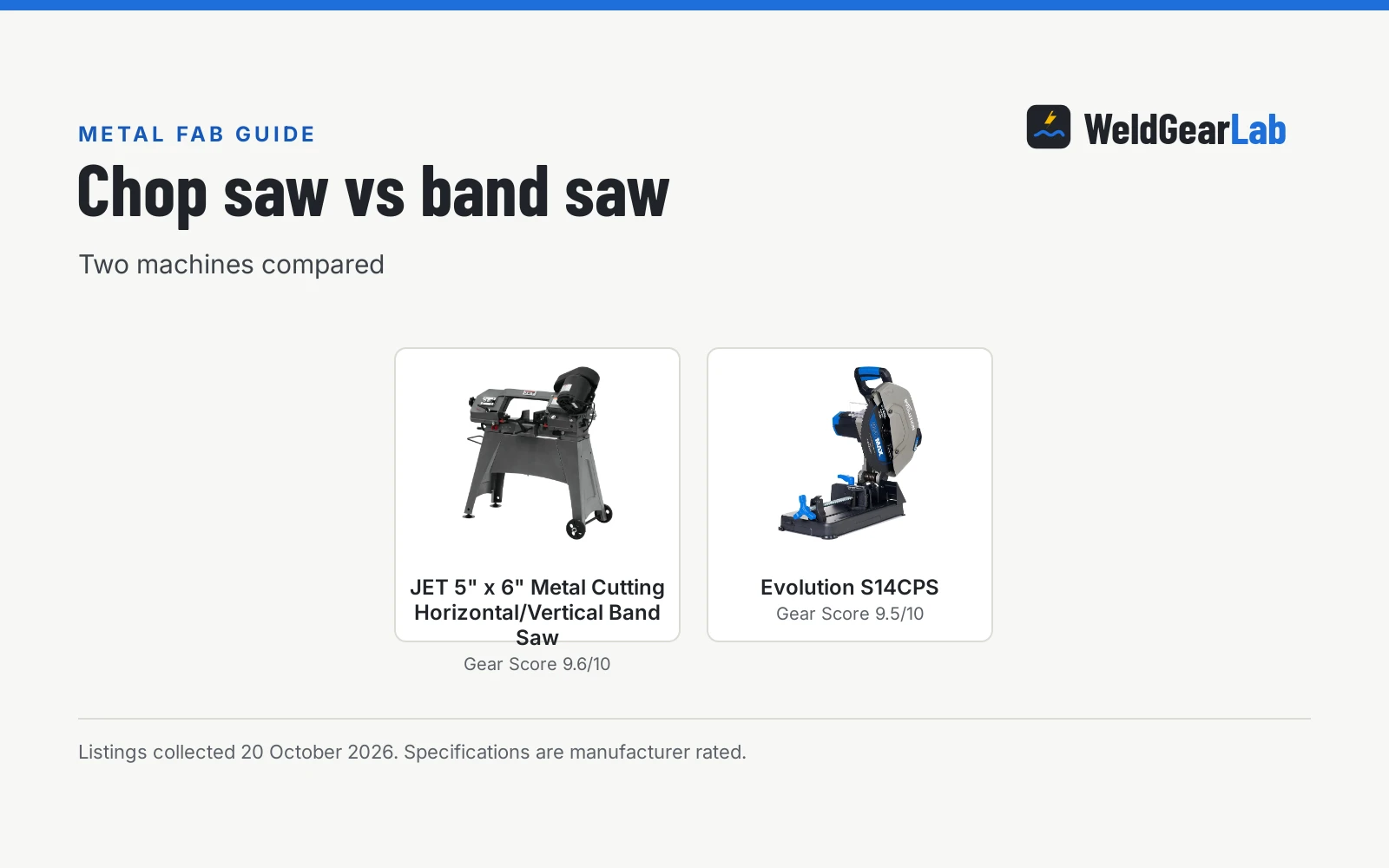
 JET 5" x 6" Metal Cutting Horizontal/Vertical Band Saw9.6/10View on Amazon
- 3
 Makita 4131 7-1/4" Metal Cutting SawView on Amazon
- 4
 Klutch Horizontal/Vertical Metal Cutting Band SawView on Amazon
- 5
 WEN Portable Band Saw for MetalView on Amazon
- 6
 VEVOR Portable Band SawView on Amazon
- 7
 MAXXT 2-in-1 Band Saw with Table Saw BaseView on Amazon
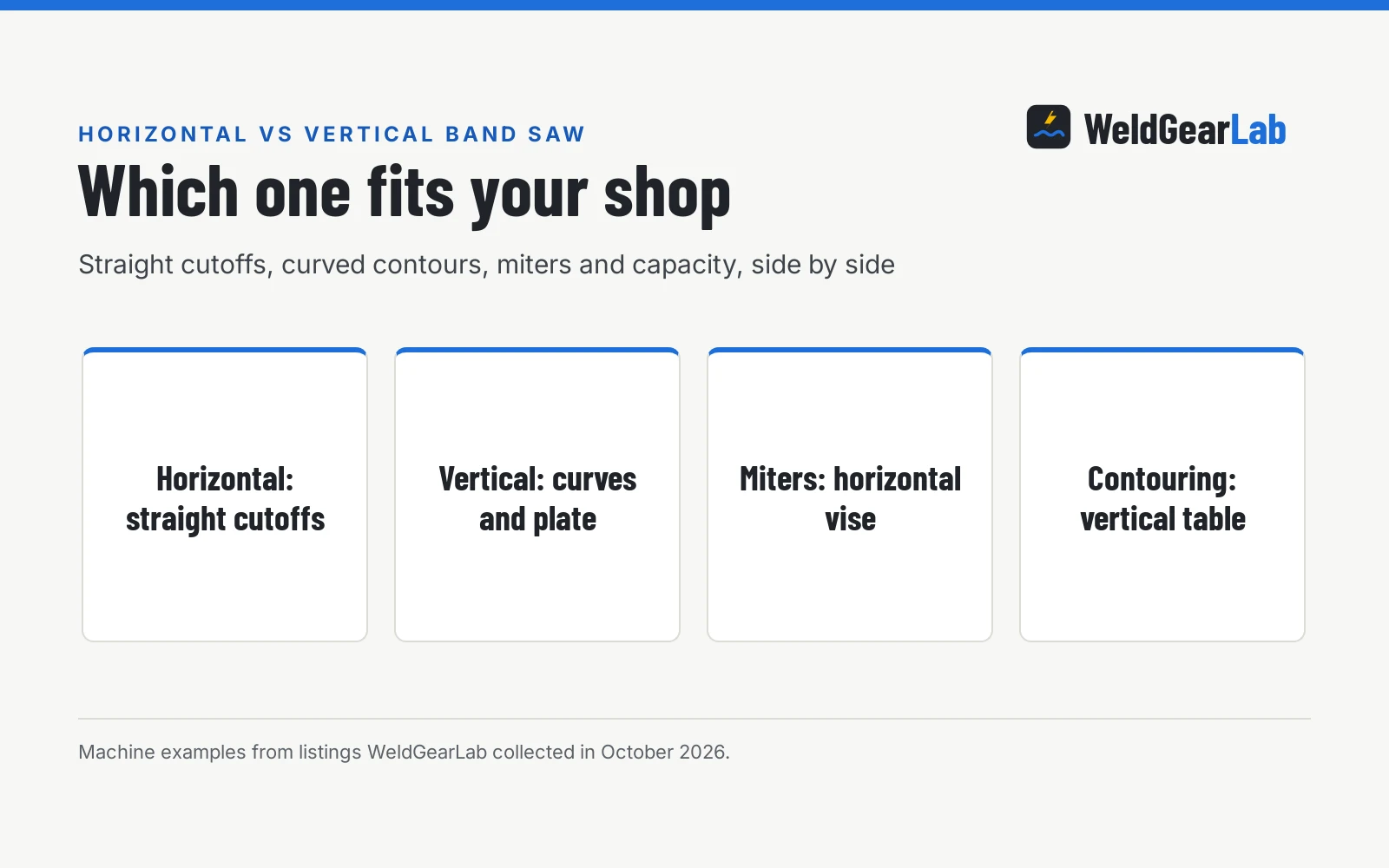
Metal cold saw vs horizontal band saw, the direct answer: a cold saw cuts fast with a toothed blade and leaves a cool, burr-free edge ready to weld, while a horizontal band saw cuts slower through a thin kerf, wastes less metal, and handles long stock and bundles better. Both cut metal; the choice is speed and edge quality against capacity and economy. This guide explains the differences step by step, with figures from the cold-cut listings WeldGearLab collected.
Other welders and gear to compare
 Makita 4131 7-1/4" Metal Cutting SawCheck price on Amazon
 Klutch Horizontal/Vertical Metal Cutting Band SawCheck price on Amazon
 WEN Portable Band Saw for MetalCheck price on Amazon
 VEVOR Portable Band SawCheck price on Amazon
 MAXXT 2-in-1 Band Saw with Table Saw BaseCheck price on Amazon
WeldGearLab gets a commission on purchases made through links on this page, and your price stays the same. Affiliate disclosure.
Metal cold saw vs horizontal band saw: the short version
The 2 saws take opposite approaches to the same job:
- Cold saws (dry-cut chop saws and metal circular saws) spin a carbide or cermet toothed blade at moderate RPM. The Evolution S14CPS lists over 3,500 cuts per blade, the WEN CM1446 spins its 14-inch blade at 1450 RPM, and the VEVOR chop saw runs 4000 RPM on a 1200W motor. Cuts are fast and cool: the Evolution blades claim virtually no sparks and a cut you can touch within moments.
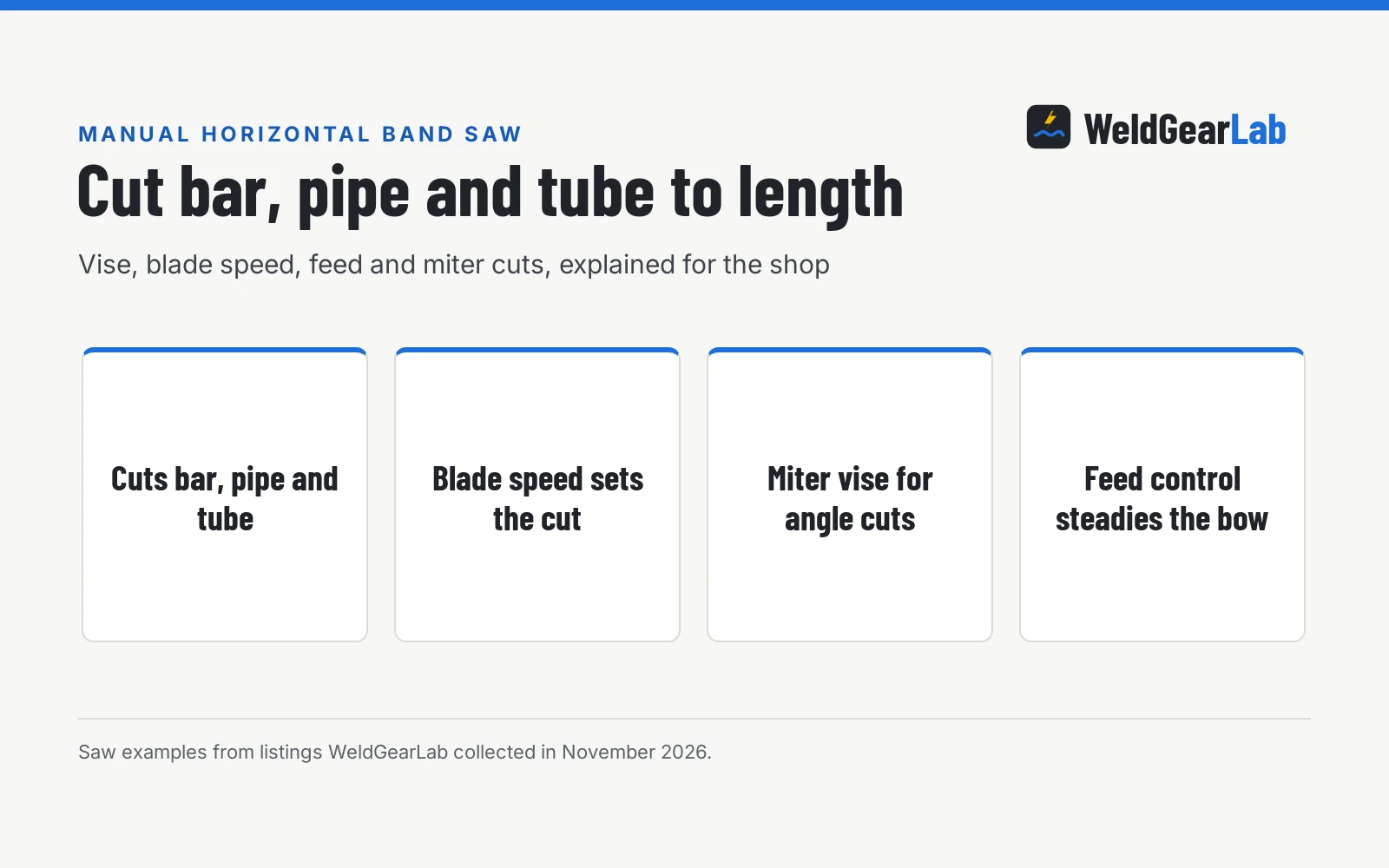
- Horizontal band saws run a continuous toothed band that cuts on the downstroke through a narrow kerf. No band saw listings are in this guide, so the band saw side is general sizing guidance: slower per cut, less metal lost to the kerf, and a vise that holds long stock and bundles.
What the cold-cut listings state
9 cold-cut listings give a clear picture of the class. Blade sizes run 7-1/4 inch (VEVOR, Evolution S185CCSL, Makita 4131) to 14 inch (Evolution S14CPS, WEN CM1446, Evolution 14BLADEST, Diablo D1472CF). Speeds run from 1450 RPM (WEN) to 4000 RPM (VEVOR), with the Evolution S185CCSL at 3700 RPM and the SKILSAW worm drive at 3900 RPM. Tooth counts run 24 (VEVOR, Makita) to 80 (Evolution S14CPS), with 60 and 66 teeth on the Evolution chop blades and 72 on the Diablo.
Cutting capacity on the WEN CM1446: 3.75 by 7.25 inches rectangular, 5.125 inches round tube, and steel plate up to 0.5 inches thick, with a 45-degree adjustable fence. The VEVOR lists a 2.76-inch cutting width and 2.56-inch cutting thickness with 0 to 45-degree angle adjustment. The Evolution S185CCSL bevels 0 to 45 degrees with depth settings up to 2-1/2 inches, per the listing. Weights run 11.4 pounds (Evolution S185CCSL) to 71 pounds (Evolution S14CPS). Warranties: 3 years (Evolution S185CCSL), 2 years (WEN), 1 year (SKILSAW, Makita), 30 days (Diablo).
When a cold saw is the right call
Buy a cold saw if you cut to length all day and want each piece ready to weld. The dry-cut blades leave cool, burr-free edges: the Evolution listings say the cut is touchable within moments and produces virtually no sparks, and the Diablo lists a triple-chip grind for precise, burr-free cuts. Blade changes are quick, angles adjust to 45 degrees on several models, and the saws are portable: 11.4 to 15.3 pounds for the handheld-class saws. The trade-off is kerf: a 14-inch blade removes more metal per cut than a band, and the Evolution 14BLADEST warns it is for mild steel only, not galvanized, hardened or high-carbon steel.
When a horizontal band saw is the right call
Buy a horizontal band saw if you cut long stock, bundles, or thick sections. The band-saw side of this comparison is general guidance, since no band saw listings are in this guide: the choice here is capacity on long stock against speed per cut and edge finish, where a band cut may need deburring before welding.
Side-by-side comparison
| Topic | Cold saw | Horizontal band saw | From the listings |
|---|---|---|---|
| Cut speed | Fast; seconds per cut | Slower per cut | Listings state RPM and cuts per blade |
| Edge quality | Cool, burr-free, weld-ready | May need deburring | Evolution, Diablo blade listings |
| Kerf | Wider; more metal lost | Narrow; less waste | 14 in blades vs narrow bands |
| Long stock | Limited by blade and fence | Vise holds long stock and bundles | WEN 45-degree fence |
| Portability | 11.4 to 71 pounds | Generally a shop station | S185CCSL, S14CPS listings |
Blade and band notes
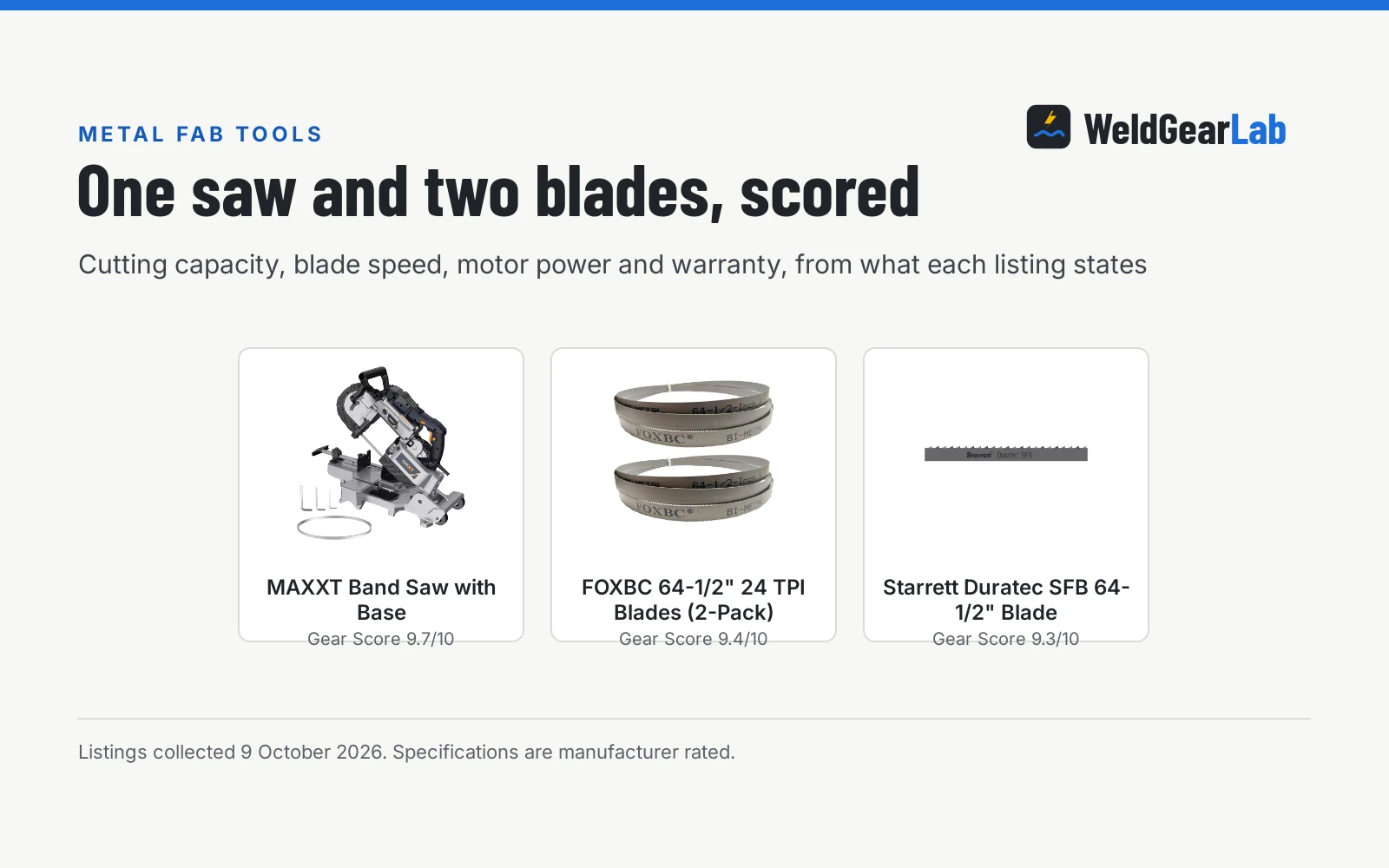
Match the blade to the metal. The Evolution 14BLADEST and 12BLADEST are for mild steel only, not galvanized, hardened or high-carbon steel; the Diablo D1472CF lists ferrous metals and cast iron. The Evolution S14CPS claims over 3,500 cuts per blade and 30 percent longer blade life from its motor technology, and the VEVOR blade claims over 3,500 cuts. Let the blade reach full speed before contact and feed steadily: the Evolution listing warns that a slow feed rate causes sparking and heat buildup. On a band saw, the equivalent rule is matching tooth pitch to the material thickness.
Buying advice: matching the saw to the stock
Size the saw to the thickest cut
Buy for the thickest material cut regularly, not the average. The WEN CM1446 lists steel plate up to 0.5 inches thick, 5.125-inch round tube and 3.75 by 7.25 inch rectangular capacity; the VEVOR lists 2.56-inch cutting thickness and 2.76-inch cutting width; the Evolution S185CCSL cuts to 2-1/2 inches deep with 0 to 45 degree bevel. If the stock is thicker than the saw’s stated capacity, the answer is a bigger saw or a band saw, not forcing the cut.
Blade cost is the running cost
The saw is the one-time buy; blades are the running cost. The Evolution S14CPS claims over 3,500 cuts per blade with 30 percent longer blade life from its motor technology, and the VEVOR blade claims over 3,500 cuts. The Diablo D1472CF lists cermet II teeth for longer life with a 30-day warranty. Let the blade reach full speed before contact and feed steadily: the Evolution listing warns that a slow feed rate causes sparking and heat buildup, which shortens blade life.
FAQ for welders
Is a cold saw better than a band saw for metal?
For fast, weld-ready cuts to length, yes. For long stock, bundles and kerf economy, a horizontal band saw is the better tool.
Can a cold saw cut stainless steel?
The VEVOR chop saw lists a stainless steel cold cut blade. The Evolution mild-steel blades are for mild steel only, so match the blade to the metal.
How thick can a cold saw cut?
The WEN CM1446 lists steel plate up to 0.5 inches thick and 5.125-inch round tube; the VEVOR lists 2.56-inch cutting thickness.
Do cold saws need coolant?
No. These are dry-cut saws: the listings describe cool, virtually spark-free cuts with no coolant.
More welding guides
For more cutting gear, browse our metal fab tools guides.