Manual Horizontal Band Saw: Cutting Bar, Pipe and Tube to Length
A manual horizontal band saw cuts bar, pipe and tube to length with a loop blade held in a vise, and this guide explains how to set it up and run a clean cut.

On this page
Top picks at a glance
As an Amazon Associate I earn from qualifying purchases.
- 1
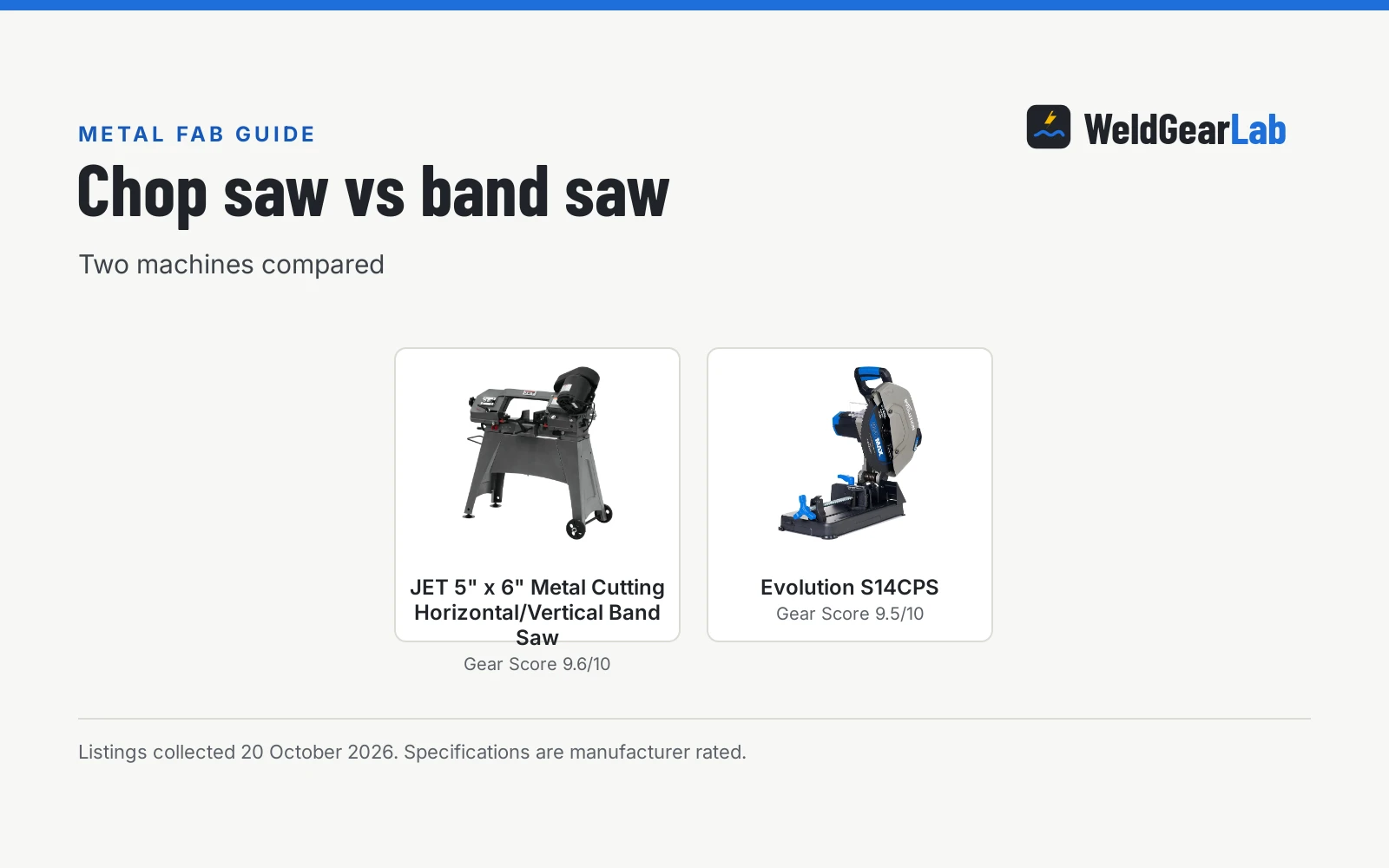
 JET 5" x 6" Metal Cutting Horizontal/Vertical Band Saw9.6/10View on Amazon
- 2
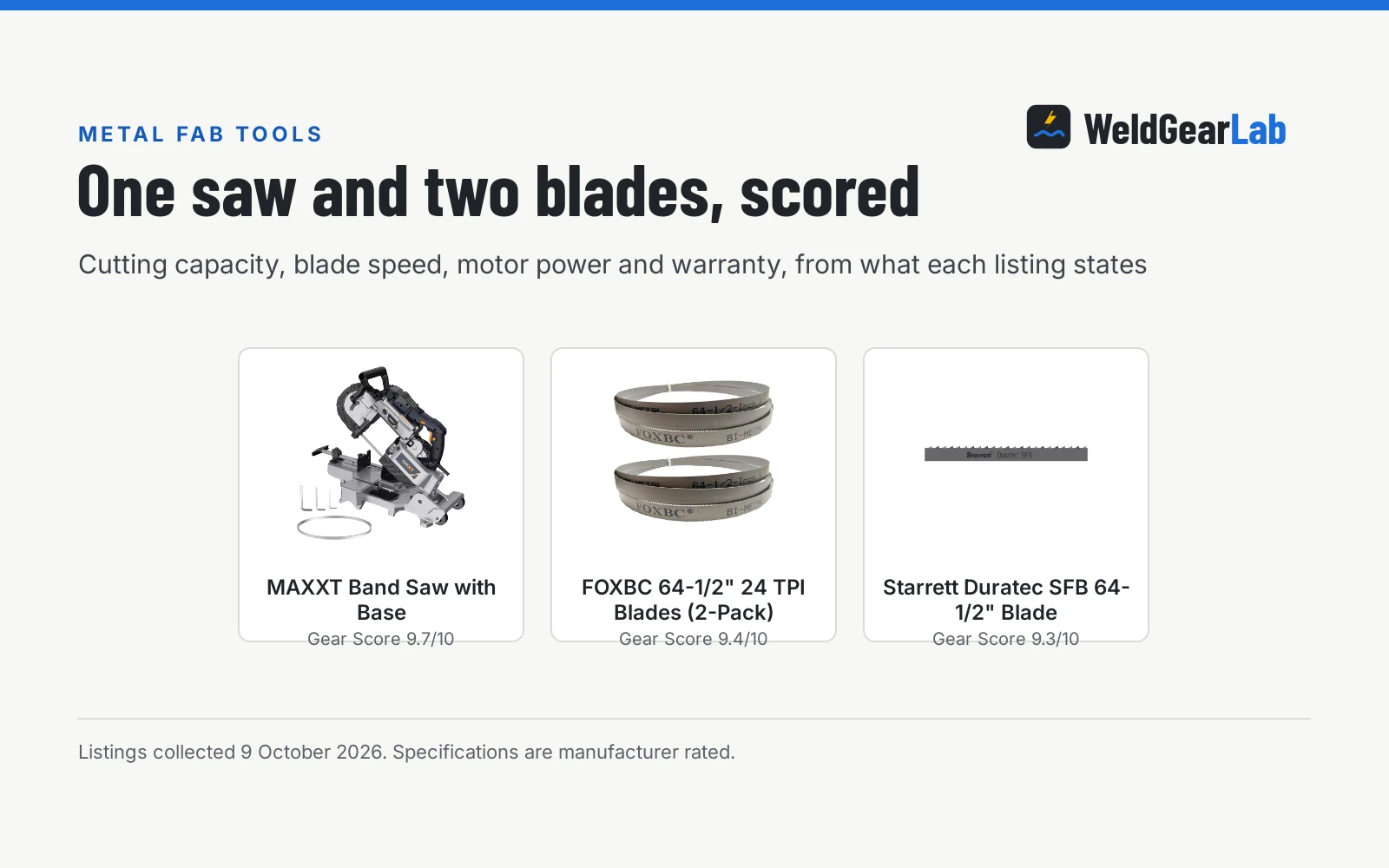
 MAXXT Band Saw with Lightweight Aluminum Base9.7/10View on Amazon
- 3
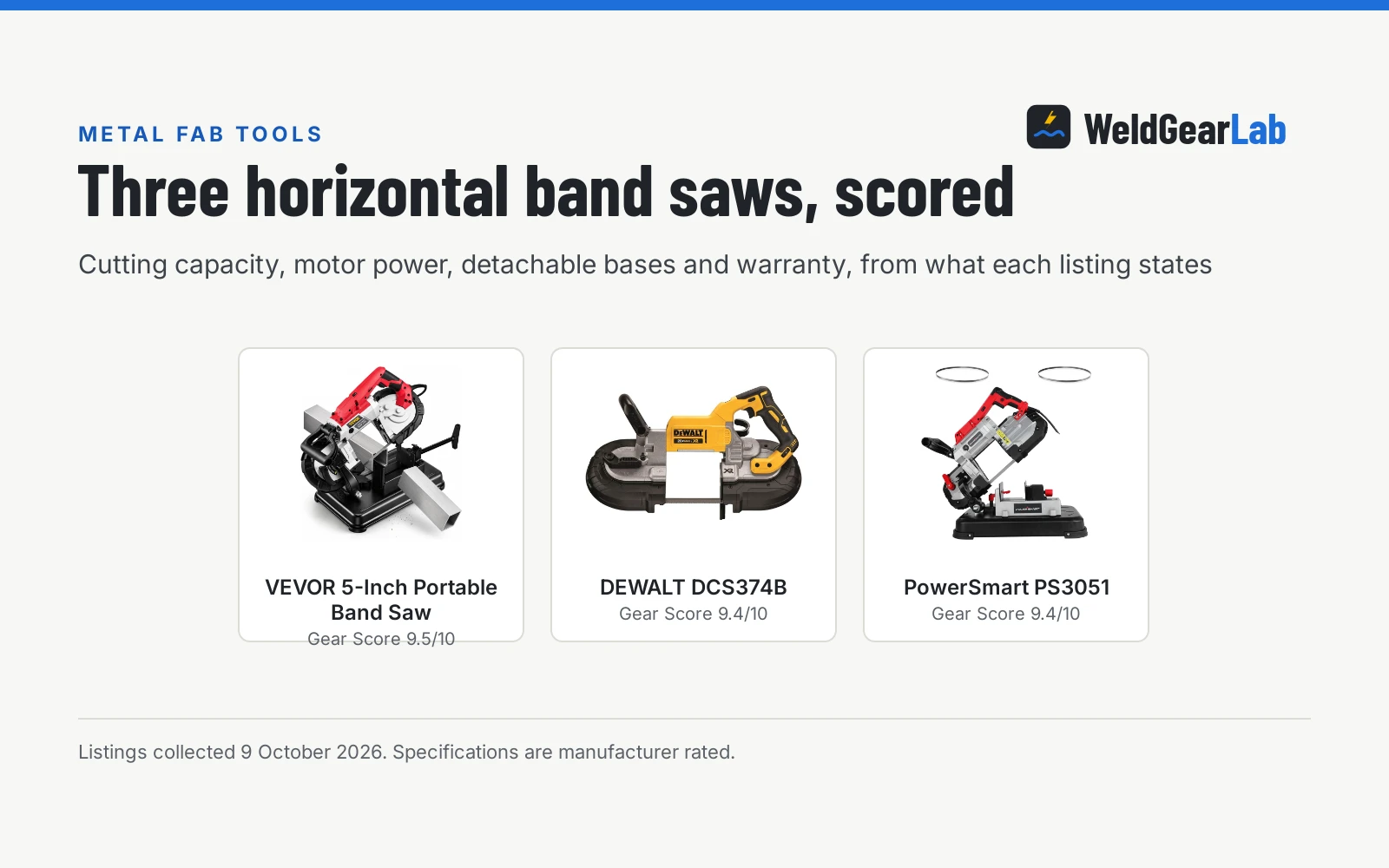
 VEVOR Portable Band Saw9.5/10View on Amazon
A rack of bar stock, a length of pipe and a bracket that needs a square cut. The job is simple, but a hacksaw makes slow work of it and a chop saw throws sparks and heat. A manual horizontal band saw answers that job: the blade runs in a loop, the stock sits clamped in a vise, and the saw head lowers through the cut while the blade does the work.
This guide links to our product roundups, where WeldGearLab gets a commission on purchases made through links on this page, and your price stays the same. Read our affiliate disclosure.
What a manual horizontal band saw is
The saw holds a loop blade between wheels, with the cutting run facing down across a vise. The stock clamps in the vise, the head pivots down, and the blade moves through the metal in a steady line. The listings describe saws that run in horizontal mode for cutoff work and swing up for vertical mode when the job needs a freehand cut. For rated picks, see the best horizontal band saw guide.
A manual saw differs from an automatic saw in who controls the feed. The operator sets the blade speed and the vise angle, then lowers the head, with a hydraulic cylinder steadying the descent on saws that list one. The KAKA BS-912B and the VEVOR saws list hydraulic downfeed, the KAKA BS-712N lists a feed ON/OFF valve, and the WEN, KAKA and VEVOR saws list automatic shut-off that stops the saw after the cut.
Side by side
| WEN BA4664 | KAKA BS-912B | Jet HVBS-712D | |
|---|---|---|---|
| Cutting capacity | Not stated | 9 in round, 7 x 12 in rectangular at 90° | 7 x 12 in |
| Blade speeds | 80, 120 or 200 feet per minute | 32, 60, 88, and 115 m/min | Not stated |
| Miter vise | 0 to 45 degrees | 0 to 45 degrees | 15, 30, and 45 degrees |
| Warranty | 2-year warranty | 1 year | 2-year warranty |
| Coolant system | Not stated | Built-in coolant system | Base coolant system |
The WEN listing gives blade speeds in feet per minute, while the KAKA BS-912B listing gives its speeds in meters per minute, with feet-per-minute equivalents in parentheses. The Jet HVBS-712D (on Amazon) listing gives preset miter positions instead of blade speeds. Warranty terms differ too.
How to run a cut, step by step
Running a cut follows the same order on most shop saws.
- Measure and mark. Measure the stock and mark the cut line, then set the length stop when the saw has a block feeder.
- Clamp the stock. Clamp the stock in the vise so it cannot shift, and set the vise angle for a miter cut.
- Pick a blade speed. Pick a blade speed from the speeds the listing states for the metal at hand.
- Lower the head. Lower the head, using the hydraulic feed control where the saw has one, and let the blade move through the stock without forcing it.
- Finish the cut. Wait for the cut to finish, and on saws with automatic shut-off the saw stops itself, then lift the head and clear the cut piece and chips.
Coolant helps manage heat at the blade and workpiece on the KAKA saws and on the Jet HVBS-712D, J-7040 and HBS-916, and the Baileigh saw pairs a chip removal brush with a flood coolant system.
Blade speed and material
Blade speed follows the metal. The WEN saw (on Amazon) runs at 80, 120 or 200 feet per minute, and the VEVOR saws run at 86, 132, 178 or 260 feet per minute. The KAKA BS-912B lists 32, 60, 88, and 115 m/min, and the KAKA BS-712N lists 27, 41, 59, and 78 m/min. The Jet J-3130 (on Amazon) lists speed ranges for hardened ferrous, ferrous, and non-ferrous metal with plastic and wood: 82 – 130 SFPM, 130 – 180 SFPM, and 180 – 230 SFPM. See the band saw blade speed chart for a speed reference by metal.
Material lists in the listings cover steel bar, aluminum, pipe, tubing, and structural metal on the KAKA saws, and steel, aluminum, brass, wood, and plastics on the VEVOR saws. Match the speed to the material and the listing.
Miter cuts and capacity
Capacity is stated at 90° for a square cut and drops at an angle. The KAKA BS-912B cuts round stock up to 9 in and rectangular stock up to 7 x 12 in at 90°, and at 45° the capacity is 6 in round and 5 x 6 in rectangular. The KAKA BS-712N cuts round stock up to 7 in and rectangular stock up to 7 x 12 in at 90°, and at 45° the capacity is 5 in round and 4.75 x 4.88 in rectangular. The Baileigh saw cuts 7 in round and 7 x 10.25 in rectangular at 90° and miters up to 45 degrees.
The Jet HVBS-712D vise locks at preset mitering positions at 15, 30, and 45 degrees. A length stop helps repeat fixed-length cuts on the KAKA BS-912B.
Power, size and setup in the shop
Motors in the listings include 1 HP on the Baileigh saw, 1.5 HP on the KAKA saws and the Jet HBS-916, and 2 HP on the Jet J-7040 (on Amazon), with smaller motors on the Jet J-3130 and HVBS-712D. The VEVOR and KAKA saws list a 1.1 kW motor, and the VEVOR saws run at 1680 RPM. Power is 115V or 230V on the KAKA saws and on the Jet HVBS-712D, J-3130 and HBS-916, 230/460V on the Jet J-7040, 110/220V on the VEVOR saws, and 120V on the Baileigh saw.
Wheels help move the saw: the WEN saw ships with a stand with wheels, the KAKA BS-912B lists stand wheels, and the Jet HVBS-712D lists rubber wheels.
Saw safety starts before the blade moves. Wear eye and face protection, clamp the work so it cannot shift, keep guards in place, and keep gloves away from rotating parts. OSHA machine guarding rules cover the guarding on shop saws, so check the manual for the saw at hand before cutting.
FAQ for welders
What is a manual horizontal band saw?
It is a shop saw that cuts metal bar, pipe and tube to length with a loop blade. The stock clamps in a vise, the head lowers through the cut, and the operator sets the speed and the feed.
What can a manual horizontal band saw cut?
The listings cover steel bar, aluminum, pipe, tubing, and structural metal, and the VEVOR saws also list brass, wood, and plastics. Capacity depends on the saw: the KAKA BS-912B cuts round stock up to 9 in and rectangular stock up to 7 x 12 in at 90°. Check the listing for the saw at hand before cutting near the stated limit.
How to pick a blade speed?
Pick a speed the listing states for the metal at hand. The WEN saw lists 80, 120 or 200 feet per minute, the VEVOR saws list 86, 132, 178 or 260 feet per minute, and the KAKA BS-912B lists 32, 60, 88, and 115 m/min. Slower speeds suit harder metal, and the listing and the manual for the saw at hand give the match.
Can a manual horizontal band saw cut angles?
Yes, with a miter vise. The WEN and KAKA saws list a vise that turns from 0 to 45 degrees, and the Jet HVBS-712D locks at 15, 30, and 45 degrees. Capacity drops at an angle, so check the capacity the listing states at 45° before cutting a miter.
Does a manual horizontal band saw need coolant?
Some listings include a coolant system and others do not mention one. The KAKA BS-912B lists a built-in coolant system, the Jet HVBS-712D lists a coolant system in the base, and the Baileigh saw lists a flood coolant system. The WEN listing does not list a coolant system, so check the listing for the saw at hand.
Related: best horizontal band saw, horizontal vs vertical metal band saw, chop saw vs horizontal band saw, band saw blade speed chart, how to sharpen band saw blades, and the metal fab tools hub.