Cold Saw vs Band Saw: Which One Should You Buy?
Cold saws and band saws both cut metal cleanly in the shop, but they differ in blade action, cut speed, miter accuracy, and stock capacity for fabrication projects.
 By WeldGearLab Editorial
Updated October 9, 2026
By WeldGearLab Editorial
Updated October 9, 2026
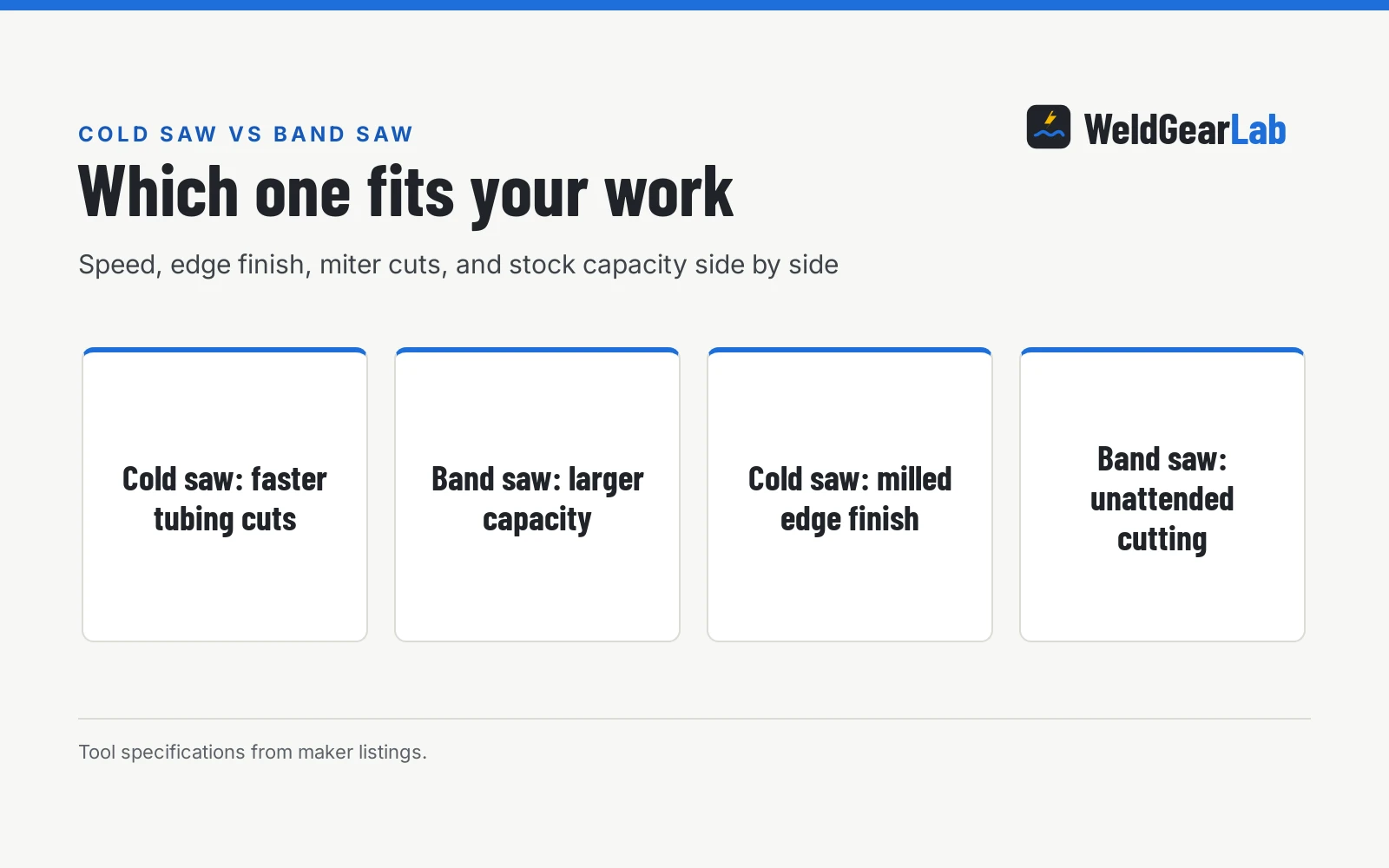
In the debate of cold saw vs band saw for metal fabrication, the right choice depends on whether your priority is cut speed and ready-to-weld edge quality or large cross-section capacity and unattended operation. A cold saw uses a rigid toothed circular blade to produce sharp, perfectly square, and burr-free cuts on tubing and profile stock that can go straight to the fit-up table without grinding. A horizontal band saw uses a continuous flexible loop blade driven around drive wheels to slice through wide structural shapes, solid bar stock, and thick material while gravity feeds the cut automatically. This guide compares cold saw vs band saw performance across cut speed, accuracy, material capacity, blade life, and shop workflow to help fabricators choose the proper tool.
As an Amazon Associate I earn from qualifying purchases. This guide links to our product roundups, where WeldGearLab earns a commission when you buy through links, at no extra cost to you. Read our affiliate disclosure.
The difference in one paragraph
The mechanical difference comes down to blade geometry and cutting motion. A cold saw spins a heavy, solid circular toothed blade at calibrated rotational speed to mill away material as individual chips, transferring heat into the waste shavings rather than the workpiece. This leaves cool, square edges with no discoloration or hardened heat-affected zone. A band saw draws a thin, continuous flexible band around drive wheels and through guide bearings to cut progressively through stock. Because the thin band experiences lower cutting resistance, a band saw can slice through dense solid billets and wide structural beams that would stall or exceed the physical capacity of a circular blade. A cold saw delivers unmatched speed and miter precision on light to medium tubing, while a band saw provides broader versatility and unattended cutting across heavy, bulky metal.
Side by side
| Cold saw | Horizontal band saw | Portable band saw | |
|---|---|---|---|
| Blade type | Rigid circular toothed disc | Continuous loop on horizontal bow | Continuous loop in handheld frame |
| Cutting motion | Circular rotation with high torque | Continuous downward travel on wheels | Continuous band travel around drive wheels |
| Cut finish | Milled, burr-free, square edge | Smooth finish with light tooth marks | Clean cut with light tooth marks |
| Heat at the cut | Minimal heat, cool to the touch | Low heat, cool workpiece | Low heat, cool workpiece |
| Cutting speed | Fast on tubing and profile shapes | Steady, controlled feed rate | Moderate speed on pipe and conduit |
| Mitering capability | Swivel head or vise for angle cuts | Swivel head or angle vise | Manual positioning against stock |
| Stock capacity | Limited by blade diameter | Broader width and throat clearance | Compact pipe and channel clearance |
| Operation style | Manual pull-down handle | Gravity feed with auto shut-off | Handheld trigger switch operation |
| Coolant requirement | Flood coolant or dry-cut carbide | Flood coolant, mist, or dry blade | Dry blade cutting |
| Sparks and debris | Virtually no sparks, metal chips | Virtually no sparks, fine chips | Virtually no sparks, fine chips |
Capacities and cutting rates vary by machine class and blade selection; always consult your saw manual and blade packaging for manufacturer guidelines. While cold saws excel at rapid, repeatable cuts on structural tubing, band saws handle diverse stock shapes with quiet, steady feed action.
When a cold saw is the better choice
- Precision miter cuts for welding. When fabricating handrails, frames, or chassis, cold saws deliver clean, accurate angled cuts that fit tight with minimal gap, eliminating joint prep grinding.
- Burr-free, cool edges. Because heat transfers directly into the cut chips, the metal workpiece remains cool to the touch and free from melting or heavy slag burrs.
- Fast cycle times on tubing and pipe. Slicing through hollow rectangular tube, square tube, and pipe takes only brief seconds with a downward stroke of the lever handle.
- Immediate welding fit-up. With square edges and no abrasive grit embedded in the steel, cut pieces move straight from the saw vise to the welding fixture.
Our cold saw for metal guide covers shop machines designed for clean, burr-free cuts across tubing, pipe, and bar stock.
When a band saw is the better choice
- Large cross-section capacity. Deep throat clearances and long horizontal vises allow band saws to cut large structural beams, wide plate, and bulky channel that circular blades cannot bridge.
- Solid bar and thick billets. Continuous blade cooling and constant chip evacuation allow narrow band blades to power through dense solid stock without overheating or binding.
- Unattended gravity feed. Hydraulic dampener cylinders or counterweights let the saw bow feed through stock automatically while you prep joints or run welds elsewhere in the shop.
- Lower consumable cost per cut. Flexible carbon steel or bi-metal band blades cost substantially less to replace when worn compared to large-diameter carbide-tipped circular blades.
Our best horizontal band saw guide reviews shop machines built for heavy structural profiles and unattended cutting. For non-ferrous projects, see our review of horizontal band saw for aluminum.
Cold saw vs band saw: how to choose
Choosing between a cold saw and a band saw requires evaluating your daily fabrication materials, production volume, and available shop floor space. Look for these factors when deciding which metal cutting saw fits your shop:
- Dominant material profiles. If your work consists primarily of hollow tube, angle iron, and light profiles for furniture, gates, and roll cages, a cold saw cuts faster and fits joints tighter. If you routinely cut solid rounds, heavy plate, or large beams, a horizontal band saw is indispensable.
- Tolerances and joint prep time. Cold saws provide milled-grade cut finishes that eliminate the need for disc grinding or deburring before tack welding. Band saws produce acceptable cuts for general fabrication, but may require light deburring on square tubing ends.
- Manual vs unattended cutting. Most benchtop cold saws and metal chop saws require manual pull-down operation, meaning the operator controls the handle throughout each cut. A horizontal band saw with a hydraulic downfeed and shut-off switch lets you clamp stock, start the motor, and step away to assemble other components while the cut finishes.
- Noise, debris, and shop footprint. Cold saws throw heavier chips into a collection tray without dust clouds, though fast dry-cutting circular saws can produce loud cutting noise. Band saws operate with quiet drive motors and produce fine swarf, though their horizontal beds take up greater linear floor space.
Fabricators needing compact cutting solutions for smaller workpieces can also compare options in our small chop saw for metal guide.
Blade speeds and cutting action
The mechanical efficiency of each saw type hinges on blade speed and tooth contact. Cold cutting metal saws use rigid circular blades designed to turn at calibrated rotational speeds with high torque. For instance, MK Morse lists a 14-inch metal cutting saw running at 1300 rpm with a 72-tooth blade that cuts through 6 inches by 1/4 inch thick steel in approximately 12 seconds. Evolution lists a 14-inch mild steel cutting blade with 66 teeth rated for 1600 RPM with a .094-Inch kerf and a 1-Inch arbor size. For handheld circular metal cutting, Evolution also lists a 15 Amp saw with a 7-1/4 inch 40-tooth blade turning at 3700 rpm that provides up to a 2-1/2 inch cutting depth and a 45 degree bevel adjustment.
In contrast, horizontal and vertical band saws run continuous looped blades over guide bearings at steady surface feed rates, distributing cutting heat along the entire length of the flexible band. Band saws in metal shops span multiple formats, from stationary horizontal cut-off saws to compact benchtop and portable jobsite units. In portable battery equipment, DEWALT lists a 20V band saw for cordless field cutting. For compact shop benches, SKIL lists a 2.8 Amp 9-inch 2-speed benchtop saw, and WEN lists a 9-inch band saw. While circular metal saws rely on rapid tooth entry and high chip load per tooth, band saws use narrow kerf bands that remove minimal stock material, preserving motor power on dense shapes.
Can one saw handle every job?
For many small welding shops and hobby garages, space and budget dictate starting with a primary cutting tool. If your projects center around square tubing frames, handrails, roll cages, or furniture builds, a dedicated circular cold saw or dry-cut metal saw often proves most practical because cut pieces require no secondary edge cleanup before welding. If your fabrication work spans solid steel shafts, round stock, angle iron brackets, and thick plate, a horizontal band saw serves as the more versatile workhorse due to its expansive throat opening and unattended feed capability. Many busy commercial shops ultimately retain each tool style: the cold saw for rapid, repetitive square and miter cut-offs on tubing, and the horizontal band saw for slicing through heavy billets, bar bundles, and thick structural profiles. For broader tooling selections, explore our best cold cut saw guide and the comprehensive metal fab tools hub.
Metal cutting shop safety. Saws cutting ferrous metal generate flying chips, pinch hazards, and sharp cut edges. Always wear eye protection with side shields and hearing protection during operation. Clamp workpieces securely in the vise before engaging the blade, as loose stock can catch, shatter circular blade teeth, or twist band saw blades off their tracking wheels. Never reach across a spinning blade or attempt to clear chips while the motor runs. Support long tubing and bar overhangs with roller stands to prevent stock from tipping or binding during the cut.
Frequently Asked Questions
Is a cold saw more accurate than a band saw?
A cold saw generally delivers superior cut squareness and edge accuracy because its circular blade body is rigid and resistant to lateral deflection. Band saws use thin, flexible blades that can bow or drift slightly under heavy downward feed pressure. When tuned properly with snug guide bearings and correct blade tension, a band saw achieves clean cuts, but cold saws remain the benchmark for tight joint fit-up.
Can a band saw cut metal as fast as a cold saw?
A cold saw typically cuts hollow tubing and structural shapes considerably faster than a band saw due to its aggressive tooth engagement and rigid downward leverage. Band saws cut more slowly because their narrow teeth must progress through the cut without binding. However, on large solid steel rounds or dense billets, a band saw handles the volume smoothly while a circular saw blade can bog down.
Do cold saws require liquid flood coolant?
Traditional low-rpm cold saws use continuous flood coolant to lubricate the high-speed steel blade teeth and flush chips away from the cut. Modern dry-cut metal saws use specialized carbide-tipped blades that cut cleanly without liquid coolant by transferring heat directly into the expelled metal shavings. Choosing between flood coolant and dry-cutting depends on whether your shop prioritizes maximum blade longevity or clean, liquid-free cutting.
Why do band saw blades wander during a cut?
Blade wandering in a band saw usually stems from insufficient blade tension, worn guide bearings, or excessive downward feed force. When an operator forces the saw arm down faster than the teeth can clear chips, the flexible blade flexes sideways along the path of least resistance. Inspecting blade tension, adjusting guide rollers close to the workpiece, and allowing steady gravity feed ensures true vertical cuts.
Which saw is better for a beginner welding shop?
For beginners focusing on home welding projects, furniture building, and light chassis fabrication, a dry-cutting cold saw or chop saw offers the easiest path to clean, weld-ready joints without complex setup. If your planned builds involve salvage yard steel, solid axles, and wide structural channels, an entry-level horizontal band saw provides broader cutting versatility. Beginners who need unattended operation often prefer the band saw because the tool cuts automatically while they prepare fixtures.
Related: cold saw for metal, best horizontal band saw, best cold cut saw, and the metal fab tools hub. Also see our guide on what is a cold saw.
About the author
WeldGearLab Editorial is the editorial team behind WeldGearLab. We research product listings, specifications, safety listings and warranty terms, score every pick with the published Gear Score method, and correct errors when readers report them. We do not run our own shop trials; see How We Pick for exactly how picks are made.