Abrasive Chop Saw vs Cold Saw: Which One Should You Buy?
Abrasive chop saws and cold saws tackle metal cutting with very different speeds, blade wear, heat buildup, and finished edges based on what their listings state.
 By WeldGearLab Editorial
Updated October 10, 2026
By WeldGearLab Editorial
Updated October 10, 2026
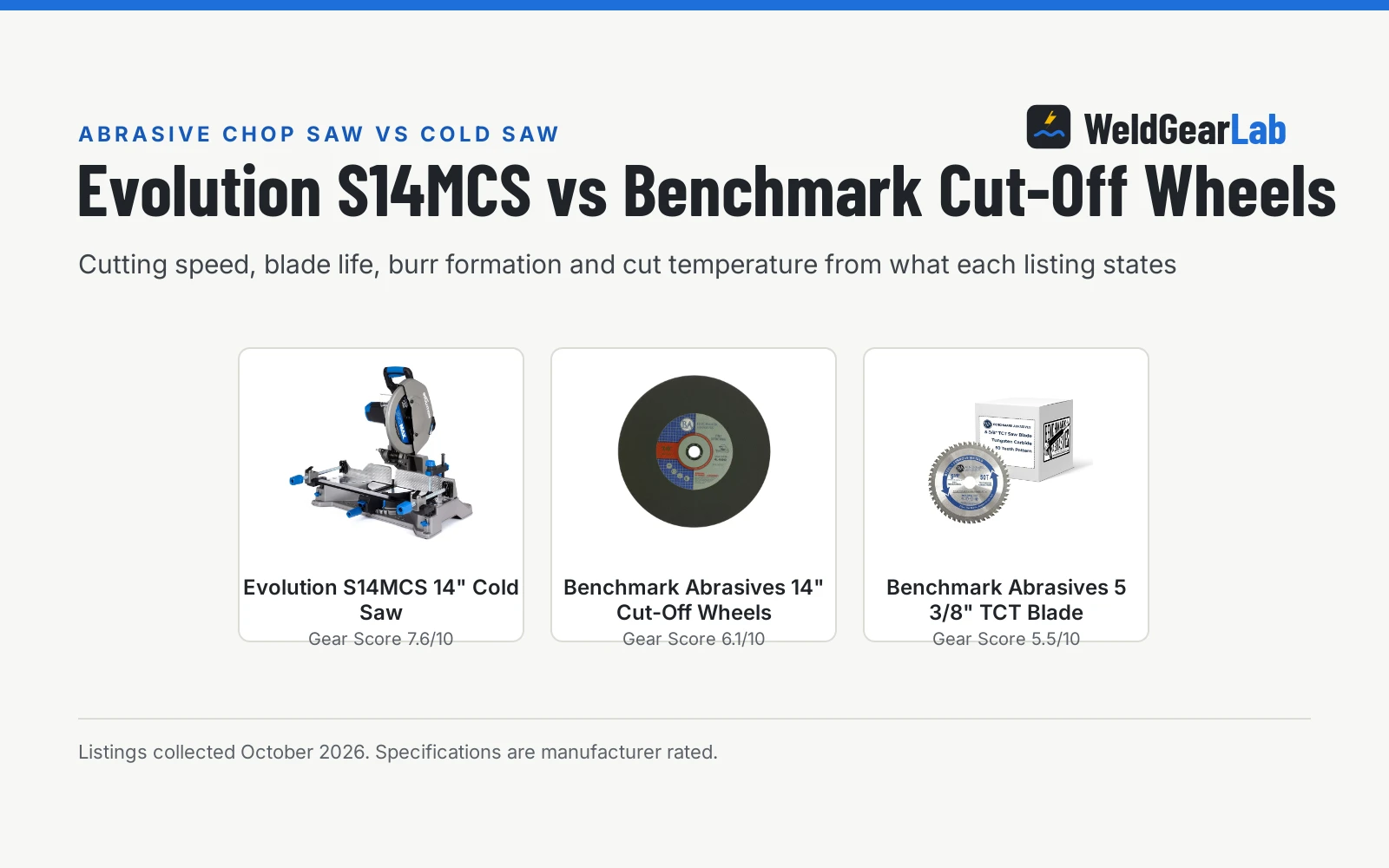
Verdict. In the abrasive chop saw vs cold saw comparison, the Evolution S14MCS cold saw example is the pick for fabricators who want a dedicated machine with 1,100 RPM cutting, 46-degree mitering, and manufacturer-claimed burr-free cuts. The Benchmark Abrasives cut-off wheel example is the choice for shops that already own a chop saw and want multi-pack abrasive discs for general steel cutting, though its listing leaves machine specs and cut times unstated.
Deciding between an abrasive chop saw vs cold saw comes down to cutting technology, speed ratings, and how listings specify edge finish. In standard shop use, an abrasive chop saw cuts metal using high-speed composite wheels like the 14-inch Benchmark aluminum oxide disc, while a cold cut saw like the Evolution S14MCS uses a toothed carbide blade running at 1,100 RPM to shear chips. Deciding whether to choose a chop saw or cold saw depends on whether you need a dedicated mitering saw or replacement cutting discs for an existing machine.
As an Amazon Associate I earn from qualifying purchases. WeldGearLab earns a commission when you buy through links on this page, at no extra cost to you. Read our affiliate disclosure.
Side by side
| Evolution S14MCS | Benchmark 14″ Cut-Off Wheels | Benchmark 5 3/8″ TCT Blade | |
|---|---|---|---|
| Gear Score | 63 | 50 | 45 |
| Side / Method | Cold saw (cermet carbide blade) | Abrasive chop saw (grinding wheel) | Abrasive saw side (carbide blade) |
| Diameter | 14 in | 14 in | 5 3/8 in |
| Speed | 1,100 RPM | 4400 rpm max | Not stated |
| Power | 15A, 1800W corded electric | Wheel pack (saw dependent) | Blade only (saw dependent) |
| Mitering | +/-46 degrees | Saw dependent (wheel only) | Miter saw compatible |
| Teeth / Grit | 80 teeth (cermet carbide) | 80 grit (aluminum oxide) | 50 teeth (tungsten carbide) |
| Thickness | Not stated | 1/8 in (table states 0.1 in) | 0.08 in |
| Weight | 72.4 lb | Not stated | Not stated |
| Warranty | Limited warranty (term not stated) | Not stated | Not stated |
Specifications are manufacturer rated, as published on each listing and collected 10 October 2026. None of the three listings state a CSA, UL, or ETL safety certification.
Abrasive chop saw vs cold saw: cutting mechanism
The defining distinction between these tools is how their blades separate metal. The Evolution cold saw listing states that its 80-tooth cermet carbide blade cuts metal at 1,100 RPM with cool results, transferring cutting heat into the chips rather than the workpiece. However, Evolution notes that operators must maintain firm, consistent pressure, warning that a slow feed rate causes excessive sparking and heat buildup. By contrast, the Benchmark Abrasives 14-inch cut-off wheel example relies on an 80 grit aluminum oxide abrasive rated up to 4400 rpm, where friction grinds through metal. The Benchmark 5 3/8-inch blade provides a 50-tooth tungsten carbide option for circular and miter saws, showing that toothed blades also appear in listings on the chop saw side.
Cut quality, heat, and weld preparation
Cut quality directly impacts how much shop time you spend preparing joints for fit-up. The Evolution listing claims that its cold cut saw delivers burr-free, weld-ready results with zero airborne dust, allowing fabricators to fit parts without edge cleanup. When preparing thicker metal for fabrication, you can proceed straight to joint preparation; see our guide on how to bevel metal for welding. The Benchmark 14-inch abrasive wheel listing does not claim burr-free edges, highlighting instead its aluminum oxide grain for general cutting across iron, steel, and drywall studs. Interestingly, the Benchmark 5 3/8-inch blade listing on the chop saw side also claims clean, burr-free cuts using its 50 tungsten carbide tips, showing that edge quality depends on blade design rather than category alone.
Cutting speed and motor ratings
Listing data reveals substantial differences in rated rotational speeds and stated machine details. The Evolution S14MCS specifies a 15A, 1800-watt corded electric motor running at 1,100 RPM, with active speed optimization claimed to extend blade life by 30%. Evolution claims this cold saw cuts metal 4x faster than abrasive saws. However, neither Benchmark listing states cutting times or saw motor wattage, as both describe replacement blades rather than complete machines. The Benchmark 14-inch wheel listing lists a maximum rotational speed of 4400 rpm and notes compatibility with low-horsepower, stationary, and portable chop saws, while the Benchmark 5 3/8-inch blade leaves operating RPM unstated. Because the abrasive listings do not publish cutting times, the comparison on cutting speed remains unstated on the abrasive side.
Mitering capacity and machine build
Accurate angled joints depend heavily on the rigidity of the saw frame and clamp assembly. The Evolution S14MCS listing details a 72.4-pound dedicated saw built with a ribbed alloy base, reinforced fence, knurled clamping surfaces, and dual sliding clamps. Its base miters up to 46 degrees in both directions, indexed by detents and a stainless steel gauge. Because the Benchmark products are consumable blades, their mitering ability and clamping rigidity depend entirely on whichever third-party chop saw machine the user operates. The Benchmark 5 3/8-inch blade listing states compatibility with miter saws, but its bullets state fitment with 7 1/4-inch tools despite a 5 3/8-inch diameter.
Blade life, consumable wear, and long-term costs
Stated blade life differs markedly across these listings. Evolution includes an EVOMAX cermet carbide blade with the S14MCS, claiming 3500+ cuts in 4-inch mild steel and rating that lifespan at 50% more than competitors. To maintain blade life, Evolution instructs users to avoid a slow feed rate that leads to heat buildup. For the abrasive side, the Benchmark 14-inch cut-off wheel listing provides a 10-pack of aluminum oxide discs but does not state an estimated cut count per wheel. The Benchmark 5 3/8-inch blade listing also omits cut counts, claiming only durable tooth edges and chip clearance from its 50 tungsten carbide tips. While the Evolution listing gives a concrete cut figure, the Benchmark listings leave overall cut counts unstated.
Warranty terms and listing accuracy
Neither side offers an airtight warranty statement in these listings. Evolution lists a limited warranty in its specification table but leaves the duration unstated, giving no term in years or months. Furthermore, the Evolution specification table contains an obvious error, listing the blade shape as rectangular. Benchmark Abrasives states no warranty term for either the 14-inch wheel pack or the 5 3/8-inch carbide blade. The Benchmark 14-inch wheel listing also contains internal discrepancies: the title and bullets specify a 1/8-inch thickness, but the specification table lists 0.1 inches and 0.04 inches, while also naming aluminum and fiberglass despite bullets emphasizing ferrous metals.
Choose the Evolution S14MCS cold saw if
- You want a complete 72.4-pound shop saw with an integrated +/-46 degree mitering base.
- You want manufacturer-rated burr-free, weld-ready cuts in mild steel.
- You want a 15A, 1,100 RPM motor equipped with a soft start and electronic blade brake.
- You value a cermet carbide blade with a manufacturer claim of 3500+ cuts in 4-inch mild steel.
Choose Benchmark abrasive cut-off wheels if
- You already own a 14-inch chop saw and need a 10-pack of replacement cutting wheels.
- Your saw operates at speeds up to 4400 rpm with a 1-inch arbor fitment.
- You cut standard ferrous metals such as iron, steel pipes, or drywall studs.
- You prefer an 80 grit aluminum oxide wheel and do not require stated cut counts or warranties.
The three products
| Award | Product | Gear Score About the Gear ScoreThe Gear Score runs from 0 to 10 and weighs performance (35%), build (25%), value (25%), safety (10%, where it applies) and warranty (5%), using only what the manufacturer and the listing publish. How we pick › | |
|---|---|---|---|
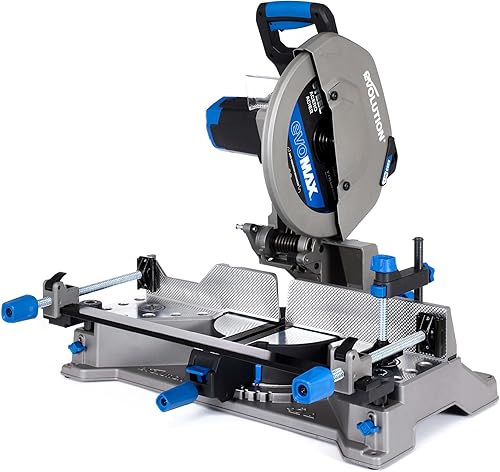 Evolution S14MCS 14" Mitering Chop Saw
|
7.6/10 | Check price on Amazon | |
 Benchmark Abrasives Aluminum Oxide Type 1
|
6.1/10 | Check price on Amazon | |
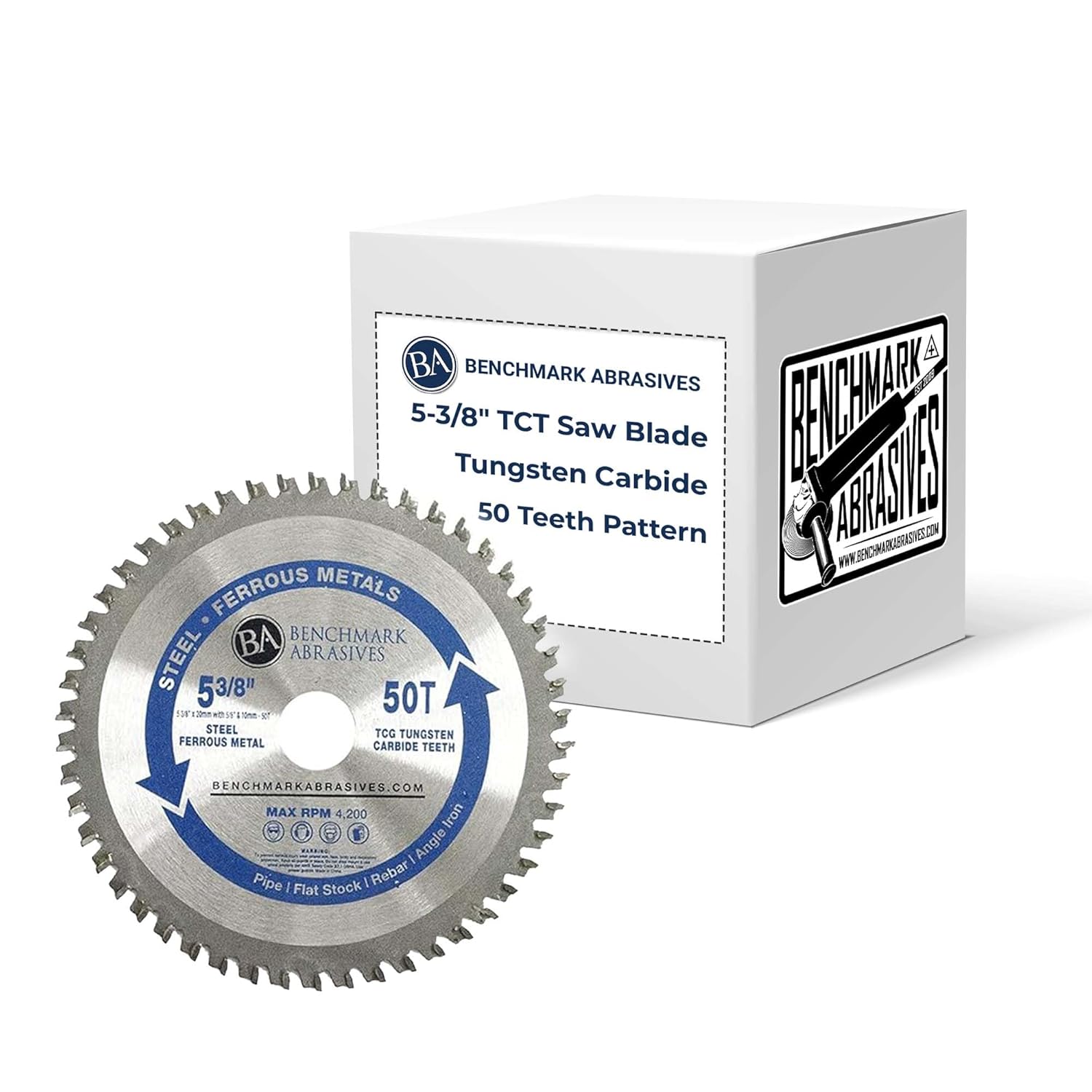 Benchmark Abrasives 5 3/8" TCT Circular Saw Blade
|
5.5/10 | Check price on Amazon |
Evolution S14MCS 14" Mitering Chop Saw
A 14-inch, 15A corded cold cut chop saw with an 80-tooth cermet carbide blade, +/-46 degree mitering, soft start, and an electronic blade brake.
Pros
- 15A, 1800-watt motor running at 1,100 RPM with soft start and blade brake
- Includes 14-inch 80-tooth cermet carbide blade claiming 3500+ cuts in 4-inch mild steel
- Miters up to 46 degrees with detents and a stainless steel gauge
- Heavy ribbed alloy base with dual sliding clamps
Cons
- Heaviest unit in this comparison at 72.4 pounds
- Spec table incorrectly lists blade shape as rectangular
- No warranty duration stated beyond limited warranty
- Listing does not state a CSA, UL, or ETL safety certification
Benchmark Abrasives Aluminum Oxide Type 1
A 10-pack of 14-inch by 1/8-inch aluminum oxide abrasive cut-off wheels with a 1-inch arbor for stationary and portable metal chop saws.
Pros
- 10-pack of 14-inch Type 1 abrasive cut-off wheels
- 80 grit aluminum oxide construction rated up to 4400 rpm
- 1-inch arbor fits standard stationary and portable chop saws
- Stated for ferrous metal cutting including iron, steel, and drywall studs
Cons
- Spec table contradicts title by stating 0.1-inch and 0.04-inch thickness instead of 1/8-inch
- Spec table lists aluminum and fiberglass contrary to the ferrous metal bullets
- No warranty term is stated in the listing
- Spec table lists unit count as 1 Count despite 10 items in the pack
Benchmark Abrasives 5 3/8" TCT Circular Saw Blade
A 5 3/8-inch, 50-tooth tungsten carbide tipped circular saw blade with a 0.08-inch thickness for cutting steel, stainless steel, and cast iron.
Pros
- 50 tungsten carbide tipped teeth on a steel core
- 0.08-inch thickness for narrower metal cuts
- Stated to cut alloy steel, cast iron, and stainless steel
- Compatible with miter saws and circular saws
Cons
- Bullets claim fitment with 7 1/4-inch tools despite a 5 3/8-inch blade diameter
- Listing leaves arbor size and maximum RPM unstated
- No warranty term is stated in the listing
- Extracted facts note 3/8-inch thickness against the 0.08-inch spec table
How we scored them
All three items are scored out of 100 on performance, build, value, safety listing and warranty, with the weights published on our How We Pick page.
| Product | Gear Score | Perf. /35 | Build /25 | Value /25 | Safety /10 | Warranty /5 |
|---|---|---|---|---|---|---|
| Evolution S14MCS 14″ Cold Saw | 7.6 | 33 | 22 | 21 | 0 | 0 |
| Benchmark Abrasives 14″ Cut-Off Wheels | 6.1 | 23 | 18 | 20 | 0 | 0 |
| Benchmark Abrasives 5 3/8″ TCT Blade | 5.5 | 21 | 18 | 16 | 0 | 0 |
Safety before you cut. Always wear safety glasses, hearing protection, leather gloves, and flame-resistant clothing when cutting metal. Abrasive cutting throws intense spark streams and airborne debris that require a workspace clear of flammable items. Cold cutting transfers heat into metal chips that fly off the kerf; while the cut workpiece stays cool, the chips remain hot and sharp. For both tools, clamp stock securely against the fence before cutting, allow blades to reach full operating speed before contact, and avoid slow feed rates that cause excessive sparking.
Frequently Asked Questions
What is the main difference between an abrasive chop saw and a cold saw?
An abrasive chop saw uses a high-speed abrasive wheel to grind through metal, as seen with the 4400 rpm Benchmark 14-inch disc. A cold saw like the Evolution S14MCS uses a toothed cermet carbide blade running at a lower 1,100 RPM to shear chips away, keeping cutting heat primarily in the chips.
Can you mount a cold saw blade on an abrasive chop saw?
No, you should not mount a carbide cold saw blade on an abrasive chop saw because their rated operating speeds differ significantly. The Benchmark 14-inch abrasive wheel listing specifies a maximum speed of 4400 rpm, whereas the Evolution cold saw operates at 1,100 RPM. A carbide blade is not rated for the higher rotational speeds of abrasive chop saws.
Does an abrasive chop saw or cold saw cut faster?
The Evolution listing claims that its S14MCS cold saw cuts metal 4x faster than abrasive saws. However, the Benchmark abrasive listings state only a maximum rotational speed of 4400 rpm and do not publish cut times. Because the abrasive listings leave cutting speeds and feed rates unstated, the listings do not provide data to directly verify that speed comparison.
Do cold saw cuts require deburring before welding?
The Evolution listing explicitly claims that its cold saw produces burr-free, weld-ready cuts right off the blade. The Benchmark 14-inch cut-off wheel listing does not claim burr-free edges, while the Benchmark 5 3/8-inch carbide blade listing also claims clean, burr-free cuts. Edge finish depends on blade type and listing specifications.
How do you prevent excessive sparking and heat buildup on a cold saw?
The Evolution listing instructs operators to allow the blade to reach full speed before contacting stock and to apply firm, consistent pressure. Evolution specifically warns against using a slow feed rate, which causes excessive sparking and heat buildup during the cut.
Related: best cold saw for small shop, best metal chop saw for home shop, what is cold saw, best chop saw for metal cutting, cold saw vs band saw, and the metal fab tools hub.
About the author
WeldGearLab Editorial is the editorial team behind WeldGearLab. We research product listings, specifications, safety listings and warranty terms, score every pick with the published Gear Score method, and correct errors when readers report them. We do not run our own shop trials; see How We Pick for exactly how picks are made.