Plasma Cutter vs Band Saw: Which One Should You Buy?
Plasma cutter vs band saw: speed against straightness. Cutting capacity, amperage and voltage figures from the plasma listings.

On this page
Top picks at a glance
As an Amazon Associate I earn from qualifying purchases.
- 1
 MAXXT Band Saw with Lightweight Aluminum Base9.7/10View on Amazon
- 2
 ARCCAPTAIN iControl CUT55 Prolux Plasma Cutter MachineView on Amazon
- 3
 ARCCAPTAIN 55A Non-HF Plasma Cutter MachineView on Amazon
- 4
 ARCCAPTAIN iControl CUT55 MP [Non-HF] Plasma Cutter MachineView on Amazon
- 5
 Reboot Plasma CutterView on Amazon
- 6
 AWT Plasma CutterView on Amazon
- 7
 Miller Electric 907529 Plasma CutterView on Amazon
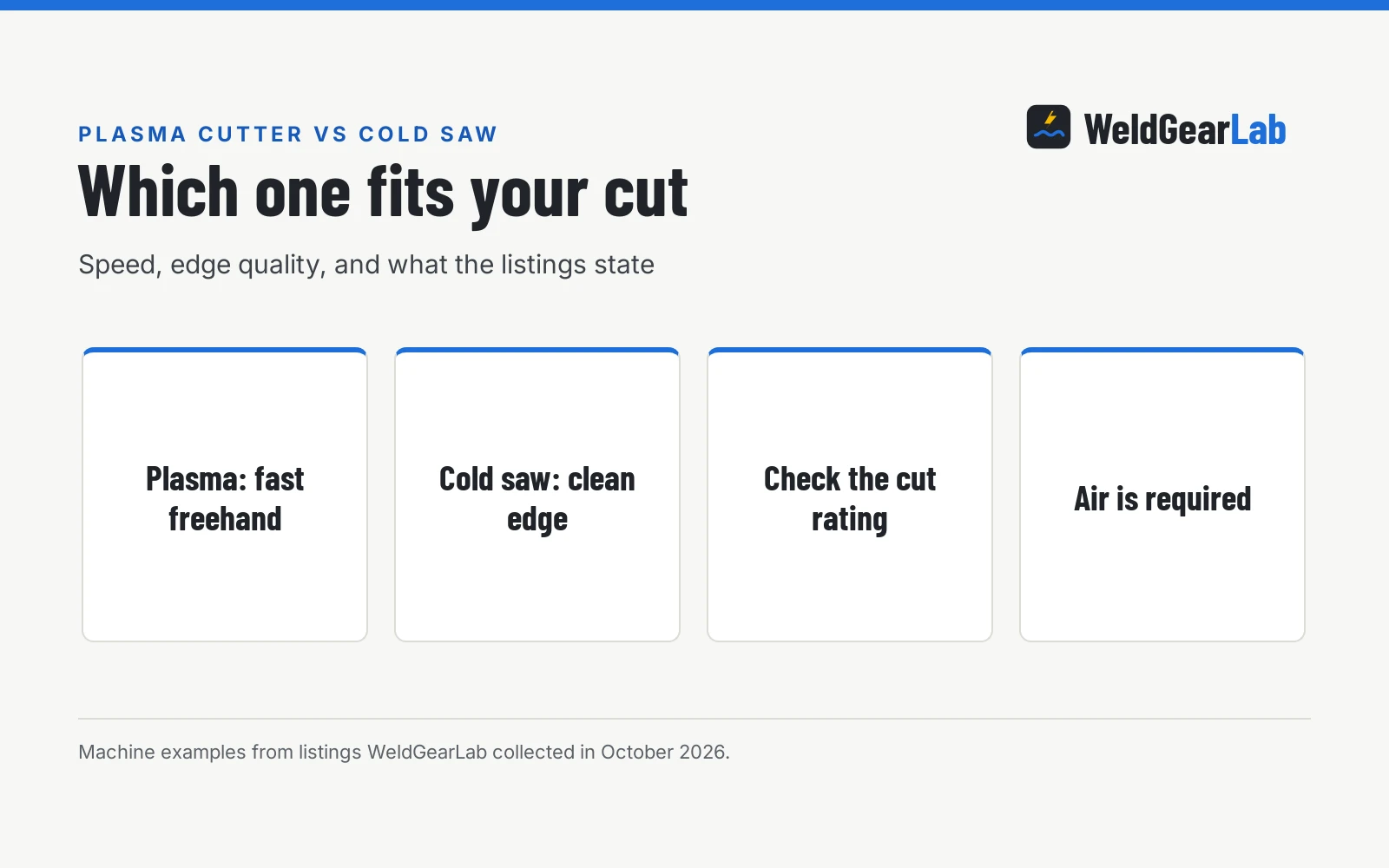
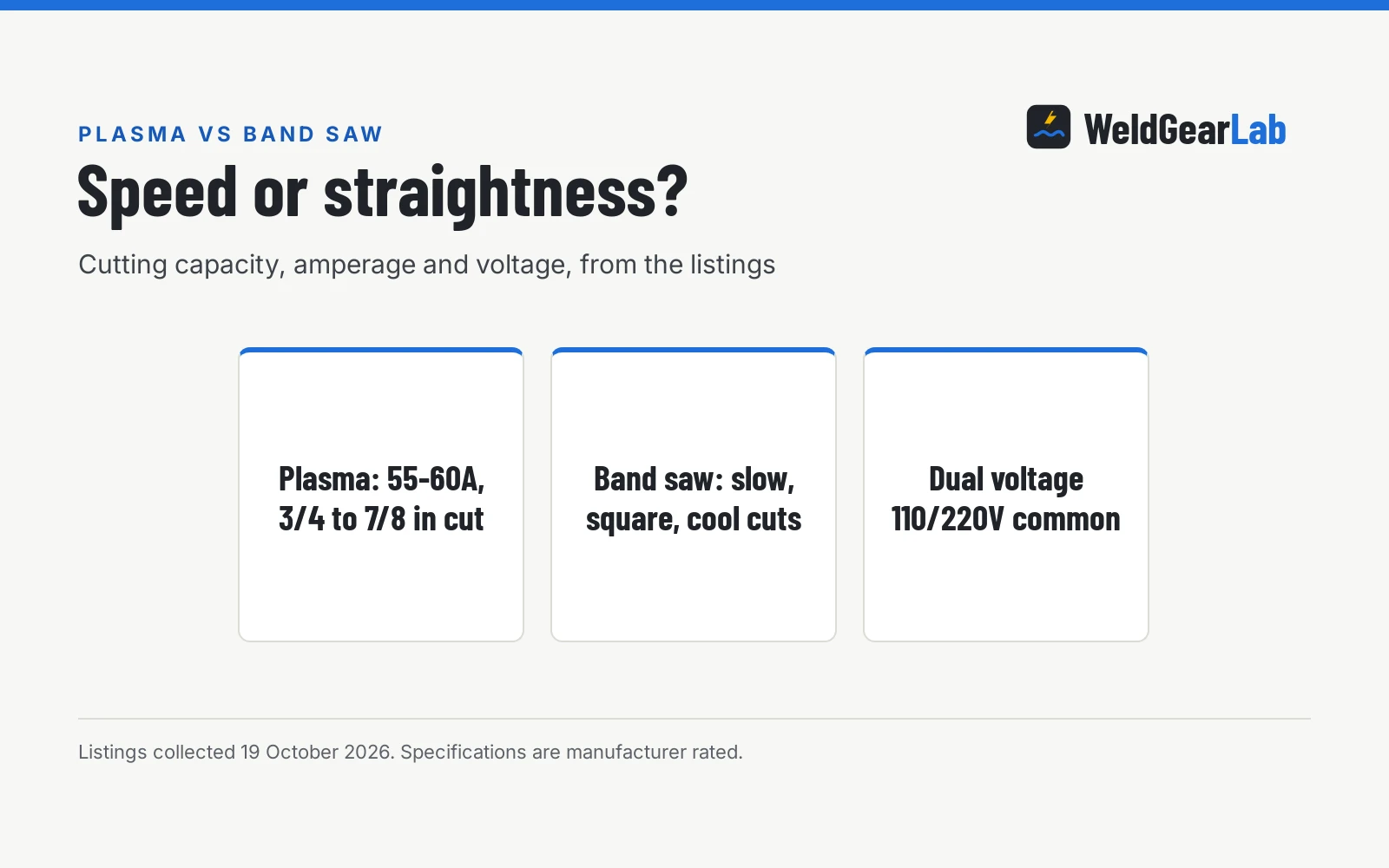
In the plasma cutter vs band saw question, the difference is speed against straightness. A plasma cutter slices metal fast with an electric arc: freehand curves, holes and quick cuts in steel, stainless, aluminum and copper. A band saw cuts slow and straight with a toothed blade: square, accurate cuts in bar, tube and angle. If you cut shapes and plate, get the plasma cutter. If you cut stock to length square and true, get the band saw. The rest of this guide explains the differences with concrete figures from the plasma cutter listings we reviewed; no band saw figures appear in the listings, so that side is described without numbers.
Other welders and gear to compare
 ARCCAPTAIN iControl CUT55 Prolux Plasma Cutter MachineCheck price on Amazon
 ARCCAPTAIN 55A Non-HF Plasma Cutter MachineCheck price on Amazon
 ARCCAPTAIN iControl CUT55 MP [Non-HF] Plasma Cutter MachineCheck price on Amazon
 Reboot Plasma CutterCheck price on Amazon
 AWT Plasma CutterCheck price on Amazon
 Miller Electric 907529 Plasma CutterCheck price on Amazon
WeldGearLab gets a commission on purchases made through links on this page, and your price stays the same. Read our affiliate disclosure.
The difference in one paragraph
A plasma cutter is an arc cutting machine: the ARCCAPTAIN iControl CUT55 Prolux listing, for example, runs 55A on 120V/240V and cuts steel up to 7/8 in thick at 240V, handling stainless steel, carbon steel, aluminum and copper. The Reboot RBC6000D listing runs 60A on 120V/240V with a 50A breaker on 120V and a 30A breaker on 240V. The AWT listing gives a 55A machine with a 3/4 in max plate cut, and the SILATU listing runs 15-40A on 110V and 15-55A on 220V. A band saw is a blade machine: it cuts slower, cooler and straighter, with no heat-affected zone to speak of and no consumables beyond the blade.
Plasma cutter vs band saw: side by side
| Factor | Plasma cutter | Band saw | Read |
|---|---|---|---|
| Amperage | 55A to 60A (listed) | Not stated | Plasma: 55-60A class |
| Max cut | 3/4 in plate; 7/8 in steel at 240V (listed) | Not stated | Plate work favors plasma |
| Voltage | 110V/220V or 120V/240V (listed) | Not stated | Dual voltage common |
| Breaker | 50A on 120V; 30A on 240V (listed) | Not stated | Check your panel first |
| Cut quality | Fast; heat-affected zone | Slow; square; minimal cleanup | Speed against squareness |
| Shapes | Freehand curves and holes | Straight cuts | Plasma for curves |
Figures are from the listings reviewed, collected 19 October 2026; a figure from one listing describes that listing only.
When a plasma cutter is the better choice
Plasma is the better choice for shapes, speed and versatility. Freehand curves, cutouts and holes are plasma work; the LOTOS listing even describes drag-cut tracking for straight lines along templates. The ARCCAPTAIN non-HF listing uses a blowback pilot arc, and its listing says the pilot arc allows cutting without touching the metal, which suits rusty or painted surfaces. That is the non-HF blowback form of pilot arc, distinct from the high-frequency non-touch pilot arc on the AWT and HIZONE listings described below. On dual voltage, the Hobart AirForce 27i listing connects to 120 or 240V receptacles with a multi-voltage plug, and the SILATU listing splits duty: 15-40A on 110V for garage work, 15-55A on 220V for thicker metal. See 120V vs 240V plasma cutter and pilot arc vs high frequency.
When a band saw is the better choice
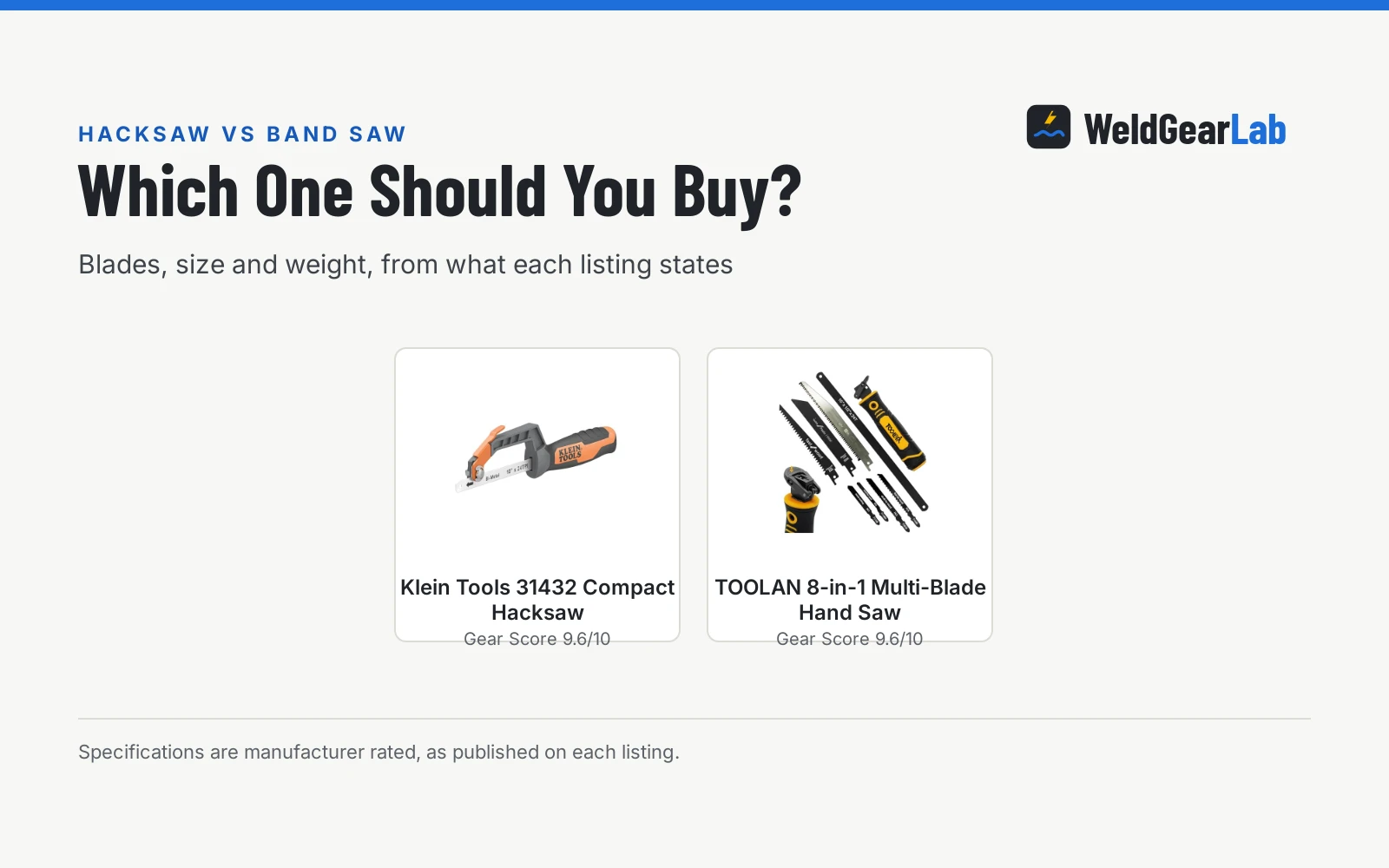
A band saw is the better choice for straight, square cuts in bar, tube and angle. It cuts cooler than plasma, so there is no heat-affected zone to grind out and no dross on the back side. It is quieter, throws no sparks, and the cut needs little cleanup. For a shop that cuts stock to length all day, a horizontal band saw with a vise is the workhorse. See portable band saw vs chop saw and horizontal vs vertical band saw.
What the listings tell you about plasma
The plasma listings cluster at 55A to 60A on dual 110V/220V or 120V/240V, with max cuts of 3/4 in plate and 7/8 in steel at 240V. Breaker sizing is stated on the Reboot listing: 50A for 120V, 30A for 240V. Arc starting splits two ways: blowback non-HF start on the ARCCAPTAIN listings, which avoids electromagnetic interference, and high-frequency non-touch pilot arc on the AWT and HIZONE listings. Only one listing states a duty cycle: the Reboot RBC6000D claims 50%. The other listings state no duty cycle, so sustained cutting time is unconfirmed for most.
Buying advice: size the plasma cutter to your shop power
Start with your receptacle, because it caps everything else. The SILATU listing splits its range by voltage: 15-40A on 110V for home garage and lighter-duty jobs, 15-55A on 220V for thicker metal and more demanding projects, and it says the machine must be used with a 40A circuit breaker. The Reboot RBC6000D lists its breakers too: 50A for 120V, 30A for 240V. If you only have a 120V receptacle, know you will be cutting at the light end of these machines’ ranges.
Next, match amperage to the metal you actually cut. The AWT listing publishes both clean and max cuts per voltage: 3/8 in clean and 1/2 in max at 110V, 5/8 in clean and 3/4 in max at 220V. The HIZONE listing gives a 5/8 in ideal clean cut and a 3/4 in max cut at 55A, 240V, 85 PSI. The SILATU listing tops out at 1/2 in on 110V/40A and 7/10 in (18mm) on 220V/55A. The ARCCAPTAIN CUT55 Prolux listing cuts steel up to 7/8 in at 240V, and the CUT55 MP listing up to 1 in at 240V. If your work is sheet and thin plate, a 110V setup covers you; if it is plate over 1/2 in, plan for 220V or 240V.
Then check duty cycle and consumables. Only the Reboot listing states a duty cycle, 50%, so sustained cutting time is unconfirmed on the rest. Plasma consumables are electrodes, tips and air: the ARCCAPTAIN non-HF listings say blowback start reduces electrode burn during idle time and extends consumable life, while the HIZONE listing says the non-touch pilot arc minimizes electrode burning. Air matters too: the HIZONE listing specifies 85 PSI, and the Reboot listing gives 70-75 PSI guidance. The LOTOS listing carries a built-in air compressor for plug-and-cut mobility at 38 lb, or accepts an external compressor to unlock the full 56A envelope.
Finally, weigh portability against features. The SILATU machine weighs 12.57 lb and the Hobart 19 lb, against 20.5 lb for the CUT55 MP and 19.84 lb for the Prolux. The Hobart adds a multi-voltage plug, fan-on-demand cooling and power factor correction that the maker says draws up to 30% less amperage. The ARCCAPTAIN Prolux and CUT55 MP listings add app control, and the Prolux carries a 3-year warranty. None of that changes the core choice: if your work is square stock cut to length, a band saw stays the better buy regardless.
FAQ for welders
Can a plasma cutter cut as straight as a band saw?
With a straightedge or template, close. The LOTOS listing describes drag-cut tracking along straightedges for straight lines. But a band saw with a vise still wins on squareness for production cuts.
Which is cheaper to run?
A band saw’s consumable is the blade; a plasma cutter’s are electrodes, tips and air. No listing here prices consumables, so compare by your local prices.
Do I need 240V for a plasma cutter?
Not necessarily: the listings run dual voltage, with 110V for lighter work and 220V/240V for full power. The SILATU listing caps 110V at 40A against 55A on 220V. See 120V vs 240V plasma cutter.
Can a band saw cut plate?
It can, slowly. Plate is plasma territory: the listings cut 3/4 in plate and 7/8 in steel. A band saw shines on bar, tube and angle.
Which is safer?
Both demand respect. Plasma throws sparks and UV; a band saw has an exposed blade. The ARCCAPTAIN non-HF listings note reduced interference and safer operation from blowback start. Guards, glasses and ventilation are on you either way.
Related: blowback vs high frequency start and portable band saw vs cold cut saw.