How to Set Up a Band Saw for Metal Cutting
Place the saw, fit the blade, set the guides and speed, and check the guards before cutting metal.

On this page
Top picks at a glance
As an Amazon Associate I earn from qualifying purchases.
- 1
 WEN 9-Inch Band Saw9.4/10View on Amazon
- 2
 DEWALT Portable Band Saw9.7/10View on Amazon
A bar of steel waits on the bench, the saw stands in the corner, and the cut needs to land square. How to set up a band saw comes down to a short run of jobs: place the saw where stock can move, fit the right blade, set the guides, set the speed for the metal, and check the guards before the blade moves. This guide walks through each job in order, with speeds, sizes and capacities taken from the listings the makers publish.
This guide links to our product roundups, where WeldGearLab gets a commission on purchases made through links on this page, and your price stays the same. Read our affiliate disclosure.
How to set up a band saw: the steps in order
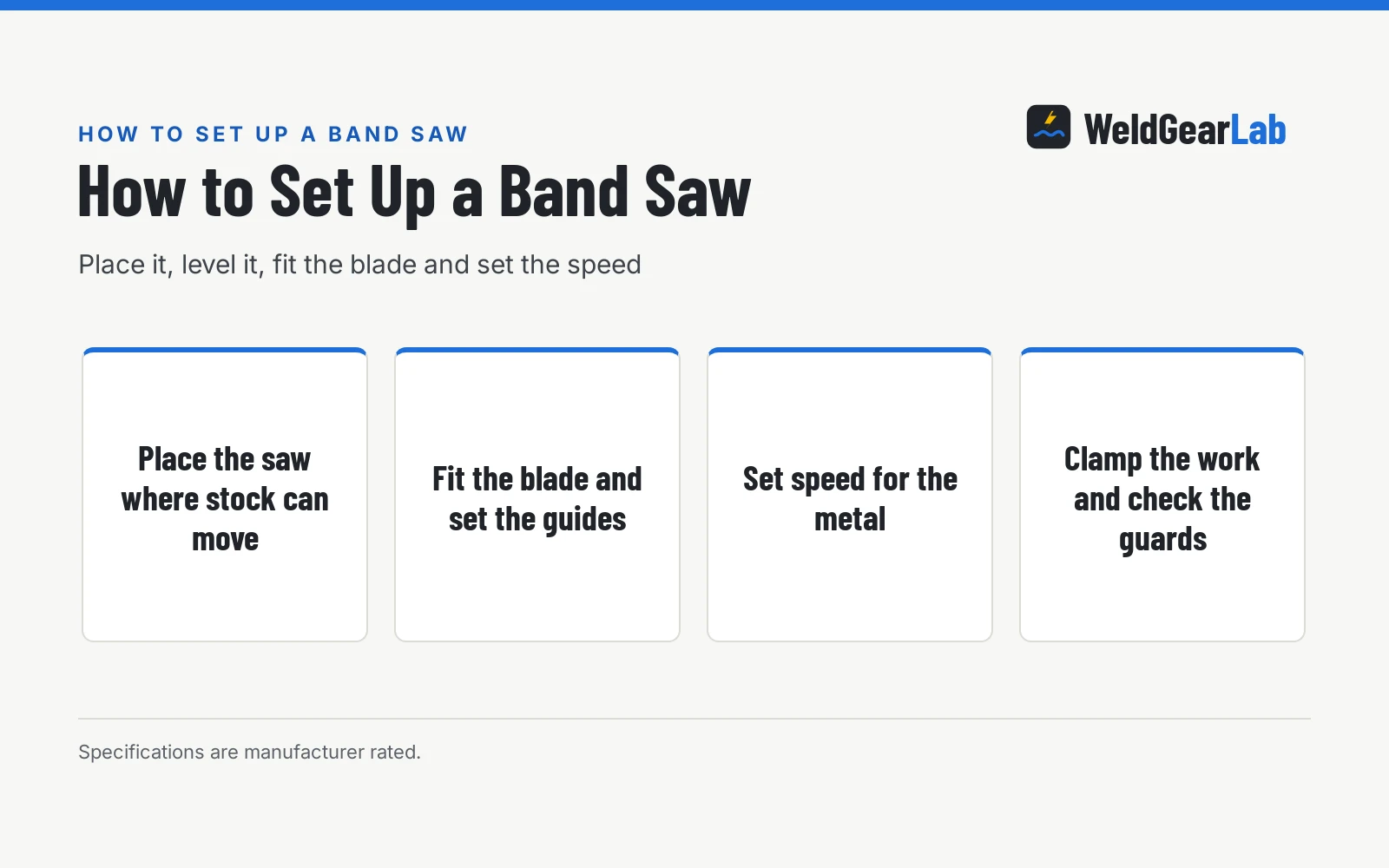
Setup is a sequence, and each step makes the next step easier. A saw that sits level and steady holds a blade that tracks true, guides set close to the work keep the blade from wandering, and a speed matched to the metal keeps the cut clean. The sections below follow that order: placement, blade, guides, speed, table and vise, coolant and dust, then a cut.
Side by side
| Benchtop | Portable | Horizontal | |
|---|---|---|---|
| Cutting capacity | 3-1/2 in deep, 9 in wide | 5 in deep cut | 9 in round, 7 x 12 in rectangular |
| Blade speed | Up to 2500 FPM | 137.8-472.4 FPM | 105, 197, 289, 377 SFPM |
| Motor | 2.8 amp | 10 amp | 1.5 HP |
| Blade length | 59-1/2 in | Not stated | Not stated |
| Table or vise | 12-1/4 x 11-7/8 in table | Hand held | 0 to 45 degree miter vise |
| Work it suits | Benchtop cuts | Jobsite cutting | Cutting bar, pipe and tubing to length |
Saw types differ in capacity and speed, and the table above shows the spread the makers list. A benchtop saw suits a bench, a portable saw suits work away from the bench, and a horizontal saw suits cutoff work on bar, pipe and tubing. Pick the type by the stock on the bench and the space in the shop.
Place the saw
Give the saw a level spot with room for stock on both sides of the blade, and room to walk around it. A benchtop saw sits on a bench; the WEN BA3959 (on Amazon) lists a 2.8-amp motor and a 12-1/4 x 11-7/8-inch work table, so the bench needs room for the table. A horizontal saw takes more floor: the KAKA BS-912B lists 555.0 lb and stand wheels, so it can be rolled into place and parked. A portable saw goes to the work instead: the VEVOR portable lists 15.8 lb and the DEWALT portable (on Amazon) lists 15.0 lb, and both are made to carry to the job. Keep the area clear of clutter and cords.
Fit the blade
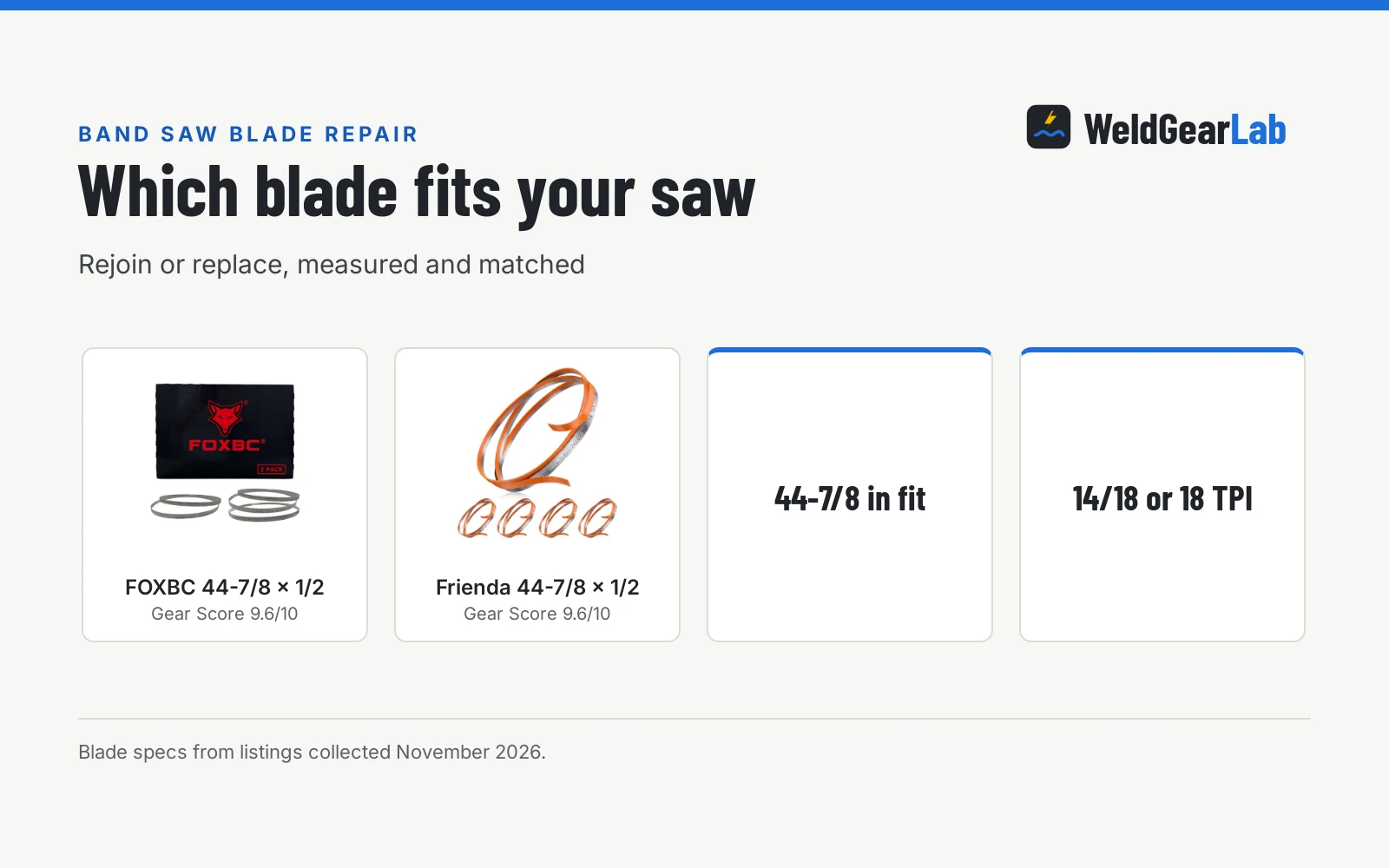
Fit a blade that matches the saw’s length and the work. The WEN BA3959 uses 59-1/2-inch blades from 1/8 to 3/8 inches in size, and includes a 1/4-inch-wide blade. The VEVOR 10-inch benchtop saw lists a sawblade length of 72.13 in. The Hoteche 7-1/2-inch saw (on Amazon) lists a 56-inch x 1/4-inch blade with 6 teeth per inch. The JET 14-inch saw runs 116-inch-long blades from 1/8 inch wide to 3/4 inch wide. Check the length and width the saw takes before ordering a blade. Loosen the tension, seat the blade on the wheels with the teeth pointing the right way, and tension it to the maker’s setting. The VEVOR portable lists a tool-free blade changing lever, and the DEWALT portable lists a blade tracking adjustment that increases blade life by providing better blade tracking.
Set the guides
Blade guides hold the blade steady at the cut. The JET saw lists independently adjustable ball-bearing blade guides. The KAKA BS-912B lists adjustable bearing blade guides. The WEN BA3959 lists an adjustable blade guard with ball-bearing supports. The DEWALT portable lists dual bearing blade guide rollers. Set the guides close to the work, with the guard low over the stock, and spin the wheels by hand to check that the blade tracks in the middle of the wheels before powering up.
Set the speed
Speed is set for the metal, and the makers list speeds for the saws below. The WEN BA4664 (on Amazon) adjusts to 80, 120 or 200 feet per minute. The Bucktool benchtop saw (on Amazon) adjusts from 137 to 472 FPM, and the VEVOR portable lists 137.8-472.4 ft/min. The KAKA BS-912B lists 4 blade speeds: 105, 197, 289 and 377 SFPM. The DEWALT portable lists a variable speed dial from 100 to 350 spm. The WEN BA3959 rotates the blade up to 2500 feet per minute. That is the top speed listed for that benchtop saw, not a metal-cutting speed: the metal saws here list speeds from 80 to 472 feet per minute. Pick the listed speed that matches the metal in the saw.
Set the table, fence and vise
The table, fence and vise hold the work square to the blade. The WEN BA3959 lists a work table that bevels up to 45 degrees, with a rip fence and a miter gauge. The Bucktool benchtop saw lists a work table sized 13-3/8 x 9-5/8 in, expandable to 13-3/8 x 11-3/4 in with the extension table. The VEVOR 10-inch saw lists a tilting table that can be adjusted from 0 to 45 degrees, with a sawtable size of 13.39 x 13.19 in. The KAKA BS-912B lists a mitering vise that rotates from 0 to 45 degrees, with capacity at 45 degrees of 6 in round and 5 x 6 in rectangular stock. Set the table square to the blade and hold the work firm, in the vise where the saw has one, before the cut.
Coolant, dust and shut-off
Heat and chips build up at the cut, and the makers list different answers. The KAKA BS-912B lists a built-in coolant system, and the KAKA BS-712N lists coolant control. The WEN BA4664 lists automatic shut-off that turns the band saw off after a cut has been completed, and the KAKA saws list automatic shut-off as well. The WEN BA3959 includes a 2-1/2-inch dust port, so a dust collector can be connected to keep the jobsite clean. Connect coolant and dust collection where the saw provides them.
Make a cut and check the setup
Clamp the work, keep guards in place, and keep gloves away from moving parts. Wear eye and face protection. Start the saw, let the blade reach speed, and feed at a steady pace, letting the blade do the cutting. Check the cut for square and for a clean edge, then adjust the guides, the fence or the speed if the cut wanders. A setup that cuts square is ready for the job on the bench.
Band saw safety. Eye and face protection, clamped work, guards in place and no gloves near rotating parts are the basics for saws. Keep the blade guard low over the stock, check the blade for damage before each cut, and clear flammable material from the area. See the OSHA machine guarding guide and the band saw safety tips guide.
FAQ for welders
What blade speed should a band saw run at for metal?
It depends on the saw and the metal. The WEN BA4664 adjusts to 80, 120 or 200 feet per minute, the Bucktool benchtop saw adjusts from 137 to 472 FPM, and the KAKA BS-912B lists 105, 197, 289 and 377 SFPM. Use the listed speed that matches the metal in the saw.
What size blade does a band saw take?
It depends on the saw. The WEN BA3959 uses 59-1/2-inch blades from 1/8 to 3/8 inches in size, the VEVOR 10-inch saw lists a sawblade length of 72.13 in, and the Hoteche saw lists a 56-inch x 1/4-inch blade. Check the length and width the saw takes before ordering.
Can a band saw cut metal and wood?
Some saws list both. The VEVOR portable lists cutting metal, steel, aluminum and composite cable, and the VEVOR 10-inch saw lists wood, metal, copper, aluminum and plastic. The JET 14-inch saw is built for wood and board, so check the listing for the materials it names.
How are the blade guides set?
Set them close to the work. The JET saw lists independently adjustable ball-bearing blade guides, the KAKA BS-912B lists adjustable bearing blade guides, and the DEWALT portable lists dual bearing blade guide rollers. Spin the wheels by hand and check that the blade tracks in the middle of the wheels.
Does a band saw need coolant?
It depends on the saw. The KAKA BS-912B lists a built-in coolant system, and the KAKA BS-712N lists coolant control. The other saws listed here do not list coolant, so check the listing for the saw in use.
Related: types of band saws, types of band saw blades, uses for portable band saw, manual horizontal band saw, and the metal fab tools hub.