120v vs 240v Plasma Cutter: Which One Should You Buy?
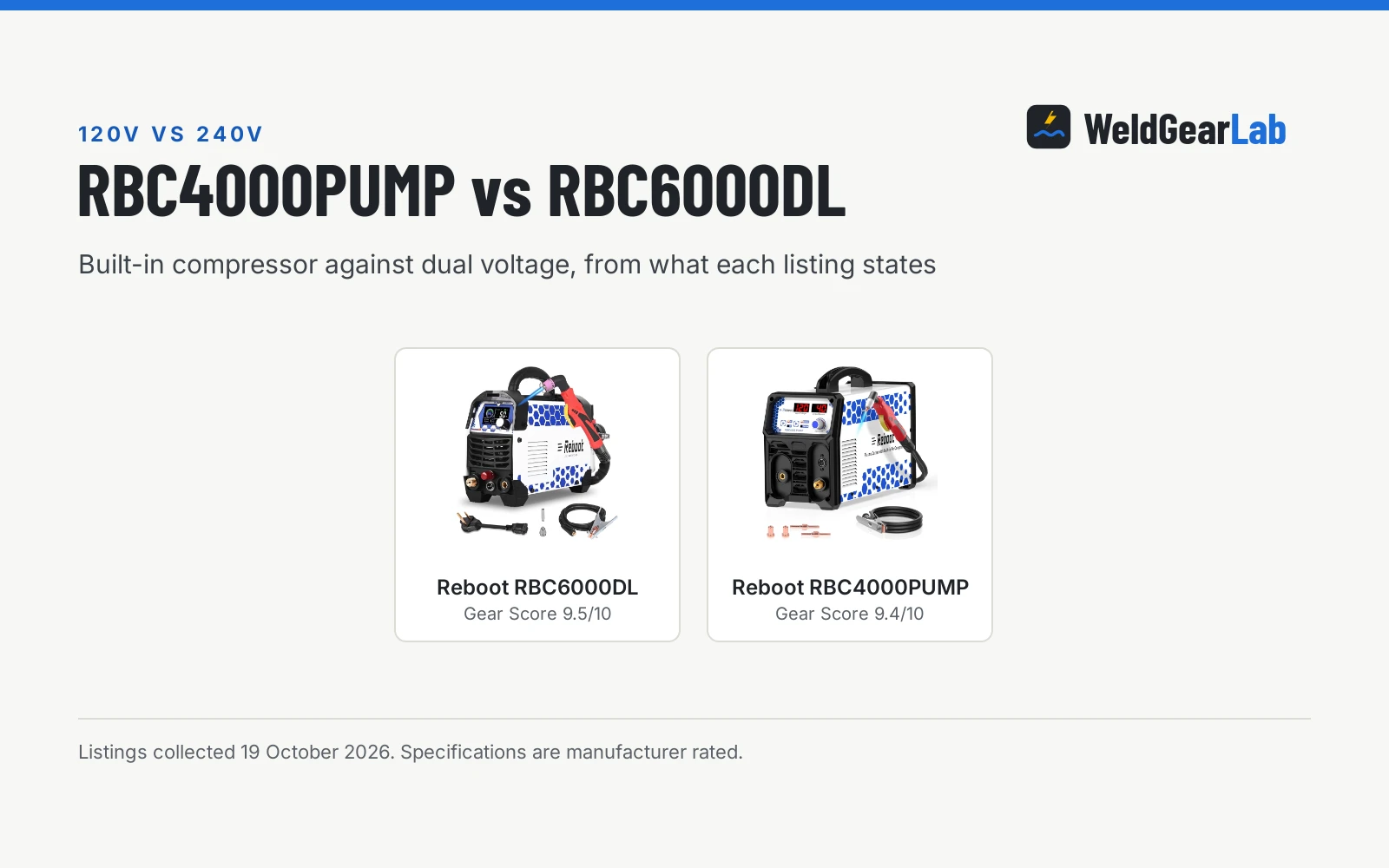
Reboot's RBC4000PUMP 120V plasma cutter with a built-in compressor against the dual-voltage RBC6000DL: compared on output, cut thickness, air supply and weight, from what each listing states.

On this page
Top picks at a glance
As an Amazon Associate I earn from qualifying purchases.
- 1
 Reboot Plasma Cutter, 2025 Upgraded 60Amps Cutter9.5/10View on Amazon
- 2
 Reboot Plasma Cutter With Built In Air Compressor9.4/10View on Amazon
Verdict. The 120v vs 240v plasma cutter question comes down to what your outlet and air supply look like. The Reboot RBC6000DL runs on both voltages and cuts thicker stock on 240V, but it needs an external air compressor and a 240V circuit with a 30A+ breaker for its best numbers. The Reboot RBC4000PUMP is the simpler 120V-only option with the compressor built in: set it down, plug it in, start cutting, as long as 40A output and a 3/8 in clean cut cover your work.
You are facing a repair or a fab job, a stack of plate on the bench, and one question first: what does your power look like? If you only have standard 120V outlets, that answers half the question. If you have a 240V circuit and a compressor in the shop, it opens the other half. This comparison puts the Reboot RBC4000PUMP, the 120V example with a built-in compressor, against the Reboot RBC6000DL, the dual-voltage 120/240V example, on what each listing states.
WeldGearLab gets a commission on purchases made through links on this page, and your price stays the same. Read our affiliate disclosure.
The two machines

Reboot Plasma Cutter, 2025 Upgraded 60Amps Cutter
A dual-voltage 120/240V plasma cutter rated 10 to 60A on 240V, with a 1/2 in clean cut, non-touch high frequency arc start and an AG60 torch; needs an external air compressor.
Pros
- Dual voltage 120/240V; on 240V it runs 10 to 60A with a 1/2 in clean cut and 4/5 in maximum cut
- Non-touch high frequency arc start, rated for rough, painted and rusty stock with minimal slag
- 16.52 lb listed weight with a 17 by 10.75 by 9.75 in package
- Pre-installed air filter regulator for the airtight setup the maker describes
Cons
- Needs an external air compressor sized to 90 PSI, 250L/min, 2.2 kW and above, not in the box
- Full 10 to 60A output and 1/2 in clean cut need 240V and a 30A+ breaker
- No duty cycle stated at any amperage
- No warranty term stated

Reboot Plasma Cutter With Built In Air Compressor
A 40A, 120V plasma cutter with a built-in air compressor, rated for a 3/8 in clean cut and a 3/5 in maximum cut; plug-and-play setup with no external air equipment.
Pros
- Built-in air pump: no external compressor, hoses or pressure adjustments
- 120V plug-and-play operation the listing describes as beginner friendly
- 40A output rated for a 3/8 in clean cut and a 3/5 in maximum cut
- Self-contained compact design for job sites and small shops
Cons
- 120V only, no 240V option for thicker stock
- 30.5 lb listed weight, heavier than the dual-voltage example
- Needs a 50A+ breaker on 120V, not a standard household circuit
- No duty cycle and no warranty term stated
Other welders and gear to compare
 Reboot 60A Plasma Cutter Dual Voltage 120V/240VCheck price on Amazon
 FLARING Plasma CutterCheck price on Amazon
 Hobart AirForce 40i Plasma Cutter 500576Check price on Amazon
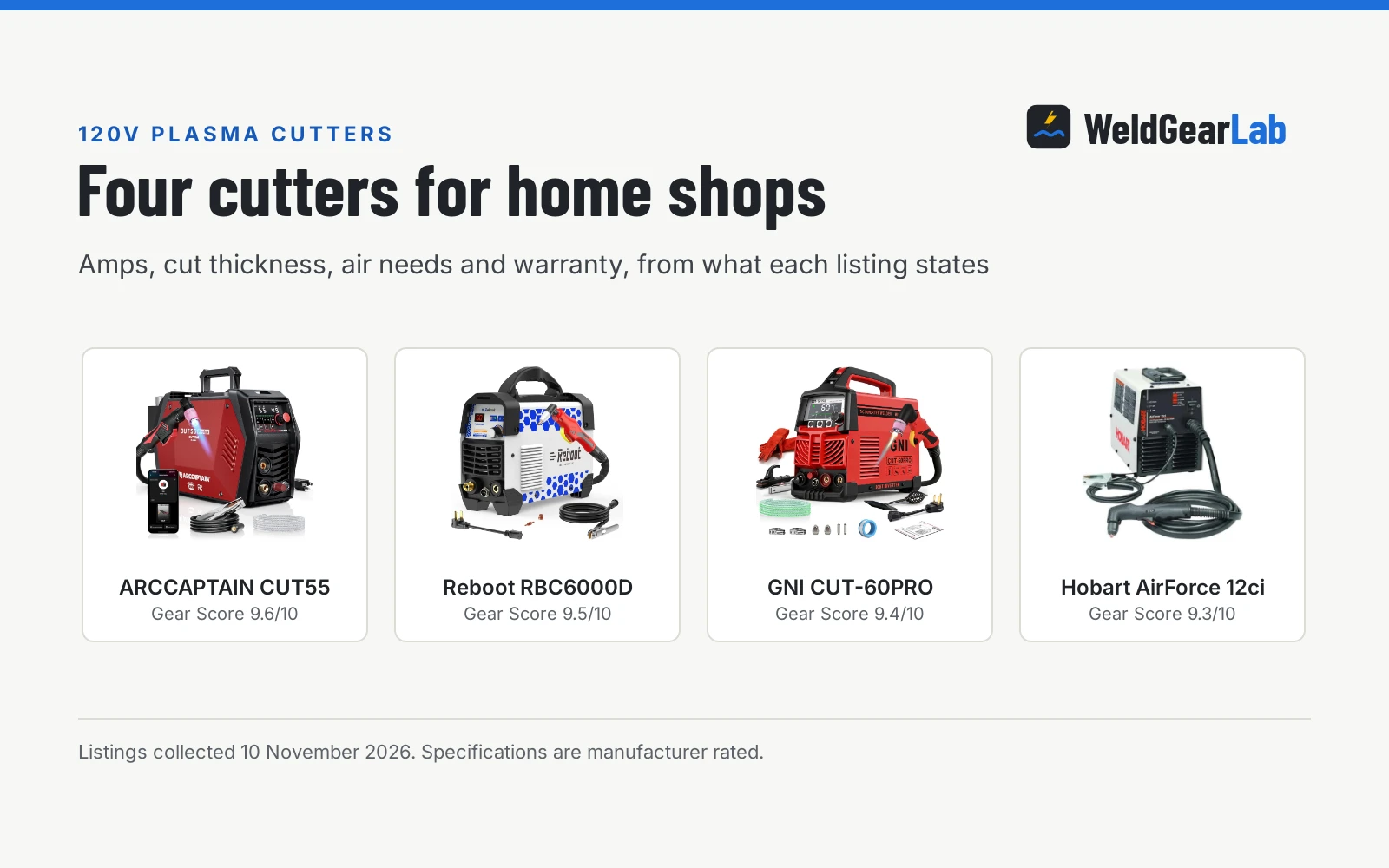
 Hobart AirForce 12ci Plasma Cutter 120V with Built-In AirCheck price on Amazon
 Miller 907757 Multimatic® 220 AC/DC Multiprocess WelderCheck price on Amazon
120v vs 240v plasma cutter: side by side
| Reboot RBC6000DL | Reboot RBC4000PUMP | Difference | |
|---|---|---|---|
| Gear Score | 58 | 53 | RBC6000DL higher |
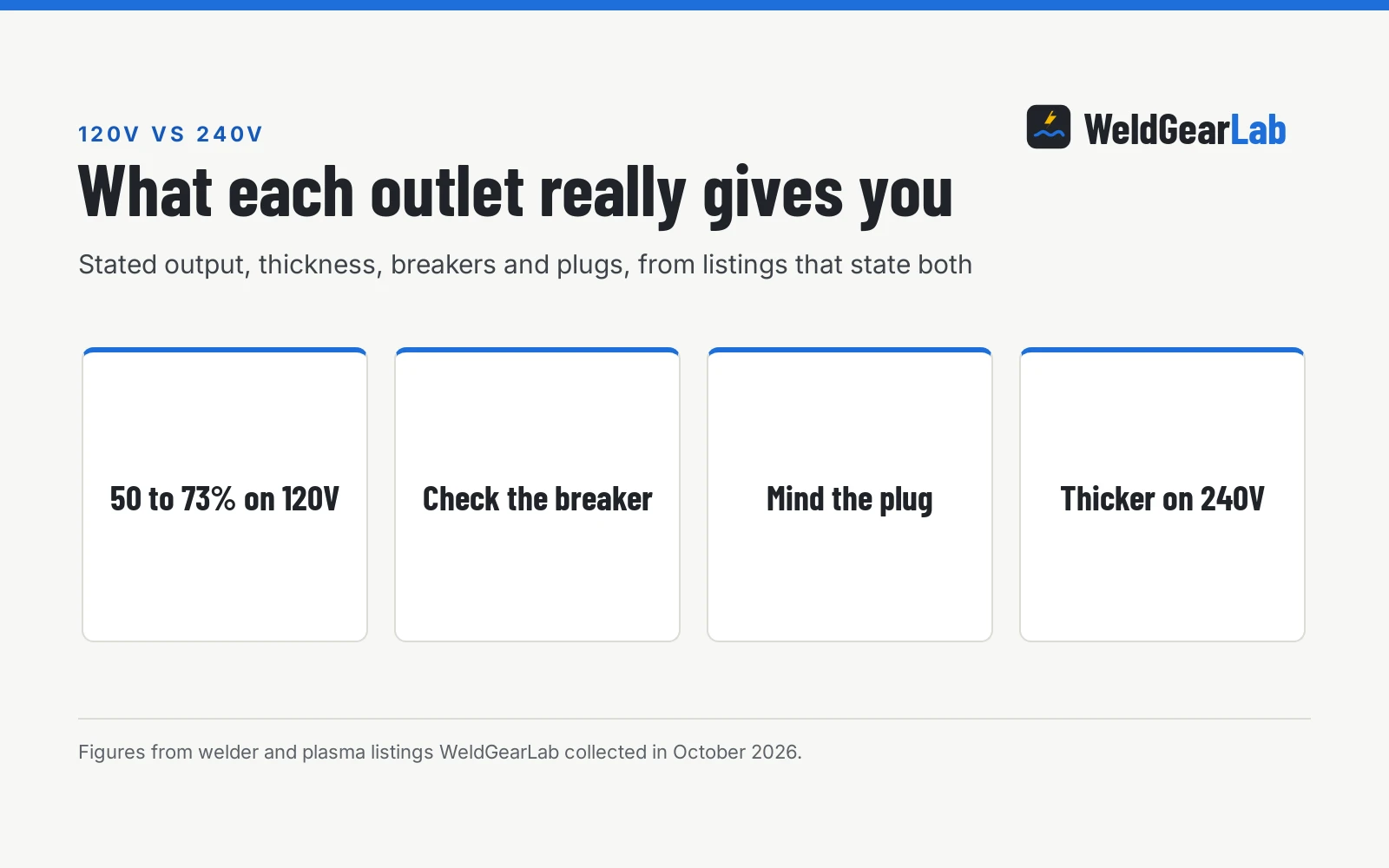
| Input | 120/240V dual voltage | 120V only | Dual voltage only on RBC6000DL |
| Output | 10 to 60A on 240V; 10 to 35A on 120V | 40A | 60A top on 240V vs 40A |
| Clean cut | 1/2 in on 240V; 3/8 in on 120V | 3/8 in | 1/2 in vs 3/8 in on 240V |
| Maximum cut | 4/5 in on 240V; 1/2 in on 120V | 3/5 in | 4/5 in vs 3/5 in |
| Air supply | External compressor required; 90 PSI, 250L/min, 2.2 kW and above; 30 to 60 PSI operating | Built-in air pump, no external compressor | Built-in vs external |
| Arc start | High frequency, non-touch | High frequency | Non-touch vs high frequency |
| Breaker | 50A+ on 120V; 30A+ on 240V | 50A+ on 120V | 30A+ on 240V vs 50A+ only |
| Weight | 16.52 lb | 30.5 lb | 16.52 lb vs 30.5 lb |
| Duty cycle | Not stated | Not stated | Neither stated |
| Warranty | Not stated | Not stated | Neither stated |
Ratings in this table are the makers’ own claims taken from each product page (19 October 2026). Neither listing states a CSA, UL or ETL listing, a duty cycle, or a warranty term.
Power and output
The RBC4000PUMP is a 120V-only machine rated at 40A. The RBC6000DL is dual voltage: on 240V it runs 10 to 60A DC output, and on 120V it runs 10 to 35A. Both are IGBT inverter machines, and both listings describe high frequency arc starting. The gap on the top end between 40A and 60A is the real separator: it is what lets the dual-voltage example claim thicker clean cuts. See our amperage vs thickness chart for how output maps to plate.
Cut capacity
Both listings state clean cut and maximum cut figures, so this spec can be compared directly. The RBC4000PUMP is rated for a 3/8 in clean cut and a 3/5 in maximum cut on 120V. The RBC6000DL on 240V is rated for a 1/2 in clean cut and a 4/5 in maximum severance cut; on 120V those drop to a 3/8 in clean cut and a 1/2 in maximum. Neither listing states a pass count, so treat the top figures as needing clean conditions and the right speed. On 120V alone, both examples are rated for the same 3/8 in clean cut, which is worth noting: the 240V advantage only exists when you actually feed it 240V.
Air supply
This is the biggest setup difference. The RBC4000PUMP has the air pump built in: no external compressor, no hoses, no pressure adjustments, per the listing. The RBC6000DL needs your compressor: the listing calls for 90 PSI, 250L/min, 2.2 kW and above, with an operating range of 30 to 60 PSI, and it ships with a pre-installed air filter regulator for what the maker calls an airtight setup. Our built-in vs external compressor guide walks through the tradeoffs in detail. If you already own a compressor sized to those figures, the dual-voltage example costs you nothing extra in air; if you do not, the 120V example removes a whole purchase from the job.
Arc start
Both are high frequency machines. The RBC6000DL is specifically non-touch: the torch head does not need to touch the plate, and the listing says it cuts rough, painted and rusty surfaces with minimal slag, which suits farm and repair work where the metal is never clean. The RBC4000PUMP listing describes high frequency starting without the non-touch detail. Our arc start explainer covers the difference.
Breakers and circuits
The RBC4000PUMP listing recommends a 50A+ breaker for its 120V input. The RBC6000DL recommends a 50A+ breaker when run on 120V and a 30A+ breaker when run on 240V. Note the point: on 120V, both examples call for a 50A+ breaker, so neither one is a plug-into-the-garage-wall machine. The dual-voltage example’s 240V side actually asks for less breaker on paper, which is one of the quiet benefits of stepping up the voltage.
Weight and what is in the box
The RBC4000PUMP lists at 30.5 lb with package dimensions of 21 by 15.7 by 11.1 in; the compressor inside accounts for the weight. The RBC6000DL lists at 16.52 lb with package dimensions of 17 by 10.75 by 9.75 in, lighter because the air supply is somebody else’s job. The dual-voltage example names an AG60 cutting torch and upgraded electrodes in the listing, with the maker claiming 25% more cutting power than standard 50-amp models; that percentage is the maker’s claim, not a measured comparison. The 120V example’s included components list names only the machine itself.
Choose the Reboot RBC6000DL if
- You have a 240V circuit and want the 1/2 in clean cut it gives on 240V.
- You already own a compressor rated to the stated 90 PSI, 250L/min, 2.2 kW figures.
- You cut rusty, painted or rough stock and want the non-touch arc start.
- You want one machine that also works on 120V at reduced output.
Choose the Reboot RBC4000PUMP if
- You have only 120V outlets and no compressor to spare.
- You want the simplest setup: machine, power cord, cut.
- Your stock stays at or under a 3/8 in clean cut.
- You carry the cutter to jobs, where built-in air beats hauling a compressor.
FAQ for welders
Can the RBC6000DL run on a normal 120V outlet?
It runs on 120V at 10 to 35A, with a 3/8 in clean cut and a 1/2 in maximum, but the listing recommends a 50A+ breaker for 120V use. That is not a standard household circuit, so plan the electrical supply before you buy.
Does either machine come with an air compressor?
The RBC4000PUMP has the compressor built in. The RBC6000DL needs an external compressor sized to the stated figures: 90 PSI, 250L/min, 2.2 kW and above, operating at 30 to 60 PSI.
How thick can each machine cut?
The RBC4000PUMP is rated for a 3/8 in clean cut and a 3/5 in maximum cut. The RBC6000DL is rated for a 1/2 in clean cut and a 4/5 in maximum on 240V, dropping to 3/8 in clean and 1/2 in maximum on 120V.
Which one is easier to carry to a job?
The RBC6000DL lists at 16.52 lb against 30.5 lb for the RBC4000PUMP, but the lighter machine needs a compressor wherever it works. For field work without shop air, the heavier self-contained unit is the practical pick.
Does either listing state a duty cycle or warranty?
No. Neither listing states a duty cycle at any amperage or a warranty term, so both earn no points for those in the Gear Score.
Related: built in vs external compressor, amperage vs thickness chart, and our best home hobby plasma cutter picks.
Scoring, line by line
Both machines are scored out of 10 on performance, build, value, safety listing and warranty, with the weights published on our How We Pick page.
| Product | Gear Score | Perf. /35 | Build /25 | Value /25 | Safety /10 | Warranty /5 |
|---|---|---|---|---|---|---|
| Reboot RBC6000DL | 9.5 | 30 | 20 | 20 | 0 | 0 |
| Reboot RBC4000PUMP | 9.4 | 26 | 19 | 20 | 0 | 0 |
The lowest score we show is 9.2 and the highest is 9.8; every point total is spread proportionally across that span, so extra points mean a higher figure.
Before you strike an arc. Wear a helmet with the right shade for the process and amperage, safety glasses underneath, leather gloves and flame resistant clothing. Weld and cut with good ventilation, clear anything flammable from the area, and keep an extinguisher close. Plug each machine into a circuit and breaker sized for its stated input, as the manual specifies. Size your compressor to the numbers the RBC6000DL listing states, 90 PSI, 250L/min, 2.2 kW and above, and run it in the 30 to 60 PSI operating range. See the OSHA welding overview and our Safety Disclaimer.