Parts of a MIG Welder Explained
A MIG welder is a set of parts that work together: a power source, a wire feeder, a gun, a ground clamp, a gas system and consumables, each with one job to do.


On this page
Top picks at a glance
As an Amazon Associate I earn from qualifying purchases.
- 1
 035" V Groove Drive Roll Kit Compatible with Miller9.6/10View on Amazon
- 2
 Hobart Handler 125 Flux-Core Wire Feed Welder9.5/10View on Amazon
- 3
 Forney 271 Easy Weld 140 MP Multi-Process Welder9.5/10View on Amazon
A cracked trailer bracket, a gate hinge that has pulled loose, a patch panel that needs stitching back into a fender. The job on the bench decides what the machine has to do, and the machine is a set of parts that each do one job. The parts of a MIG welder are the power source, the wire feeder, the MIG gun, the ground clamp, the gas system and the consumables inside the gun, and this guide walks through each one in the order the wire and the current travel.
This guide links to our product roundups, where WeldGearLab gets a commission on purchases made through links on this page, and your price stays the same. Read our affiliate disclosure.
Parts of a MIG welder at a glance
| Part | What it does | What wears out | Check before welding |
|---|---|---|---|
| Power source | Turns wall power into welding current and sets voltage | Cooling fans | Fan vents clear and power switch off before moving leads |
| Wire feeder | Pushes wire from the spool through the gun at a set speed | Drive rolls | Wire size matches the drive roll groove |
| MIG gun | Carries wire, gas and current to the joint | Contact tip, nozzle and liner | Tip tight, nozzle clean, liner straight |
| Ground clamp | Returns current from the work to the machine | Clamp jaws and cable | Clamp bites clean metal, cable undamaged |
| Gas system | Shields the puddle from air on gas MIG | Hose and regulator seals | Hose seated, cylinder held upright |
| Consumables | Parts that guide wire, carry current and direct gas | Contact tips first | Spares on hand before starting |
The power source
The power source is the box the rest of the machine hangs off. It takes power from the wall and turns it into the current and voltage the arc needs. Dual voltage machines switch between household and shop power: the ARCCAPTAIN MIG205PCT (on Amazon) runs on 120/240V and the BESTMIG 145A on 110/220V. The ARCCAPTAIN lists MIG at 30-205A, DC TIG and MMA at 20-205A, and cutting at 20-50A, with a rated duty cycle of 60%. The BESTMIG 145A is the 4-in-1 machine of the pair, named for its 145A figure. The ARCCAPTAIN uses dual cooling fans and carries 3 years of quality service.
The wire feeder and drive rolls
On a standard MIG setup, the wire feeder lives inside the machine case. A motor turns drive rolls that grip the wire and push it from the spool to the contact tip. The drive roll groove has to match the wire diameter. The BESTMIG 145A lists solid wire at .030 inch and flux-cored wire at .030 and .040 inch, and its box includes V and W shaped wire feed wheels. A spool gun is a separate feeder for soft aluminum wire: the ARCCAPTAIN lists spool gun aluminum welding as one of its 8 modes, with the spool gun sold separately. When wire slips or stutters, the feeder is the first place to look: see the guide to MIG welder wire feed problems and the MIG wire feeder parts guide.
The MIG gun: handle, neck, nozzle, contact tip and liner
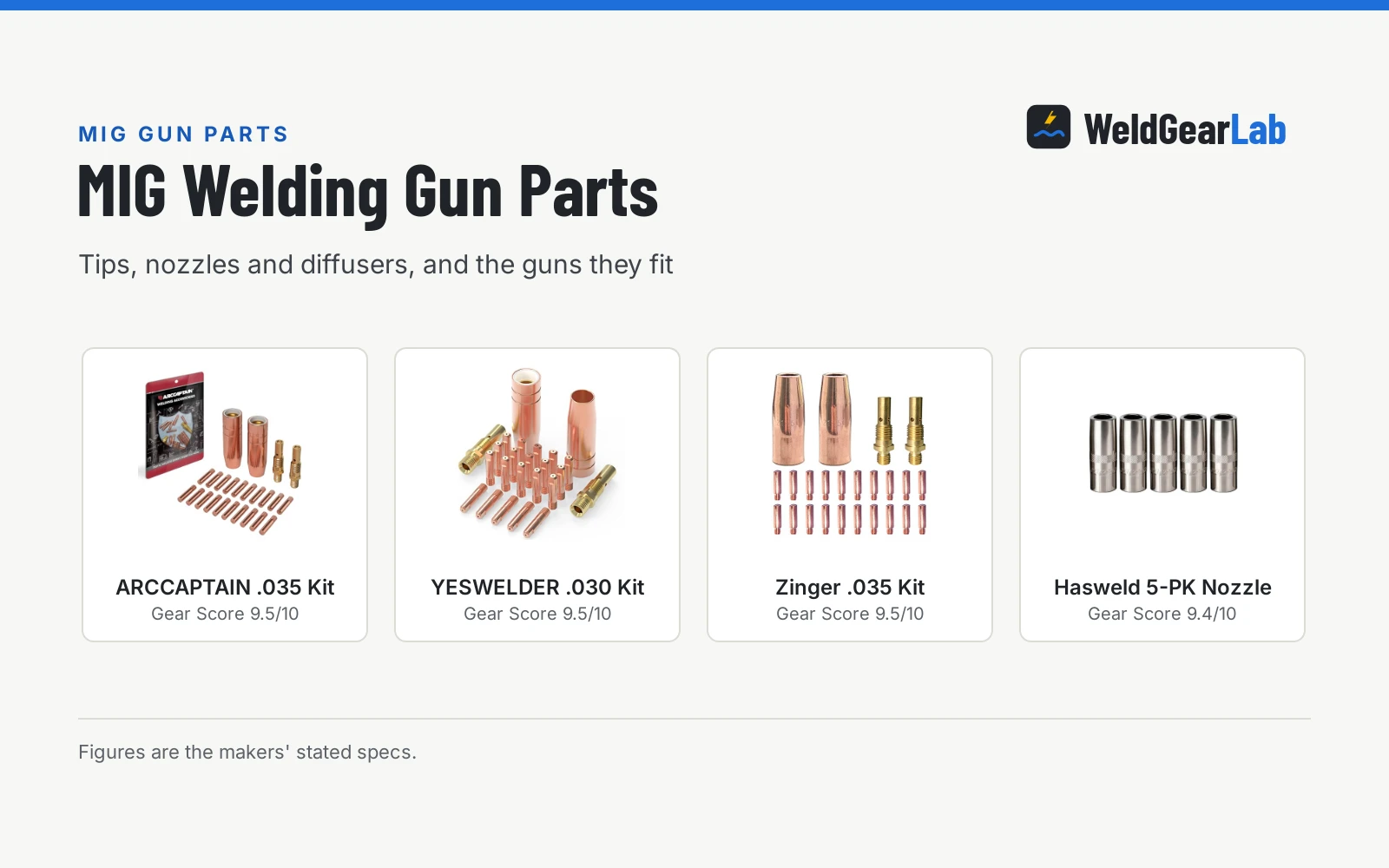
The gun is the part you hold, and it carries wire, shielding gas and current to the joint at once. The trigger starts and stops the wire feed, the neck angles the tip toward the joint, and the nozzle shapes the gas flow around the puddle. The contact tip is the small copper piece the wire passes through, and it sets the electrical contact point. A kinked or dirty liner feeds wire unevenly. Tips, nozzles and liners are consumables, sized to the wire and simple to keep as spares, so a tip made for .040 inch wire will not feed .030 inch wire cleanly. The MIG welding gun parts guide names each piece, and the contact tip guide covers when to swap them.
The ground clamp and work lead
The ground clamp, also called the work clamp, closes the circuit. Current flows from the machine, through the gun and arc, into the work, and back through the clamp and work lead. A clamp that bites rust, paint or mill scale gives a poor return path, so clamp to clean metal close to the joint. The BESTMIG 145A box includes a ground clamp, an electrode holder and a MIG torch. The ARCCAPTAIN lists VRD functionality, which lowers voltage at the terminals when the machine is idle. Keep the cable clear of the weld area and sharp edges.
The gas system: cylinder, regulator, hose and solenoid
Gas MIG shields the puddle with gas from a cylinder. The cylinder holds the gas, the regulator drops the pressure, and a solenoid valve opens the flow when you pull the trigger. Self-shielded flux core wire needs no gas: the flux inside the wire makes its own shield, so gasless machines skip the cylinder, regulator and hose entirely. The ARCCAPTAIN runs gas MIG and gasless MIG among its 8 modes, and the BESTMIG runs gas and gasless flux core in its 4-in-1 set. The guide to MIG welding gas covers which gas suits steel, stainless and aluminum.
Consumables and spares to keep on hand
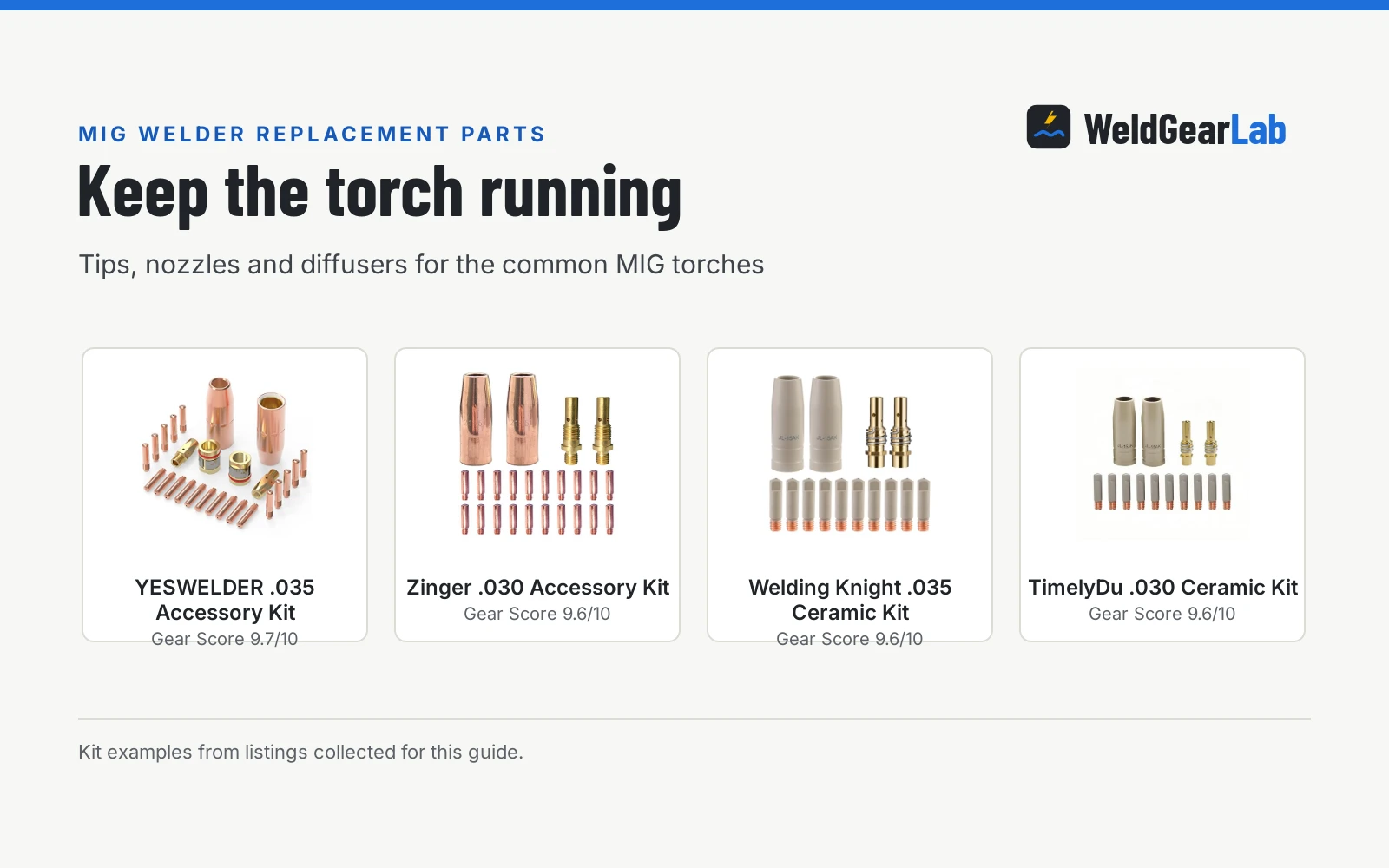
Contact tips wear first, then nozzles, then liners. Tips are sized to the wire diameter: .030 inch and .040 inch cover the wire the BESTMIG lists. Nozzles pick up spatter and need cleaning or swapping when gas flow goes ragged. Liners last longer but a kinked liner feeds wire in fits and starts. Keep spare tips, a spare nozzle and a spare liner in the shop, and check the MIG welder replacement parts guide before ordering, since tips and nozzles differ by gun brand and thread.
How the parts work together
Pull the trigger and the parts move in order. The solenoid opens the gas flow, the feeder motor turns the drive rolls, wire runs out of the contact tip, and current flows from the power source through the tip into the wire. The arc melts wire and base metal into a puddle, the gas shields it, and the ground clamp carries current back to the machine. Release the trigger and the wire stops, the gas shuts off, and the puddle freezes into the bead. When a weld goes wrong, walk the chain backward: gas, wire feed, tip, ground, then settings. If you are shopping for a machine, the best flux core welder guide compares machines by the parts above.
FAQ for welders
Do all MIG welders need a gas cylinder?
No. Gas MIG needs a cylinder, regulator and hose, but self-shielded flux core wire makes its own shield and runs with no gas. The ARCCAPTAIN lists gas MIG and gasless MIG among its 8 modes, and the BESTMIG runs gas and gasless flux core. For outdoor work or rusty steel, self-shielded flux core is the simpler setup, and the gasless vs gas MIG welder guide compares gas and gasless.
What parts wear out soonest on a MIG welder?
Contact tips wear first, since the wire passes through them on every weld and the arc heats them. Nozzles come next, as spatter builds up inside them and disturbs the gas flow. Liners and drive rolls last longer but still wear, and a worn liner or wrong groove size shows up as uneven feeding. Keep spare tips and a spare nozzle in the shop.
What wire sizes do these machines run?
The BESTMIG 145A lists solid wire at .030 inch and flux-cored wire at .030 and .040 inch. The ARCCAPTAIN lists spool gun aluminum welding as one of its 8 modes, with the spool gun sold separately. Match the contact tip, drive roll groove and liner to the wire diameter, and check the wire size guide before ordering.
What thickness figures do the listings state?
Thickness depends on the machine, the process and the joint, and the listings state it differently. The ARCCAPTAIN lists cutting thickness at quality 10mm (3/8 inch) and maximum 18mm (2/3 inch), with cutting current at 20-50A. The BESTMIG lists mild steel up to 3mm (2/5 inch) thick. Check the machine manual and door chart for settings on your metal and thickness.
Can one machine weld aluminum?
Yes, with the right setup. The ARCCAPTAIN lists spool gun aluminum welding as one of its 8 modes, with the spool gun sold separately, and it runs on 120/240V with MIG current at 30-205A. Aluminum needs a spool gun or push feed setup and argon gas, and flux core cannot weld aluminum. Check the manual for the wire, gas and polarity your machine calls for.
Related: how to choose a MIG welder, MIG welding for beginners, MIG welder set up, and the welders hub. Also see the MIG welders hub.