MIG Wire Feeder Parts: Drive Rolls, Liners and Guns
Drive rolls, liners, contact tips and guns are the wear parts that feed MIG wire, and this guide explains what each one does and how to match it to your wire.

On this page
Top picks at a glance
As an Amazon Associate I earn from qualifying purchases.
- 1
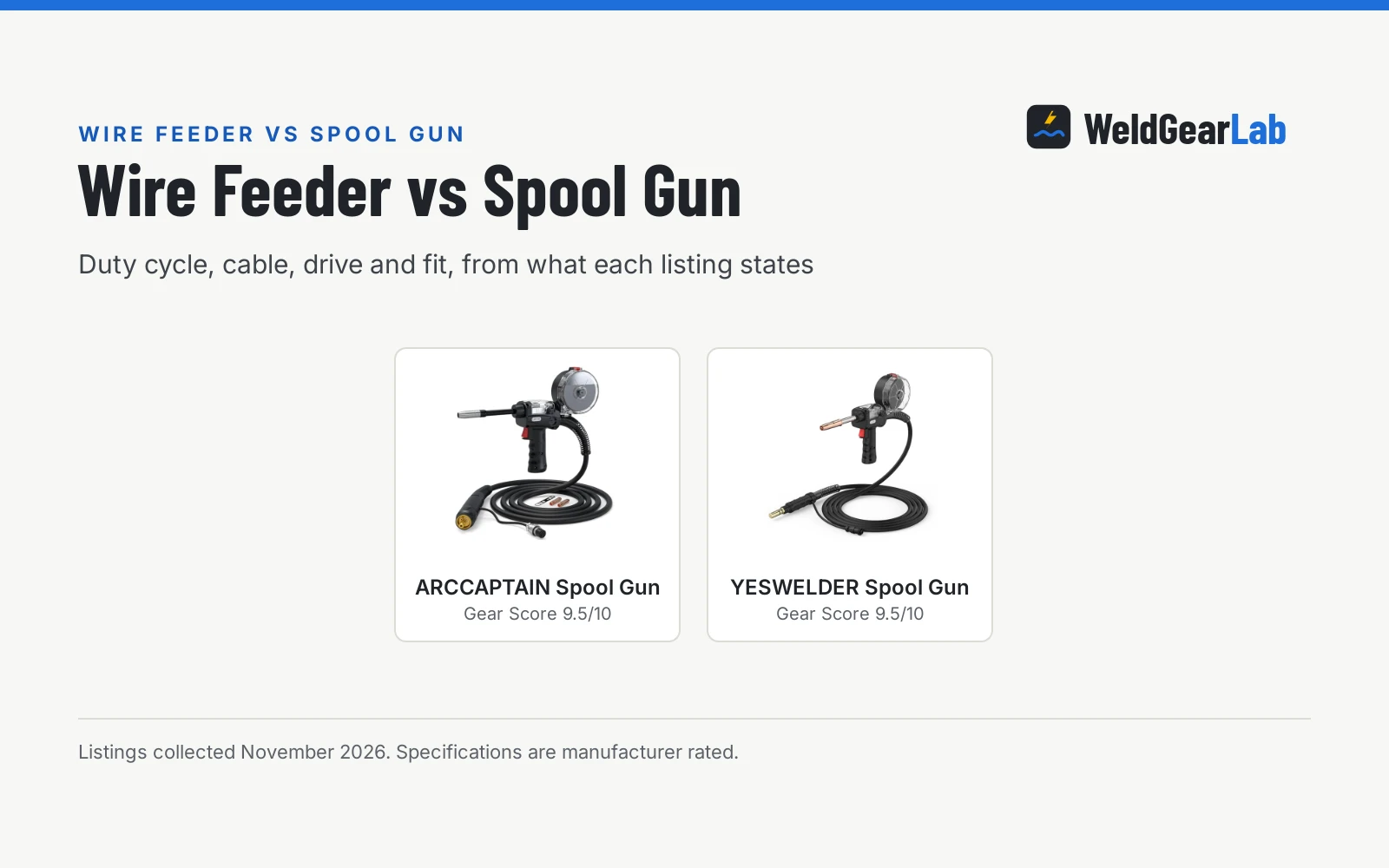
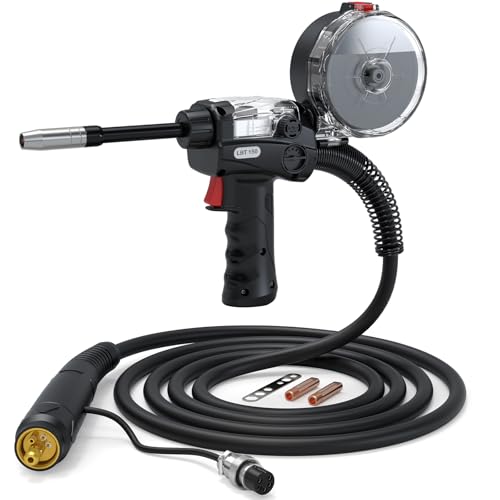 ARCCAPTAIN Spool Gun 5-Pin for Aluminum Welding 150A Euro9.5/10View on Amazon
- 2
 YESWELDER 150A Spool Gun9.5/10View on Amazon
MIG wire feeder parts move wire from the spool to the gun: drive rolls grip the wire, the liner guides it through the cable, the contact tip passes current to it, and the gun puts it where the weld goes. When wire slips, nests up or feeds in jerks, one of those parts is usually worn, dirty or matched to the wrong wire size. This guide walks through each part, what it does, and how to match it to your wire.
This guide links to our product roundups, where WeldGearLab gets a commission on purchases made through links on this page, and your price stays the same. Read our affiliate disclosure.
What MIG wire feeder parts do
The feed path starts at the spool, where wire leaves the reel and enters the drive housing. Drive rolls pinch the wire between them and push it forward into the liner, a tube that runs inside the gun cable and guides the wire to the gun. At the end of the gun, the contact tip touches the wire and passes welding current into it, so the arc forms at the wire end. Every part in that path has to match the wire size, or the feed turns rough.
Drive rolls: the part that grips the wire
The drive roll is a small wheel with a groove cut around its edge, and the groove is what grips the wire. Groove styles in the listings here include a smooth V-groove for solid wire, a knurled K-groove for gasless flux-cored wire, and a smooth groove for solid wire. The V-groove listings cover solid wire from .023 to .045 inch, while the knurled rolls cover flux-cored wire from 0.6 to 0.8 mm and the smooth groove rolls cover 0.6 to 0.8 mm. Match the groove to the wire on the spool, not to the machine brand.
Rolls also differ in size and center. The VILLCASE rolls (on Amazon) measure 0.94 by 0.94 by 0.27 inches, with a 7 mm square center and a 24 mm outside diameter. The Auto-plaza SSJ16 rolls (on Amazon) measure 25 mm across with a 7 mm square center, and the SSJ-29A rolls measure 30 mm across with a 10 mm center. The Moryzian rolls (on Amazon) measure 1.2 inches across with a .40 inch center bore. A roll only fits when its center matches the drive shaft, so measure the shaft before you order.
Some rolls carry two grooves, one on each face, so you flip the roll over to change wire size. The Dimakung roll (on Amazon) is one of those: one groove takes .023 to .025 solid wire and the other takes .030 to .035 solid or flux-cored wire. The Zorqon kit (on Amazon) pairs its roll with a guide tube and fits Lincoln Power MIG 216, 255XT and 350MP machines, along with the LN-15, Power Feed 25M, LF-72 and LN-25 PRO feeders.
Groove types side by side
| V-groove drive roll | Knurled K-groove drive roll | Smooth groove drive roll | |
|---|---|---|---|
| Wire it suits | Solid wire | Gasless flux-cored wire | Solid wire |
| Wire sizes in the listings | .023 to .045 inch | 0.6 to 0.8 mm | 0.6 to 0.8 mm |
| Grip | Smooth V shape holds the wire | Knurling grips flux-cored wire | Smooth surface, steady feed |
| Example fit | Lincoln Power MIG and Weld-Pak machines | SSJ16 wire feeder machines | SSJ16 wire feeder machines |
When the groove and the wire disagree, the roll either slips on hard wire or crushes soft wire. Knurled rolls bite into flux-cored wire without flattening it, while a smooth V-groove holds solid wire with steady pressure. If the feed stutters on a new roll, check the groove against the wire size on the spool label first.
Liners, contact tips and the gun
Past the rolls, the liner carries the wire through the gun cable to the gun. A liner that is kinked, clogged with dust or cut short lets the wire drag, so the feed stutters even with a good roll. The contact tip at the end of the gun is the last part the wire touches before the arc, and a worn tip makes the arc wander. The gun itself holds the liner, the tip and the trigger together, and the Zorqon kit shows how the small parts travel together by including a guide tube with its roll.
Match the roll to your feeder
Start with the feeder, not the wire. The listings here name the feeders they fit: SSJ16 and SSJ-29A wire feeder machines, Lincoln Weld-Pak 100, 100HD, 125, 155, 175HD, 3200HD and 5000HD welders, Lincoln Power MIG 140C, 140T, 180C, 180T and 180 Dual machines, and Lincoln SP-140T, SP-180T, MIG Pak 140, MIG Pak 180, Pro-MIG 140, Pro-MIG 180, Weld-Pak 125HD, 140HD and 180HD machines. The Moryzian rolls fit MIG 100/130/160/180/200 machines, and the Chicago Electric rolls fit Chicago Electric kits.
Then match the center and the wire size. A 7 mm square center fits a square drive shaft, a 10 mm round center fits a round shaft, and a .40 inch bore fits its own shaft size. Rolls come in packs of two in several listings here, so a spare is on hand when the groove wears. See our best flux core welder guide and our best welder for beginners guide for machines that use these rolls.
When to swap a worn part
Swap the roll when the wire slips under load, when the feed surges and slows, or when the groove looks polished and shallow next to a new roll. Clean the liner when the wire drags, and check the contact tip when the arc wanders or the wire sticks at the tip. Keep a spare roll and a spare tip in the shop, since both are wear parts and both are worth keeping on hand.
Feeder safety. Unplug the machine before you open the drive housing or change a roll, and keep your hands clear of the rolls while the machine is powered. Welding fumes need ventilation, so weld outdoors or with the shop door open and your head out of the plume, and clear anything flammable from the area. See the OSHA welding overview.
FAQ for welders
What does a MIG wire feeder drive roll do?
The drive roll grips the wire and pushes it from the spool into the liner. Its groove matches the wire size, so the roll feeds the wire at a steady pace without slipping or crushing it. When the groove wears, the feed turns rough and the weld suffers.
Which groove do I need for flux-cored wire?
Use a knurled K-groove roll for gasless flux-cored wire. The VILLCASE rolls use a knurled K-groove for 0.6 and 0.8 mm flux-cored wire, and the Auto-plaza SSJ-29A rolls use a knurled groove at the same sizes. Solid wire runs on a smooth V-groove or a smooth groove instead.
Can I flip a drive roll to use a different wire size?
Some rolls carry a groove on each face, and the Dimakung roll is one of them: one groove takes .023 to .025 solid wire and the other takes .030 to .035 solid or flux-cored wire. Flip the roll over to change sizes, and check that the groove matches the wire on the spool.
How do I know which drive roll fits my welder?
Match the feeder model, the center size and the wire size. The listings here name their fits, from SSJ16 and SSJ-29A feeders to Lincoln Weld-Pak and Power MIG machines, and they state centers of 7 mm square, 10 mm and .40 inch. Measure the drive shaft and check the wire size before you order.
Do drive rolls wear out?
Yes. The groove wears smooth with use, and a worn groove slips on the wire instead of gripping it. When the feed slips or surges, swap in a spare roll. Rolls come in packs of two in several listings here, so a spare is easy to keep on hand.
Related: MIG welder wire feed problems, MIG welding gun parts, MIG welding contact tips, MIG welder replacement parts, and the MIG welders hub and the welders hub. Also see our MIG welding wire size guide.