Flux Core Welding Wire Types: Gasless and Gas-Shielded
Flux core wire shields its own weld with flux, and the types differ by shielding, passes and size: gasless E71T-GS and E71T-11, plus gas-shielded wire.

On this page
Top picks at a glance
As an Amazon Associate I earn from qualifying purchases.
- 1
 ARCCAPTAIN Flux Core Welding Wire E71T-GS .035" 2LB x 1 Mild9.5/10View on Amazon
- 2
 TOOLIOM E71T-GS .035" Gasless Flux Core Welding Wire 10LB9.4/10View on Amazon
- 3
 3 Packs 2-Pound 035 Flux Core Welding Wire9.4/10View on Amazon
A gate hinge has cracked off its post, the steel is rusty, and the wind keeps moving across the yard. The repair needs a weld that holds, and it needs wire that shields its own puddle, with no cylinder to drag along and no hose to snag on the fence. Flux core welding wire types answer that job, and the choice comes down to how each wire shields the molten metal, what kind of passes it suits, and what size it runs.
This guide links to our product roundups, where WeldGearLab gets a commission on purchases made through links on this page, and your price stays the same. Read our affiliate disclosure.
Flux Core Welding Wire Types at a Glance
Flux core wire is hollow, with flux packed inside the steel sheath. As the wire melts, the flux burns and forms shielding gas around the puddle, then leaves a layer of slag on the bead. That flux is what sets flux core apart from solid MIG wire, which needs gas from a cylinder to shield the puddle. Read what flux core wire is for the full picture of how the wire works.
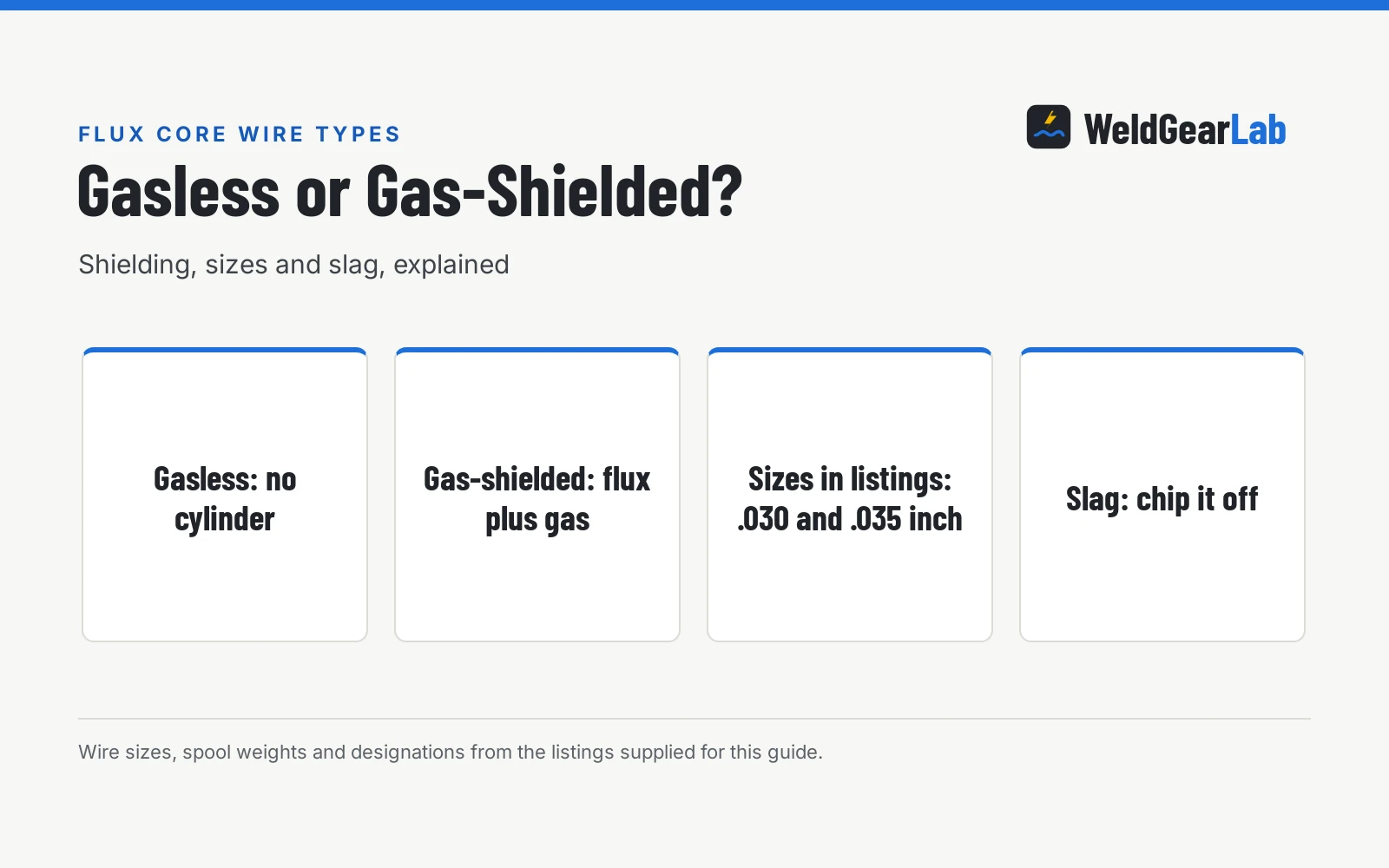
The listings supplied for this guide show self-shielded wire under the designations E71T-GS and E71T-11. Self-shielded wire needs no cylinder at all, so it suits outdoor work and mobile repairs. Gas-shielded flux core wire pairs the flux inside the wire with shielding gas from a cylinder, which suits shop work where the gas stays put.
Side by Side
| Self-shielded E71T-GS | Self-shielded E71T-11 | Gas-shielded flux core | |
|---|---|---|---|
| Shielding | Flux inside the wire | Flux inside the wire | Flux plus shielding gas |
| Gas cylinder | None needed | None needed | Needed |
| Passes | Single or multi-pass | Made for multi-pass | Multi-pass |
| Positions | All positions | Flat, horizontal, vertical upwards and overhead | Varies by wire |
| Sizes in the listings | .030 and .035 inch | .030 inch | Not stated |
| Outdoor work | Suits wind and drafts | Suits outdoor and mobile jobs | Needs shelter from wind |
| Slag | Slag to chip off | Slag that lifts off with ease | Slag to chip off |
Polarity follows the wire. The Blue Demon E71T-11 (on Amazon) listing states DCEN, with the electrode negative. Other wires state their polarity on the spool label and in the machine manual, so check the label before striking an arc.
Self-Shielded Wire: E71T-GS
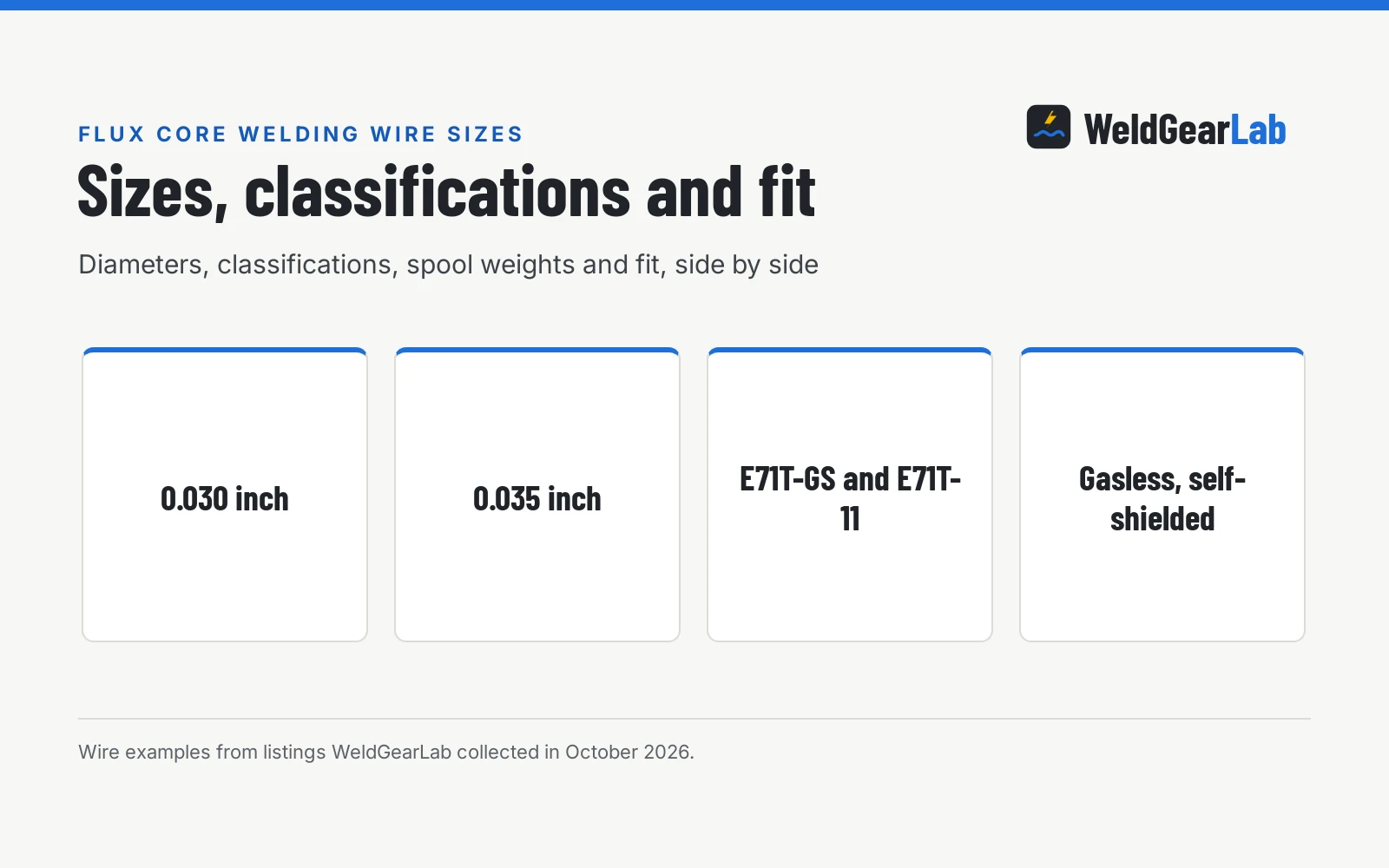
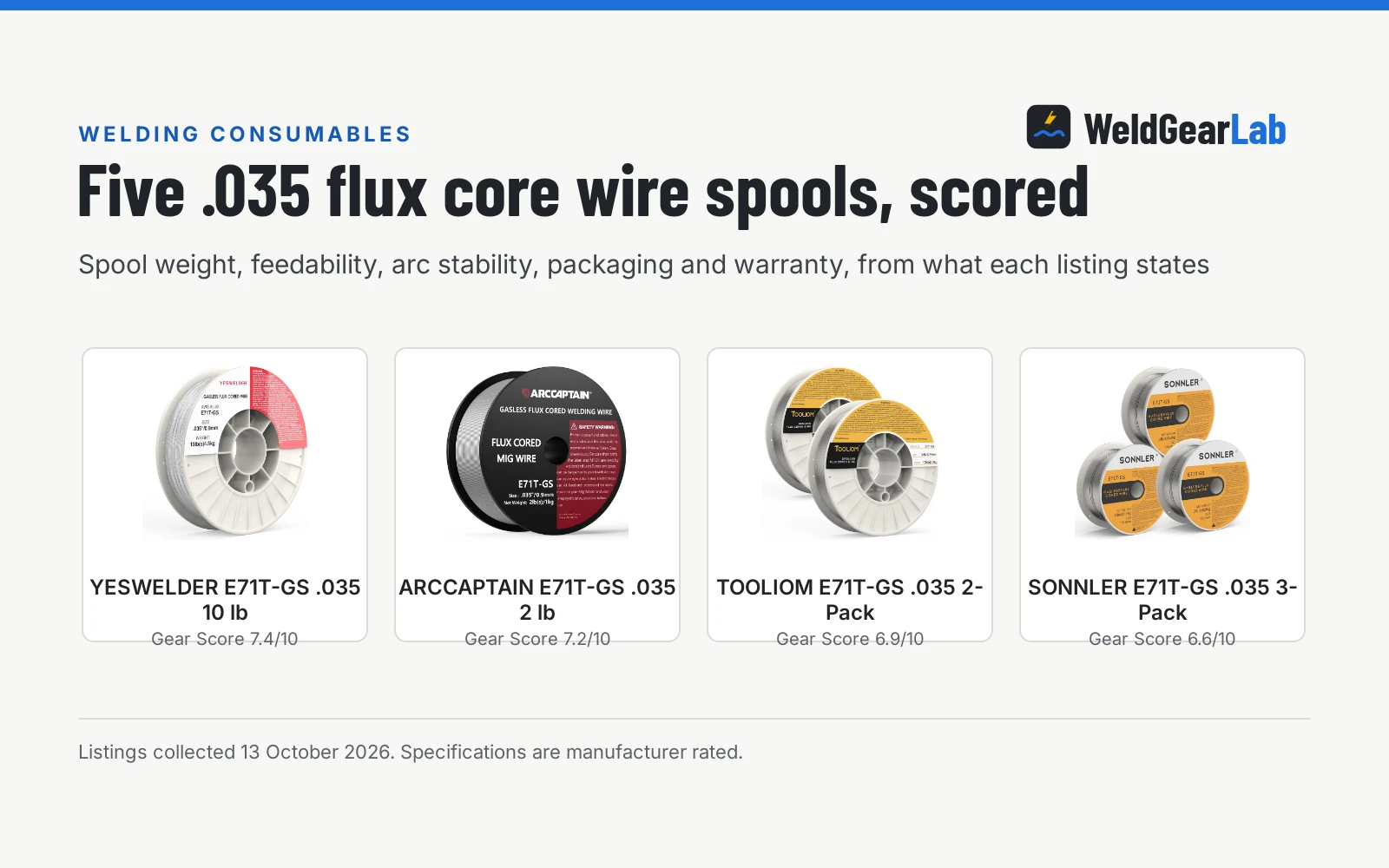
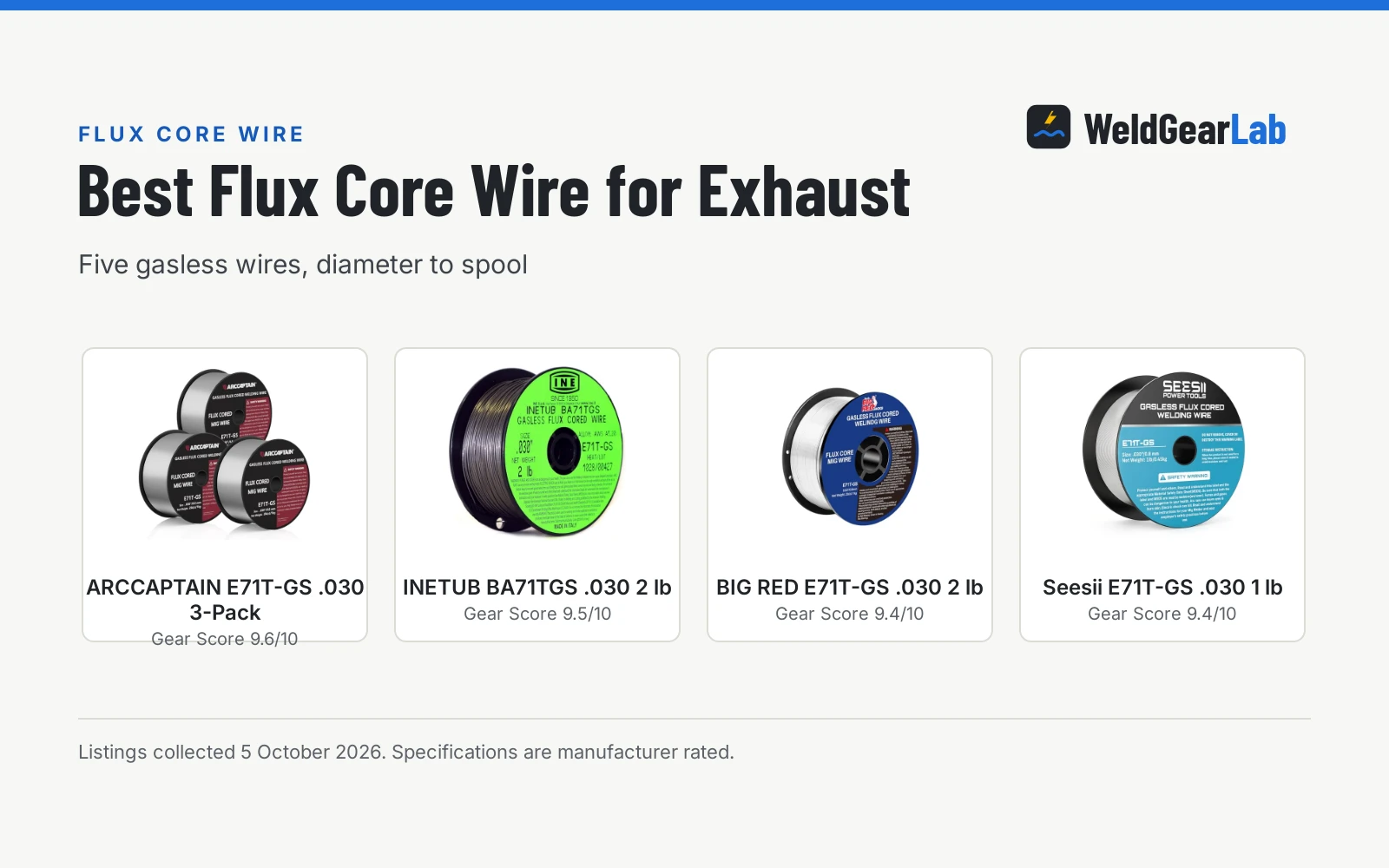
E71T-GS is the common gasless designation in the listings, and it runs without a cylinder. The ARCCAPTAIN listing shows .035 inch wire in a 2 lb spool, sold as a 3-pack with a net weight of 6 lb, while Rumvita and KISWEL list .035 inch wire on 10 lb spools. YixangDD lists .030 inch wire in 2 lb rolls, sold as a 2-pack. Match the spool weight to the job so wire does not sit open and gather moisture.
The listings describe E71T-GS as all-position wire for single or multi-pass welds, with smooth feeding and low spatter. ARCCAPTAIN lists T-joints, butt welds and lap welds, while YixangDD lists galvanized, stainless and mild steel. Vacuum packing comes up across the listings, with sealed packs that keep dust and moisture off the wire. See the best flux core wire .030 guide and the best .035 flux core welding wire guide for spools in each size.
Self-Shielded Wire: E71T-11
E71T-11 is the other self-shielded designation in the listings, and Blue Demon lists it as a .030 inch gasless wire on a 2 lb spool. The listing states that E71T-11 runs much like E71T-GS, with a key difference: E71T-11 is made for multi-pass work, while E71T-GS suits single or multi-pass welds. The wire runs on DCEN and suits flat, horizontal, vertical upwards and overhead positions.
Blue Demon lists silicon for a fluid weld pool, manganese for hardness, and other deoxidizers, with low spatter and slag that lifts off with ease. The listing also states that the wire is less sensitive to rust and mill scale than solid wire, which suits maintenance repairs, automotive repairs and light structural work on carbon and galvanized steel. Note a mismatch: the title calls it a 2 lb spool, while the spec table lists an item weight of 1.8 pounds. Trust the title and the bullets over the spec table. For the wider comparison, see E71T-1 vs E71T-11 wire.
Gas-Shielded Flux Core Wire
Gas-shielded flux core wire, also called dual-shield wire, keeps the flux inside the wire and adds shielding gas from a cylinder. The flux still helps the puddle and leaves slag, while the gas gives a steadier shield in still air. That pairing suits indoor shop work, where wind cannot strip the gas away. The trade is setup: a cylinder, a regulator and a gas hose join the kit.
No gas-shielded spool appears in the listings supplied for this guide, so no size or spool weight is stated for it here. Every self-shielded spool above welds with no gas at all, which is why gasless wire owns the outdoor and mobile jobs. For the head-to-head, see gasless vs gas shielded flux core wire and solid wire vs flux core wire.
How to Pick a Wire Size
The listings show .030 inch and .035 inch wire, and the choice follows the steel and the machine. Smaller wire feeds a cooler, narrower bead for thinner steel, while larger wire carries more metal into the joint for thicker steel. Either size needs drive rolls and a contact tip that match the wire, so check the machine manual and the spool label before loading a new size. See .030 vs .035 flux core wire for the size comparison.
For more options, see our welding consumables guides.
FAQ for welders
What is the difference between gasless and gas-shielded flux core wire?
Gasless wire shields the puddle with flux alone, so it needs no cylinder and suits wind and outdoor work. Gas-shielded wire pairs flux with gas from a cylinder, which gives a steadier shield indoors but ties the work to the gas supply.
Does flux core wire need shielding gas?
Self-shielded flux core wire does not, since the flux inside the wire makes its own shield as it burns. Gas-shielded flux core wire does need gas from a cylinder. Check the designation on the spool: E71T-GS and E71T-11 in the listings are self-shielded.
Can flux core wire weld galvanized steel?
Yes, in the listings supplied here. YixangDD lists galvanized, stainless and mild steel for its E71T-GS wire, and Blue Demon lists carbon and galvanized steel for its E71T-11 wire. Weld galvanized steel with ventilation and keep clear of the plume.
Why does flux core wire leave slag on the weld?
The flux inside the wire melts and forms a crust over the bead as it cools, which shields the hot metal from air. Chip the slag off with a chipping hammer and a wire brush before the next pass or before paint, since paint and a fresh pass need clean metal.
What size flux core wire do the listings show?
The listings show .030 inch and .035 inch wire. YixangDD and Blue Demon list .030 inch wire, while ARCCAPTAIN, Rumvita and KISWEL list .035 inch wire. Match the contact tip and drive rolls to the size.
Related: what flux core wire is, gasless vs gas shielded flux core wire, flux core welding pros and cons, and best flux core wire for outdoor use.