Gasless vs Gas Shielded Flux Core Wire: Which One Should You Buy?
Gasless and gas shielded flux core wire both use flux to protect the weld puddle, but they differ in external gas needs, wind tolerance, cleanup, and penetration.

On this page
Top picks at a glance
As an Amazon Associate I earn from qualifying purchases.
- 1
 INETUB BA71TGS Flux Core Welding Wire .030"9.5/10View on Amazon
- 2
 YESWELDER Flux Core Gasless MIG Welding WireView on Amazon
- 3
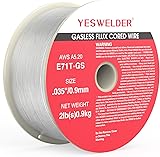 YESWELDER Gasless Flux Core MIG WireView on Amazon
- 4
 PGN E71T-11 .035" Gasless Flux Core Welding Wire 2 lb LowView on Amazon
- 5
 Gasless Flux Cored Welding WireView on Amazon
- 6
 HZXVOGEN Gasless Flux Core MIG Welding WireView on Amazon
- 7
 Flux Core Welding Wire .030"View on Amazon
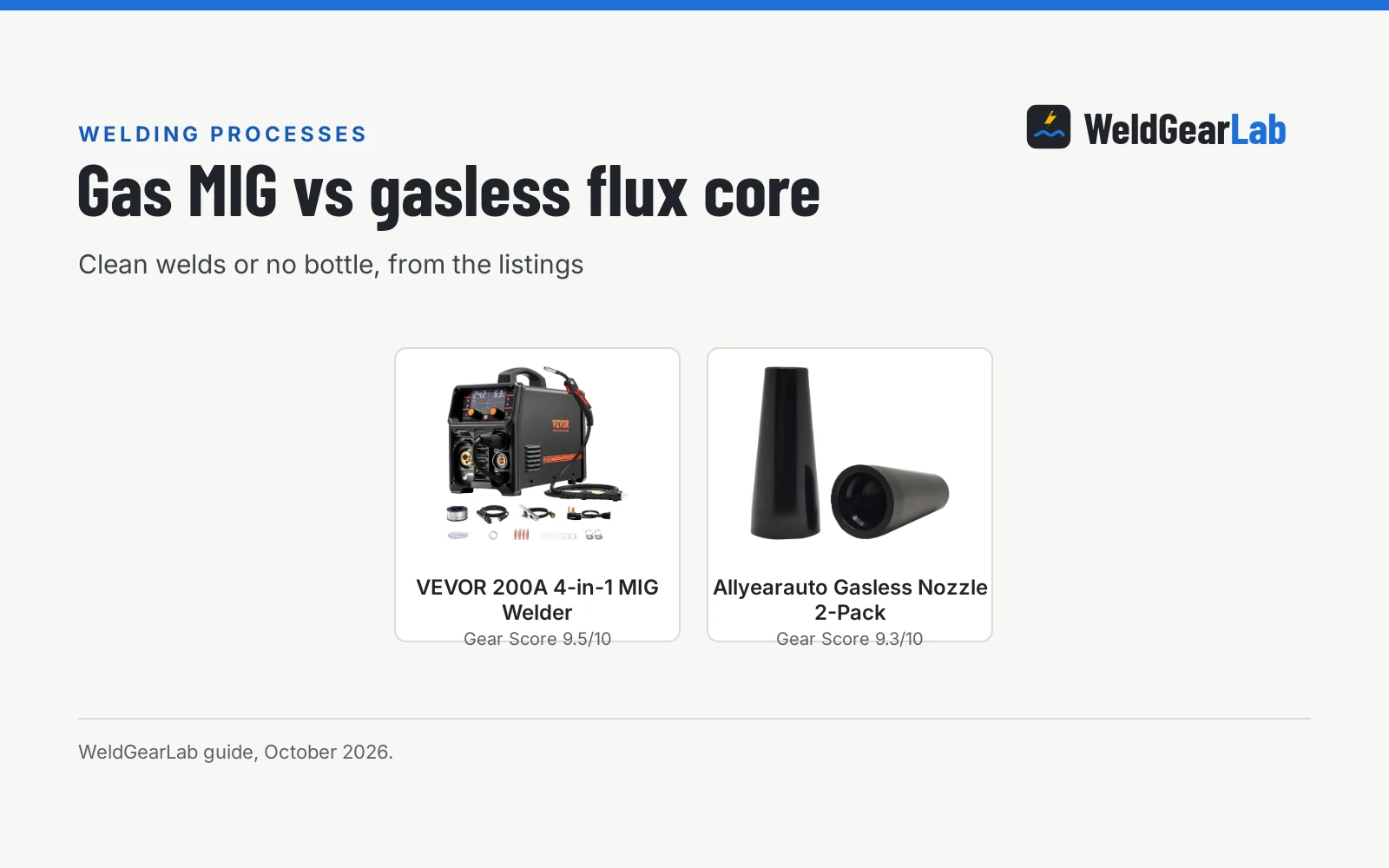
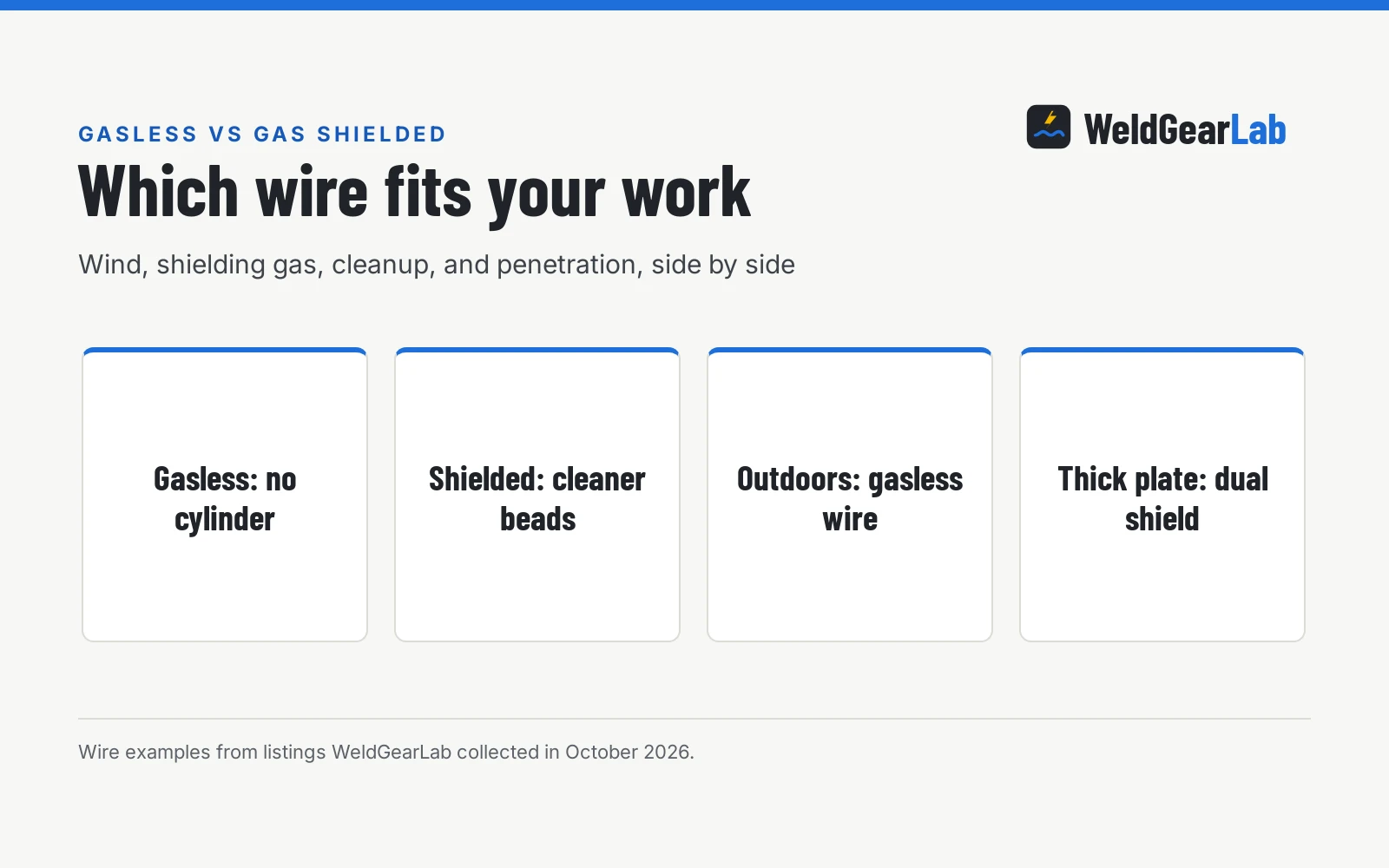
Choosing between gasless vs gas shielded flux core wire comes down to where you weld and how much penetration you need. Gasless flux core wire uses internal flux compounds to generate its own shielding atmosphere as it melts, letting you weld outdoors without hauling a heavy gas bottle. Gas-shielded flux core wire, also known as dual shield, pairs an internal flux with an external shielding gas cylinder to lay down smooth, heavy beads on structural fabrication jobs. For a portable machine on a farm gate or field trailer, gasless wire gets the job done without wind blowing away your shield. For heavy plate and multi-pass joints inside a shop, dual shield delivers deeper penetration, cleaner deposits, and less spatter. Here is how they compare across equipment needs, cleanup, and shop performance.
Other welders and gear to compare
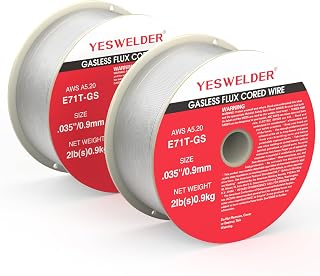 YESWELDER Flux Core Gasless MIG Welding WireCheck price on Amazon
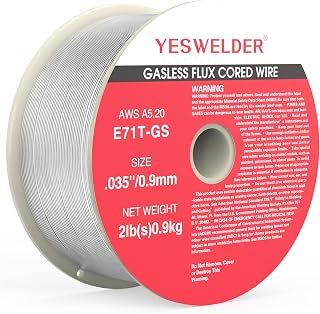 YESWELDER Gasless Flux Core MIG WireCheck price on Amazon
 PGN E71T-11 .035" Gasless Flux Core Welding Wire 2 lb LowCheck price on Amazon
 Gasless Flux Cored Welding WireCheck price on Amazon
 HZXVOGEN Gasless Flux Core MIG Welding WireCheck price on Amazon
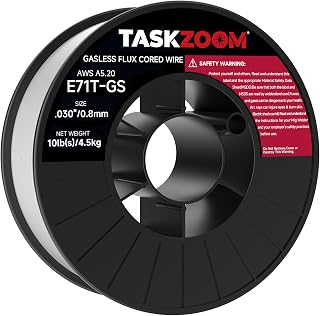 Flux Core Welding Wire .030"Check price on Amazon
This guide links to our product roundups, where WeldGearLab gets a commission on purchases made through links on this page, and your price stays the same. Read our affiliate disclosure.
The difference in one paragraph
Both processes feed a tubular wire packed with mineral flux through a wire feed gun. The difference is how the molten puddle stays protected from oxygen and nitrogen in the surrounding air. Gasless flux core wire, classified under specifications like E71T-GS and E71T-11, generates its own protective gas envelope from the core ingredients and forms a protective slag over the bead. Gas-shielded flux core wire adds an external shielding gas flow from a nozzle around the wire, shielding the arc while the flux core refines the weld pool and supports high-amperage deposition. Gasless wire requires only a spool of wire; dual shield requires a cylinder, gas hose, and regulator.
Side by side
| Gasless (self shielded) | Gas shielded (dual shield) | Solid wire (gas MIG) | |
|---|---|---|---|
| Shielding | Internal flux core only | Internal flux core plus external gas | External gas from cylinder only |
| Gear beyond welder | Gasless flux core wire | Dual shield wire, cylinder, regulator, hose | Solid wire, cylinder, regulator, hose |
| Wind and outdoor work | Tolerates wind and drafts well | Gas blows away in wind, needs shelter | Gas blows away in wind, needs shelter |
| Dirty or rusty steel | Forgiving on light rust and mill scale | Prefers cleaner joint fit-up | Requires clean, bare steel |
| Slag and cleanup | Heavy slag crust, more spatter | Easy peeling slag, low spatter | No slag, minimal spatter |
| Smoke and fumes | Heavy smoke, needs good ventilation | Moderate smoke | Low smoke |
| Typical polarity | DCEN (electrode negative) | DCEP (electrode positive) | DCEP (electrode positive) |
| Primary shop use | Field repairs, farm gates, portable jobs | Heavy fab shops, structural joints, thick plate | Sheet metal, auto body, clean shop fabrication |
Polarity depends on the wire chemistry; always follow the polarity printed on your wire spool label and in your welder manual. Most wire feed welders allow swapping the polarity leads inside the wire drive cabinet when changing wire types.
When gasless flux core wire is the better choice
- Outdoor and mobile repairs. Fence lines, farm implements, utility trailers, and job site repairs. Wind or breezes that disperse cylinder gas do not disrupt the internal shielding of gasless wire.
- Rusty, scaled, or less-than-clean steel. The core formulation incorporates deoxidizers that tolerate light surface rust and mill scale better than solid MIG wire.
- No gas cylinder logistics. You skip buying or leasing a high-pressure bottle, paying for refills, or hauling heavy tanks into the back of a truck.
- Farm and field utility repairs. Readily available in small spools that fit portable machines without extra plumbing.
Wire listings show how makers package these consumables. YESWELDER packages its E71T-GS gasless wire in 0.030 in and 0.035 in diameters on 2-pound spools. For larger jobs, ARCCAPTAIN lists a 0.035 in E71T-GS wire with a stated tensile strength of 80496 psi on a 10-pound spool and lists TÜV certification. VEVOR lists its 0.035 in E71T-GS wire with a tensile strength of ≥490 MPa on 2-pound spools. PGN Bearings provides 0.035 in E71T-11 wire on a 2-pound spool for multi-pass tasks. HZXVOGEN lists a 10-pound spool of 0.035 in E71T-GS wire with a 2 Year Manufacturer warranty. For stainless steel jobs, YESWELDER lists an E308LFC-O gasless flux core wire in .030 in diameter with a tensile strength of 570 megapascals on a 2-pound spool for metals like 304 and 308. If you want a dedicated machine for this work, check our best flux core welder guide, learn what is flux core wire, or see our roundup of the best .035 flux core welding wire.
When gas shielded flux core wire is the better choice
- Heavy structural fabrication. Large beams, equipment frames, and thick plate where deep penetration and high deposition rates speed up production.
- Cleaner weld beads. External gas shielding paired with specialized flux creates minimal spatter and a smooth slag crust that peels off with light chipping.
- Multi-pass integrity. Formulations provide high impact toughness and crack resistance required for code-compliant structural welds.
- Production shop speed. Allows higher wire feed speeds and deposition rates than solid wire or self-shielded wire without sacrificing bead shape.
Dual shield wire is primarily a fabrication shop consumable. If your shop already has a cylinder setup and a machine with sufficient amperage, dual shield lets you run thick fillets with less post-weld cleanup. To see how solid and flux wires compare on shop welders, browse our guide to the best MIG welding wire or explore options in our best multi-process welder guide.
Gasless vs gas shielded flux core wire: machine and setup needs
Running these wires requires different machine capabilities and gas hardware:
- Polarity setup. Common carbon steel gasless flux core wires run on direct current electrode negative (DCEN, or straight polarity), where the torch connects to the negative terminal and the work clamp connects to the positive terminal. Gas-shielded dual shield wire runs on direct current electrode positive (DCEP, or reverse polarity), the same configuration used for standard solid wire MIG. For detailed hookup steps, see our guide on what polarity for flux core welding.
- Drive rolls. Tubular flux core wires have a thinner steel sheath than solid wire. Excessive drive tension can crush the wire and cause feeding jams. Gasless and dual shield wires feed best using knurled drive rolls, which grip the wire surface with light pressure.
- Contact tips and nozzles. Gasless wire operates with a thread-on or slip-on insulated nozzle designed to shield the contact tip, or an open tip holder, since no gas flows through the torch. Dual shield wire requires a standard MIG gas nozzle to direct the shielding gas column evenly around the puddle.
- Power requirements. Self-shielded wire in smaller diameters feeds on compact home welders. Dual shield wire requires higher operating voltage and higher amperage, meaning it needs heavier shop machines with substantial duty cycles.
Which shielding gas for dual shield wire
Gasless flux core wire requires no external gas cylinder whatsoever. Dual shield wire, by contrast, relies on a shielding gas supply from a high-pressure cylinder. The most common gas choice for mild steel dual shield wire is an argon and carbon dioxide mixture, or straight carbon dioxide. Straight carbon dioxide offers deep penetration and lower cylinder refill expenses, though it produces slightly more spatter. An argon and carbon dioxide blend stabilizes the arc, produces a smoother puddle, and minimizes post-weld cleanup. Always verify the exact gas mixture specified on your dual shield wire packaging before opening the cylinder valve.
Can one wire feed welder run both?
Commercial shop welders with sufficient power output can run both gasless and gas-shielded flux core wires, provided the machine delivers the required operating voltage, includes a gas solenoid and rear gas inlet, and allows changing polarity. Compact benchtop welders that produce limited amperage or lack a gas solenoid can only run gasless wire. For fabricators evaluating machines that support multiple processes, see our guide to the best multi-process welder.
Safety, fumes, and slag handling. Both types of flux core wire produce significant smoke, flux fumes, and hot slag. Always weld in well-ventilated areas, keep your helmet out of the rising plume, and wear proper eye protection under your welding hood when chipping slag crust. Clear away combustible debris from your work zone, and secure all high-pressure gas cylinders upright with safety chains. For proper personal gear recommendations, browse our welding safety gear resources.
FAQ for welders
Is gas-shielded flux core wire stronger than gasless wire?
Dual shield wire generally provides higher impact toughness and superior ductility compared to typical self-shielded flux core wires. For basic non-critical repairs and farm fabrications, quality gasless wire provides plenty of joint strength. For code-certified structural steel, dual shield is preferred.
Can I run gas-shielded flux core wire without an external gas cylinder?
No. Dual shield flux core wire does not contain sufficient internal gas-generating elements to protect the molten puddle on its own. Running it without external shielding gas results in severe porosity, worm tracking, and compromised joint strength.
What polarity does gasless flux core wire use compared to dual shield?
Common carbon steel gasless flux core wires run on DCEN (electrode negative), placing the torch on the negative terminal to melt the wire efficiently. Gas-shielded dual shield wire runs on DCEP (electrode positive), which produces a stable spray-type metal transfer under external shielding gas. Always verify the polarity printed on your specific wire spool label before welding.
Why does gasless flux core wire produce so much spatter and slag?
The internal core contains deoxidizers, arc stabilizers, and slag formers that burn and solidify as the bead cools. This chemical reaction creates heavier smoke and surface spatter than gas-shielded processes, leaving a slag crust that requires mechanical chipping.
Can a small home MIG welder run dual shield flux core wire?
Most compact benchtop welders lack the voltage and amperage output required to run dual shield wire effectively. Dual shield wires operate best at higher heat inputs on larger shop machines capable of sustained duty cycles and continuous wire feeding.
Related: how to choose flux core wire, gasless MIG welder pros and cons, best wire for gasless MIG welder, and the welding consumables hub. Also see our how to store flux core wire to prevent rust.