What Is Flux Core Wire? How It Works and When to Use It
Flux core wire is a hollow steel electrode filled with flux that shields the weld without gas, making it ideal for outdoor repairs and dirty steel.

On this page
Top picks at a glance
As an Amazon Associate I earn from qualifying purchases.
- 1
 Blue Demon 308LFC-O X .045 X 10LB Spool Stainless Steel Flux9.7/10View on Amazon
- 2
 VEVOR Flux Core Welding Wire9.6/10View on Amazon
- 3
 Flux Core Mig Wire9.6/10View on Amazon
When you need to fix a cracked steel trailer tongue, patch a tractor bucket, or run bead outdoors where wind blows shielding gas away, shop welders reach for gasless wire. What is flux core wire? Flux core wire is a hollow steel electrode tube filled with flux compounds that protect the molten puddle under arc heat. In home, farm, and portable welding, welders primarily use self-shielded flux core wire, which vaporizes its internal core under arc heat to shield the puddle without an external gas cylinder. Because the shielding generates inside the wire, it lets you weld carbon steel in breezy fields and through light rust where solid MIG wire would fail.
This guide links to our product roundups, where WeldGearLab gets a commission on purchases made through links on this page, and your price stays the same. Read our affiliate disclosure.
What Is Flux Core Wire?
Flux core wire, or flux-cored arc welding wire, is a continuous consumable electrode made for wire feed machines. Solid MIG wire relies on an external gas tank to shield the weld puddle from air. In contrast, flux core wire carries its shielding agents inside a hollow metal sheath. Makers roll a flat strip of mild carbon steel around a core of powdered minerals, deoxidizers, and arc stabilizers, drawing the tube down to its final spool diameter.
During welding, the core materials perform essential tasks:
- Shielding vapor. Core minerals vaporize under arc heat to push oxygen and nitrogen away from the molten puddle.
- Deoxidation. Scavengers react with surface impurities and mill scale, floating contamination out of the puddle to prevent porosity.
- Arc control. Stabilizing agents smooth electrical flow across the arc gap.
- Slag formation. Melted minerals form a protective slag blanket over the cooling bead that shapes the deposit and seals it from air.
For home, farm, and portable maintenance, self-shielded flux core wire generates its own protective envelope, operating completely gasless and eliminating the heavy gas cylinder, regulator, and hose.
How Flux Core Wire Works Step by Step
The internal flux reactions occur continuously as wire feeds into the arc:
- Wire feeding. The drive rolls feed the tubular wire through the gun liner and contact tip to complete the welding circuit.
- Arc ignition. Striking the arc against the grounded workpiece melts the outer steel sheath into molten droplets that enter the joint.
- Core vaporization. The arc heat vaporizes the core powder instantly, expanding into a protective gas envelope around the weld puddle.
- Deoxidizing the pool. Core deoxidizers chemically bind with surface oxides. Listings like YESWELDER note that these agents ensure clean welds through light rust or mill scale.
- Slag blanket formation. Liquid slag floats to the surface of the weld pool. As the bead cools, the slag solidifies into a protective crust.
- Slag cleanup. Once the weld cools, the welder chips away the brittle slag with a chipping hammer and cleans the surface with a wire brush.
Why Use Flux Core Wire?
Why use flux core wire over solid wire with gas? The choice comes down to portability, wind, and surface conditions:
- Outdoor wind resistance. Even a light breeze blows gas away from a standard MIG nozzle, causing weld porosity. Flux core wire generates shielding directly at the puddle, making it dependable in breezy outdoor conditions.
- No gas cylinder needed. Skipping the cylinder, regulator, and hose eliminates refill trips and makes your setup easier to transport in a truck or around a farm.
- Deals with dirty steel. Internal deoxidizers tolerate light rust and mill scale better than solid MIG wire.
- Deep penetration. Concentrated arc heat delivers solid penetration on joint seams.
- All-position capability. Rapidly freezing slag supports the puddle in flat, horizontal, vertical, and overhead positions.
For machine comparisons, see our guide on flux core welding pros and cons and our best flux core welder guide.
E71T-GS vs E71T-11: Common Wire Classifications
AWS markings on flux core wire spools tell you how the electrode performs:
- E: Electrode carrying welding current.
- 7: Minimum tensile strength category for the deposited weld metal.
- 1: All-position capability for flat, horizontal, vertical, and overhead welding.
- T: Tubular flux-cored construction.
- GS: General use, single-pass applications with high deoxidizer content.
- 11: General-purpose wire suited for single-pass and multi-pass welding.
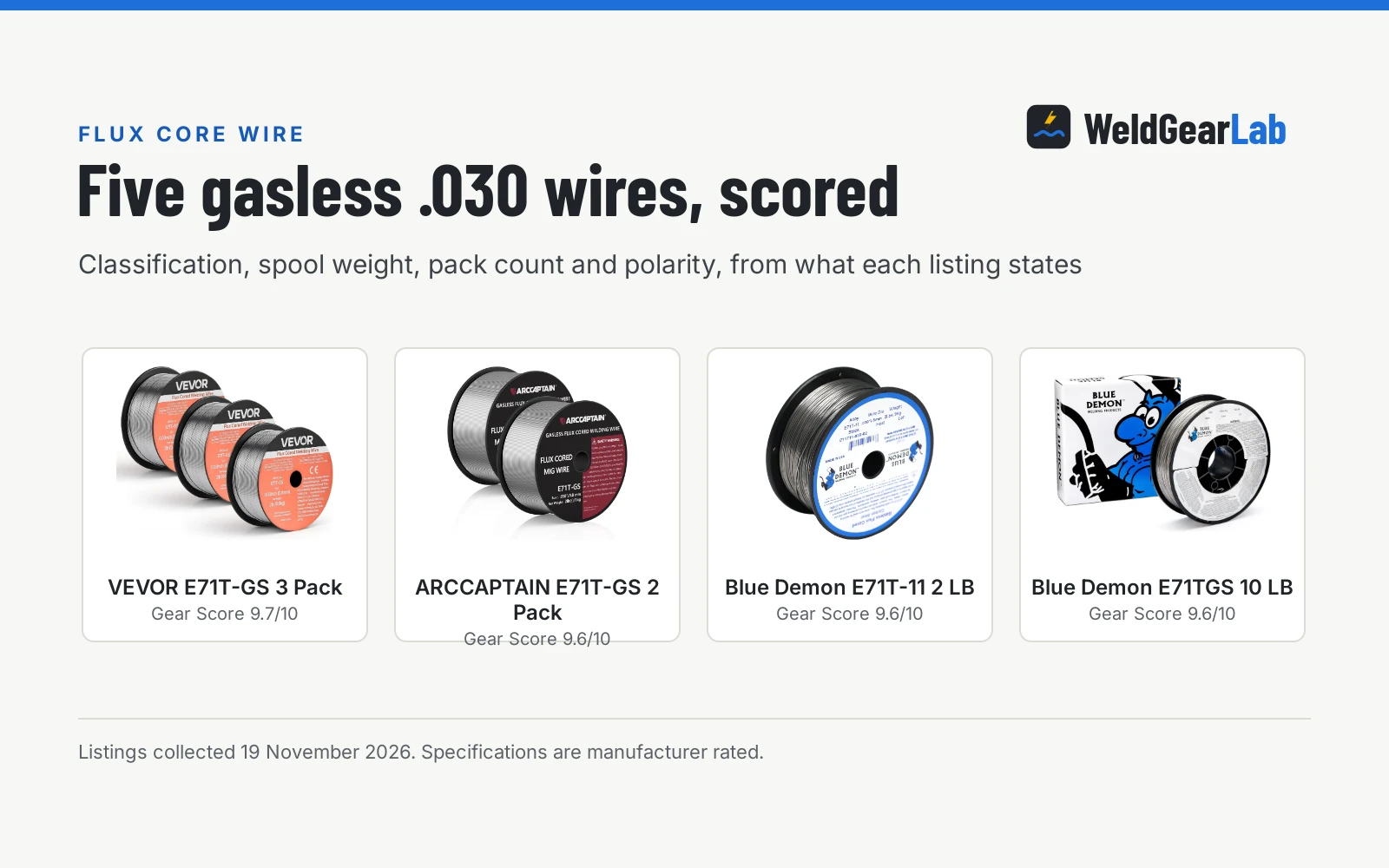
While the number indicates the minimum tensile strength classification, individual listings publish specific ratings for their spools: ARCCAPTAIN lists a tensile strength of 80496 psi for its wire, while VEVOR lists tensile strength of ≥490 MPa.
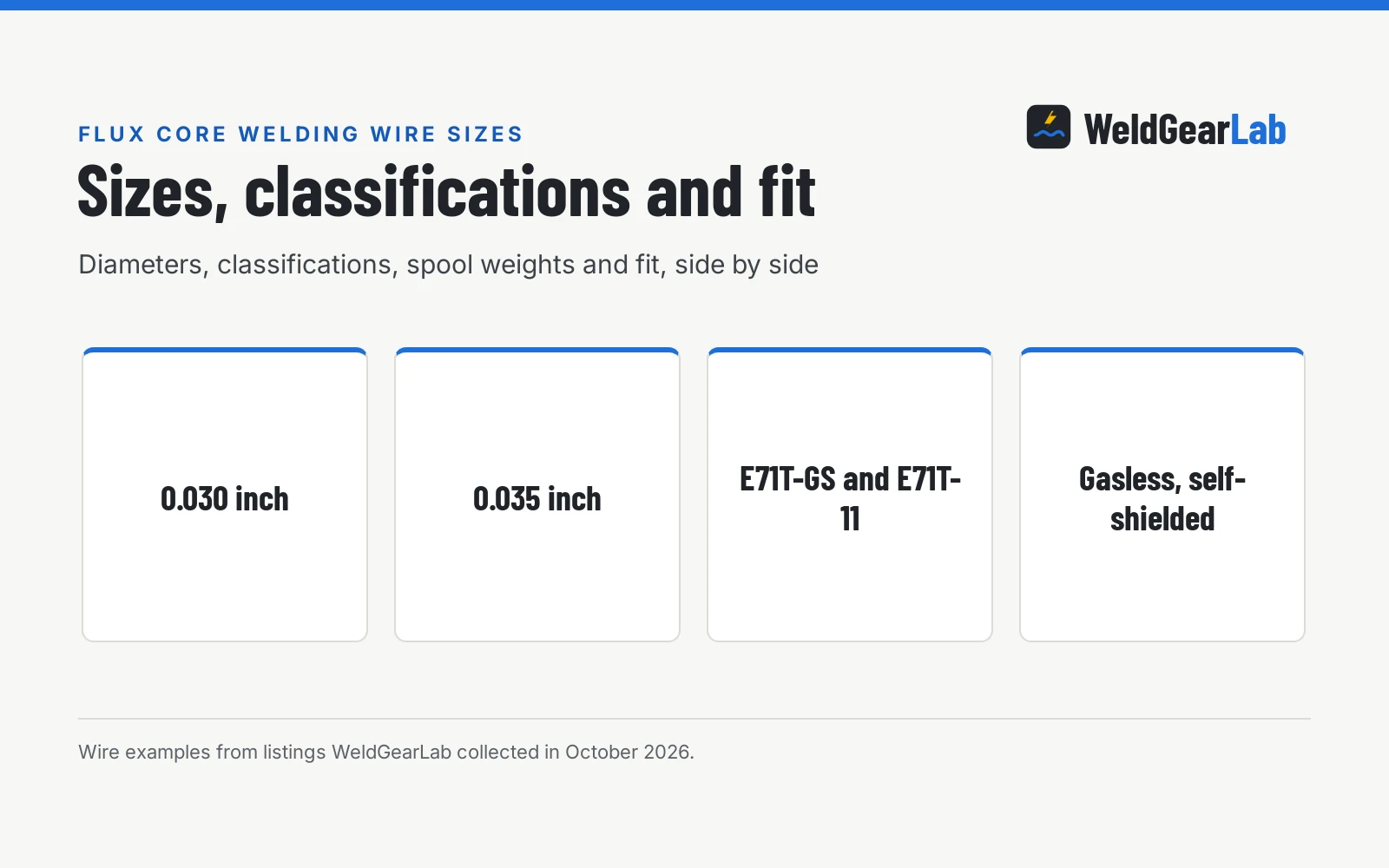
The main difference between these two designations is pass capacity. AWS classification defines E71T-GS for single-pass applications because its high deoxidizer content can lead to brittle deposits if layered in multiple passes. Listings like YESWELDER, ATLAS WELDER, and VEVOR supply E71T-GS for these single-pass tasks. By comparison, AWS E71T-11, such as the wire from PGN Bearings, maintains balanced chemistry that allows welders to deposit both single-pass and multi-pass joints on thicker steel fabrication.
Flux Core Wire Comparison
| Flux Core (E71T-GS) | Flux Core (E71T-11) | Solid MIG Wire | |
|---|---|---|---|
| Weld pass capability | Single-pass only | Single-pass and multi-pass | Single-pass and multi-pass |
| Shielding method | Self-shielded (internal flux) | Self-shielded (internal flux) | External shielding gas cylinder |
| Operating polarity | DCEN (electrode negative) | DCEN (electrode negative) | DCEP (electrode positive) |
| Spool weights in data | 2 lb and 10 lb | 2 lb | Not stated |
| Wire diameters in data | .030, .035, and 0.039 inch | .030 inch | Not stated |
| Slag removal | Chipping hammer and wire brush | Chipping hammer and wire brush | No slag coating |
| Outdoor wind tolerance | Tolerates breezy conditions | Tolerates breezy conditions | Gas blows away, needs shelter |
| Surface condition | Welds through light rust and mill scale | Tolerates light rust and mill scale | Requires clean ground steel |
Always match wire classification to your joint design: use E71T-GS for quick single-pass repairs, use E71T-11 when building joints that require stacked passes, and choose solid MIG wire with gas for clean indoor sheet work.
What Flux Core Wire to Use: Diameters and Spool Sizes
When choosing what flux core wire to use, consider wire diameter and spool capacity:
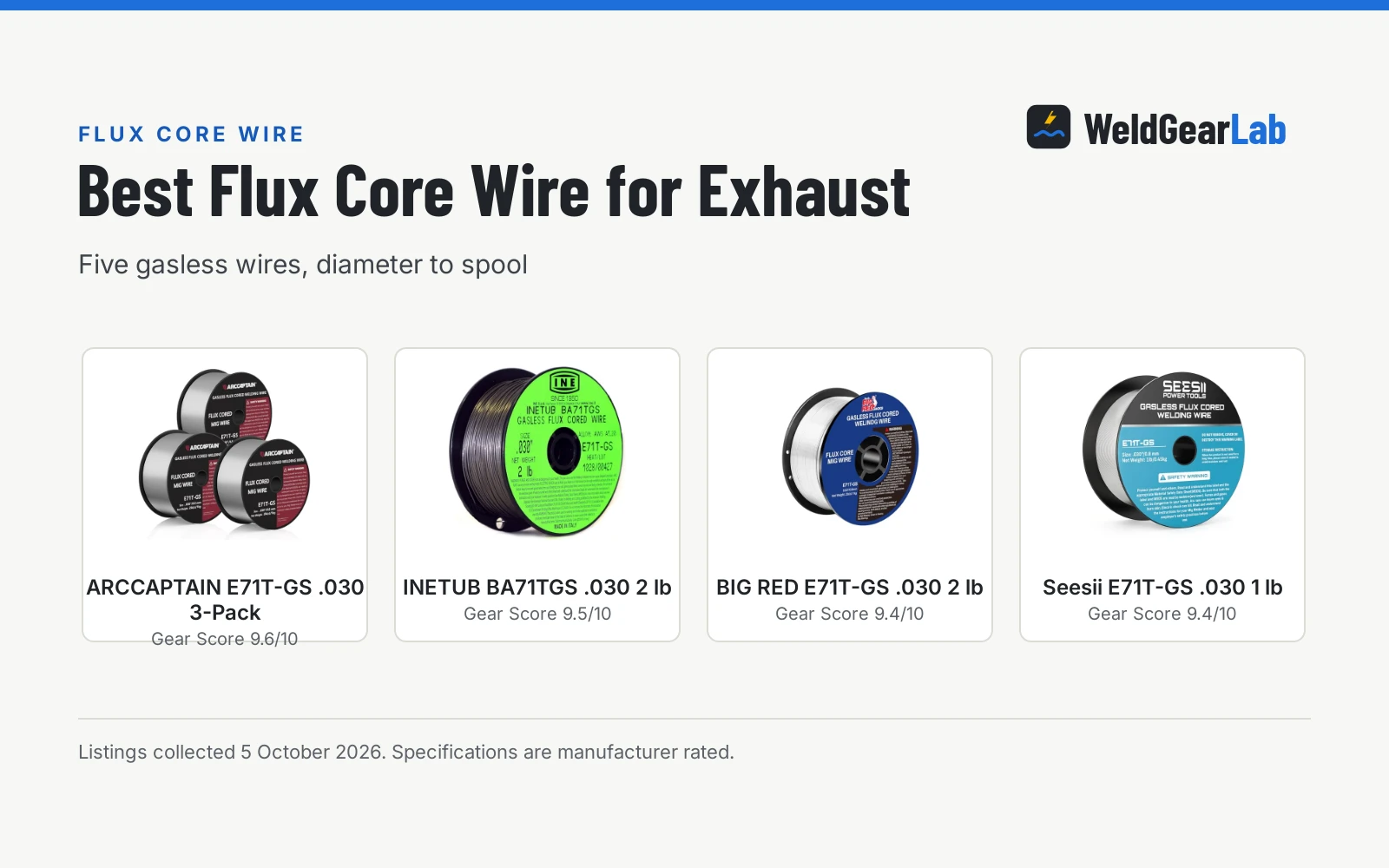
- .030 inch wire. This smaller diameter runs at lower heat input than thicker wire, making it easier to control on thin carbon steel sheet metal. PGN Bearings, ATLAS WELDER, Rumvita, and BIG RED offer .030 inch wire for light repair tasks.
- .035 inch wire. The standard diameter for general shop repairs and farm fabrication. It handles heavier steel and deposits filler metal more quickly. YESWELDER, ARCCAPTAIN, and ATLAS WELDER list .035 inch wire. See our best .035 flux core welding wire guide for top spools.
- 0.039 inch wire. A thicker diameter, listed by RUBIK, for heavier deposition on thicker carbon steel.
Spool sizes match different machines:
- 2 lb spools. Compact spools fit portable machines and small wire compartments. YESWELDER, ARCCAPTAIN, VEVOR, PGN Bearings, RUBIK, and Rumvita package wire on 2 lb spools.
- 10 lb spools. Larger spools fit dedicated shop welders for extended welding runs. ARCCAPTAIN, ATLAS WELDER, and BIG RED offer 10 lb options.
Makers like ARCCAPTAIN, Rumvita, and BIG RED provide vacuum packaging to protect flux from moisture during storage. Compare more options in our best wire for gasless MIG welder guide and how to choose flux core wire.
Machine Setup and Polarity for Flux Core Wire
Setting up your welder for flux core wire requires specific adjustments:
- DCEN polarity. Gasless flux core wire requires Direct Current Electrode Negative (DCEN), or straight polarity. Connect the gun lead to negative and the work ground clamp to positive. Running flux core on DCEP causes violent spatter and poor penetration. See our guide on what polarity for flux core welding.
- Knurled drive rolls. Tubular wire can crush under standard V-groove rollers. Knurled drive rolls have serrated grooves that grip the wire without excessive tension.
- Contact tips and nozzles. Match the contact tip to your wire size (.030 or .035 inch). Use a flux core nozzle or thread protector to prevent spatter buildup on the torch.
- Stickout length. Keep a longer stickout than solid wire to preheat the flux core before it enters the arc.
For setup steps, see our guide on gasless MIG welding for beginners.
Safety, Fumes, and Slag Removal
Welding with flux core wire creates fumes, hot spatter, and slag that require protective habits:
Fumes and smoke. Flux vaporization produces dense smoke. Always weld in well-ventilated areas or outdoors, and keep your face away from the rising fume plume.
Chipping slag. Cooling slag shrinks and can pop off the bead unexpectedly. Always wear safety glasses underneath your welding helmet when chipping or brushing the weld.
Fire precautions. Flux core produces hot spatter. Clear dry grass and flammable materials from the work area. See the OSHA welding overview and our Safety Disclaimer.
FAQ for welders
Is flux core wire as strong as solid MIG wire?
Both flux core and solid MIG wire make sound, dependable welds on mild steel when paired with proper settings and clean fit-up. Published ratings, like 80496 psi on ARCCAPTAIN E71T-GS or ≥490 MPa on VEVOR, show solid joint strength. Overall strength depends on penetration depth and welder technique rather than wire type alone.
Is flux core wire good for beginners?
Flux core wire is an accessible starting choice for beginners because it removes the expense and hassle of shielding gas cylinders. New welders can set up a small wire feeder outdoors and start practicing immediately. Beginners must remember to set DCEN polarity and clean slag off each bead.
What is the best flux core wire to use for home repairs?
For general home repairs and farm fixes, .030 or .035 inch AWS E71T-GS wire on a 2 lb spool is the most practical choice. It runs smoothly on compact wire feed welders and handles mild carbon steel. If you need to weld thicker joints with multiple passes, choose AWS E71T-11 wire instead.
Why does flux core wire create so much spatter?
Flux vaporization and arc turbulence inside the tubular electrode naturally create more spatter than solid wire with gas. Running on incorrect polarity, such as DCEP instead of DCEN, causes excessive spatter and irregular beads. Proper stickout length and dialed wire speed keep spatter under control.
Can you weld aluminum with flux core wire?
Standard gasless flux core wire cannot weld aluminum. Self-shielded flux core wires are formulated strictly for carbon steel and low-alloy steel. Welding aluminum requires solid aluminum wire with pure argon shielding gas or a TIG welding setup.
Can you use flux core wire with shielding gas?
Self-shielded wires like E71T-GS and E71T-11 are designed to run without shielding gas. Adding external gas alters the puddle chemistry, wastes gas, and can cause weld porosity. Dual-shield wires exist for heavy industrial work, but common shop spools are strictly gasless.
Related: flux core vs MIG welding, how to choose flux core wire, best flux core welder, what polarity for flux core welding, and the welding consumables hub.