Drill Press Speed Chart by Bit Size
A drill press speed chart matches bit size and material to spindle speed, and this guide shows how to read it and which bits suit the sizes it covers.

On this page
Top picks at a glance
As an Amazon Associate I earn from qualifying purchases.
- 1
 AIMLENTOOL 5Pcs Step Drill Bit & 5Pcs Countersink9.6/10View on Amazon
- 2
 COMOWARE Reduced Shank Drill Bit Set9.6/10View on Amazon
A drill press can burn a bit, wander off the mark or grab the work when the spindle runs at the wrong speed for the hole. A drill press speed chart takes that guesswork away: it pairs the size of the bit with the material being drilled and points to the spindle speed that suits that combination. This guide shows how to read that chart, what changes the speed, and which bits suit the sizes the chart covers.
This guide links to our product roundups, where WeldGearLab gets a commission on purchases made through links on this page, and your price stays the same. Read our affiliate disclosure.
AIMLENTOOL 5Pcs Step Drill Bit & 5Pcs Countersink
A set with 5 step bits covering 50 sizes and 5 countersink bits, in an aluminum case with a foam layer.
Pros
- 5 step bits cover 50 sizes from 1/8 to 1-3/8 in
- 5 countersink bits from 1/4 to 3/4 in cut 90° holes
- 118° split tip with a double groove design for self-centering
- Titanium coated high speed steel in an aluminum case with a foam layer
Cons
- No warranty term is stated in the listing
- No maximum material thickness is stated
- No shank size is stated for the step bits
- Countersink bits are listed for wood and soft metal only
COMOWARE Reduced Shank Drill Bit Set
An 8-piece set of reduced shank bits from 9/16 to 1 in, M2 high speed steel with a 3-flat 1/2 in shank, in a heavy duty aluminum case.
Pros
- 8 bits from 9/16 to 1 in, each 6 in long
- M2 high speed steel with titanium and black nitride coatings
- 135° split point and 3-flat 1/2 in shank to prevent walking
- Heavy duty aluminum case for storage and transport
Cons
- No warranty term is stated in the listing
- No sizes below 9/16 in in the set
- No speed guidance is given in the listing
- No center punch is listed with the set
How to read a drill press speed chart
Think of the chart as a grid. Bit sizes run down the side, materials run across the top, and the speed sits where a row meets a column. Find the row for the bit size, find the column for the material, and read the speed where they meet. The chart on the machine door or in the manual is the chart to follow for that machine, since pulley ranges differ between machines.
Side by side
| Pick | Bits in the set | Point angle | Material | Case |
|---|---|---|---|---|
| AIMLENTOOL SD-11PCS | 5 step bits and 5 countersink bits, 50 sizes | 118° split tip | High speed steel, titanium coating | Aluminum case with foam layer |
| COMOWARE TGReduced | 8 bits, 9/16 to 1 in | 135° split point | M2 high speed steel, titanium and black nitride coatings | Heavy duty aluminum case |
Bit size sets the speed
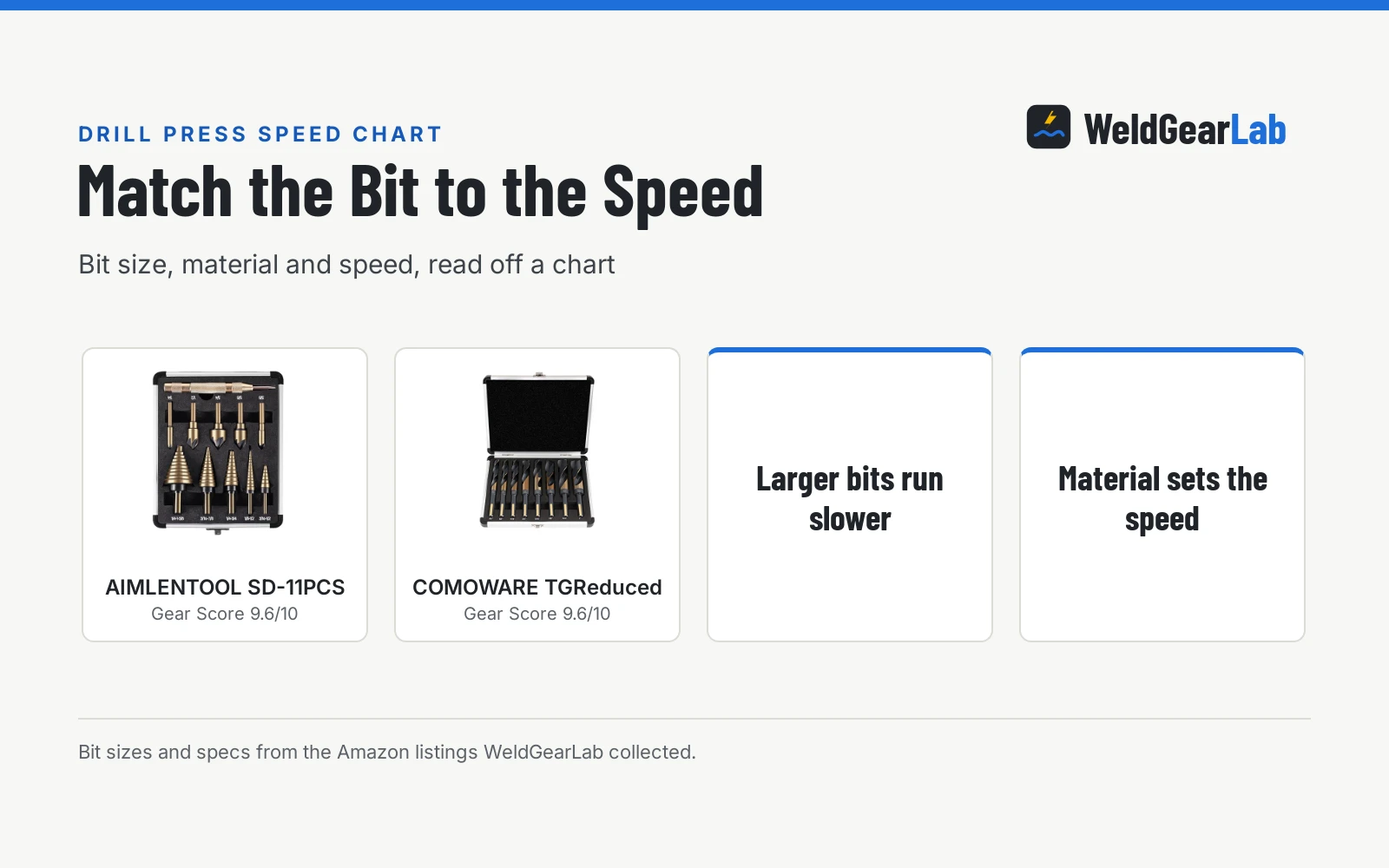
Larger bits run slower, smaller bits run faster. The chart shows it plainly: as the bit size grows, the speed drops. A step bit that opens a hole in stages still follows the same rule, with the largest step setting the pace. The sets below cover different parts of the chart: step bits that work up from small sizes and reduced shank bits for larger holes. A standard drill bit size chart lists the sizes in order.
Material matters as much as size
Hard material takes a slower speed than soft material at the same bit size, and the chart lists materials in separate columns for that reason. The listings for the sets below name the materials each bit is made for, from steel and aluminum to wood and plastic, and the chart column to use is the column that matches the work on the bench.
How to set the speed on your drill press
On a belt drive drill press, speed changes by moving the belt between pulleys, and the chart on the door shows which belt position gives which speed. Open the cover, move the belt to the position the chart shows for the bit and material, and check the tension before switching the machine on. If the chart is missing from the door, the manual for the machine carries the same chart. The best drill press for metalworking guide covers machines for this kind of work.
Drill press safety. Wear eye and face protection, clamp the work to the table, keep guards in place, and keep gloves away from rotating parts. A bit that grabs can spin the work, so the clamp matters more than a firm grip.
Bits that cover the chart
The sets below cover the sizes the chart runs through, from small step bit sizes up to larger reduced shank sizes, and each bit’s size sets which row of the chart to read.
For more options, see our metal fab tools guides.
FAQ for welders
What does a drill press speed chart show?
It pairs bit size with material and points to a spindle speed for that combination. Find the row for the bit size and the column for the material, and read the speed where they meet.
Why do larger drill bits run slower?
A larger bit’s outer edge travels further with each turn, so at the same spindle speed it moves faster through the material and builds heat faster. Slowing the spindle keeps that edge speed in the range the chart shows for the material, so the edge keeps cutting instead of burning. The chart reflects that by dropping the speed as the bit size grows.
Does the material change the speed?
Yes. Hard material takes a slower speed than soft material at the same bit size, which is why the chart has a separate column for each material. Use the column that matches the work on the bench, not the column for a different material.
What happens if the speed is too fast?
The bit overheats, dulls quickly and can wander or grab the work. The hole may also come out rough or oversize. Dropping to the speed the chart shows for that bit and material avoids most of that trouble.
Where do I find the speed chart for my drill press?
On the inside of the belt cover door, or in the manual that came with the machine. If the door chart is missing, the manual carries the same chart.
Related: drill press vs hand drill, drill press vs mill, best twist drill bit set, step drill bit vs twist drill bit, and best drill press vise.