Bench Vise Types: Which One to Buy
Swivel-base, fixed-base and clamp-on bench vises compared, with jaw widths, clamping force and mounting explained.

On this page
Top picks at a glance
As an Amazon Associate I earn from qualifying purchases.
- 1
 6-Inch Bench Vise with Jaw Pads9.6/10View on Amazon
- 2
 Kosday 360° Swivel Bench Vise9.6/10View on Amazon
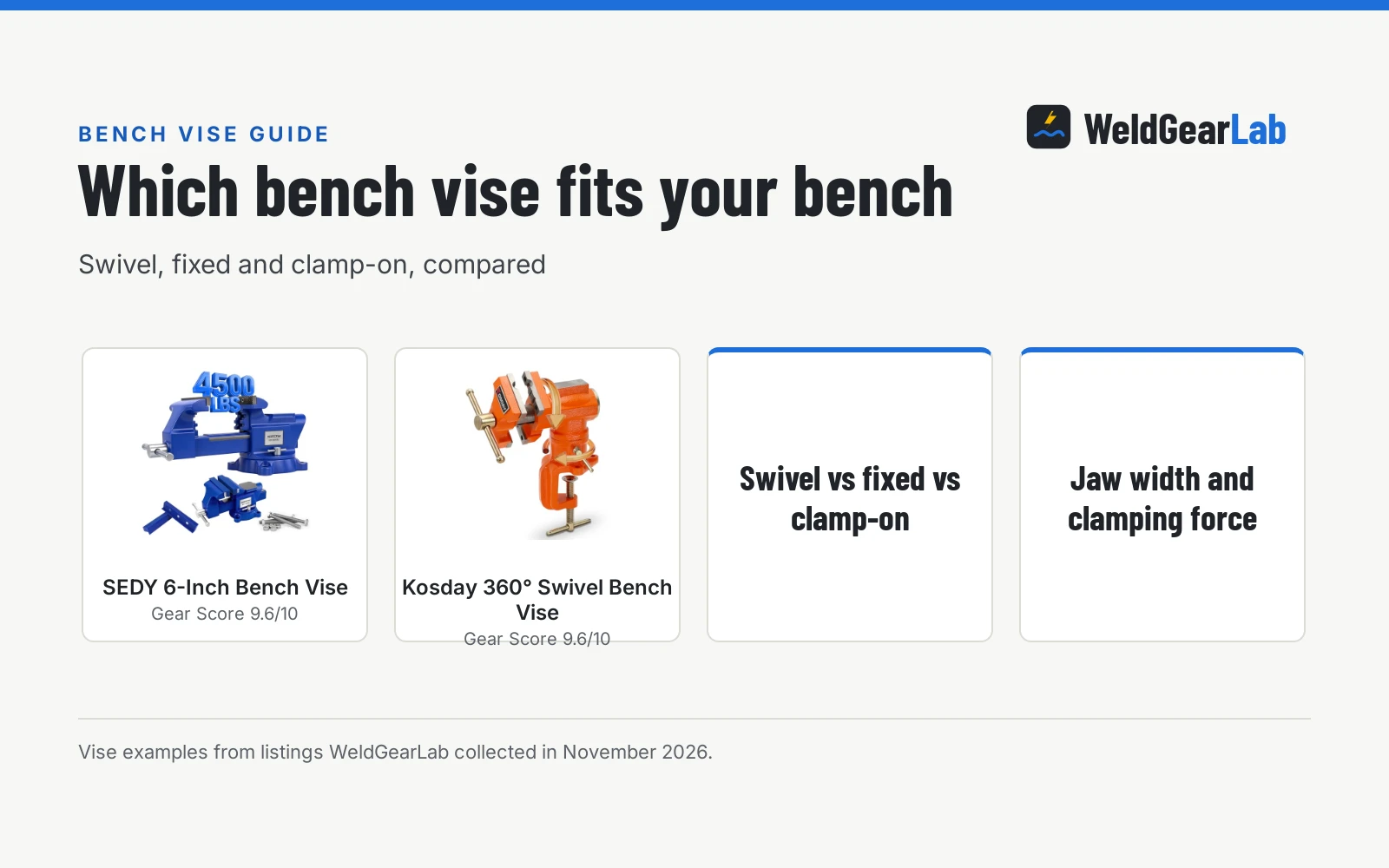
A vise holds the work so your hands stay free for the tool. When the work slips, the cut wanders, the drill walks and the weld lands in the wrong place. Bench vise types split on how the vise mounts to the bench, whether the base swivels, and what the jaws hold. This guide walks through each type, then shows two workbench vises that cover the common ground: a bolt-down swivel-base bench vise and a clamp-on swivel vise.
This guide links to our product roundups, where WeldGearLab gets a commission on purchases made through links on this page, and your price stays the same. Read our affiliate disclosure.
6-Inch Bench Vise with Jaw Pads
A 6 inch swivel-base bench vise rated at 4500 lbs of clamping force, with a built-in anvil, pipe jaws and two magnetic jaw pads. It handles heavy clamping, pipe cutting and hammering on the anvil.
Pros
- 4500 lbs of clamping force from 60,000 PSI ductile iron
- 360 degree swivel base with dual locking handles for multi-angle work
- Built-in anvil plus integrated pipe jaws for hammering and round stock
- Two magnetic jaw pads protect finished surfaces from scratches
Cons
- No warranty term is stated
- No maximum jaw opening is stated
- A 6 inch jaw is more vise than small parts need
- The swivel base needs bench clearance to rotate a full 360 degrees
Kosday 360° Swivel Bench Vise
A clamp-on swivel vise with 2.5 inch serrated jaws and 1.5 inch smooth jaws, a 2 x 1 inch anvil and 1124 lbs of clamping force at 7.7 lbs. It handles small parts, light hammering and work that moves between benches.
Pros
- Dual jaws: 2.5 inch serrated for grip, 1.5 inch smooth for delicate work
- 360 degree swivel head and base adjust without remounting
- 1124 lbs clamping force with 52-58HRC quenched jaws
- Clamp-on mount fits benches 9/32 to 1-9/16 inch thick at 7.7 lbs
Cons
- No warranty term is stated
- 2 inch maximum jaw opening limits larger stock
- 2 x 1 inch anvil suits light hammering only
- Clamp-on mount only fits benches 9/32 to 1-9/16 inch thick
Bench vise types at a glance
A bench vise is a clamp that bolts or clamps to a bench and grips the work between two jaws. The fixed-base vise bolts down and stays in one spot. The swivel-base vise sits on a base that rotates, so the work turns without unbolting the vise. The clamp-on vise grips the edge of a bench with a clamp, so it moves from bench to bench with no holes drilled. A pipe vise, or a bench vise with pipe jaws, grips round stock that flat jaws would let spin or slip. Woodworking vises use wide wooden jaws for boards; metalworking vises use serrated steel jaws, and many have an anvil for hammering.
Side by side
| SEDY 6-Inch Bench Vise | Kosday 360° Swivel Bench Vise | Notes | |
|---|---|---|---|
| Mount | Bolt-down swivel base | Clamp-on swivel head and base | Bolt-down holds under hammering; clamp-on moves between benches |
| Jaw width | 6 in | 2.5 in serrated, 1.5 in smooth | Wider jaws spread the grip across wider stock |
| Max jaw opening | Not stated | 2 in | Opening sets the thickest stock |
| Clamping force | 4500 lbs | 1124 lbs | Force is the maker’s rating |
| Jaw hardness | Not stated | 52-58HRC | Harder jaws resist wear |
| Anvil | Built-in | 2 x 1 in | Anvil is for hammering and shaping |
| Pipe jaws | Integrated | Holds pipes and tubes | Flat jaws do not grip round stock well |
| Item weight | 27.85 pounds | 7.7 lb | Weight matters when the vise moves |
Mounting is where to start. A bolt-down vise stays put under heavy hammering and long leverage, while a clamp-on vise suits a bench that must stay clear for other work or a bench you do not want to drill holes in. Check the bench thickness a clamp-on vise accepts before ordering: the Kosday here fits benches from 9/32 inch to 1-9/16 inch thick.
When a swivel-base vise is the better choice
- Work that turns. A swivel base rotates the work to the grinder, the drill or the light without unbolting the vise.
- Long stock. Pipe and bar that run past the bench edge are easier to reach when the vise turns with the work.
- Shared benches. Two people working opposite sides of a bench can swing the vise around instead of walking around the bench.
- Pipe and round stock. Pipe jaws grip round stock that flat jaws let spin, and the anvil takes hammering and shaping.
Our clamp-on vs bolt-down bench vise guide compares the two mounts in more depth.
When a clamp-on vise is the better choice
- A bench that must stay clear. A clamp-on vise lifts off when the bench is needed for assembly or layout.
- A bench that cannot be drilled. Rented benches and finished tops stay intact when nothing bolts through them.
- Portable work. At 7.7 lbs, the Kosday here carries to a job site or another bench.
- Small parts and light metalwork. Dual jaws grip flat stock, pipes, tubes and small workpieces without a big footprint.
See our best clamp-on bench vise guide for more clamp-on picks.
How to size a bench vise
Jaw width sets how much of the stock the jaws contact across its face: wider jaws spread the grip over more of the work. The SEDY here has a 6 inch jaw, and the Kosday has 2.5 inch serrated jaws and 1.5 inch smooth jaws, with a 2 inch maximum jaw opening. Clamping force is the maker’s rating for how hard the vise squeezes: 4500 lbs on the SEDY, 1124 lbs on the Kosday. Match the force to the work: heavy hammering and pipe cutting want the higher rating, while light metalwork and model making suit the lower rating.
Check the mount before ordering. A bolt-down vise needs holes in the bench, and a clamp-on vise needs a bench edge in the thickness range the maker states. The Kosday fits benches from 9/32 inch to 1-9/16 inch thick. An anvil and pipe jaws add jobs the vise can take: hammering and shaping on the anvil, pipe cutting and threading with pipe jaws. Clamp the work before cutting or drilling, wear eye protection when hammering on the anvil, and keep hands clear of the jaws while tightening.
The vises in this guide
Jaw width and clamping force are the measurements that sort these vises: the SEDY handles heavy clamping, pipe cutting and hammering on its anvil, and the Kosday handles small parts, light hammering and work that moves between benches.
For more options, see our metal fab tools guides.
FAQ for welders
What size bench vise do I need?
Match the jaw to the stock. A 6 inch jaw like the SEDY suits wide stock and heavy bench work, while 2.5 inch and 1.5 inch jaws like the Kosday suit small parts, pipes and tubes. Check the maximum jaw opening too: the Kosday opens to 2 inches, and the SEDY does not state an opening.
Can a bench vise hold pipe?
Yes, when it has pipe jaws. The SEDY has integrated pipe jaws for pipe cutting and threading, and the Kosday holds pipes and tubes between its jaws. Flat jaws alone let round stock spin, so pipe jaws matter for round work.
Does a swivel base matter?
It matters when the work needs turning. The two vises here swivel 360 degrees, so the work turns to the tool without unbolting or unclamping the vise. A fixed base suits a vise that stays in one spot and a bench with room to walk around it.
What bench thickness fits a clamp-on vise?
It depends on the clamp. The Kosday fits benches from 9/32 inch to 1-9/16 inch thick, so measure the bench edge before ordering. A bench outside that range needs a bolt-down vise or a different clamp.
Do I need jaw pads?
Jaw pads help when the work must stay unmarked. The SEDY includes two magnetic jaw pads that protect finished and delicate surfaces from scratches while holding a firm grip. For rough stock and heavy work, bare serrated jaws grip better.
Related: best 6 inch bench vise, ductile iron vs cast iron bench vise, bench vise vs post vise, and the swivel vs fixed welding vise.